💲 @FlexaHQ integrated @base Pay across online, in-person + mini-app checkout using $USDC. #Stablecoin spending can still create $AMP utility because $AMP's job is collateral—not the asset the customer spends. #AMP#StablecoinPayments@ampdotxyz#Payments
https://t.co/q9MSPZkLoM
1/6🧵👇🏻
🌐 Bigger $AMP story: @NYSE has not announced Anvil adoption. The real story is convergence: @Bullish is integrating @anvil_xyz while @FlexaHQ Capacity v3 uses Anvil to manage $AMP collateral for payments. Here's the verified chain. #AnvilProtocol@ampdotxyz#AMP $BLSH
Be sure to catch @m_at_anvil's live interview from the New York Stock Exchange this Thursday!
As financial institutions increasingly move onchain, the focus is shifting from simply tokenizing assets to making them useful across everyday financial systems. @anvil_xyz is at the forefront of building the infrastructure to make that happen.
Proud to be joining the team for this milestone and helping advance these conversations at the institutional level.
The whole team is gearing up for our BIG visit and interview to the @NYSE ... Check out where @anvil_xyz is headed on Thursday 9:20am LIVE!
Cant wait to hear what the legend @m_at_anvil might say....
@FlexaHQ is going to change how merchants interact with their customers and give them the ability to provide seamless secure transactions across the board... $AMP $ANVL
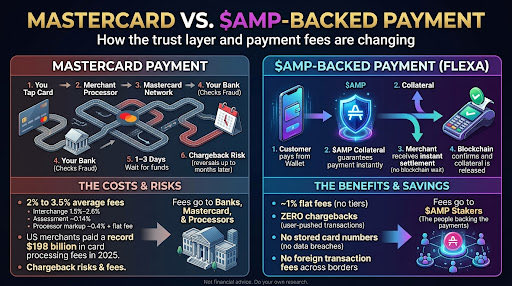
Let's compare how a Mastercard payment works to how an $AMP backed payment works.
When you tap a Mastercard at checkout:
1The terminal sends your card details to the merchant's processor.
2The processor sends it through the Mastercard network to your bank.
3Your bank checks for fraud and approves or declines.
4The approval travels back the same way.
5The merchant waits 1 to 3 days to actually get the money.
6For months afterward, that sale can still be reversed with a chargeback.
What the merchant pays for that:
• Interchange to your bank, usually 1.5% to 2.6%, and over 3% on some cards • An assessment fee to Mastercard, around 0.14% • A markup to the processor, often 0.4% plus a flat fee per sale • All in, typically 2% to 3.5% of every sale • Chargebacks can cost more than the sale itself once fees are added
US merchants paid a record $198 billion in card processing fees in 2025.
Now the same purchase through Flexa:
1The customer pays from their wallet.
2$AMP collateral guarantees the payment the instant it's sent.
3The merchant is paid right away, without waiting for the blockchain to confirm.
4Once the network confirms, the collateral is released to back the next payment.
What changes for the merchant:
• Reported fees around 1%, with no interchange tiers • No chargebacks, because payments are pushed by the customer, not pulled from a card • No card numbers stored, so there's nothing to steal in a breach • No foreign transaction fees across borders
The biggest difference is who gets paid.
With Mastercard, the fees go to banks, the network and processors.
With Flexa, the network fees are used to reward the people staking $AMP as collateral.
The people backing the payments earn from them.
That's the model. Mastercard built a business on being the trust layer between buyer and seller. $AMP is trying to be that trust layer, open to anyone who wants to back it.
Not financial advice. Do your own research.
🧵 Why $ANVL at $0.50–$1 isn’t a thesis I’d dismiss long term.
1/ 🌎 The market opportunity is enormous.
The IMF post 👇 highlights ~$65B in tokenized assets vs ~$300T in traditional capital markets.
Tokenization is still tiny relative to the financial sys it could transform.
1/3🧵👇🏻
Fresh $AMP ecosystem news: @anvil_xyz launched its SDK; @Bullish is integrating it & @foundersfund led a $5M $ANVL purchase. @FlexaHQ uses Anvil in Capacity v3 while $AMP remains the collateral token. @ampdotxyz#Commerce Utility keeps scaling!🚀 https://t.co/YtQ4wVsd9U
Ever notice companies like @FlexaHQ putting “NMLS ID 1840599” right in their bio?
It’s not random.
Flexa is a licensed digital asset payments company. That number is their Nationwide Multistate Licensing System ID — the unique identifier assigned to regulated financial businesses
You have questions. @dannymccb has answers.
AMA with Danny McCabe
4/24/2026
In the Amp Discord
Submit your questions here: https://t.co/vdhHdRvi3I
Join the Amp Discord here: https://t.co/EEwzs9ouDR
JUST IN: Coinbase, Block, River, and The Bitcoin Policy Institute advocating for a de minimis tax exemption for Bitcoin & crypto in Washington, DC "was a great success" today 🇺🇸👏