US Market at $69 Trillion
Something had to happen.
Around $500 BILLION has been wiped out from the US stock market in just 20 minutes as markets started dumping immediately after open.
Insane Madness In America 🚨
The top 1% of US firms now capture 80% of all corporate revenue.
In the 1950s that number was 60%.
It has moved in one direction for 100 years straight, through every boom, bust, and policy era.
It gets more extreme when you look at assets. The top 1% of corporations now control 97% of all US corporate assets. In the 1930s it was 70%. The bottom half of all US businesses collectively own almost nothing.
Corporate profits after tax are now 12% of US GDP. In 2001 they were around 5-6%. In Q4 2025 alone, US corporations earned a record $3.6 trillion in profits. That is more than the entire annual GDP of India.
The stock market tells the same story. Seven companies (Apple, Microsoft, Nvidia, Amazon, Alphabet, Meta, Tesla) make up 34% of the entire S&P 500. In 2015 they were 12%. In 2025 those seven stocks drove 42% of the index’s total return.
The margin gap is widening too. The top 10 S&P firms expanded operating margins by 7 points since 2015. The rest of the index managed 4. Return on capital for the biggest firms went from 18% to 73%. Everyone else went from 23% to 34%.
Walmart alone did $681 billion in revenue last year, leading the Fortune 500 for the 13th year running. The top 10 US companies combined did $3.8 trillion in sales. That rivals the GDP of Germany.
This is not random. It is M&A consolidation, network effects, IP law, and an AI spending race topping $700 billion in 2026 that only the giants can afford. Each force makes the next one easier.
A shrinking number of companies is capturing a growing share of revenue, profits, market cap, and power. And there is no structural force currently pushing the other way.
The US economy is more concentrated than at any point in modern history.
🚨 BREAKING: Google Gemini can now completely edit your videos for you so you can create polished content at lightning speed.
Here are 10 Gemini prompts to edit videos 10x faster: 👇
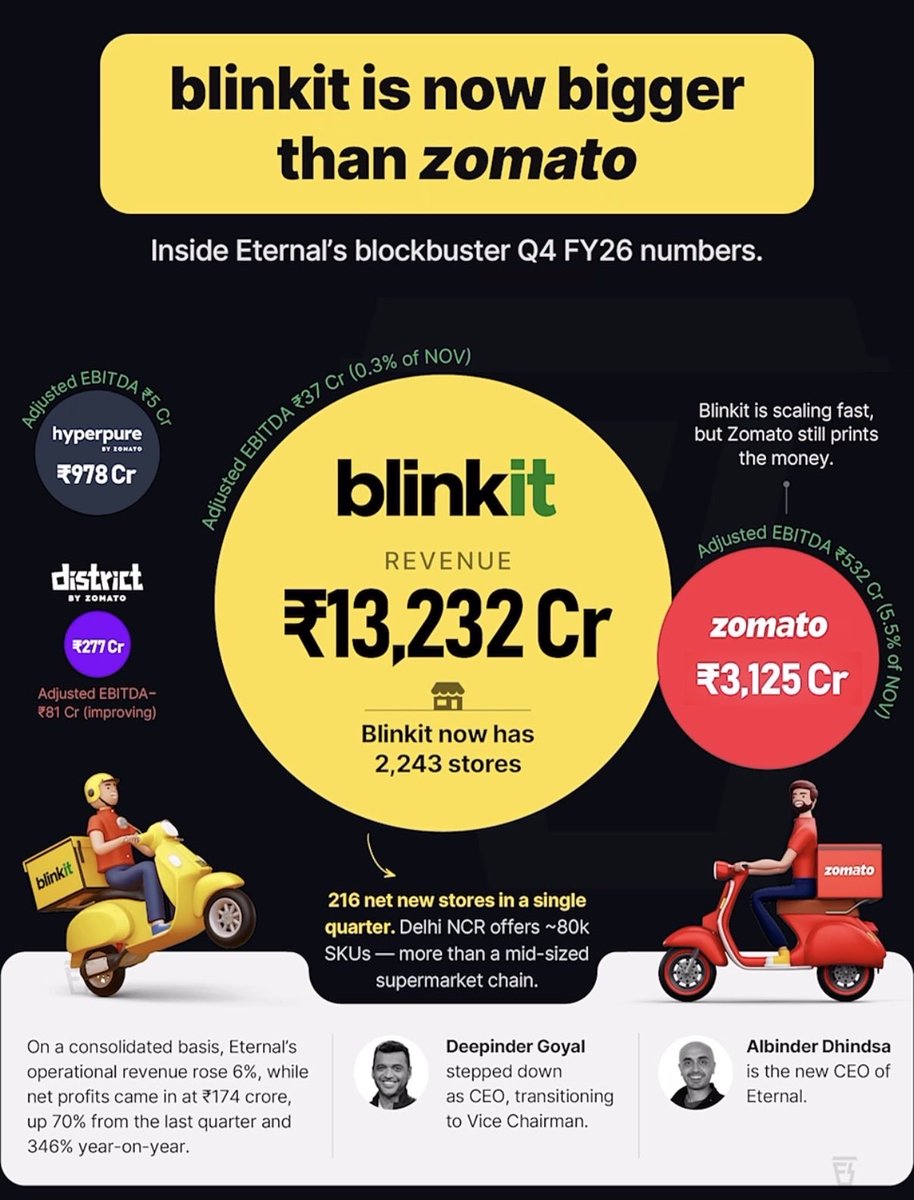
I still remember @Ashneer_Grover’s dumb statement that rather than blinkit @deepigoyal should have acquired Swiggy. Kek.
Now Blinkit numbers are 4 times bigger than zomato.
Tag your fav influencers and ask them to raise #thecockroachquestions of their field.
This Movement needs structured shape & can’t be allowed to fail for personal gains.
This is Frank Rosenblat the Man Who built the ancestor of Claude and ChatGPT in 1958 out of photocells and motors, was buried by a rival’s book in 1969, died two years later thinking his life was wasted, and was proven right 15 years after his death by the scientists who now run the field.
In 1958, in a Cornell laboratory, the 30-year-old psychologist wired together 400 photocells, a tangle of motors, and a refrigerator-sized cabinet of circuits, and built the first machine in history that could learn from its own mistakes without a human rewriting it.
He called it the Perceptron.
The idea did not come from engineering. It came from neuroscience. Rosenblatt had been reading Donald Hebb, the Canadian psychologist who proposed in 1949 that learning in the brain happens when neurons that fire together strengthen the connection between them. Rosenblatt asked a question almost nobody was asking. If that is how the brain learns, could you build a machine that learns the same way?
The Perceptron worked like this. You showed it a card with a shape on the left half or the right half. The photocells fed signals into a layer of artificial neurons. Each neuron had a weighted connection to an output, and at first those weights were random, so the machine guessed wrong almost every time.
But every time it guessed wrong, motors physically turned dials to adjust the weights. Connections that had pushed toward the right answer grew stronger. Connections that had pushed toward the wrong one grew weaker.
Within hours, it was getting the shapes right.
Nothing like this had ever existed. For the first time, a machine was changing its own internal structure in response to experience, which is exactly what a brain does.
The New York Times ran the story on July 8, 1958. The Navy, which had funded the work, told reporters the Perceptron was the embryo of a computer that would one day walk, talk, see, write, and reproduce itself.
Then the field killed him.
In 1969, Marvin Minsky and Seymour Papert, two of the most powerful figures in artificial intelligence at MIT, published a book called Perceptrons. In it they proved mathematically that a single-layer Perceptron could not solve certain basic logical problems. They were technically correct. They were also catastrophically misleading, because the limitation vanished the moment you added a second layer of neurons, which Rosenblatt had already been working on.
But the book landed like a verdict. Funding for neural networks evaporated almost overnight. Researchers were warned away from the field. The entire approach was declared a dead end, and what followed became known as the first AI winter.
Two years later, on his 43rd birthday in 1971, Rosenblatt drowned in a sailing accident on Chesapeake Bay.
He died believing his life’s work had been a failure.
For the next fifteen years almost nobody in computer science would admit to working on neural networks. The field went silent. Then in 1986, Geoffrey Hinton and two colleagues published the backpropagation paper, which described exactly how to train the multi-layer networks Rosenblatt had been reaching toward. The math Minsky said was impossible turned out to be a matter of one more layer and a better learning rule.
Every neural network running today is a direct descendant of the Perceptron. The model that translates your messages, the one that recognizes faces in your photos, Claude and ChatGPT writing sentences for millions of people every day, all of them adjust their internal weights in response to error using a method Rosenblatt was the first to build into a working machine.
He just did it 60 years too early to be believed.
The fruit of his work is on every screen you own. His name is on almost none of them.
🚨The Fed just said AI is breaking the economy in three different ways.
This was not in any public statement. It came directly from the April 28-29 FOMC minutes.
THE FIRST WAY IS INFLATION.
The Fed's own members said that strong AI investment spending is pushing up input costs across multiple industries. Every company building or using AI infrastructure is paying more for power, equipment, and services, and those costs are being passed down the supply chain.
The Fed flagged this as a direct contributor to core inflation that is separate from energy prices and tariffs. AI was supposed to reduce costs across the economy. The Fed is now saying it is adding to them.
THE SECOND WAY IS THE PRIVATE CREDIT MARKET.
Software companies that borrowed money from private credit funds are quietly deferring their interest payments using payment-in-kind arrangements, where instead of paying cash interest they just add it to the loan balance. The Fed flagged this specifically in Q4 2025 and Q1 2026.
The reason investors are pulling money out of these funds is that they believe AI will destroy the business models of the software companies inside them. Private credit funds saw net outflows in Q1 2026 specifically because of AI disruption fears. Blue Owl, one of the largest private credit managers in the world with $36 billion in its flagship fund, was forced to cap redemptions after investors tried to pull 21.9% of the fund in a single quarter.
Its technology-focused fund saw 40.7% of investors request their money back in the same period. Blue Owl halted redemptions entirely, sold $1.4 billion in loan assets, and Blackstone, Apollo, Ares, and KKR all fell 5 to 6% the same day.
The $1.8 trillion private credit market is cracking from the inside and the Fed confirmed in these minutes that AI disruption fears are the reason why.
THE THIRD WAY IS JOBS.
Multiple Fed members said that business contacts are already telling them they plan to delay or reduce hiring specifically because of AI adoption. This is not a future risk.
Companies are making those decisions right now, before AI has fully arrived, and the Fed internally flagged it as a risk that could push unemployment sharply higher very quickly.
The Fed held rates unchanged. But for the first time, their internal minutes show AI is no longer just an economic opportunity they are monitoring. It is now a source of inflation, a credit market risk, and a hiring slowdown, all at the same time.
how many of these can you actually make with AI right now?
• Polished commercials
• 2D & 3D game assets
• Cinematic scenes
Most people still think it’s not there yet... but you can learn how to craft them following the tips on the article below 👇
🇨🇳 NEW: CHINA’S BIGGEST DATA CENTERS ARE NOW TRADING ELECTRICITY
For the first time in history, China's largest data centers are joining electricity spot trading as “virtual power plants.”
These facilities now adjust AI computing loads in real-time based on spot market price forecasts.
That means AI compute can be ramped up when electricity is cheap, and slowed down when it's expensive.
The AI race is may no longer just be a tech story.
It is becoming an energy trading story too.
India is quietly executing the largest gold financialisation in history. Nobody is talking about it.
On May 10, 2026, Prime Minister Narendra Modi told 1.4 billion Indians to stop buying gold for one year.
Six days earlier, the Reserve Bank of India confirmed it has quietly moved 77% of India’s sovereign gold back onto Indian soil. The largest repatriation since 1991.
Both moves are happening simultaneously. Here is why.
The Number That Explains Everything
In October 2025, Morgan Stanley economists Upasana Chachra and Bani Gambhir published a research note that should have shaken Indian finance.
Indian households hold 34,600 tonnes of gold. At June 2025 prices, that is $3.78 trillion. This is 88.8% of India’s GDP. It is 3.1 times the value of every share Indians own in their stock market.
The Indian stock market gets all the SEBI regulation, all the financial press, all the policy attention. The bigger pile sits in lockers. Untaxed. Unbanked. Invisible.
The State has decided this cannot continue.
The Timeline Nobody Has Connected
May 4, 2026. NSE launches Electronic Gold Receipts. Physical gold in SEBI-accredited vaults. Dematerialised into digital receipts. Tradable like stocks. Convertible back to physical on demand.
May 6, 2026. RBI half-yearly data confirms 680 tonnes of gold now stored inside India. In March 2023, only 301 tonnes sat domestically. 168 tonnes were repatriated in the last twelve months alone.
May 10, 2026. Modi tells Indians to stop buying gold. Six days. Three moves. Same direction.
The Three Rails
Rail one is the sovereign vault. Gold inside India cannot be frozen by foreign powers. In 2022, the G7 froze $300 billion of Russia’s reserves overnight. Every central bank took notes. Gold’s share of India’s forex reserves doubled from around 8% in March 2023 to 16.7% in March 2026.
Rail two is the digital pipe. EGRs cut the friction. Standardised gold enters a SEBI-approved vault, becomes a tradable digital receipt, and converts back to physical on demand. The Gold Monetisation Scheme failed because families refused to melt heirloom jewellery. EGRs offer a path that does not require destroying the family asset.
Rail three is demand suppression. Modi’s appeal works in 2026 because the alternatives now exist. SGBs, Gold ETFs, EGRs, GMS short-term deposits. The State could not say this in 2020. Now it can.
Why The Timing Matters
The forex concern is real. Gold imports hit $72 billion in FY26, a 24% jump even though volumes actually fell 5%. Gold prices alone widened the dollar drain. But three deeper shifts make this moment urgent.
Banks are losing low-cost deposits as households park disposable income in bullion. Credit creation slows. Interest rates rise.
Physical gold remains the perfect black money vault. EGR, SGB and GMS make ownership visible to the tax system.
Most importantly, in Q1 2026, investment demand for gold rose 54% year-on-year. Gold ETF inflows rose 186%. Indians are no longer buying gold for weddings. They are buying it as a hedge against the rupee.
The Bigger Picture
For 70 years, Indians treated gold as protection from the State. From inflation. From currency collapse. From political risk.
The State has finally decided it cannot build a $10 trillion economy while nearly $4 trillion of household wealth sits in lockers it cannot see, tax, or deploy.
It is not banning gold. It is doing something smarter. It is changing what gold means.
From jewellery to bullion. From bullion to digital receipt. From digital receipt to sovereign collateral.
Same metal. Different master.
GPT Image 2 + Seedance 2.0 Prompt Share
Tried using IPA + FACS for a contemporary performance piece where live singing and choreography happen simultaneously. Not sure how much of it actually worked technically but I think the final result turned out pretty interesting.
I also ended up color-coding the storyboard annotations because otherwise annotations were confusing the model. Different colors helped separate body movement, camera motion, framing and lighting directions from the actual environment and character drawings.
You can find color-coded storyboard prompt + seedance 2.0 prompt in the replies.
GPT Image 2 + Seedance 2 = cartoon chase scene.
I wanted to see how far I could push storyboard-to-video consistency, so I created a full 15-second cat vs mouse sequence inside a completely destroyed house.
The process was actually simple:
- generated a 3x3 cinematic storyboard sheet in GPT Image 2
- designed every frame like a real animation pre-production sketch
- added camera directions, motion cues, timing notes, and destruction progression
- used Seedance 2 to animate the entire sequence into one continuous cinematic shot flow
What surprised me most was how well Seedance 2.0 understood the visual continuity between frames. The flying debris, motion blur, exaggerated jumps, and camera movement felt surprisingly cohesive.
.
.
.
Smart money is avoiding US stocks. SPX just keeps printing new highs.
3 straight weeks of hedge funds selling alongside 3 straight weeks of SPX ATHs.
Buffett Indicator printed 227%. Above 200% is like "playing with fire".
So why is the market still ripping?
Full breakdown of the liquidity playbook driving the SPX rally👇
Trump has blocked Strait of Hormuz.
No Ship will be allowed to Enter or Exit.
This is going to have massive consequences and could be the beginning of “Great Reset” which he himself posted about on 10th of April.
Trump has blocked Strait of Hormuz.
No Ship will be allowed to Enter or Exit.
This is going to have massive consequences and could be the beginning of “Great Reset” which he himself posted about on 10th of April.