@Mercurially_@astropriestesss@valkyrierunes You do have a point there! If one is curious and is looking through charts for facts -- what you stated (hopefully) indeed is found to be true!!
@ijyotish Natal signatures (combinations, functional maleficience etc) of planets must always be kept in mind even when dashas/dishas (directions) or transits are being examined during life after the *moment* (epoch)...
My ebook: Easing into Vedic Astrology
will be available for FREE download from
https://t.co/PqF4euzBz9
Please use coupon: SBW74
(Until 31st December 2025)
Thanks and please enjoy!
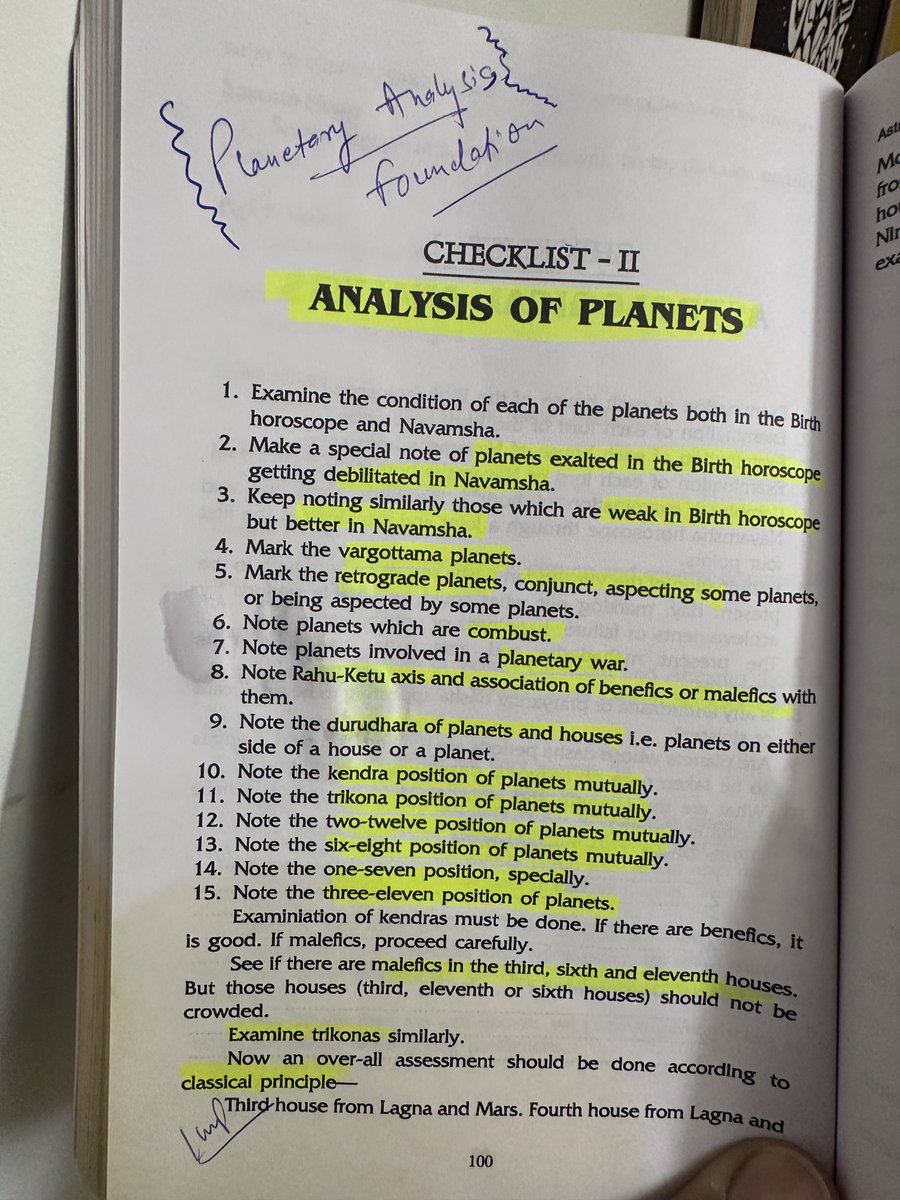
Here is the Ultimate planetary analysis sheet, by the legendary Astrologer Shri KN Rao..
The checklist every serious student must refer/master:
Save / Bookmark & Thank me later..
Here’s the foundation of planetary analysis in Jyotish:
1. Examine the condition of every planet in both the Birth Chart and Navamsha. Weak in one and strong in another can change everything.
2. Note planets exalted in the Birth Chart but debilitated in Navamsha, such shifts reveal hidden instability.
3. Similarly, watch for planets weak in the Birth Chart but stronger in Navamsha, they mature beautifully with time.
4. Identify Vargottama planets, same sign in Birth and Navamsha. These planets retain strength across dimensions.
5. Mark retrograde planets, conjunctions, and aspects. These show inner conflicts or redirected karma.
6. Check for combust planets, their light burned by the Sun, losing outward power but gaining inner fire.
7. Note planetary wars, when two planets battle for dominance, only one wins.
8. Study the Rahu-Ketu axis, where illusion meets truth. Their company decides whether energy heals or harms.
9. Observe durudhara yoga, planets on both sides of the Moon or house. It shows how life is supported or pressured.
10. Examine kendra positions (1st, 4th, 7th, 10th): planets here shape one’s core strength and stability.
11. Study trikona positions (1st, 5th, 9th): they reveal past-life blessings and future dharma.
12. Review 2-12, 6-8, 1-7, 3-11 relationships: these show tension, dependence, and growth through friction.
13. Examine malefics in the 3rd, 6th, and 11th houses carefully, they can destroy or discipline, depending on context.
14. Judge each house from multiple points, Lagna, Moon, Sun: to see the story from body, mind, and soul.
15. And finally, look at the 3rd house for parental longevity: often ignored, but deeply telling.
Every great reading starts with this. No shortcuts.
This is the soul of Jyotish: observation, patience, and depth.
#astrology #astrologer #jyotish #vedic #astrology #vedicastrology #astro #hindu #indian #sanatan #kundli #kundali
@CrysVani Largely Yes. As a simple thumb rule, #BhavatBhavam hints at executor to the potency of bhava. In a way, potency warrants execution for manifestation in this incarnation. Without execution, it’s just a dormant potency - perhaps to be destined in later births.
@ijyotish +
Poorvapunya being considered in above message by me as a dynamic but restricted account (?) and not as a locked in fixed deposit account for the lifetime...?
@ijyotish Perhaps the positive mutual dispositions/sambandha etc of the bhavat bhavam lords of H5 and H3 could serve as pointers in charts whose nativities feed into (invest) poorvapunya *account*. If the relationship is *negative* then efforts would lead ineffectively to poorvapunya...?
@Jyotisharnava Many of us who have been through a pile of required reading and then some more can relate to how you feel. It is an internal signal that now one must begin looking at horoscopes (applied astrology) more intensively and extensively (time-permitting) and open the next door!