Medical internship in Uganda needs to be treated as a national health workforce issue, not simply a student welfare issue.
The new NETH policy has created a deeply troubling distinction between medical interns based on how they financed their university education.
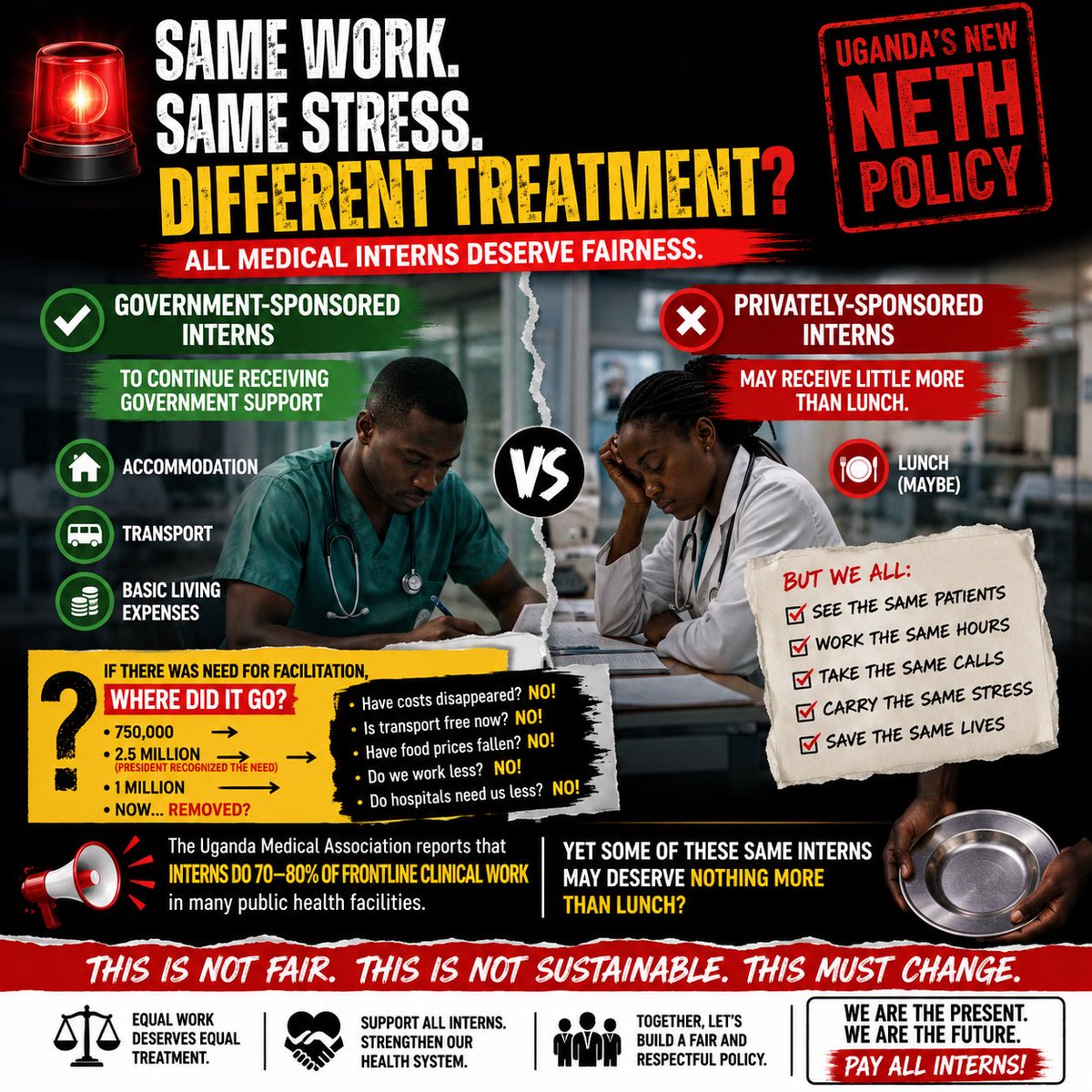
Government-sponsored interns are to continue receiving government support, while privately sponsored interns may receive little more than lunch.
But once we enter the hospital, what exactly changes?
Do privately sponsored interns see fewer patients?
Do they work fewer hours?
Do they take fewer calls?
Do they perform fewer procedures?
Do they have less responsibility?
Do they experience less exhaustion?
No.
We all undergo the same mandatory internship, work in the same hospitals, serve the same patients and are subjected to the same clinical demands.
So why should the source of our university tuition determine whether we deserve facilitation for the work we perform during internship?
And there is another question government needs to answer:
If medical internship required facilitation previously, where did that need go?
The allowance was previously UGX 750,000, then the President recognized the need to increase it to UGX 2.5 million, before it was subsequently reduced to UGX 1 million.
Now the proposed direction is effectively to remove it for some interns altogether.
Have the costs of accommodation disappeared?
Has transport become free?
Have food prices fallen?
Have interns stopped working long shifts?
Have hospitals suddenly stopped depending on them?
None of these things has happened.
What has changed is the government’s approach to funding the people providing the service.
The argument that internship is “training” does not erase the reality that interns are also an integral part of service delivery in Uganda’s health facilities. Government itself recognizes that internship is supervised hands-on training for prospective health professionals, including doctors, dentists, pharmacists and nurses.
And if internship is truly about training, then all interns should be treated equitably as trainees.
You cannot say:
“You are all interns when we need your labour, but your sponsorship status determines your welfare.”
That is not equity.
We are not asking government to privilege privately sponsored interns over government-sponsored interns.
We are asking for equal treatment for equal work under the same mandatory professional training.
The government is also threatening interns with losing their placements if they fail to report.
But this is precisely the moment for interns to collectively ask:
What happens when the people you depend on to keep the system running simply cannot afford to show up?
This is bigger than allowances.
It is about fairness, dignity, patient safety and the sustainability of Uganda’s health workforce.
If government can find resources to facilitate one category of interns, it can find a fair mechanism to support ALL interns undertaking the same mandatory training and serving the same health system.
Interns are not asking for a favour. We are asking for a fair policy.
@MinofHealthUG@Parliament_Ug@CHRISBARYOMUNS1@NewtonAllan6@baryamureeba@dr_katumwa@marvin_lule68@HEBobiwine@ntvuganda@FDCOfficial1@Thomas_Tayebwa@rkalyes1@OPMUganda@TheUMAofficial@UgandaMediaCent
#PayMedicalInterns
#MedicalInternshipUganda
#RejectTheNETHPolicy
#UgandaHealthSystem