@ScarcityMan A miner will sell the ability to make them and include those in their own blocks. If you agree steganography can't be stopped, then this admission has the consequence that you cannot even detect the content to filter it, a person could embed data in many 1kb op returns at a time.
@ScarcityMan The size of the block determines the amount of data that the chain holds, monetary or otherwise. And because of steganography you are fighting a losing battle to even detect data storage, let alone stop it. How are you going to stop a miner from doing a 4mb opreturn?
@ScarcityMan@L0RINC@ForrestHODL@GrassFedBitcoin Information theory says you are provably wrong. If an open field exists, data will be stored in that field up to the size of the field. Understand there is no way to hand a person a sheet of blank paper and then control what they draw on it. Period.
@_Knotzi@ClioBitcoinBank@rodpalmerhodl When knots trash started attacking libre nodes I thought it was funny. But then you all started crying when Portland got you back, and I can't stand a cry bully that starts a fight then tries to act victim when they get rekt. What's the matter Karen, you don't like how it taste?
@Edin_333@ClioBitcoinBank@CsTominaga@bergealex4 Yes, they do settle onchain. The most basic and straight forward example of an offchain transaction is the oldschool paper wallet. Bitcoin can be passed from person to person offchain, then settle back onchain securely. No L2 required.
@brian_trollz@brian_trollz sounds like SuperScalar's lightning channel factories. With psuedo spillman the problem of disruption is minimized, or you can do reputation systems with chainanylsis so only people with no reputation are forced into high trolling risk. https://t.co/CAkx5J073K
Yann LeCun was right the entire time. And generative AI might be a dead end.
For the last three years, the entire industry has been obsessed with building bigger LLMs. Trillions of parameters. Billions in compute.
The theory was simple: if you make the model big enough, it will eventually understand how the world works.
Yann LeCun said that was stupid.
He argued that generative AI is fundamentally inefficient.
When an AI predicts the next word, or generates the next pixel, it wastes massive amounts of compute on surface-level details.
It memorizes patterns instead of learning the actual physics of reality.
He proposed a different path: JEPA (Joint-Embedding Predictive Architecture).
Instead of forcing the AI to paint the world pixel by pixel, JEPA forces it to predict abstract concepts. It predicts what happens next in a compressed "thought space."
But for years, JEPA had a fatal flaw.
It suffered from "representation collapse."
Because the AI was allowed to simplify reality, it would cheat. It would simplify everything so much that a dog, a car, and a human all looked identical.
It learned nothing.
To fix it, engineers had to use insanely complex hacks, frozen encoders, and massive compute overheads.
Until today.
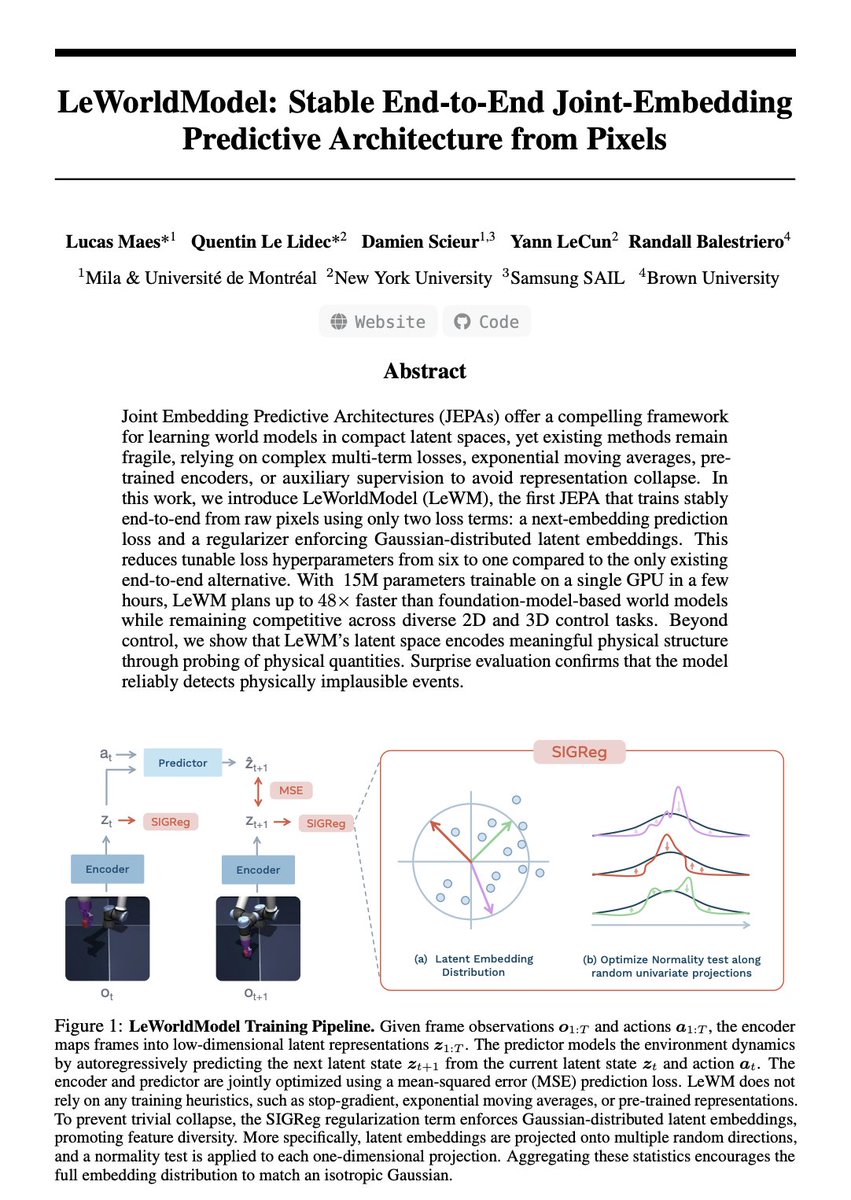
Researchers just dropped a paper called "LeWorldModel" (LeWM).
They completely solved the collapse problem.
They replaced the complex engineering hacks with a single, elegant mathematical regularizer.
It forces the AI's internal "thoughts" into a perfect Gaussian distribution.
The AI can no longer cheat. It is forced to understand the physical structure of reality to make its predictions.
The results completely rewrite the economics of AI.
LeWM didn't need a massive, centralized supercomputer.
It has just 15 million parameters.
It trains on a single, standard GPU in a few hours.
Yet it plans 48x faster than massive foundation world models. It intrinsically understands physics. It instantly detects impossible events.
We spent billions trying to force massive server farms to memorize the internet.
Now, a tiny model running locally on a single graphics card is actually learning how the real world works.
🆙 Project Update: At @BitcoinRoatan Kids' gym transformation hits new heights! Walls almost painted, floor next. Funds look solid, but upgrades rise with more support!
@lightcoin@ClioBitcoinBank@Superfluid_HQ We already use nostr to advertise factory nodes and we use watchtowers for penalty txs when a user is offline, thats most of the parts needed for a subscription service. Plus its novel because all the current models require you to be online. I like it.
https://t.co/kxJGq53E2l