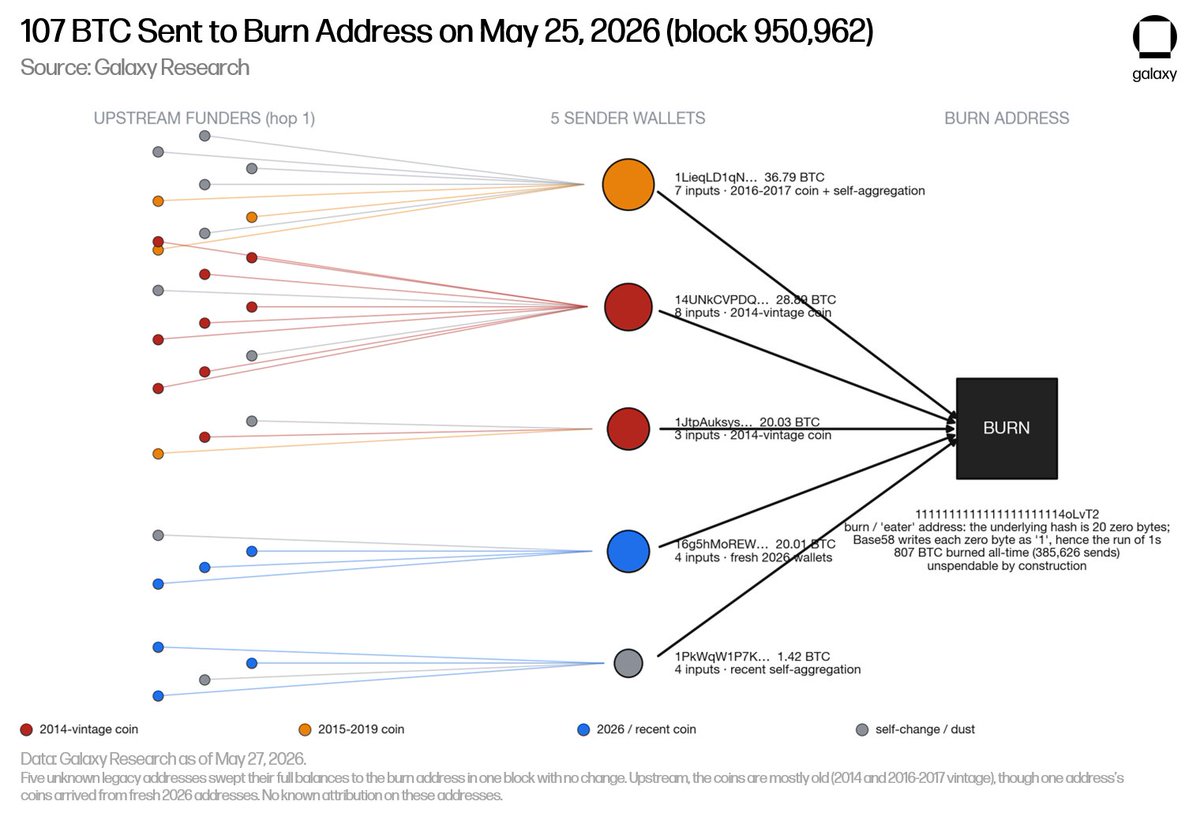
stop using fucking "burn addresses" that are not provably secure and pollute the utxo set. use op_return!!!
p.s. maybe satoshi left the coins there intentionally, like a bounty for crqc's. who knows? mind your own coins!
stop using fucking "burn addresses" that are not provably secure and pollute the utxo set. use op_return!!!
p.s. maybe satoshi left the coins there intentionally, like a bounty for crqc's. who knows? mind your own coins!
Dear Satoshi Nakamoto,
If you:
* are still alive
* still have your keys
* don't intend to spend your BTC
It would be immensely helpful to the ecosystem if you'd send your early mined coins to a burn address.
ACTUAL ONCHAIN BOATING ACCIDENT?
On Monday, 5 bitcoin addresses sent ~107 BTC ($8.3m) to an old burn address, making the coins provably unspendable.
Why would someone do this? The Galaxy Research team's best theories are in the thread below (spoiler: none are very good).
Didn't expect to see the Pope lowkey calling for the abolition of The Securities Exchange Act of 1934 so that non-accredited investors can be eligible to invest in privately-held technology companies and benefit from their growth from the earliest stages, but love to see it!
Today, among the goods that are universally intended for everyone, we must also include new forms of property, such as patents, algorithms, digital platforms, technological infrastructure and data. In a context where the wealth of nations depends increasingly on knowledge and technology, when these goods remain concentrated in the hands of a few, without adequate forms of sharing and access, a new imbalance is created that contradicts the universal destination of goods. In turn, it widens the gap between the included and the excluded, between those who can participate in the digital revolution and those who remain on the margins. #MagnificaHumanitas
2/2 In collaboration with @jungly, we intend to dedicate significant engineering resources to @p2poolv2, a project that attacks some of the core drivers of pool centralization. Learn more about the initiative in our latest blog post: https://t.co/fHhUe0FeN9
Caveats:
- Sender wallets must support sending to SP addresses
- Amounts and tx graph are still publicly visible; UTXOs received to an SP address must be carefully managed with coin control to avoid triggering CIOH*
* Payjoin can help confound this but not impossible to untangle
@btc_ireland You can now use a single bitcoin address without destroying your privacy.
You can give a silent payment address to anyone, and each transaction they create will go to a unique address within your wallet.
Unpopular opinion (apparently, even in the bitcoin community)
Governments should not own bitcoin. We should delay or prevent their acquisition of BTC for as long as possible.
The American Reserve Modernization Act (ARMA) would authorize the U.S. Treasury to acquire up to 200,000 bitcoin per year for five years, targeting a reserve of 1 million BTC.
The bill was introduced Wednesday by Rep. Nick Begich with 16 original cosponsors. It is a rebranding and expansion of the original BITCOIN Act co-introduced last year by Begich and Senator Cynthia Lummis. It would codify Trump's March 2025 executive order establishing a Strategic Bitcoin Reserve into permanent law that cannot be reversed by a future president.
The bill classifies bitcoin as a "Tier 1" strategic reserve asset, putting it on the same legal footing as gold. A separate digital asset stockpile would hold other federally owned crypto.
All acquisitions must be budget-neutral. The funding mechanism is revaluing Federal Reserve gold certificates from their current statutory price of $42.22 per ounce, set in 1973, to current market prices. That gap generates hundreds of billions in accounting gains without new taxpayer debt.
The bill also ends the practice of auctioning off seized bitcoin. All future seizures would be transferred directly to the Strategic Reserve instead of being liquidated by the U.S. Marshals Service. Existing government holdings would be consolidated into a single audited ledger.
Bitcoin in the reserve would be held for a minimum of 20 years. The bill establishes federal custody standards including geographic distribution of private keys across air-gapped facilities, multi-signature governance requiring authorization from the Treasury, the Fed, and an independent third agency, and investment in "quantum-resistant cryptographic upgrades."
Rep. Pat Harrigan, one of the cosponsors, said "The United States government already holds billions in seized bitcoin with no coherent strategy for managing it, and that needs to change."
Are any developers being prosecuted for "writing code" right now? I agree that BRCA protections are important but we need to be careful not to strawman our opponents. "Code is speech" has been precedent for decades; we won the crypto war.¹ This new war is something else.
Limiting or weakening the BRCA is a non-starter.
Prosecuting non-custodial developers will not help law enforcement. It'll waste valuable enforcement resources chasing folks who do not custody customer funds, execute trades, or control user assets.
The CLARITY Act must protect developers and preserve the BRCA’s core protections. You do not strengthen America by prosecuting developers for writing code.
@CabanaChemistry@emollick yeah if they did additional training and used this "internal model" only for this problem then there would not be anything else to amortize the training cost against.
@CabanaChemistry@emollick yes in this context the training cost is effectively amortized across all uses of the model, approaching (but never quite reaching) 0 at the limit