THIS DEVELOPER RUNS 8 AI MINIONS FROM HIS PHONE AND MAKES $10,000/MONTH - KIMI AT $0.09, OPUS AT $1.41, COSTS CUT 43%
8 terminal sessions running in parallel on a server - he connects from his phone, types a command and all 8 agents respond
phone view, desktop view, doesn't matter - the server runs everything and he picks which screen to use
routine tasks route to Kimi K2.6 at $0.09 - complex work stays on Opus at $1.41 - context never drops between switches
$2.07 down to $1.62 per session - 43% cheaper, same output, just smarter routing
8 minions, one phone, one server - and $10,000/month running whether he's at the desk or on the way home
Official Job website of these European Countries:
1. Germany 🇩🇪
https://t.co/lAlRj6nA0V
2. Sweden 🇸🇪
https://t.co/b1hiVjHp2j
3. Estonia 🇪🇪
https://t.co/CcLNjbuMUo
4. Finland 🇫🇮
https://t.co/hV1PI92jPQ
5. Denmark 🇩🇰
https://t.co/e52xr9SWTj
6. LITHUANIA 🇱🇹
https://t.co/UVOv1BckzH
7. LUXEMBOURG 🇱🇺
https://t.co/bOoKNcS87d
TWO ENGINEERS SHOWED THE GIT TRICKS THAT MAKE PEOPLE THINK YOU'RE A WIZARD -- THE ONES 95% OF DEVELOPERS HAVE NEVER ONCE TOUCHED
42 minutes from Johan Abildskov and Jan Krag, bending git with custom configs, attributes and hooks most people don't even know exist.
-> The moment it lands, git stops being four commands you repeat in fear. The same tool you've used for years turns out to have a whole layer built to bend to you.
Hooks that run your checks before a bad commit ever lands. Attributes that end the "it works on my machine" merge wars. Config that makes the painful parts just stop happening.
Memorizing commands was never the ceiling -> shaping git to do the work for you is. And while everyone else fights the tool by hand, the person who set it up right is shipping clean three times faster.
Most people use 5% of git and call it a day. This is the other 95% nobody showed you.
Bookmark it and Watch today ↓
GERMANY SCHOLARSHIP 2027 | MASTER’S & PhD 🇩🇪
🏆 Rosa Luxemburg Stiftung Scholarship 2027
📍 Host Country: Germany 🇩🇪
🎓 Study Levels: Master’s & PhD
🌍 Eligibility: International & Domestic Students
💰 Scholarship Benefits:
✅ Financial support for living expenses
✅ Support for academic and research activities
✅ Access to seminars, workshops & training programs
✅ Mentorship from experienced academics and professionals
Details link: https://t.co/UzeRC1KT91
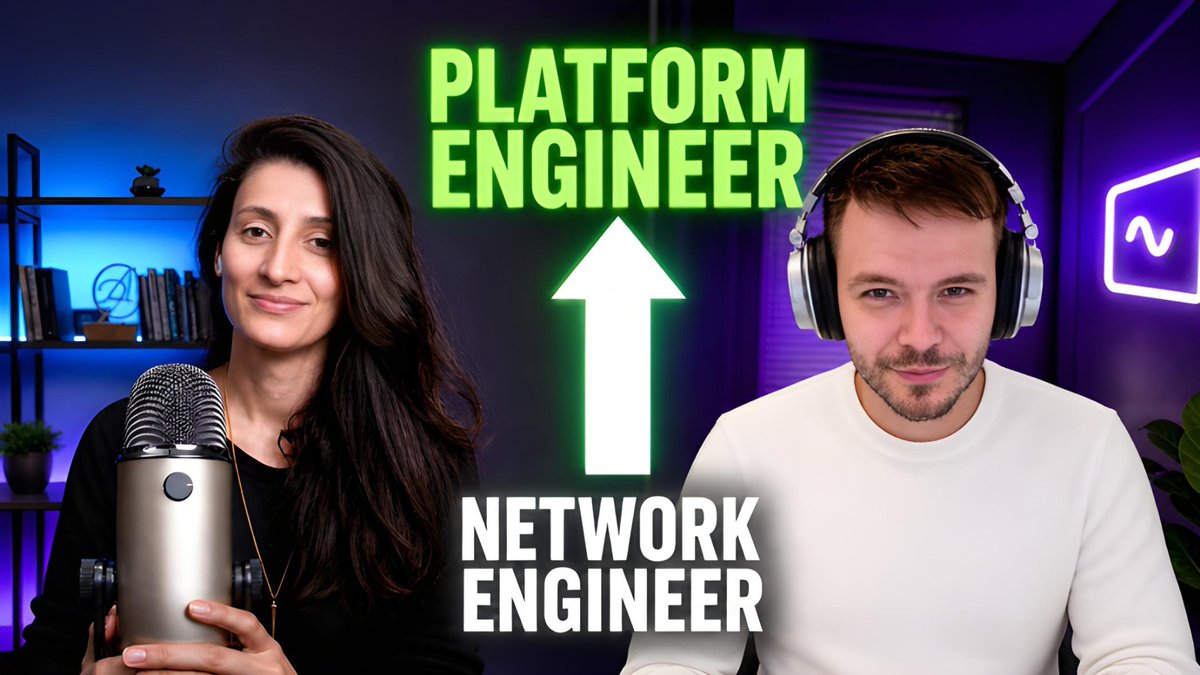
"Networks are built for 15 years ahead. I've never had a job in network engineering where I would say, wow, I'm learning a lot day by day. But the first job in DevOps was like, wow — I can't even handle all of those tools."
Patryk said this in our conversation — and if you've worked in network engineering, you probably know exactly what he means 😁
He's not complaining. It's just an honest observation about where the growth stops.
He reached that conclusion after switching several network engineering jobs — each time hitting the same ceiling, not learning enough, moving on. Until he got laid off during Covid and decided enough was enough.
From there, he decided to make the transition to DevOps and eventually landed a Cloud Platform Engineer role.
His interview is one of the most practical accounts I've heard of what it actually takes to switch from networking to DevOps — what transfers, what doesn't, and what he'd do differently if he started over today.
If you're a network engineer thinking about making a similar move, this one is for you. But of course there are many learnings that apply to any engineering role 🙂
🎥 Full interview here: https://t.co/C9jtmG8rtc
At the end of the conversation, he gives one piece of advice:
Document your journey from day one. Post it. Let people know what you can build. Not only because it helps you get a job — but more importantly, because there are many brilliant engineers out there that nobody knows about.
Patryk didn't just say that. He went and did it.
So now he actually runs his own consultancy. And he has even built a community of 17,000+ followers on LinkedIn — simply by doing exactly what he recommends at the end of this video.
Patryk, thank you for sharing the whole journey, not just the cherry picked stuff. This one will surely be inspirational for many people 🙌
Knowledge built over 6 years of remote work as the applicant and then the person approving applications.
1. Hone your resume
2. Build a portfolio especially if you’re in content
3. Know where to look and what to look for
Comment REMOTE to get my 100+ Remote Work Resources Database
#remotework #remotejobsearch #remotejobs
10 Books that will make you a 10x AI engineer:
1 Building LLMs for Production
2 AI Engineering
3 Designing Machine Learning Systems
4 Build a Large Language Model
5 Designing Data-Intensive Applications
6 LLM Engineer's Handbook
7 Deep Learning
8 Hands-On Machine Learning with Scikit-Learn, Keras, and TensorFlow
9 Prompt Engineering for LLMs
10 Introduction to Statistical Learning
What else should make this list?
You may not have a “bad CV” — but if it can’t pass ATS, recruiters may never even see it.
And that’s exactly why many qualified Nigerians keep applying and hearing nothing back.
Before you send out another application, run your CV through the FREE Resume Scan on NoResumeNoJob👇
If you are looking for jobs abroad, this might help you ;
✅ Tailor your CV to each role
✅ Optimize your LinkedIn
✅ Apply consistently
✅ Focus on shortage occupations
Apply using uncommon job platforms too
Everything you need 👇
https://t.co/RMq0wk5HXw
Jensen Huang: "none of us knew how to do anything"
he said that about starting NVIDIA. 1993, three guys in a Denny's, a 30-year-old engineer with no idea how to build a company
their first chip failed. by 1996 they were six months from bankruptcy. it took a pivot and years before the product that worked shipped
that company just became the first $5 trillion company in history
here's what actually changed since then: starting used to cost years, a team, and near-bankruptcy. now it costs one Claude Code setup and $0 of infrastructure
i built a real product solo on exactly that.. live, 320 on the waitlist, 3 B2B contracts signed at $2,000/month
they didn't know how to do anything and started anyway. the only difference now is the barrier they fought through is basically gone
the full system, every number shown, below
i tested a fully local ai coding setup: gemma4 from @GoogleDeepMind running through @lmstudio, paired with pi which is a minimal open source coding harness
this is part 1 of a two part series. here we cover the why and the complete hands-on setup
0:00 - Running a coding agent fully local
0:47 - Why Pi as the coding agent harness
1:39 - Why Gemma 4 and which variant to pick
2:44 - Architecture: Pi, LM Studio and Gemma 4
3:45 - LM Studio setup and model download
5:01 - Starting the local server
5:19 - API sanity check with curl
6:08 - Installing the Pi coding agent
6:20 - Configuring models.json for local models
8:20 - First run: selecting the model in Pi
8:58 - Fixing the context length error
10:16 - Testing the working setup
10:50 - What is coming in Part 2
You no longer need a Photographer to get your passport just use this prompt to get your ready print passport
@ChatGPTapp
How To Use The Prompt:
1. Open the Chatgpt App
2. Upload your image
3. Copy & Paste the prompt below 👇
Anthropic and OpenAI are both telling engineers to write loops.
Not prompts.
Not agents.
Loops.
That is not a coincidence.
When the two most important AI labs on the planet independently converge on the same pattern — that is a signal worth paying attention to.
Most engineers are still thinking in terms of single calls.
Input → model → output.
The engineers winning in 2026 think in cycles.
Output becomes input. The model evaluates its own work. The loop runs until the result is right.
This is the complete breakdown of what loops are, why they matter, and how to build them ↓