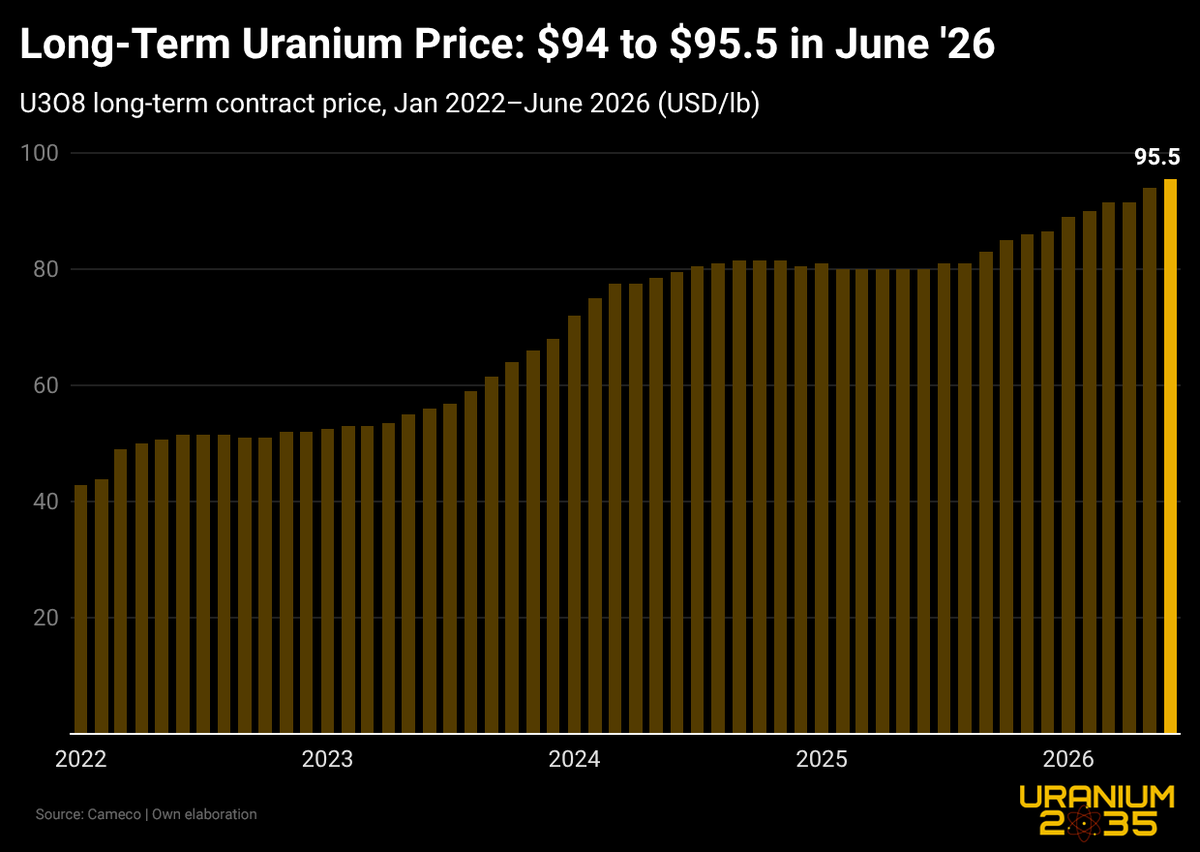
Patiently awaiting the long-delayed arrival of the major purchasers of the potent yellow powder, U3O8, from the mining firms. Investment advice-free zone
"The wise have said that the hour was not yet come, and that only one speaking in person for the cause of [the uranium investors], pleading for pardon on their misdeeds and pity on their woes, might move the counsels of the Powers." - J.R.R. Tolkien
Season 3 is off to a strong start → The WIDEST intersection to date at RIB North: 37 m of total composite uranium mineralization 📊 "the 2026 drill program has delivered results that support continuity of uranium mineralization..." –Cliff Revering VPX $SASK.V $SASKF
Full quote: “We are very encouraged by the results to date across the RIB Mineralized Corridor, with the RIB North area continuing to emerge as a key focus within the broader trend. Building on the initial RIB North discovery in 2025, the 2026 drill program has delivered results that support continuity of uranium mineralization across meaningful step-out distances completed to date. These results are important because they continue to validate our exploration model and strengthen our view that the RIB Mineralized Corridor remains a highly prospective uranium-bearing system.
As we advance the 2026 program, our focus remains on systematically testing this mineralized trend, while continuing to assess the broader scale potential of RIB North and the surrounding corridor. These results provide a strong foundation for continued exploration and underscore the significance of this area within our overall exploration strategy.”
SILVER MINERS REVOLT: KEITH NEUMEYER DEMANDS NEW PRICING SYSTEM TO ESCAPE BANK MANIPULATION
Keith Neumeyer, CEO of First Majestic Silver, just delivered a bold message at the Rick Rule Symposium. He exposed how banks manipulate silver prices through paper markets and called on miners to break free by building their own pricing system. This idea could reshape the entire silver industry for years to come.
THE RIGGED GAME
➡️ Keith Neumeyer calls the current silver pricing system a complete scam controlled by banks through the COMEX and LBMA.
➡️ First Majestic and other miners produce real physical silver but have no say in setting its price unlike almost every other industry on earth.
➡️ Banks closely track future mine production and use that knowledge to hedge positions and keep prices artificially low.
THE BOLD SOLUTION
➡️ Keith Neumeyer is urging silver mining CEOs to come together and create their own independent pricing mechanism immediately.
➡️ The industry must stop relying on the bank-run system that has suppressed silver prices for far too long.
➡️ A new producer-led system would finally align prices with actual physical supply and surging global demand.
THE PHYSICAL TRUTH
➡️ Explosive physical demand for silver continues to grow from electronics, solar panels, electric vehicles and everyday household appliances.
➡️ Worldwide silver mine production has remained flat at around 860 million ounces per year for a decade.
➡️ At the same time consumption has risen sharply to 1.3 billion ounces annually creating a massive and growing deficit.
THE BOTTOM LINE
Keith Neumeyer has thrown down the gauntlet. Silver miners have the power to end the manipulation if they act together. The future of fair silver pricing starts with their decision to lead.
This is the sound of an industry finally waking up to its own strength.
HT: YouTube ITM TRADING, INC.
#SilverMinersRevolt #NewSilverSystem #KeithNeumeyer #FirstMajestic #BreakBankControl #PhysicalSilverDemand #TripleDigitSilver
Oil. Gold. Silver.
All moving higher together.
The last comparable setup came during the 1973–74 OPEC oil crisis... where they moved like this in roughly 5 months:
- Oil: +302%
- Gold: +94%
- Silver: +130%
Stay Vigilant. 👀
#Oil#Gold#Silver#Preciousmetals
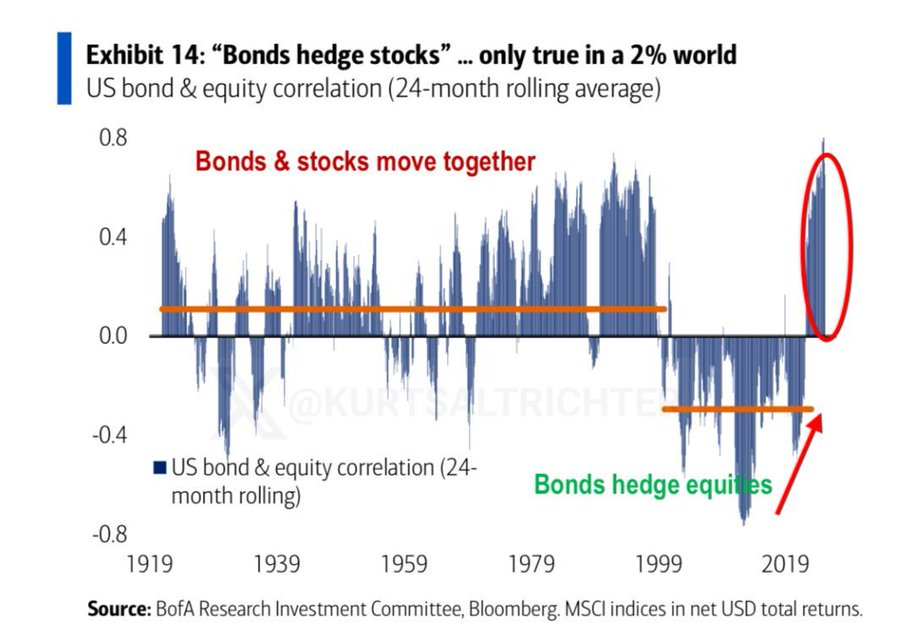
Gold has replaced bonds as a hedge against equities.
Looking back over 100 yrs:
- bonds and equities moved together for 80 yrs
- bonds hedged equities for 20 yrs
- 2021 bonds and equities move together
If you’re looking to hedge both equity and geopolitical risk, gold is becoming increasingly attractive.
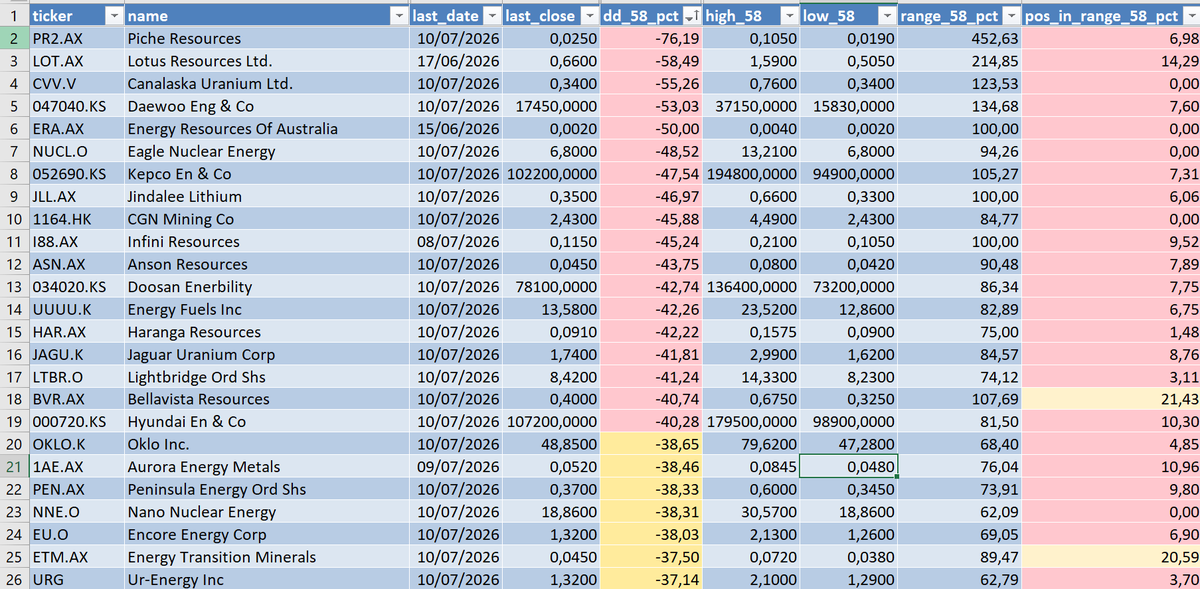
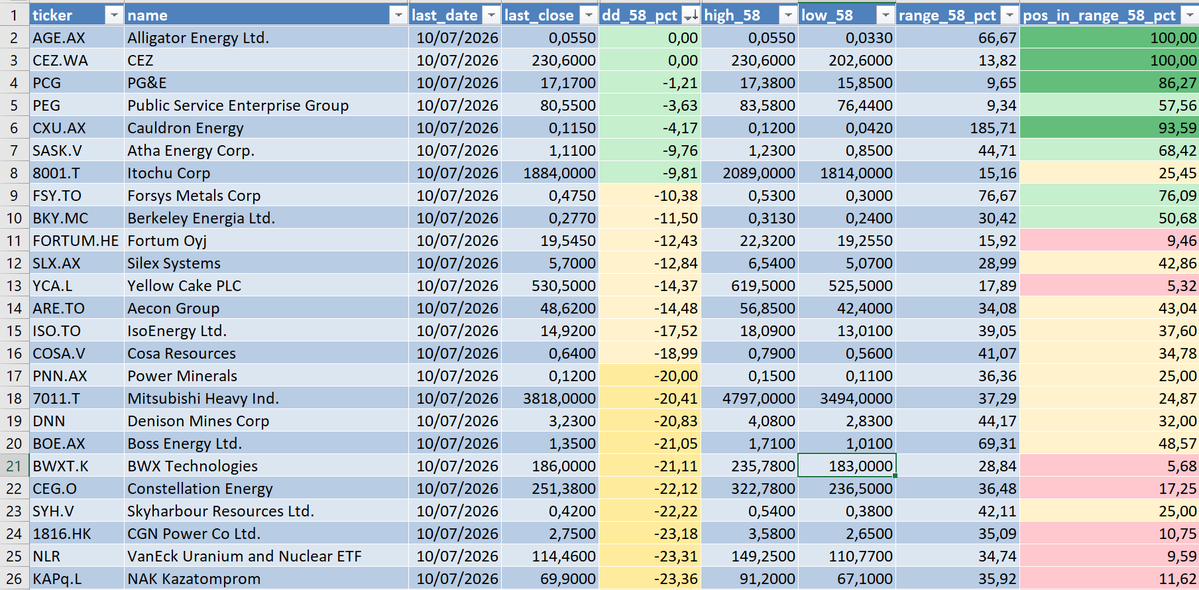
📊 Uranium: Which Companies Have Held Up Best During the Correction That Began on January 29, 2026?
I analyzed the performance of a broad universe of companies linked to the uranium and nuclear sectors since the correction began on January 29, 2026, focusing on three key areas: total return, largest drawdowns, and smallest drawdowns.
The first conclusion is quite clear: strength has been highly concentrated.
The standout winner during this period has been Cauldron Energy, with a gain of +109.1%, far ahead of the rest. It is followed by Samsung C&T (+35.2%), Atha Energy (+30.6%), Alligator Energy (+25.0%), and Forsys Metals (+23.4%).
Also still in positive territory are Berkeley Energia (+9.7%), CEZ (+9.2%), and Aecon Group (+4.3%).
In other words, while a large part of the sector has gone through a deep correction, a small group of companies has not only held up well but has actually continued to advance. This kind of relative strength is always worth watching: stocks that remain strong during a corrective phase are often among the first candidates to lead when the sector resumes a sustained uptrend.
But the other side of the picture shows just how wide the dispersion within the sector has been.
Among the largest drawdowns are Piche Resources (-76.2%), Lotus Resources (-58.5%), CanAlaska Uranium (-55.3%), Daewoo Engineering & Construction (-53.0%), and Energy Resources of Australia (-50.0%).
Other significant declines include Eagle Nuclear Energy (-48.5%), KEPCO E&C (-47.5%), Jindalee Lithium (-47.0%), CGN Mining (-45.9%), Infini Resources (-45.2%), Energy Fuels (-42.3%), and Lightbridge (-41.2%).
In several cases, prices are also trading very close to the bottom of their entire range for the period, confirming the technical deterioration suffered by a significant part of the universe analyzed.
At the opposite end are the companies that have done the best job of protecting capital.
Alligator Energy and CEZ show a 0% drawdown, as both are trading at their highs for the period. They are followed by PG&E (-1.2%), Public Service Enterprise Group (-3.6%), and Cauldron Energy (-4.2%).
Other names showing notable resilience include Atha Energy (-9.8%), Itochu (-9.8%), Forsys Metals (-10.4%), and Berkeley Energia (-11.5%).
The conclusion, in my view, is important: not all uranium stocks are behaving the same way.
The correction has produced losses of more than 40%, 50%, and even 70% in some names, while others have maintained much stronger structures or even posted significant gains.
That is why, during periods like this, rather than trying to guess exactly where the sector will bottom, it is especially useful to watch which companies are showing relative strength, which ones are limiting their drawdowns, and which ones remain close to their highs.
That is often where the leadership of the next bullish phase begins to emerge.
#Uranium #NuclearEnergy #Nuclear #UraniumStocks #Mining #Commodities #Energy #Investing #StockMarket #TechnicalAnalysis #RelativeStrength
Uranium: decisive weeks ahead for the sector
The URA/S&P 500 ratio continues to send a very clear message: the uranium sector remains in a delicate phase relative to the broader market. We are not yet seeing a definitive breakdown, but we are clearly approaching a critical area where support levels are becoming increasingly important.
The main uranium ETFs are still sitting near key technical support zones. For URA, the level to watch is around $40. For URNM, the key reference level is near $50. My customized uranium index is also anchored around its 30 support level.
That means the next few weeks could be decisive. If these supports hold, this could simply be a deep correction within a still constructive long-term structure. But if they break, the risk would increase significantly, and additional downside of around 30% in some uranium names would not be out of the question.
Looking at individual stocks, the situation also calls for caution. Bannerman Energy has bounced from the A$3 area, but if the sector loses support, that level could come under pressure again. Cameco, in my opinion, is heading toward the $80 area; losing that level would open the door to a much deeper correction. Deep Yellow has already lost its A$1.50 support, although it managed to bounce from its 200-week moving average. Denison Mines is still clinging to the $3 level, a key area whose loss could accelerate the downside.
It is also worth watching Lightbridge, which is holding near its 50-week moving average but losing momentum; Kazatomprom, which needs to hold the 67 support level; NexGen Energy, which seems to be pointing toward the C$10 area and could see the correction worsen if that level breaks; Oklo, which is close to its $45 support and also losing momentum; and Uranium Energy, which is still holding on to its $10 support, although its structure is becoming increasingly fragile.
The conclusion is simple: support levels must be watched very closely. As long as they hold, the current setup can still be interpreted as a consolidation phase. But if they break, the message from the URA/S&P 500 ratio suggests that we could be entering the worst part of the current correction.
The long-term uranium story remains extremely powerful, especially given the growing need for firm energy, nuclear power, electrification, artificial intelligence, and data centers. But even the strongest long-term stories go through difficult corrective phases. Right now, the market is demanding patience, discipline, and close attention to the key levels.
#Uranium #URA #URNM #UraniumStocks #NuclearEnergy #EnergyTransition #Commodities #Cameco #Kazatomprom #NexGen #DenisonMines
Yahoo Finance referenced my interview with Cameco President Grant Isaac in this #uranium article.
Utilities preparing for triple-digit uranium prices shows what we discussed: security of supply is becoming the priority.
https://t.co/WFdEsZnXex
ICYMI: NUCLEAR PURE PLAY PODCAST | Cameco and the AP1000 reactor
Cameco’s Nuclear Pure Play Podcast provides insight into the company and the nuclear energy industry. In this episode, Cameco President and COO Grant Isaac and VP of Investor Relations and Communications Cory Kos discuss why the Westinghouse AP1000 is the right nuclear reactor technology for Canada's future.
Watch the full podcast: https://t.co/QnEAxQO8NU
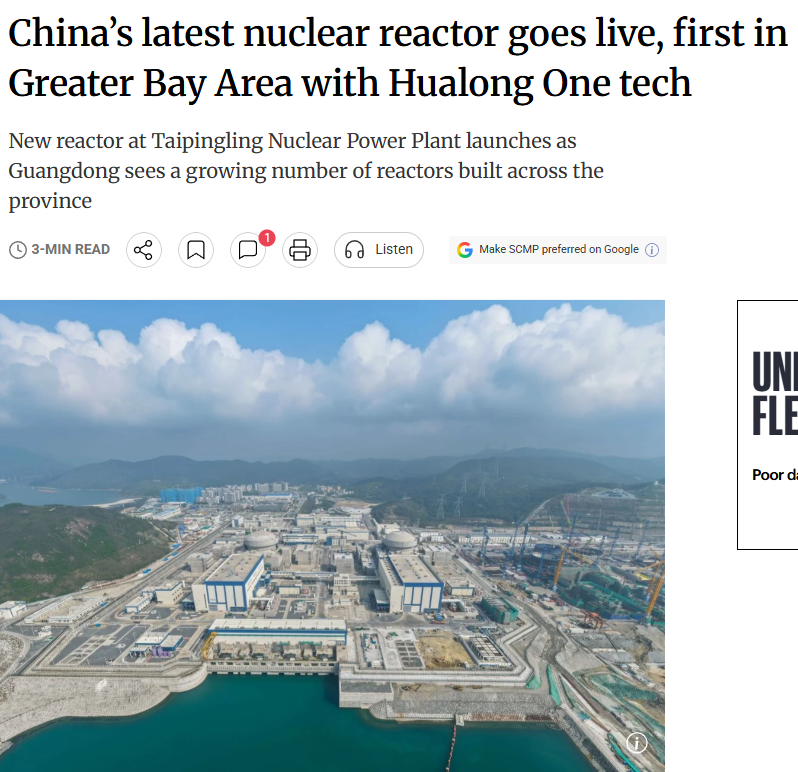
Another day, another Chinese reactors starts operation (Taipingling Unit 2). It is another domestic Hualong One reactor. China's plants are taking only ~five years to build. Article link in reply.
The goal is to have 110 GW of capacity by 2030. They would overtake the US and be the country with the most nuclear capacity.
The Taipingling plant will eventually have six reactors, that will be built at a cost of only ~$18 billion! That's $3 billion for a ~1 GW reactor. The last US project (Vogtle) cost ~$16 billion per GW. More than that if you acount for inflation. The Vogtle project started construction over ten years ago. Reactors being built in Europe are even more expensive.
One frustrating thing, pointed out by the article, is that China is still not allowing nuclear plants to be build in inland regions, "due to safety considerations."
This policy is bizarre. Baseless. Countries around the world have inland nuclear plants, adjacent to rivers or lakes, etc.. Most US plants are inland. There are no tangible safety issues with using rivers, etc.. as a heat sink.
And yet, China allows dirty COAL plants in inland regions. The health, and climare, effects are horrific! Coal plants also need water as a heat sink. Does China think that inland nuclear plants would be more dangerous and harmful than coal plants??!! Coal plants are known to be a thousand times as dangerous and harmful than nuclear plants. Even more so in China!
Imagine how much China could achieve, in terms of nuclear deployment, without this baseless restriction! Imagine how much coal could be replaced. Imagine how much less pollution and CO2 emissions there would be. How many Chinese lives would be saved..
It's almost like they have this incredible ability to build nuclear plants in 5 years for a fraction of the cost, and they're throwing it away to a large extent. Is this more about lacking the skilled labor to build plants at a higher rate ("so we might as well build them in the "safer" coastal regions")?? All I can think of...
🇨🇦 ‼️ The world's highest-grade #uranium mine stopped producing
✍️ On July 1, $CCJ suspended mining at Cigar Lake in northern Saskatchewan. Nothing is wrong with the mine. The problem sits 70 km away at a separate mill, McClean Lake, operated by Orano, where every pound of Cigar Lake ore gets processed. The mill's sulfuric acid plant went down for repair, and Orano is now waiting on spare parts while it hunts for an alternative acid supply.
Cigar Lake can only stockpile so much ore on site. Once that buffer fills, there is nowhere to put what you dig up, so you stop digging.
Cameco expects the mill back in roughly two weeks and, on that schedule, no change to its 2026 production outlook. ‼️ But if the acid plant repairs run longer than planned, and depending on the length of any additional delays, its 2026 production outlook for Cigar Lake could be impacted.
McClean Lake can produce up to 24 Mlb of yellowcake a year (it hit a record 19.8 Mlb in 2025). The whole chain can be paused by one acid plant waiting on a part.
Primary supply is not a smooth, redundant machine. It is a short list of very large, concentrated nodes that lean on each other 🤷♂️ The world keeps asking uranium supply to scale up, and supply keeps showing how little slack it has.
⚠️ Context worth holding: a month ago Cameco and Orano bought out the remaining 5% of the Cigar Lake partnership, lifting Cameco to 57.4% and Orano to 42.6%. Spot sits in the mid-USD 80s/lb, and RBC just raised its Cameco target to C$175 from C$160.
The supply side not only breaks in dramatic ways. It also does it in small, boring, physical ones... like this 🙄
Cigar Lake, the world's highest grade #uranium mine, has temporarily suspended mining operations due to an outage at the sulfuric acid plant at the McClean Lake mill.
The repair is expected to take about two weeks, but if it takes longer, Cameco says 2026 production guidance could be affected.
The uranium market remains incredibly tight. Even short term supply disruptions at one of the world's most important uranium mines highlight how fragile global uranium supply has become. 2.3 billion lbs uranium deficit is coming. $LEU $UEC $UUUU
Bullish for uranium.
Cigar Lake temporarily suspended operations due to challenges at McClean Lake mill, which encountered operational challenges with its sulfuric acid plant that caused a shut down in order to conduct repairs
They expect the mill to restart work in 2 weeks, but it could take longer