Good evening, X fam ❤️
After disappearing for weeks because of exams 😩, your favourite Psychology girl is finally back!
I’ve missed this space sha. 🥹
From now on, I’ll be bringing you Psychology gist, interesting facts and those "Omo, so THIS is why I behave like this?" 😂
Always give yourself something small to look forward to…
like a nice meal or a weekend hangout
Your mind and body need reminders that life is meant to be enjoyed, not just survived.
Personally, I would prefer to teach in the same school as my children. It would give me greater peace of mind and allow me to monitor them more closely.
Yes, I would be concerned. Will invite the teacher for a conversation to understand the reasons behind the decision. I would offer a discount if affordability is the issue to make it more accessible. If they are sending their children to a better school, I would carefully study what makes that school superior and work to incorporate those strengths into mine. Of course, there may be other reasons beyond my control.
That foam may be one of the warnings your kidneys can give you. And there may not be another obvious one.
Now, everybody’s urine can foam a little because of the force of the urine. That usually settles within seconds and means nothing.
I am talking about foam that is still sitting there when you look back.
Here is why I am making noise about it.
Your kidneys are filters. They remove waste from your blood and keep useful things like protein in your body.
So when protein starts showing up in your urine, it can mean the kidney’s filter is becoming damaged.
And this damage can happen quietly.
No pain. No warning.
It can happen over years because your kidneys do not have the kind of nerves that make you feel pain when they are being damaged. They can keep working until they are no longer able to work properly.
By the time you feel something, a lot of the damage may have already happened.
That is why this small sign matters.
The test, by name:
› Urinalysis — most labs can do this for very little. It checks your urine for protein.
› If it shows anything, ask for a urine albumin-to-creatinine ratio (UACR). This is more specific and can detect kidney damage earlier than a general urine test.
Two names. Write them down.
Now, what actually causes kidney damage?
It is almost never mysterious.
The two major roads to kidney damage in this country are high blood pressure and high blood sugar, especially when they stay high for years without being controlled.
Painkillers taken regularly for many years can also damage the kidneys.
Unlabelled herbal preparations are another risk, and people often overlook them.
So if you notice persistent foam in your urine, ask yourself:
What is my blood pressure?
What is my blood sugar?
What medications or painkillers have I been taking regularly?
And here is where I stop. On purpose.
I am not going to sit here and tell you what to eat for a damaged kidney on a public page.
And if you see a page doing that, leave it.
Because early kidney disease and late kidney disease do not always require the same diet.
Protein and potassium, for example, may need to be handled differently depending on the person and the stage of kidney disease.
I cannot see your results, so I cannot safely tell you what your body needs.
What I will tell you is this:
Many of the things that can take a person down this road can be prevented or controlled, and I have already shared information about them on this page for free.
Go and ask for a urinalysis this week.
That is information that could matter for the next twenty years of your life.
And if you have already been told that there is protein in your urine and you do not know what to eat, that is a conversation, not a public post.
Bring the actual result. My messages are open.
Don't forget to reach out for a well-structured meal plan on WhatsApp: +2349118909688.
Share this post and tag your friends.
THAT CHILD IS NOT JUST SHORT.
THAT CHILD WAS SHORTCHANGED.
Not by God.
Not by genetics alone.
But by years of plates that filled the stomach without truly feeding the body.
Every child is born with a genetic blueprint.
A height they have the potential to reach.
Whether they ever get there depends on many things — illness, environment, and one of the biggest factors of all…Nutrition.
Sadly, too many Nigerian children never get the chance.
Not because their parents do not love them. But because protein has become a luxury.
A child’s body is built from protein.
Bones.
Muscles.
Brain.
Skin.
Hormones.
The immune system.
Every single day, a growing child is trying to build a stronger body.
The question is what building materials are we giving them?
Pap in the morning.
Rice in the afternoon.
Swallow at night.
Three large portions of carbohydrate, one tiny piece of meat that everyone at the table is struggling to share.
The stomach becomes full.
The body remains underfed.
That is the tragedy.
The scary part is that malnutrition does not always look like starvation.
It whispers.
The child who is always tired.
The child who catches every infection going around.
The child who struggles to concentrate in class.
The child who grows but never quite catches up.
Then there is another problem. A lie that has survived for generations.
“Do not give children too many eggs.” “They will become thieves.” “Too much meat will make them stubborn.”
Who started these stories?
Because children across the world are eating eggs almost every day. They are not becoming thieves. They are becoming stronger.
Their bones become stronger.
Their muscles become stronger.
Their brains develop better.
Protein does not spoil a child’s character. It helps build the body and the brain that child will depend on for the rest of their life.
Now, let me be fair. I know meat is expensive. Fish is expensive.
Many parents are not denying their children protein because they do not care. They simply cannot afford enough of it. That is a painful reality.
But whenever you have a choice…
Choose eggs before biscuits.
Choose sardines before sugary cereals.
Choose liver whenever you can.
These are some of the most nutrient-dense foods a growing child can eat. Feed them eggs, not bread.
Every parent dreams of giving their child a better life. A good school. A good house. Money. An inheritance.
But the first inheritance you ever give your child is their body.
And that inheritance is built one plate at a time.
Feed the stomach. Yes.
But never forget to feed the future.
When you’re ready to build a plate that truly nourishes your family, don't forget to reach out for a well-structured meal plan on WhatsApp +2349118909688
Speaking fluent English while your grandmother's tongue dies in your mouth is not progress. It is the most successful colonial experiment in human history.
They didn't just take your land. They took the language you used to name it. Every time a child grows up fluent in English but mute in their mother tongue, the colonial project wins—silently, generationally, completely. This is not about rejecting English. It is about understanding what was stolen before you decide what to keep.
There are over 2,000 languages and dialects spoken across Africa. Linguists predict that by 2100 more than half will be extinct—not because Africans forgot them, but because Africans were punished for speaking them.
This was not accidental. Lord Macaulay said it in 1835 in his infamous Minute on Indian Education, but the same blueprint was applied across Africa: create a class of people “Indian in blood and colour, but English in taste, opinions, morals and intellect.” Replace the mind. Control the continent forever.
Here is what they never taught you: African languages are not primitive. Yoruba has a tonal complexity that English cannot replicate. Xhosa uses click consonants that modern linguistics still struggles to fully map. These were not simple tongues. They were sophisticated systems of thought.
When you lose a language, you don't just lose words. You lose a way of seeing the world. Concepts, medicines, histories, philosophies—entire civilisations of thought—exist only in those languages. When the language dies, the knowledge dies with it. Permanently.
The most disturbing part: many Africans today voluntarily finish what colonisers started. Parents refuse to teach their children their native tongue. “It limits them,” they say. This is not practicality. It is a trauma response dressed as ambition.
Some will say English opened doors. And they are right. But ask yourself—who built those doors? Who decided which language unlocks opportunity and which one marks you as less than? Accepting that system without questioning it is not intelligence. It is submission.
You were not born ashamed of your language. That shame was installed through beatings, policy and generations of conditioning that told you the coloniser's tongue was civilisation and yours was noise. Thousands of Africans today cannot hold a full conversation in their ancestral language. That is not a coincidence. That is a designed outcome.
Ask yourself: if your language disappeared tomorrow, what exactly would be lost? And who benefits from you never asking that question?
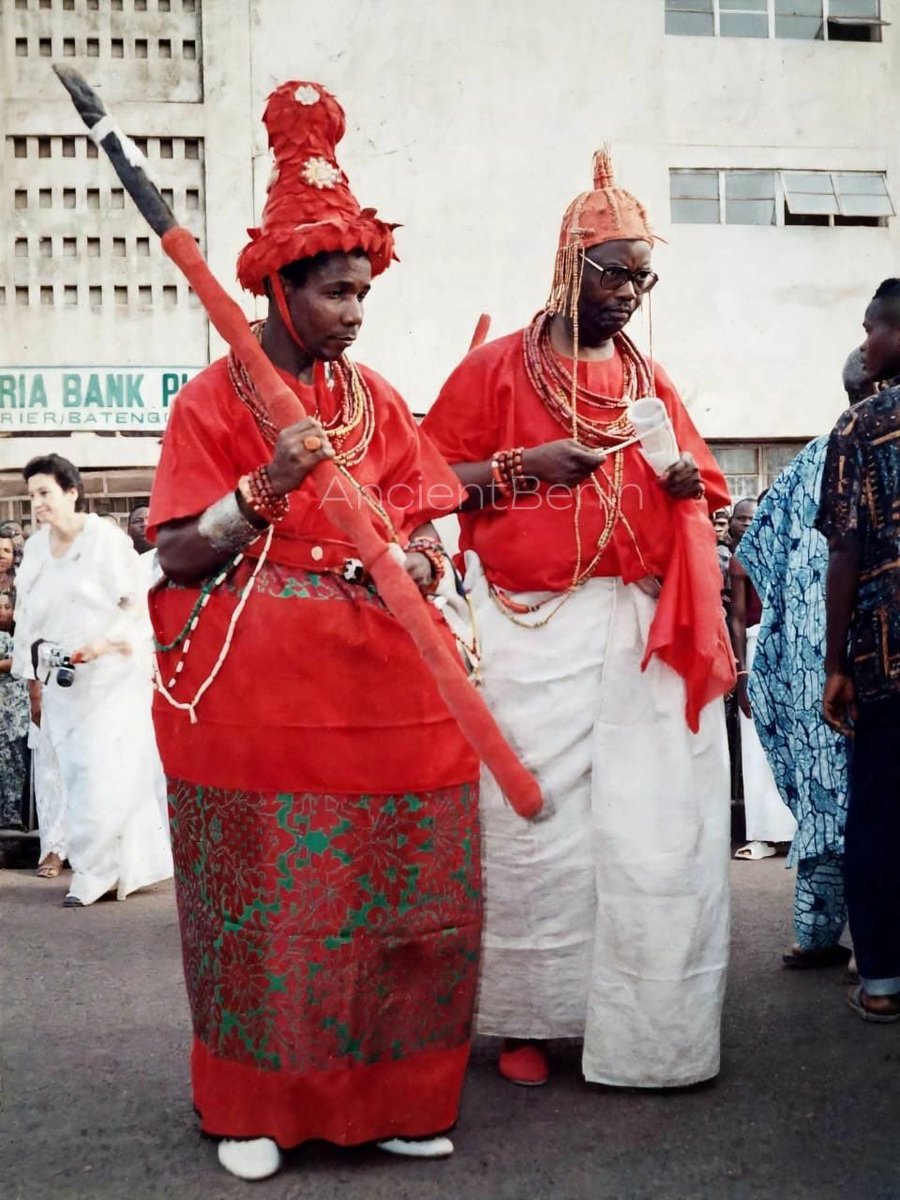
Omo N’Oba N’Edo Uku Akpolokpolo Erediauwa (r. 1979–2016), alongside Chief Nosakhare Idubor Isekhure, the Isekhure of Benin Kingdom, during the Ugie Emobo ceremony at the entrance of the Royal Palace of Benin. The Oba is seen striking a gong (bell) during a royal procession.