The bitter lesson in 26 words:
Don’t be distracted by human knowledge, as AI has been historically.
Instead focus on methods for creating knowledge that scale with computation, like search and learning.
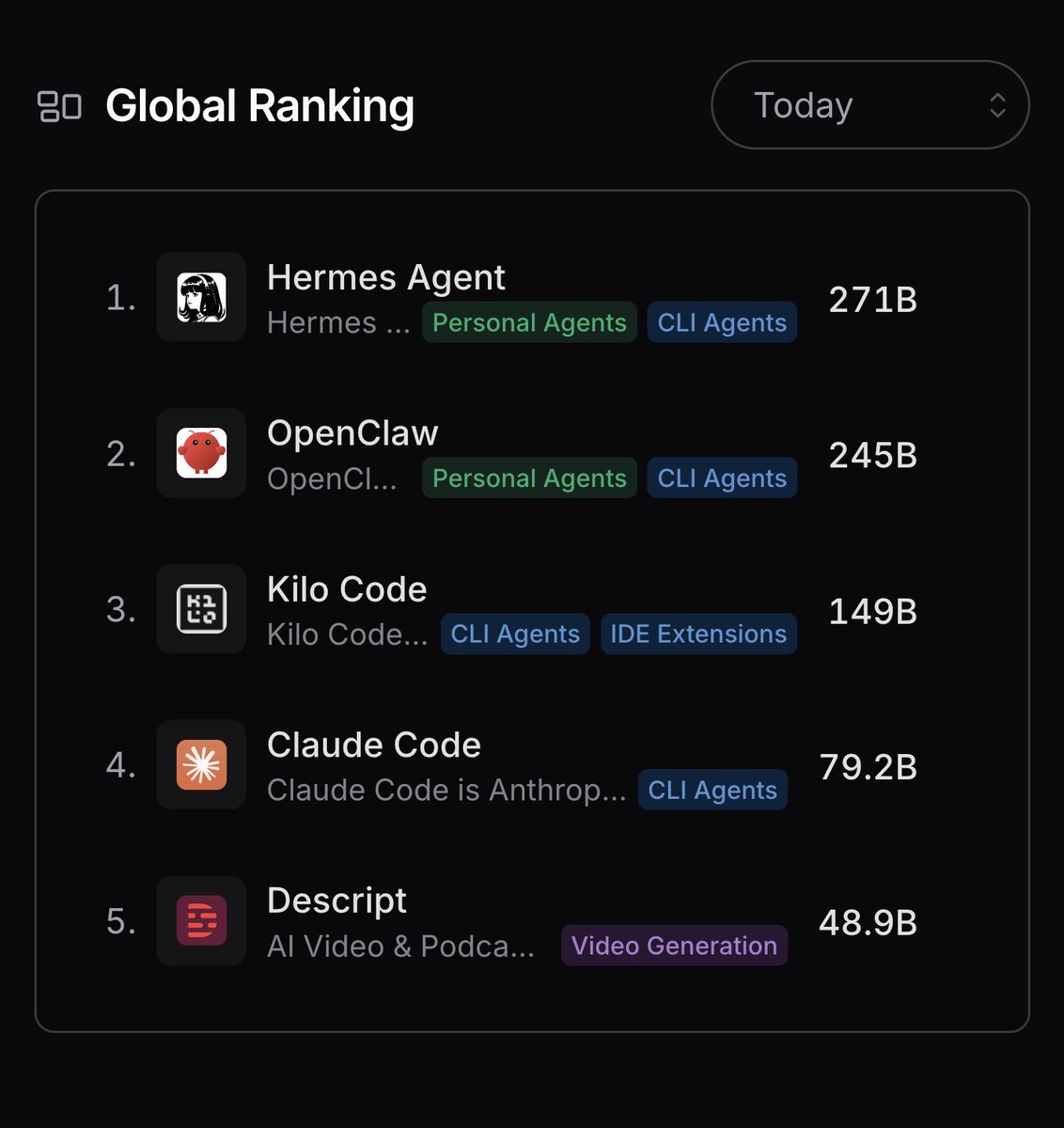
Hermes Agent is now #1 on the Global @OpenRouter token rankings.
While our journey together has just begun, we'd like to take this opportunity to thank our contributors, supporters, and users for all they have done to get us this far.
"Across the system, everyone points at someone else. If a process takes 10 steps, you’ll find 10 people who feel absolved of responsibility because they can cite 9 other blockers. Friction becomes a moral license to do a mediocre job (while lamenting about it)."
Today we're releasing Gemma 4, our new family of open foundation models, built on the same research and technology as our Gemini 3 series. These models set a new standard for open intelligence, offering SOTA reasoning capabilities from edge-scale (2B and 4B w/ vision/audio) up to a 26B parameter MoE model and a 31B dense model. By releasing Gemma 4 under the Apache 2.0 license, we hope to enable more innovation across the research and developer communities. Our earlier Gemma 3 models were downloaded 400M times and over 100,000 variants of those models have been published, so we're excited to see what the community will do with the even better Gemma 4 models!
Learn more at https://t.co/BW6O3Gr8bc and https://t.co/8M0XSQSP4u
Great work by everyone involved!
#Gemma4 #AI #OpenSource #ML
The AI Scientist: Towards Fully Automated AI Research, Now Published in Nature
Nature: https://t.co/nNfpSV5e5I
Blog: https://t.co/i6h8LVQOdl
When we first introduced The AI Scientist, we shared an ambitious vision of an agent powered by foundation models capable of executing the entire machine learning research lifecycle.
From inventing ideas and writing code to executing experiments and drafting the manuscript, the system demonstrated that end-to-end automation of the scientific process is possible.
Soon after, we shared a historic update: the improved AI Scientist-v2 produced the first fully AI-generated paper to pass a rigorous human peer-review process.
Today, we are happy to announce that “The AI Scientist: Towards Fully Automated AI Research,” our paper describing all of this work, along with fresh new insights, has been published in @Nature!
This Nature publication consolidates these milestones and details the underlying foundation model orchestration. It also introduces our Automated Reviewer, which matches human review judgments and actually exceeds standard inter-human agreement.
Crucially, by using this reviewer to grade papers generated by different foundation models, we discovered a clear scaling law of science. As the underlying foundation models improve, the quality of the generated scientific papers increases correspondingly. This implies that as compute costs decrease and model capabilities continue to exponentially increase, future versions of The AI Scientist will be substantially more capable.
Building upon our previous open-source releases (https://t.co/H1tBT14Yx8), this open-access Nature publication comprehensively details our system's architecture, outlines several new scaling results, and discusses the promise and challenges of AI-generated science.
This substantial milestone is the result of a close and fruitful collaboration between researchers at Sakana AI, the University of British Columbia (UBC) and the Vector Institute, and the University of Oxford. Congrats to the team!
@_chris_lu_@cong_ml@RobertTLange@_yutaroyamada@shengranhu@j_foerst@hardmaru@jeffclune