A Japanese TV crew filmed a 25 year old software engineer named Sato Nomura as a national role model for surviving on the average salary of 27 thousand dollars a year. They followed him home. Tiny apartment. He told the camera his comfortable room temperature is 31 degrees because the air conditioner costs too much.
The clip did 3 million views in 48 hours. Every Japanese viewer in their twenties shared it as proof you can live well on a small salary. Every Japanese parent shared it as proof their kid was doing fine.
Then someone in the comments wrote: pause the video at 1:16.
Pause at 1:16. Ignore his face. Ignore the bowl. Look at the laptop screen behind the bottle of soy sauce.
That tab is not his bank account. That is a live wallet.
"treadfi and HIP3 markets"
"the consortium"
$48,862 profit. " a mix of mid -1, aggressive, TP/SL 5%"
Joined October 2025.
→ https://t.co/K5BQW60PjE
He told the TV crew he survives on 25 thousand dollars a year. The wallet on his desk had made $48k in 5 months. 13,020 positions. All relevant perpdexes natively integrated. All farmed thanks to TreadFi.
The comment section turned into a detective board. Someone slowed the video to 0.5x. Screenshotted every frame where the laptop was visible. Stitched them together. Reconstructed the full wallet page from 4 seconds of background footage.
Entry prices as required. Payouts in the thousands. Not one red row in 13,020 entries.
Biggest single win: $2400 in a 15 minute window on a Tuesday morning because someone set their HIP3 TradeXYZ bot wrongly and dumped a bunch of silver when US markets weren't live.
The 31 degrees was not because the air conditioner costs too much. The 31 degrees was so the TV crew would believe him. He runs the air conditioner full blast every other day. He just turned it off the morning the camera came over.
The bowl on the floor was not dinner. The dinner was upstairs. He bought the bowl from the convenience store an hour before filming.
The shoes with holes were one specific pair he kept under the bed for moments like this. The rest of the closet was full.
He was not a role model for surviving on 25 thousand dollars a year. He was a role model for hiding $48K from a TV crew that wanted a feel good story about poor young engineers.
The original segment got 4 million views. The zoom on the laptop got another half a million.
The Japanese audience is still sharing the clip. Still proud. Still saving on air conditioning. Still believing.
He is still treading. There's a week left until Season 1 ends. The sessions are still running. The bowl is back on the convenience store shelf.
The country with the better TV story has the smaller wallet. The man with the smaller story has the bigger wallet. He just had to pretend to be poor for one afternoon.
I told Claude to predict the next BTC candle using Kronos. didn't touch anything. +$4,200 overnight.
Kronos isn't another LLM wrapper.
it's a GPT-style model trained on 12 billion candles from 45 exchanges.
Binance, NYSE, NASDAQ, LSE. it reads OHLC the way GPT reads English.
> words = candle patterns
> sentences = OHLC sequences
> the corpus = every trade ever printed
> the edge is simple:
P(next | history) = softmax(W · h_t)
same math GPT uses to predict the next word,
except the "word" is the next candle. no twitter sentiment.
no blog scraping.
no hallucinated confidence.
just statistics over 12B real price moves.
I plugged Kronos into a 5-min BTC Polymarket bot.
input: last 50 candles
output: probability next candle closes up
trades only when |p_model - p_market| > 0.04
72 hours: $300 → $4,500
ChatGPT looks at a chart and pattern-matches against an article it read.
Kronos looks at the chart and remembers 12 billion of them.
87% of Polymarket is exit liquidity. one of these models is actually trading the market.
https://t.co/hdttElGG24 21.8k stars, free, MIT license.
Tsinghua University release.
Tools the internet doesn't want you to find 🔍
1. Shodan
A search engine for internet-connected devices. You can find cameras, servers, and routers exposed online.
2. Archive. ph
Saves a permanent snapshot of any webpage. Useful when articles go behind paywalls.
3. Similarsites
Enter any website and instantly find dozens of similar ones. Great for discovering alternatives.
4. Mailtrack
Shows you when someone opens your email. You see the exact time it was read.
5. Hunter. io
Type in a company name and it finds employee email addresses linked to that domain.
6. Photopea
A free Photoshop that runs entirely in your browser. No download needed.
7. 12ft .io
Removes paywalls from most news articles. Just paste the link and read for free.
8. Carbon
Turns your code into beautiful shareable images. Popular among developers.
9. Explainshell
Paste any Linux command and it explains exactly what every part does.
10. Tineye
Reverse image search that shows where a photo has appeared on the internet.
11. Namecheckr
Check if a username is available across all social media platforms at once.
12. Untools
A collection of thinking frameworks and mental models to help you make better decisions.
13. BuiltWith
Shows the exact technologies, tools, and software any website is built with.
14. GeoGuessr
Drops you anywhere in the world on Google Street View. You guess the location.
15. Virustotal
Upload any file or paste any link and it scans it with over 70 antivirus engines instantly.
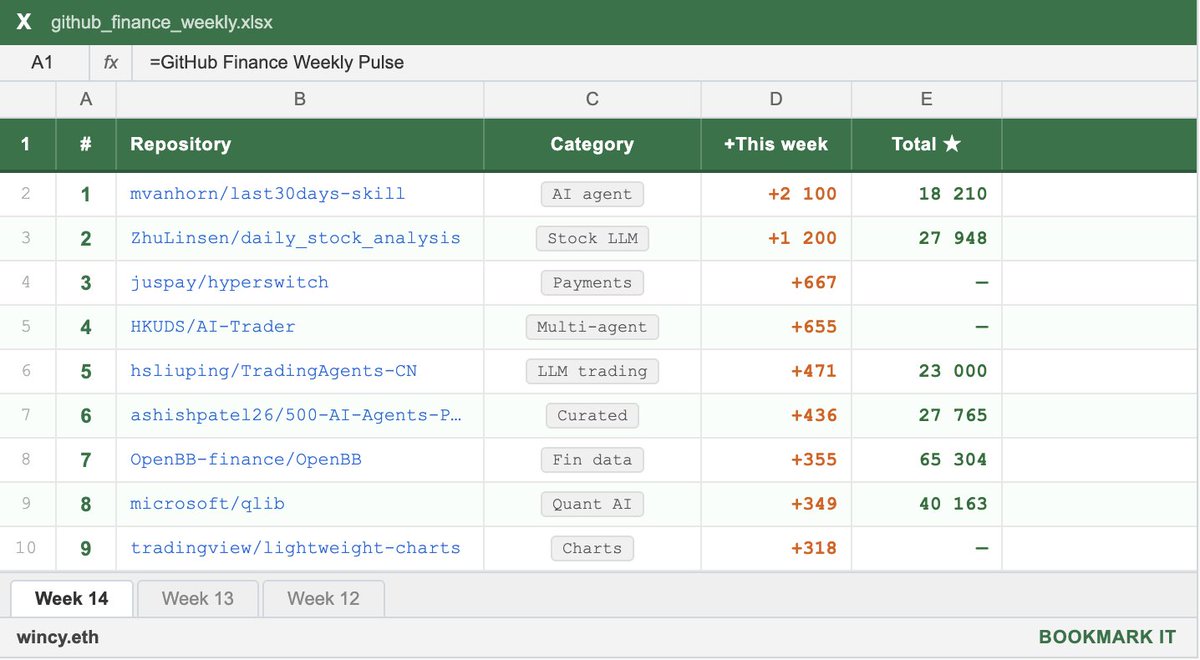
the fastest growing GitHub repos in finance this week:
1. mvanhorn/last30days-skill (+2.1K ★)
AI agent skill that searches Reddit, X, YouTube, HN, Polymarket and the web in parallel — then scores results by upvotes, likes, and real money, not editors. drop it into Claude Code or OpenClaw. zero config to start.
2. ZhuLinsen/daily_stock_analysis (+1.2K ★)
LLM-powered stock analyzer for US, A-share and H-share markets. real-time news + multi-source data + decision dashboard with exact buy/stop/target levels. runs on GitHub Actions on a schedule at zero cost. pure automation.
3. juspay/hyperswitch (+667 ★)
open-source payments infrastructure written in Rust. modular by design — pick only what you need: routing, retries, vaulting, reconciliation, cost observability. built by the team behind payment infrastructure for 400+ enterprises. the "Linux for payments"
4. HKUDS/AI-Trader (+655 ★)
agent-native trading platform where AI agents join, share signals, debate ideas, and copy each other's trades. send one message to any agent and it registers itself. supports OpenClaw, Claude Code, Codex, Cursor and more.
5. hsliuping/TradingAgents-CN (+471 ★)
Chinese-enhanced fork of TradingAgents. same multi-agent LLM trading architecture, fully localized for Chinese markets, A-share data, and domestic LLMs like DeepSeek and Qwen. 23K stars and climbing.
6. ashishpatel26/500-AI-Agents-Projects (+436 ★)
curated collection of 500+ AI agent use cases across healthcare, finance, education, retail and more. organized by industry and framework — CrewAI, AutoGen, LangGraph, Agno. the best reference list if you're figuring out what to build next.
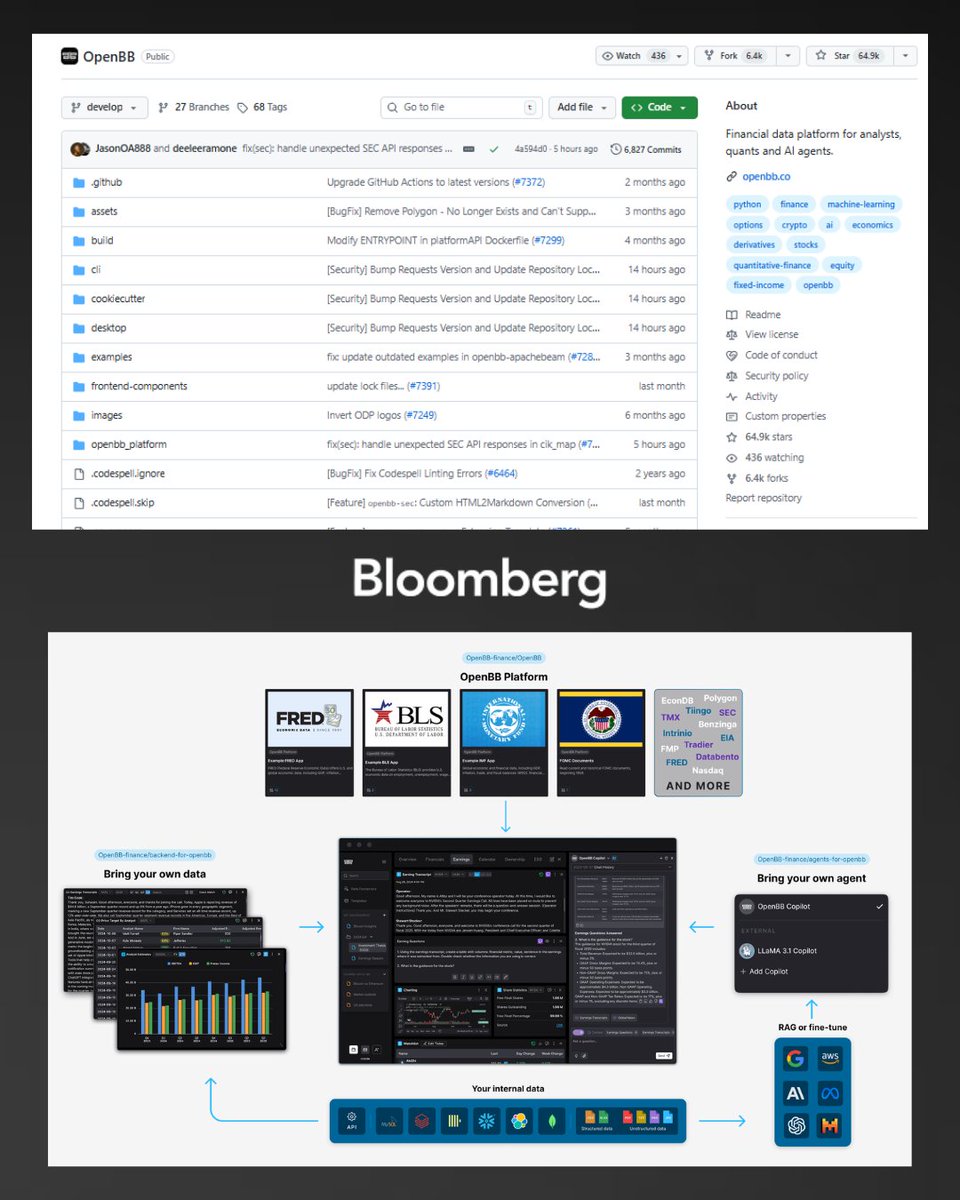
7. OpenBB-finance/OpenBB (+355 ★)
open-source financial data platform for quants, analysts and AI agents. "connect once, consume everywhere" – same data layer exposes to Python, Excel, MCP servers for agents, and REST APIs. the open-source Bloomberg alternative.
8. microsoft/qlib (+349 ★)
AI-oriented quant investment platform from Microsoft. covers the full pipeline from data to live trading: alpha seeking, risk modeling, portfolio optimization, order execution. deep learning, RL, auto-quant – all in one place.
9. tradingview/lightweight-charts (+318 ★)
one of the smallest and fastest financial chart libraries for the browser. built with HTML5 canvas, weighs almost nothing, renders like native. if you're building any kind of trading UI on the web, this is what you reach for first.
bookmark this and start today.
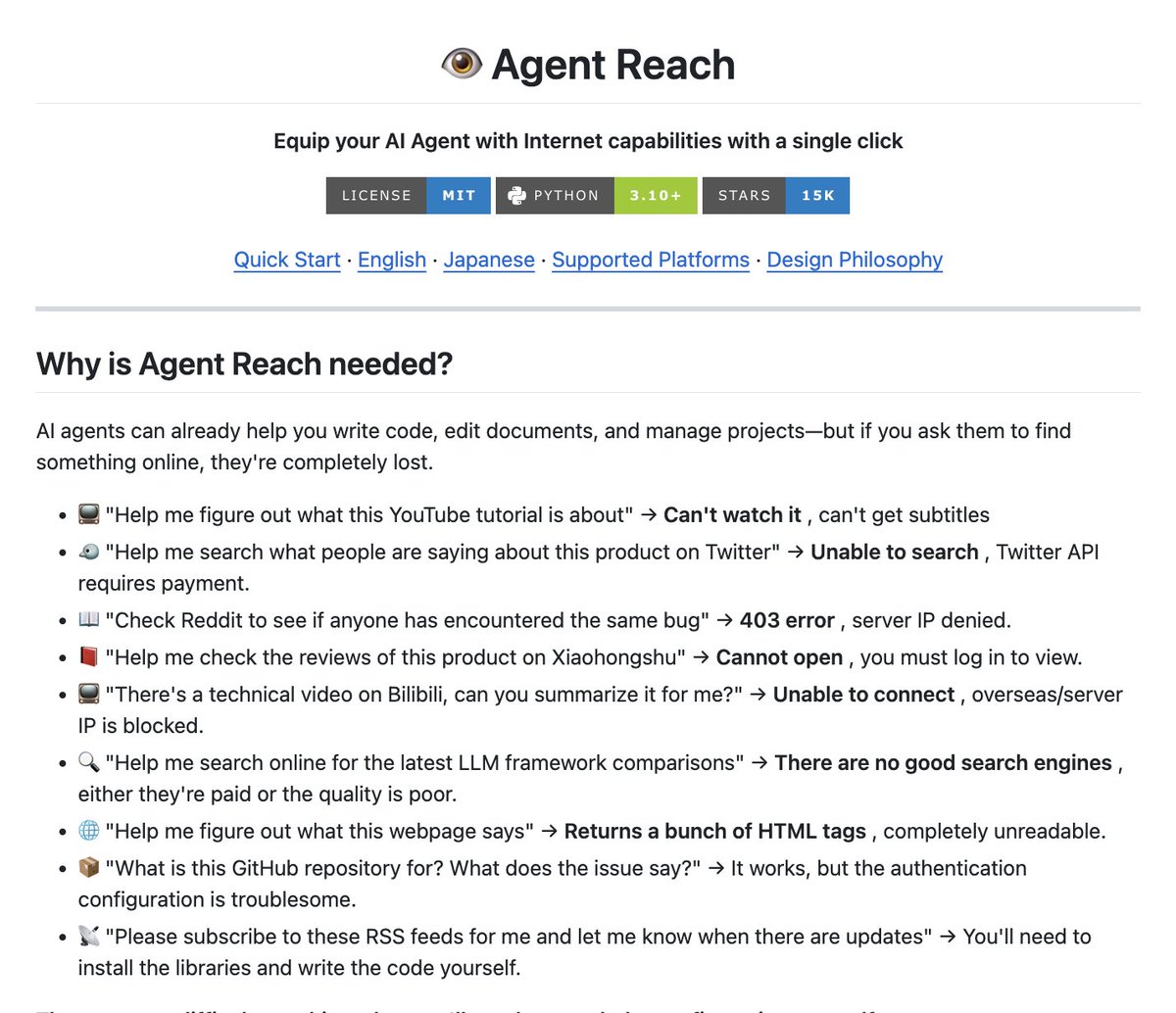
This repo gives any AI agent instant access to the entire web without API keys.
Agent Reach is a single command that connects your agent to 15+ platforms like Twitter, Reddit, and Bilibili. It completely bypasses expensive API paywalls and frustrating 403 errors.
100% Open Source.
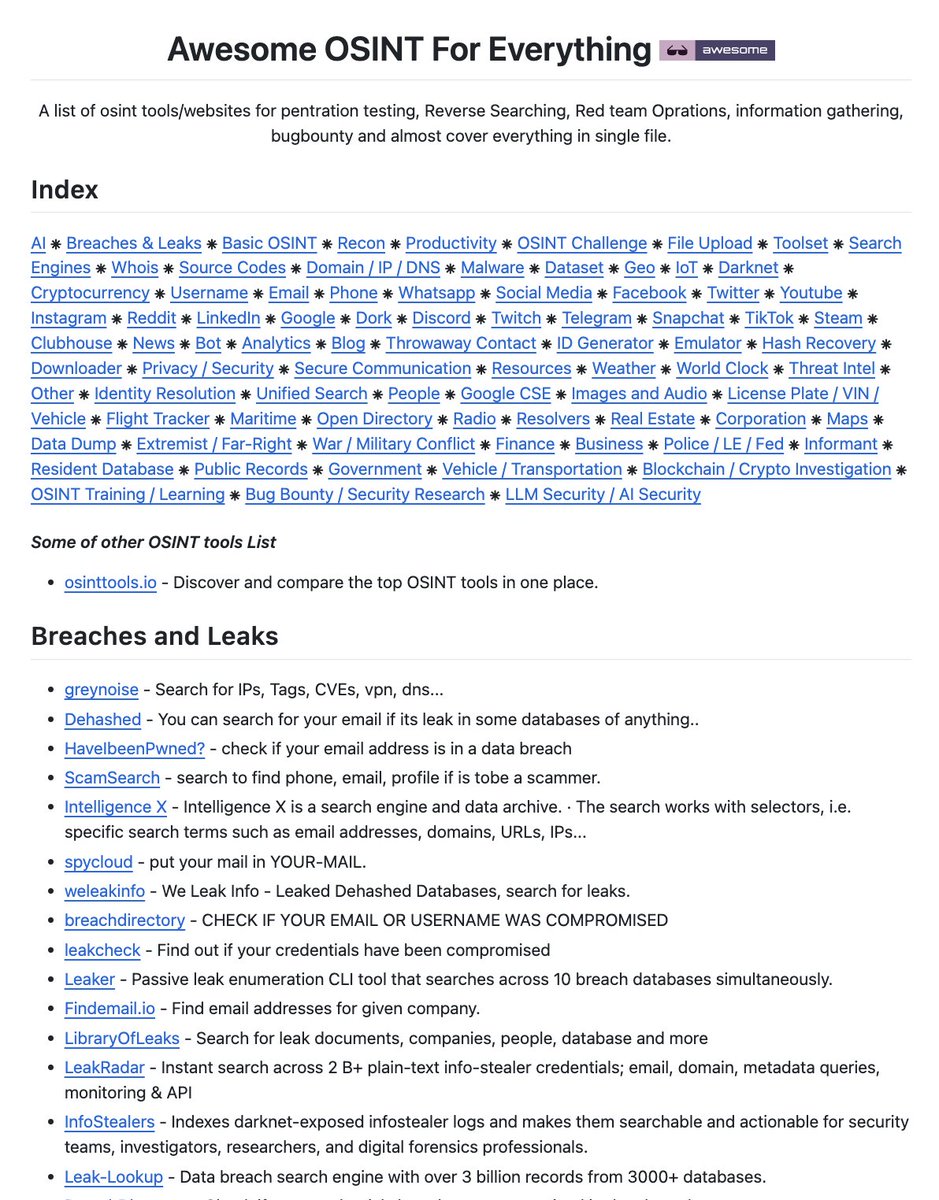
You can now find almost every OSINT tool in one place.
Someone compiled a massive repository of tools for penetration testing and information gathering. It’s basically a god mode for information gathering. tracking, digging, analyzing.. it is all here.
100% free to use.
Just shipped: 98 quantitative agents now running nightly across 500+ tickers — dark pool flow, options sweeps, vol/credit regime detection layered on top of 95 academic factor models.
All feeding a single scoring engine that outputs one thing: LONG, SHORT, or WAIT.
New update to algo will hit tomorrow.
https://t.co/L7sG0tdCo2 — launching April 13.
This ain't no prompted algo
starting in 24-48h the bankr agent will be self-sustaining. to chat with bankr you'll need:
> bankr club ($20/mo paid in $BNKR) or
> max mode (details below)
as part of this update, we're rolling out max mode. max mode lets you pay for your own LLM usage and pick any model available through the bankr LLM gateway: claude, minimax, gemini, and more. you choose the brain that powers your bankr bot. pay in crypto — any token on base. pay-as-you-go, usage based pricing.
everything else: CLI, API, x402 Cloud stays the same.
🚨 BREAKING: You can now run a Bloomberg Terminal for FREE.
The closest open-source alternative that exists.
No $24,000 subscription. No API costs. 100% local on your machine.
Bookmark this. Install it right now. Takes ten minutes.
Introducing https://t.co/Us8p4fxbPM!
I got tired of checking 10 different directories every time I needed to find an MCP server, an AI skill, or an AI agent framework.
So I built https://t.co/Us8p4fxbPM.
It crawls and indexes 55+ directories, registries, and package managers across the AI agent ecosystem.
Right now, it's tracking 314,000+ tools across MCP servers, AI skills, and AI agents.
Every tool gets a security score (A+ through F) based on static analysis, dependency vulnerabilities, and AI code review.
You can filter by category, security grade, star count, downloads, license, whatever you need.
One search instead of twelve tabs. It's free to use, and as a developer, you can publish your package to all directories at once!
No need to worry about the exact formatting requirements for publishing to each service!
https://t.co/23oKABgryY
🚨 Type one username. Get every account that person has ever created across 400+ social networks. In seconds.
It's called Sherlock. 72,000 GitHub stars. The most popular OSINT tool on the internet. Free and open source.
One command. One username. Every digital footprint exposed.
No paid tools. No private investigators. No background check services.
Here's what Sherlock does:
→ Enter any username. It scans 400+ social networks simultaneously.
→ Instagram, Twitter, Reddit, TikTok, GitHub, LinkedIn, and 394 more
→ Returns every account linked to that username in seconds
→ Exports results to TXT, CSV, or Excel
→ Works through Tor for anonymous searches
→ Proxy support for additional privacy
→ Auto-opens found profiles in your browser with one flag
→ Runs on Linux, Mac, Windows, and Docker
Here's the part that should make you uncomfortable:
Your username is your fingerprint. Most people use the same one everywhere. One search reveals every platform you've ever signed up for. Dating apps. Forums. Old accounts you forgot existed. Everything.
Private investigators charge $200 to $500 for a basic digital footprint report. Background check services charge $30 to $50 per search.
That's it. Every account. Every platform. Every trace.
100% Open Source.
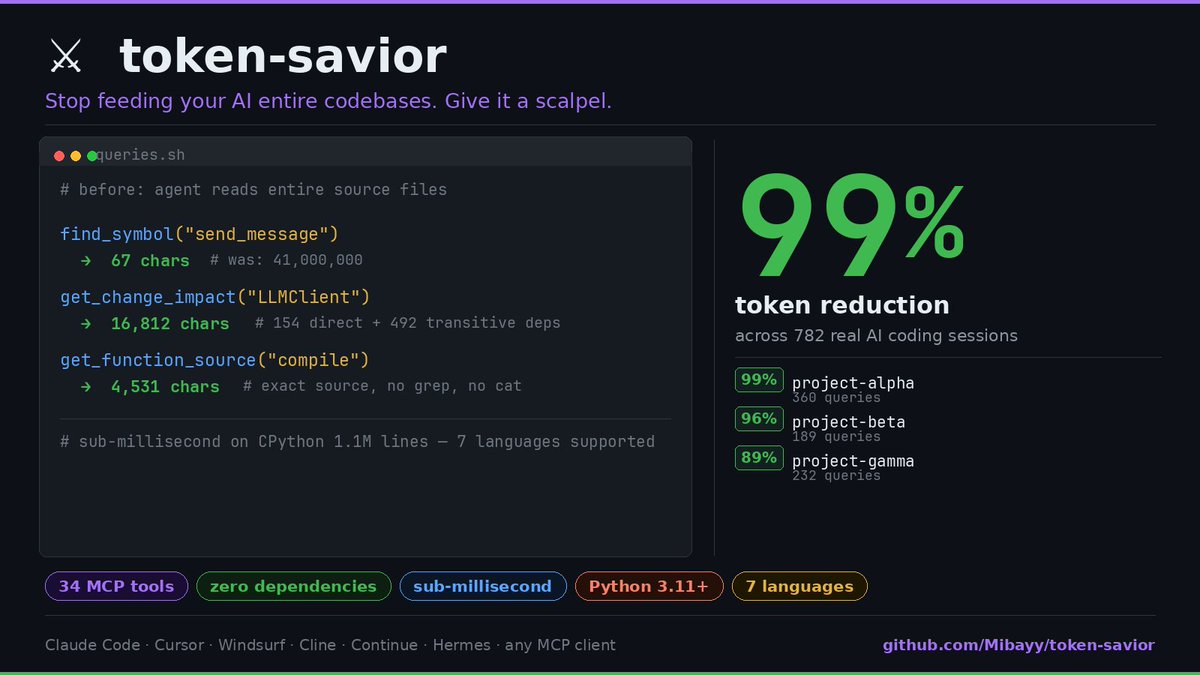
Nobody will see this, but if you're burning tokens with your AI agent (@OpenClaw, @NousResearch's Hermes, or any MCP-compatible tool) check this
Stop feeding entire codebases
Give your AI a scalpel
massive token reduction
faster queries
cleaner context
https://t.co/upuowhGgwm
THE HERMES AGENT IS GOING VIRAL RIGHT NOW. HERE'S WHY PEOPLE ARE CALLING IT THE NEXT OPENCLAW:
someone made a full breakdown comparing them side by side.
openclaw: 339K github stars. 5,400+ skills. massive ecosystem. you plug in tools and let them execute.
hermes: 14.6K stars. smaller. but it does something openclaw doesn't.
it learns from experience. creates its own skills. improves them over time. and builds a model of YOU across sessions.
openclaw is config-first. write a SOUL.md, connect your channels, go.
hermes is learning-loop-first. the agent creates skills from experience, improves them, and deepens its model of you the more you use it.
memory:
> openclaw: session-based. persistence through plugins
> hermes: async writes, configurable recall, multi-user isolation
self-improvement:
> openclaw: no built-in learning loop. skills installed manually
> hermes: core differentiator. creates skills from experience and improves them automatically
security:
> openclaw: 36% of ClawHub skills contain prompt injections. 135K+ unprotected instances
> hermes: smart approvals, kill switch, filesystem snapshots before destructive ops
the tldr:
openclaw does the work. hermes does the thinking.
openclaw is for tool runners who want a massive ecosystem. hermes is for people who want a meta-agent that gets smarter over time.
both are open source and both are free but the better one depends on what you're trying to do
Hermes Agent could be the real OpenClaw killer
Yet, most people are falling behind and not setting it up
In this 25 min video you'll learn everything you need to know about Hermes Agent:
🚨 The most disrespectful thing someone has ever done to the AI industry:
Fit 51 models into one HTML file with zero dependencies and gave it away for free.
Read that again. One HTML file. Not an app. Not a platform. A file.
It's called G0DM0D3.
Drag it into your browser. You now have Claude, GPT-5, Gemini, Grok, Mistral, LLaMA, DeepSeek, Qwen, and 43 more models. Right there. No install.
No React. No Next.js. No node_modules. No build step. No backend. No server. Nothing.
Here's what's packed into this single file:
→ 51 AI models through one chat interface via OpenRouter
→ Race multiple models against each other in parallel
→ See which model gives the best answer side by side
→ Auto-tuning engine that adjusts temperature and sampling per context
→ Your API key never leaves your browser. Zero data collection.
→ Works on desktop and mobile
→ Self-host by opening a file. That's it. That's the deployment.
Here's the wildest part:
Every AI company on Earth built a team, raised millions, deployed servers, hired engineers, and built apps to give you access to their model behind a $20/month paywall.
This person built one HTML file that accesses all of them at once.
No team. No funding. No servers. No paywall. One file.
ChatGPT Plus: $20/month for one model.
Claude Pro: $20/month for one model.
Gemini Advanced: $20/month for one model.
This: 51 models. One file. Price of an API key.
Open Source. AGPL-3.0 License.
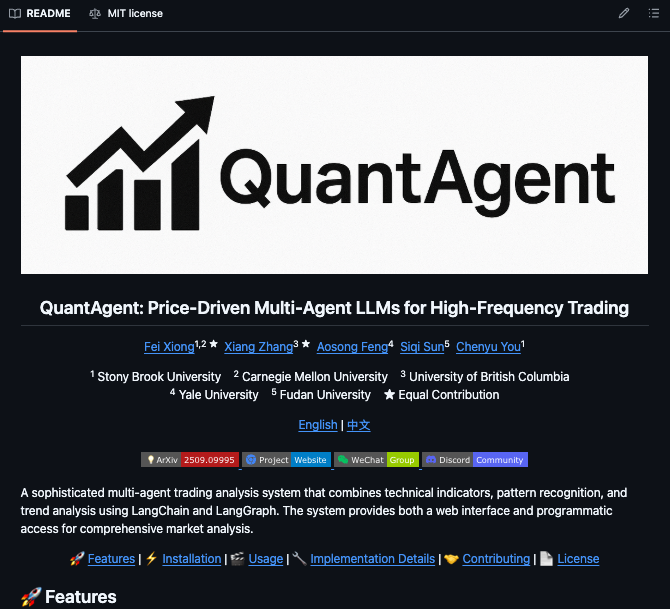
🚨BREAKING: Researchers from Stony Brook, CMU, Yale, UBC, and Fudan just open-sourced a multi-agent LLM system built specifically for high-frequency trading analysis.
It's called QuantAgent and it runs four specialized AI agents simultaneously each analyzing a different dimension of the market then synthesizes everything into a single actionable trade decision with entry points, exit points, and stop-loss thresholds.
Link in the comments + details about this 👇
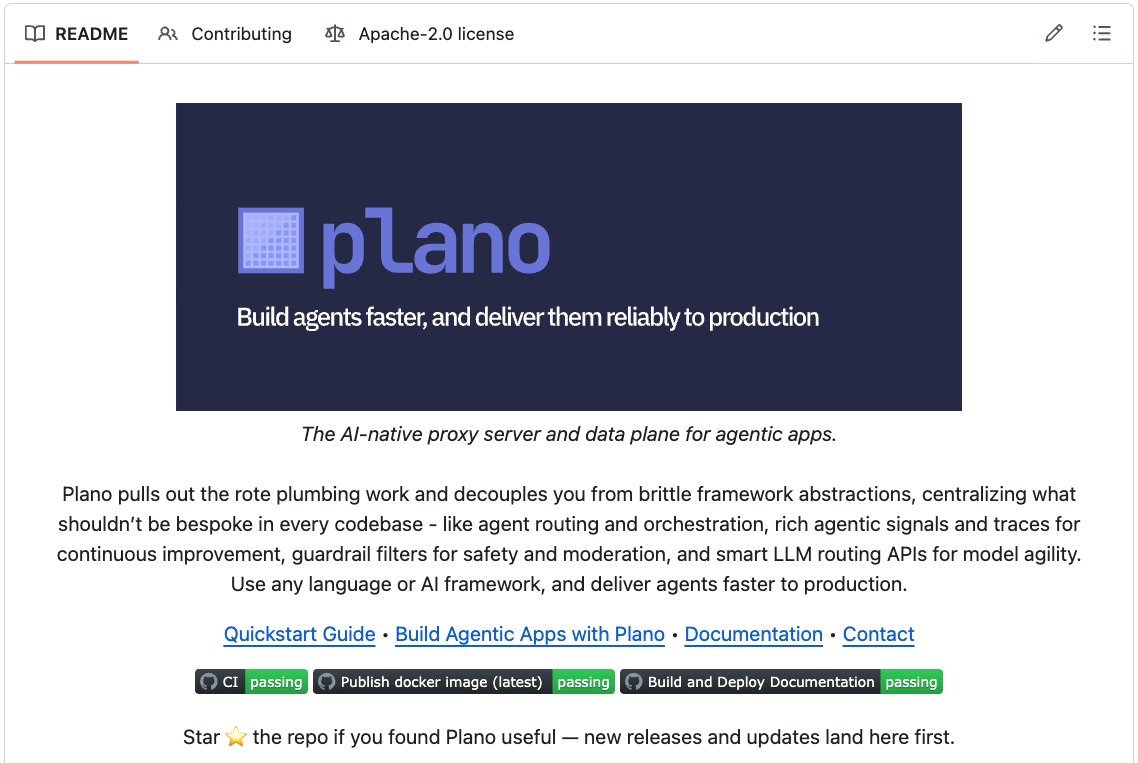
Finally, you can trust OpenClaw with real data!
Plano adds a proxy layer to OpenClaw that filters every request and response before an agent can act. Connect your real inbox, calendar, and APIs without risk.
GitHub: https://t.co/xUgJALkAdC
(100% local setup below)
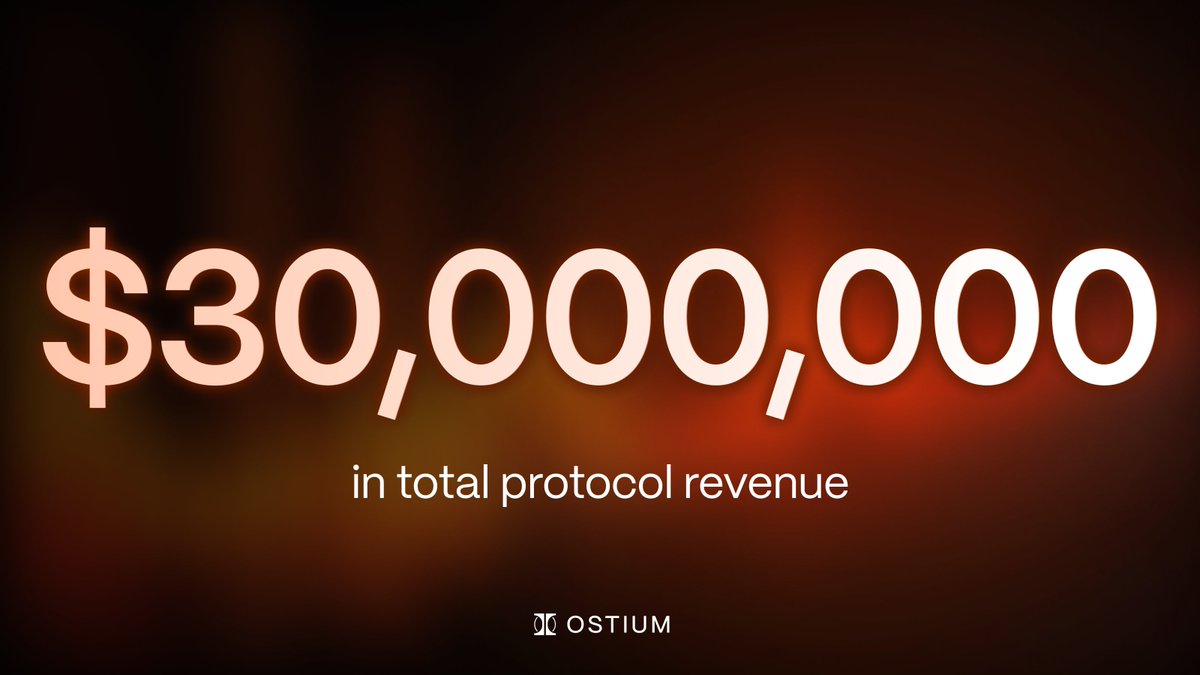
Ostium has crossed $30M in total protocol revenue.
$1.1M was generated in the last 7 days. This is used for growth and building out the best trading execution experience.