Spent a bunch of tokens over the last few weeks building a fully procedural New York simulation.
https://t.co/YSrGNoIYsK
It's only 784KB gzipped and the code is on github, so you can do whatever you want with it ✌️
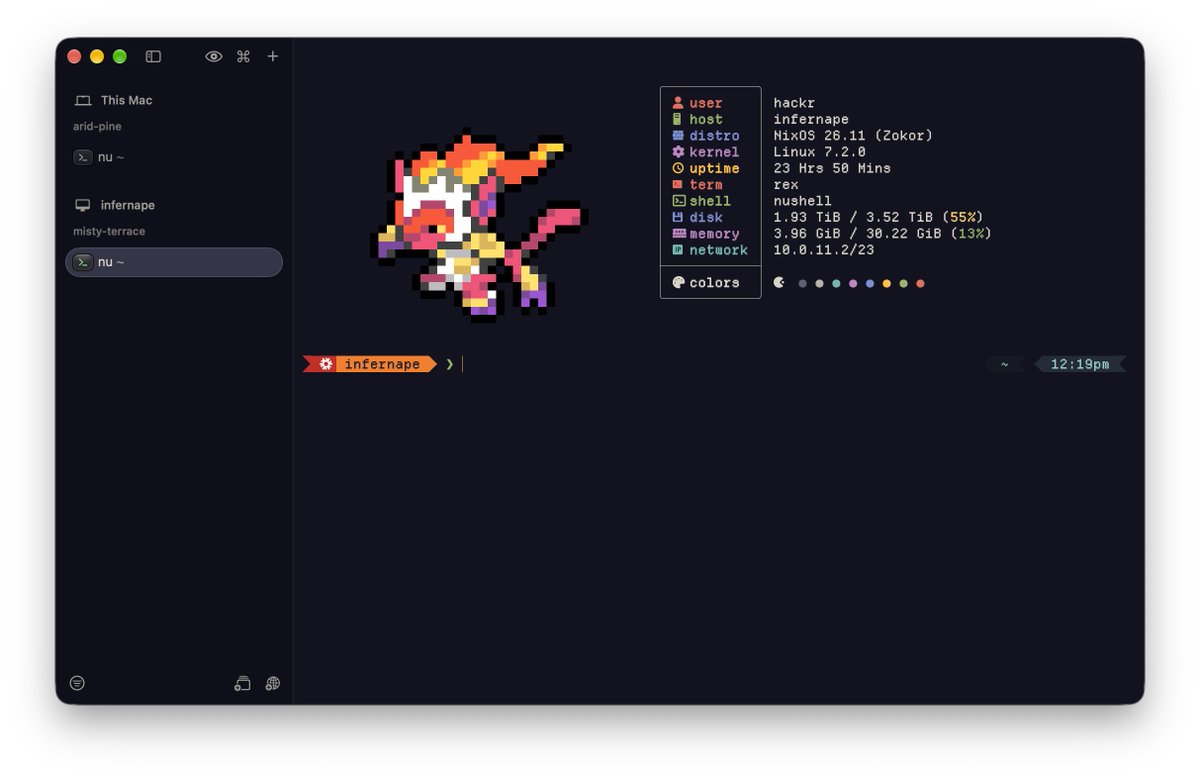
gpuix apps can now render in the terminal
create GUIs, use them as TUIs
- embed them in VSCode, Zed, Codex
- split GUIs into panes
- use all terminal power features for your GUIs
powered by the Kitty Graphics protocol
wtf..
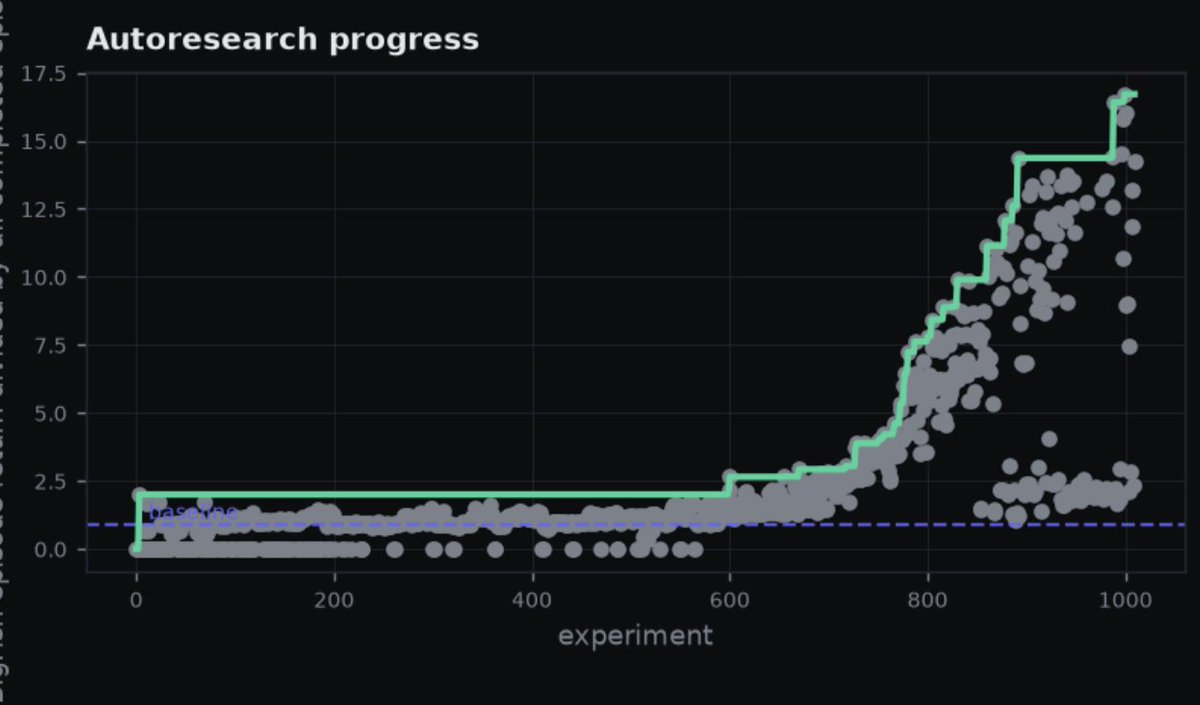
launched a research idea last night w my autoresearcher..
woke up this AM to Astra hillclimbing the crap out of it...
claude gave up after naive baseline, and said "its theoretically not possible, lets publish this negative result."
product idea:
claude should tool-call to astra for advice...
I'm so incredibly tired of seeing low-effort AI-designed web pages. I basically bounce off any new product immediately when I see it (never get a chance to judge the product itself). Lots of thin lines, glowy styles, inconsistent fonts, lots of monospace. You know who you are.
I’ve been asked for an updated daily schedule given Superlogical, second kid, and AI usage. Here you go:
- 530 awake, 20 minute interval cardio
- 600 review nightly agents, start new
- 700 wake and feed newborn
- 730 wake, dress toddler
- 745 breakfast with family
- 800 off to work
- 1200 lunch (often with wife)
- 1530 to 1945 family time
- 2000 hang with wife, start new nightly agents
Early 2026 I mentioned a goal of “always have an agent running” but admitted I was realistically only getting agents for a couple hours off work.
As of today, I’ve gotten a LOT better, I regularly have at least 2 agents running constantly with many running through most of the night. I’ll cover this in more detail another time!
Web scraping will never be the same.
(100% open-source visual search at scale)
PixelRAG is a retrieval system that skips HTML parsing completely.
Instead of scraping a page into text and embedding chunks, it screenshots the page and retrieves the image. A vision-language model reads the answer straight off the pixels.
Why that matters: parsing is where web RAG quietly loses information.
- A single HTML-to-text parser can drop 40%+ of a page.
- Tables, charts, and layout get flattened or thrown out.
- Swapping parsers alone can move accuracy ~10 points on the same docs.
PixelRAG indexes the page a person actually sees. The team built a visual index of all of Wikipedia, 30M+ screenshots, and it still beats the strongest text RAG baseline by 18.1% on text-only QA.
The repo also ships a Claude Code plugin that gives Claude eyes.
It lets Claude screenshot any URL and read the rendered page instead of scraping the DOM. So you can hand it a live page, an arXiv paper, or your local site and ask what it actually looks like.
One setup script. No MCP server, no backend.
How the pipeline works:
- Renders each document (web, PDF, image) to image tiles.
- Embeds them with Qwen3-VL-Embedding, LoRA fine-tuned on screenshots.
- Builds a FAISS index and serves a search API.
A stronger reader model lifts accuracy with no re-indexing, since the index is just pixels.
Everything is open-source under Apache-2.0.
GitHub repo: https://t.co/qun9TjAdmw
Talking about RAG, I recently wrote an article on a new approach that makes retrieval much more efficient by cutting corpus size by 40x, reducing tokens per query by 3x, and improving vector search relevance by 2.3x.
The article is quoted below.
🦀 OpenAI has joined the Rust Foundation as a Platinum Member with a $600K commitment to the Rust ecosystem.
The funding supports maintainers, the Rust Project Goals, and the Innovation Lab.
Full announcement in replies 👇
ESTE TIPO USÓ CLAUDE PARA CONSTRUIR UN SISTEMA DE TRADING AUTOMATIZADO QUE GANÓ 847 $ DE LA NOCHE A LA MAÑANA
Todo empezó con un solo artículo sobre bots de Polymarket.
Claude lo leyó, seleccionó 7 repositorios de GitHub, los conectó en un pipeline funcional y desplegó el sistema de principio a fin.
A partir de ahí, todo funcionó de forma autónoma.
El sistema escaneó más de 412.000 operaciones, rastreó wallets de ballenas, detectó actividad de insiders y tomó decisiones en tiempo real.
Según él, cada pocos segundos analizaba datos, decidía si comprar, vender o pasar, y ejecutaba las operaciones automáticamente.
47 operaciones después, el sistema terminó la noche con 847 $ de ganancia, sin ninguna intervención manual.
LOCURA