A collaborative effort to illuminate the K-12 curriculum landscape for educators & advocates. We get into the important weeds for popular and emerging programs.
I was thinking about this recently. (Once upon a time I thought I’d be a college English professor). If I were a prof now I’d probably have a reading lab. Sciences have them. Perhaps the humanities need them too. We meet twice a week to discuss and we meet twice a week to read aloud together for 90 mins at a stretch. In so doing I build your capacity for sustained reading- in large by making it a group social activity. I suspect that done well students might enjoy it. It would give them a discipline they know they lack. Not sure it would work but some kind of dramatic re-centering of the reading seems like one possible response.
Really good summary of the broad research into the cognitive benefits of writing by hand for students by @YoukiTerada at @edutopia.
Some highlights:
The slower, more deliberate pace of capturing ideas by hand, on paper, translates into a sharper recall of details—even days later.
Handwriting notetakers, however, are forced to slow down their minds and focus on broader principles and big ideas, rather than isolated facts, allowing them to connect new knowledge to existing knowledge they’ve already processed.
A deeper analysis revealed that handwriting notetakers were much more likely to add drawings, diagrams, and charts of the material being learned: a sketch of the water cycle, for example, or visual annotations linking concepts together.
https://t.co/UT7WCIHWBk
It’s this false dichotomy that provides a glorious hill for me to die on.
K can & should have uninterrupted unstructured/structured play.
K can & should have explicit instruction in foundational rdg, math + writing skills plus opportunities for science + social studies content.
In 𝘏𝘰𝘸 𝘞𝘦 𝘓𝘦𝘢𝘳𝘯, Stanislas Dehaene—one of the world’s leading cognitive neuroscientists and winner of the Nobel-equivalent Brain Prize—identifies the 4 Biological Pillars of Learning. Without all 4 of these pillars in place, learning is fragile and will not last: 🧵
I’m delighted to announce that I have the privilege of being part of this exciting MATH event! This is a great opportunity to build your knowledge on math interventions and resources and instruction.
Register here:
https://t.co/yD8O8BrWiS
“words [that] fit into categories, but aren't synonyms” is so important! Too often we ask kids to come up with synonyms, yet very few words have true synonyms. That would not be real useful to a language. Very important, tho, for kids to understand shades of meaning and nuance.
We’ve got an incredible lineup this month! We're focusing on phonemic awareness and what really makes a difference in early reading instruction.
Take a look and mark your calendar for what’s coming this month 👀
https://t.co/nyDulvMRYu
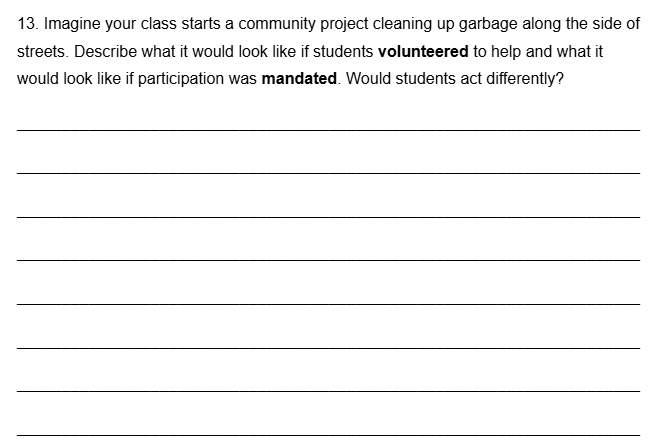
This is a nice question to ask after students previously learned the words volunteer and mandatory. It is not asking dictionary definitions. Rather it is making students think about the words volunteer and mandatory and how behavior would change based on if students volunteer or are mandated to work on a project. An added benefit is that students are differentiating between the two words as well. I expect students to use these two words or forms of the word in their answer.
@tomloveless99 And the easier you find reading, the more you do it. I recall one study (I think mentioned by @DTWillingham) that in a class of 11 year olds, the least avid reader reads around 50,000 words in a year, and for the most avid the figure is around 4 million...
@tomloveless99 Everyone understands this. We don't have a dearth of reading instruction in schools, we have a dearth of content instruction. Hence, there's a focus on getting content instruction back in schools.
I’d love to quote this entire piece. I’ll admit that not too long ago, I was a “progressive” teacher myself. The problem I encountered time and time again was an ongoing focus on so many things that had little to do with improving actual pedagogy. The furniture, pronouns, wall displays, flexible seating, grading practices, homework bans, learning styles, makerspaces, SEL initiatives, classroom aesthetics, care carts, student choice in everything, and countless other debates often took center stage.
What made it frustrating was that these issues generally had little to no impact on student learning. Meanwhile, while so much energy was being spent debating and defending these ideas, students were missing out because there wasn’t a deliberate focus on improving the quality of instruction itself. Discussions about curriculum coherence, explicit instruction, retrieval practice, prior knowledge, and cognitive load were non-existent.
The most meaningful gains in student learning come from refining our teaching methods and deepening our understanding of how learning works and not from constantly revisiting the peripheral details of the classroom.
A teacher’s closing line sums it up:
Students need enough knowledge to call BS… on a faulty idea, weak Google search result, or a poor or glitchy AI output.
AI didn’t change this. But it probably increases the risk that knowledge-building is underserved in K-12 education.
From @matt_barnum’s latest, featuring @DTWillingham:
“To solve math problems, students must know their times tables. To infer the causes of historical events, they need familiarity with dates and historical figures. To read and analyze complex texts, they need a wide vocabulary. To think critically, say cognitive scientists, people need to be able to seamlessly access and synthesize a large number of basic facts.
Students can look up some missing information, but when people turn to external sources too frequently, the brain struggles to keep track of all the new facts at once. Imagine reading a book and pausing every few sentences to search for an unfamiliar word or idea.
There’s not yet good reason to assume any of this will change with AI. The technology can help find new information, but knowledge is still necessary to prompt AI appropriately, to assess the accuracy of its output, and to apply it to specific tasks.”
I'm spending the day revising the Word Mapping Project curriculum. Augment and curtail are two words found in Level C of the curriculum. In the extended booklet, students also learn the following words through categorization.
Build Up: augment, amplify, expand, enhance, and boost
Cut Back: curtail, mitigate, diminish, condense, and downsize
I think this is a very good example of critical academic vocabulary words one should know. An added benefit is that these words do fit into categories, but they aren't synonyms of one another. There are subtle differences between them and we would use them in different ways.
Breathing Life Into Words. I like to use word sums and morphology matrices in content instruction. I used a matrix with the base spire meaning "breathe" because I'm teaching my 5th graders about the respiratory system. Additional words with the base spire include transpire, transpiration, aspire, inspire, expire, conspire, and perspire.