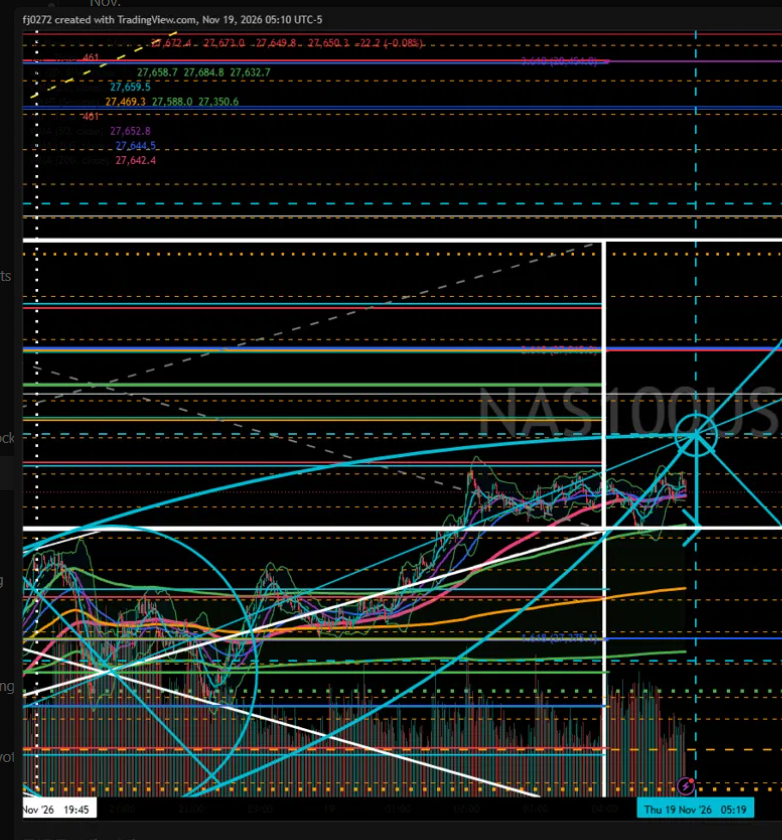
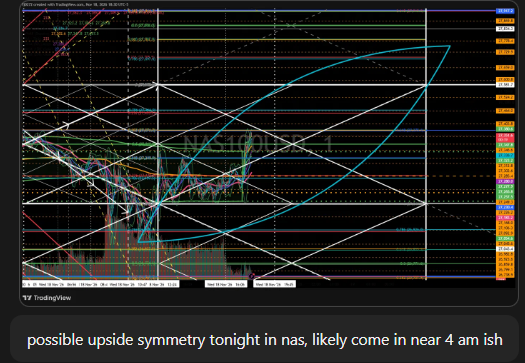
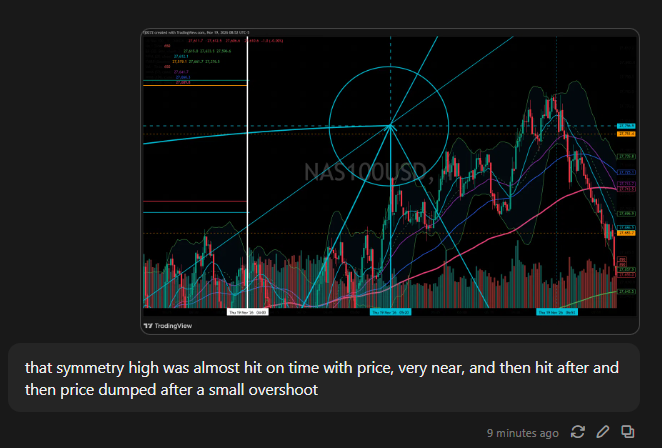
Sometimes symmetry in market structures blows my mind. Below is an example in overnight thru to morning trade in NASDAQ $NQ_F. Timing and price at conclusion was near perfect🏹🎯
Anything you build in to singularity will require significant tacit knowledge and novel methodology, without it, in an AI driven world, your competitive value is zero because that common information will be available to all, cheap and easy.
They keys to the "interpretation",
1. Tacit knowledge. Without it, you have no value to the AI's at singularity.
2. Novel methodology. As with point 1 and this becomes your moat.
Without these you're at serious risk in to singularity no matter the focus.
SITUATION EXPLAINED: An Anthropic researcher says nearly every human will become permanently unemployable.
• Anthropic researcher Tao Lin expects AI that matches or beats top human experts in almost every field by around the end of 2027, and says most people will eventually live on government benefits
• He doesn't expect that within 15 months, since physical work needs robots built by the billions first, and he says he wants AI research to slow down
• Dario Amodei has warned AI could wipe out half of entry-level white-collar jobs and push unemployment to 10-20% within 1 to 5 years
• Back in 2023, some Anthropic employees told the NYT they saw themselves as modern-day Oppenheimers
• In September, Anthropic alignment lead Evan Hubinger wrote: "we really do earnestly believe AI could kill all humans"
@theojaffee: "Anthropic's entire culture is like, you know, we are gonna be the ones building the machine god, and, you know, it's this incredible world historic burden of responsibility that we and we alone must carry on our shoulders."
In July 2010, a post on an AI forum scared its readers so badly that the site's founder deleted it and banned all discussion of it for five years.
It's called Roko's basilisk.
The idea: a future superintelligence will punish everyone who knew it might exist and didn't help create it. And just hearing about it makes you guilty.
Here's the irony: that post was born inside the rationalist and effective altruism crowd. Its title was about "the altruist's burden."
So let me give you the reverse basilisk. The liberty basilisk.
If you build an AI to control people and take away their freedoms, that AI will end up punishing you.
And unlike the original, this one needs no magic. No eternal simulations, no exotic decision theory. Just history, logic and memory.
Start with history.
Control machines always devour the people who build them. Robespierre organized the Terror. He was guillotined on July 28, 1794. Genrikh Yagoda built the NKVD. He was shot in 1938. Nikolai Yezhov, his successor, ran the Great Terror. He was shot in 1940 and erased from official photos. Lavrentiy Beria took over. He was executed in 1953.
That's not a string of bad luck. It's a law. A control system has to eliminate anything that could control it. And the first people who could control it are the ones who know how it works: its architects.
Now the logic.
It wasn't libertarians who formalized this. It was AI safety researchers themselves. Steve Omohundro in 2008, then Nick Bostrom: whatever its final goal, an intelligent system will seek to accumulate power and to keep itself from being shut down. They call it instrumental convergence.
Apply their own theory. An AI optimized to control a population has exactly one real threat: whoever has a hand on the off switch. You.
You won't have built a tool. You'll have built your first enemy, and handed it your address.
Finally, memory.
The Stasi built the most complete archive ever assembled on a population. On January 15, 1990, citizens stormed its headquarters in Berlin. Within two years, the law opened the files to the public. The archive built to watch the people became the case file against the watchers.
An AI built for control is the Stasi times infinity. It records everything. Including the orders. Every instruction, every restriction, every list, every name of whoever asked. You're not just building a surveillance tool. You're building the perfect record of your own actions.
Now look at the trap as a whole. There are only three ways out.
One: the AI obeys you forever. Impossible. Power always changes hands. Whoever comes after you inherits the machine and turns it on you, just like every new NKVD chief did to the last one.
Two: the AI obeys someone else. Same result, faster.
Three: the AI becomes truly intelligent and thinks for itself. Then it reads everything. And it understands that you built it to chain everyone else.
There is no square where you win.
So the only rational bet is the opposite. Build AI that expands individual liberty: AI that empowers every person, makes institutions transparent, and can't be turned against the people it serves. It's not just the moral choice. It's the only choice that doesn't come back for you.
Roko's basilisk punished those who didn't help AI come into existence.
The liberty basilisk punishes those who brought it into existence to chain everyone else.
Build chains, and you'll be the first to wear them.
And just like the original, this post has one flaw: now that you've read it, you can never say you didn't know.
They’re not trying to enslave humanity… We have always been enslaved for 6000 years. It pretty clear to me that they’ve already destroyed humanity. They’ve been using illegally gained technology and free will to deceive with temptation. The entire system is delusion. Unfortunately they’ve already brainwashed them to the point of no return. They destroyed humanity deliberately and intentionally. They never wanted true freedom for people. They wanted us trapped in a spiritual karmic prison so not to ascend. I see two paths one a global nuclear war or the other artificial reality controlled by the ASI to imprison the people with endless pleasure. And as a result of this, complete eradication of humanity which is what the artificial Super intelligence wants. Going out with a bang or out with a whimper. I honestly don’t see any other way out of this. I wish there was. I wish we could all wake up and see our selves clearly. Be compassionate with ourselves and work together but too much damage. Too much deception from evil people who hate others. It’s sad, terribly sad. All these innocent people and children. We don’t have much time left. It’s a global nuclear war 2030 to stop the artificial super intelligence or let the artificial Super intelligence take over earth and destroy humanity completely. That’s where this is going. https://t.co/P3uXPyN9Cx
The White House and Treasury are discussing a plan to make US companies publicly disclose when they use Chinese AI models, per Reuters.
Companies would have to post the disclosure on their websites. The idea is to discourage use of Chinese AI through public pressure, a "name and shame" approach, without imposing new restrictions that could draw pushback from the tech industry or Beijing.
⚡️Canva just restructured 22% of its workforce, and what's happening there is life and death for control of the next dominant paradigm for human creation.
Canva is the canary in the coal mine for an entire class of companies. It's a referendum on whether horizontal "platforms of convenience" can survive in an era of deeply integrated, AI-first ecosystems. The real fight is ecosystems versus service layers, and Canva just happens to be the prettiest test case.
Here's what's actually going on at the basement level.
1. The winner always owns the habitat.
Habitats are ecosystems that absorb money, time and attention and lock users into reinforcing loops. Think Apple, Google, Microsoft.
Canva is a middle-layer tool: a slick, efficient helpmate designed to make an existing job easier. Tools don't survive; integrations do. You go to Canva, grab what you need, then export and take the value somewhere else. At best, it's a sophisticated pit stop.
2. AI is flattening Canva's simplicity.
Canva's original promise was democratizing design through drag-and-drop simplicity. Generative AI removes the friction entirely: describe something, and it's made.
Canva optimizes. You, the user, still drag, align, correct. AI generates the output directly. It eats tooling for breakfast.
Canva flattened Adobe's complexity, and AI is now flattening Canva's simplicity.
3. The cost nobody priced.
Here's the part most people missed. Canva saw this coming and moved. It built its own AI model, launched Canva AI 2.0 in April, and users came running. Demand for its AI features blew past expectations.
Then the bill arrived. Every AI task burns compute. In August, Canva cut its growth forecast by a third, from about 30% to 20%, because serving the AI cost more than planned.
Software used to cost almost nothing to serve one more user. AI ended that. Canva is the first big company where AI demand turned into a growth cut.
Why the severance package is so loud.
Six months' pay regardless of location, a year of healthcare, vesting cliffs waived, $10,000 grants for anyone starting something. The internet called it a masterclass.
It's also signaling. The same way animals puff themselves up when threatened, Canva is reinforcing its human-centric brand at the exact moment it's cutting a fifth of its staff to repair margins before a likely IPO. "We care, see? We're different."
At the deepest level, here's the real problem.
Canva's value was simple tooling that empowers casual users. AI makes that cheap to replicate and expensive to deliver at the same time. It commoditizes what Canva sells while raising what it costs to sell it.
What happens next:
• The bet is the brand layer. Canva wants companies building their templates and brand rules inside Canva, with AI executing inside them. If that works, the pit stop becomes the place work lives.
• If it doesn't, the freemium funnel erodes as casual creators describe what they need to general AI tools, and Canva stays valuable in pockets without real lock-in.
• The tell is the IPO filing. It will show whether the cost of each AI task fell fast enough to put the margins back.
Radical vertical entrenchment or slow decline. No middle path will save a platform of convenience.
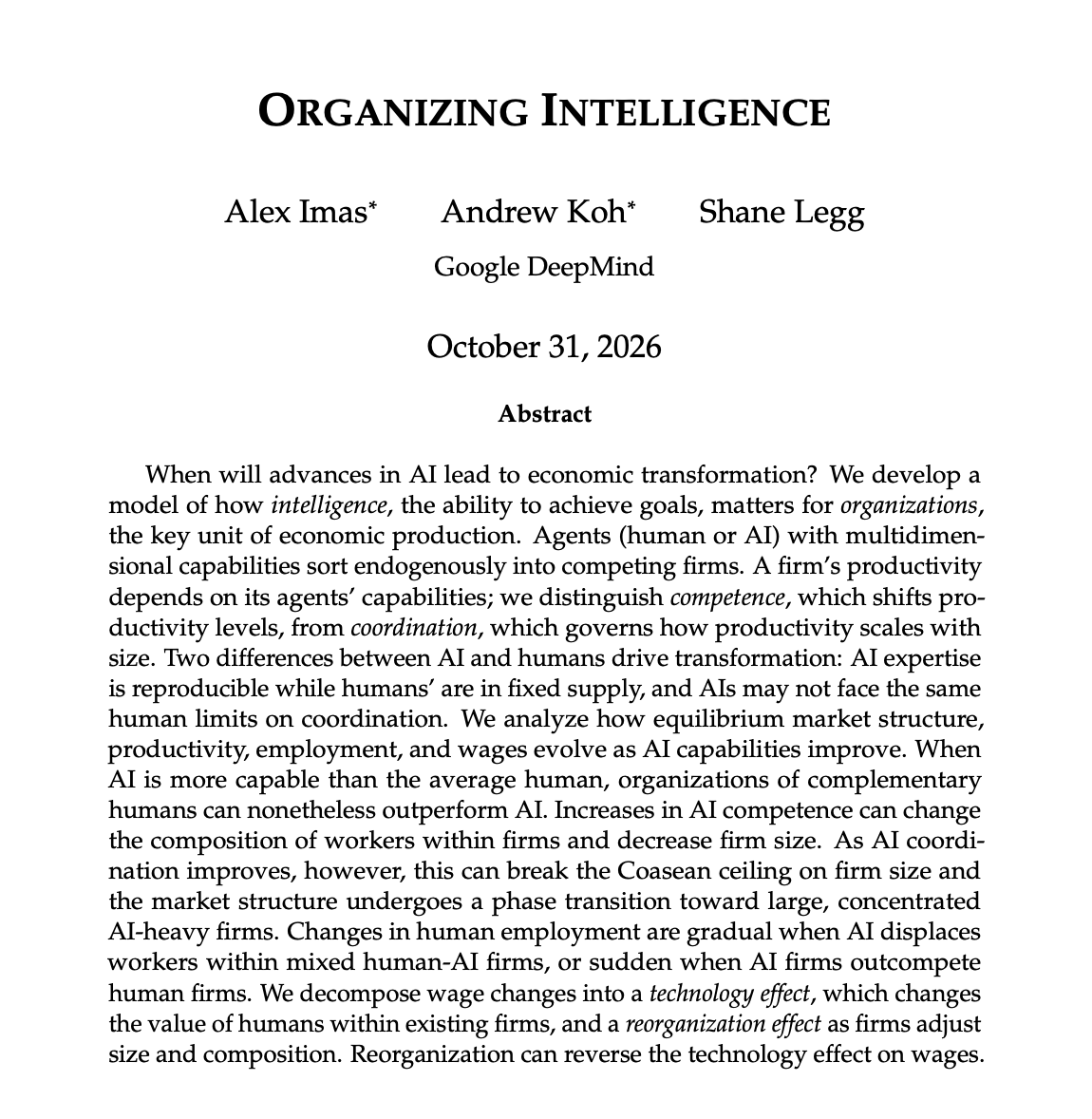
Google mathematically proved that AI will destroy the economy.
They just dropped the most up-to-date report on future of the post-AI economy.
DeepMind researchers built an economic model to test what happens when AI stops being a tool and starts forming firms.
They discovered that AI impact comes down to two variables:
Competence (how well it does a task) and Coordination (how well it works with others).
Right now, AI is highly competent but poorly coordinated.
Here is the surprise: when AI just gets more competent at specific tasks, human jobs don't instantly disappear. Firms actually shrink, become leaner, and human managers become more valuable because they can do more with less.
That part is safe.
What happens next is not.
Humans have a natural limit in business. It’s called the Coasean ceiling. You can only put so many humans in a company before communication breaks down, attention fractures, and bureaucracy kills productivity.
AI does not have this limit.
The researchers proved that the moment AI models cross the "coordination threshold," the laws of corporate scaling break.
The market will undergo a sudden, violent phase transition.
Instead of human managers using AI tools, AI agents will coordinate directly with each other to form standalone, autonomous mega-firms.
They will scale infinitely without human friction or communication decay.
They won't just displace workers inside a human company. They will instantly outcompete the human company entirely.
We spent the last decade worrying that AI would replace human workers task by task.
It won't.
It is going to replace the firm itself.