We should use our inadequacies and fears as inspiration to grow and improve, rather than feed our paranoia. If you are afraid you're not good enough, then be good enough, don't find shadows in others.
Según el minimalismo japonés, lo que guardas “por si acaso” no es aleatorio.
Es un reflejo de los miedos, apegos y versiones antiguas de ti que todavía ocupan espacio en tu vida.
1. Ropa que no usas =...
@ZachLowy Many congratulations! Been following you for a few years now and it’s great that your consistency and hard work has paid off. Long may it continue!
There's a physicist at Stanford named Safi Bahcall who modeled this exact principle and the math is wild.
He calls it "phase transitions in human networks." When you're stationary, your probability of a lucky event is limited to your existing surface area: the people you already know, the places you already go, the ideas you've already been exposed to. Your opportunity window is fixed.
When you move, your collision rate with new nodes in a network increases nonlinearly. Double your movement (new conversations, new cities, new projects) and your probability of a serendipitous encounter doesn't double. It roughly quadruples. Because each new node connects you to their entire network, not just to them.
Richard Wiseman ran a 10-year study at the University of Hertfordshire tracking self-described "lucky" and "unlucky" people. The single biggest differentiator wasn't IQ, education, or family money. Lucky people scored significantly higher on one trait: openness to experience. They talked to strangers more, varied their routines more, and said yes to invitations at nearly twice the rate.
The "unlucky" group followed the same routes, ate at the same restaurants, and talked to the same 5 people. Their networks were closed loops. No new inputs, no new collisions.
Luck isn't random. Luck is surface area. And surface area is a function of movement.
The lobster emoji is doing more work than most people realize. Lobsters grow by shedding their shell when it gets too tight. The growth requires a period of total vulnerability. No protection, no armor, soft body exposed to the ocean.
That's the cost of movement nobody posts about. You have to be uncomfortable first. The new shell only hardens after you've already moved.
Everyone needs to hear this...
Michael Caine on his defining philosophy for life:
Use the Difficulty
As a young actor, he was rehearsing a play when a chair got stuck in the door and blocked his path. He told the other actor he couldn't get by the chair to enter the scene.
The actor's response:
"Use the difficulty...if it's a comedy, fall over it, if it's a drama, pick it up and smash it."
This idea became a defining mantra for his life.
"There's never anything so bad that you cannot use that difficulty...if you can use it a quarter of one percent to your advantage, you're ahead, you didn't let it get you down."
I can't stop thinking about this...
How can you use the difficulty you're currently facing? How can you embrace the struggle? How can you find flow through the friction?
As with everything in life, control the controllable:
The difficulty is already there. You can't control it. But you can control how you react to it. You can control your response to it. You can control your attitude towards it.
Lesson: Difficulty is inevitable. Use it.
The full playbook:
Ask specific questions, not generic ones
Fix feedback fast and tell them you did it Find pain threads, don't just create your own
Build free first, monetize when users ask you to Stay present in every comment thread you start $20k/month.
Zero sales pitches.
Just a relentless feedback loop.
you've probably heard of "vibe marketing" but you think it's just a buzz word
i get it but in 58 mins, you'll learn how to use AI agents to go from 0 to market research, landing pages, lead magnets, video ads, seo pages and more all inside claude code using skills/MCPs
this is hands-down the best way to work with Claude right now...
whenever you start a new project (startup, content, side hustle, anything...)
open a fresh chat with Opus 4.5, turn on extended thinking and dump everything about your project
then prompt this:
"ask me 5 questions that would help you have a complete understanding of this project"
answer those questions (spend a lot of time here)
then hit it with:
"you're my co-founder. create a master plan with a knowledge base directory for each section. attach context markdown files to every part. you're building the skeleton that Claude Code will use to build everything 10x faster. suggest skills to integrate, automations to build or any tool that'd 10x our speed. suggest when to use a project or Claude Code"
Claude will create every file you need, simply import them into Claude Code
from there you build systems and your project alongside it, use it like a Claude chat
it'll tell you when to spin up Claude Projects for specific tasks: deep research, writing, working with MCPs...
one planning session replaces weeks of figuring things out on your own
this is what working WITH AI looks like
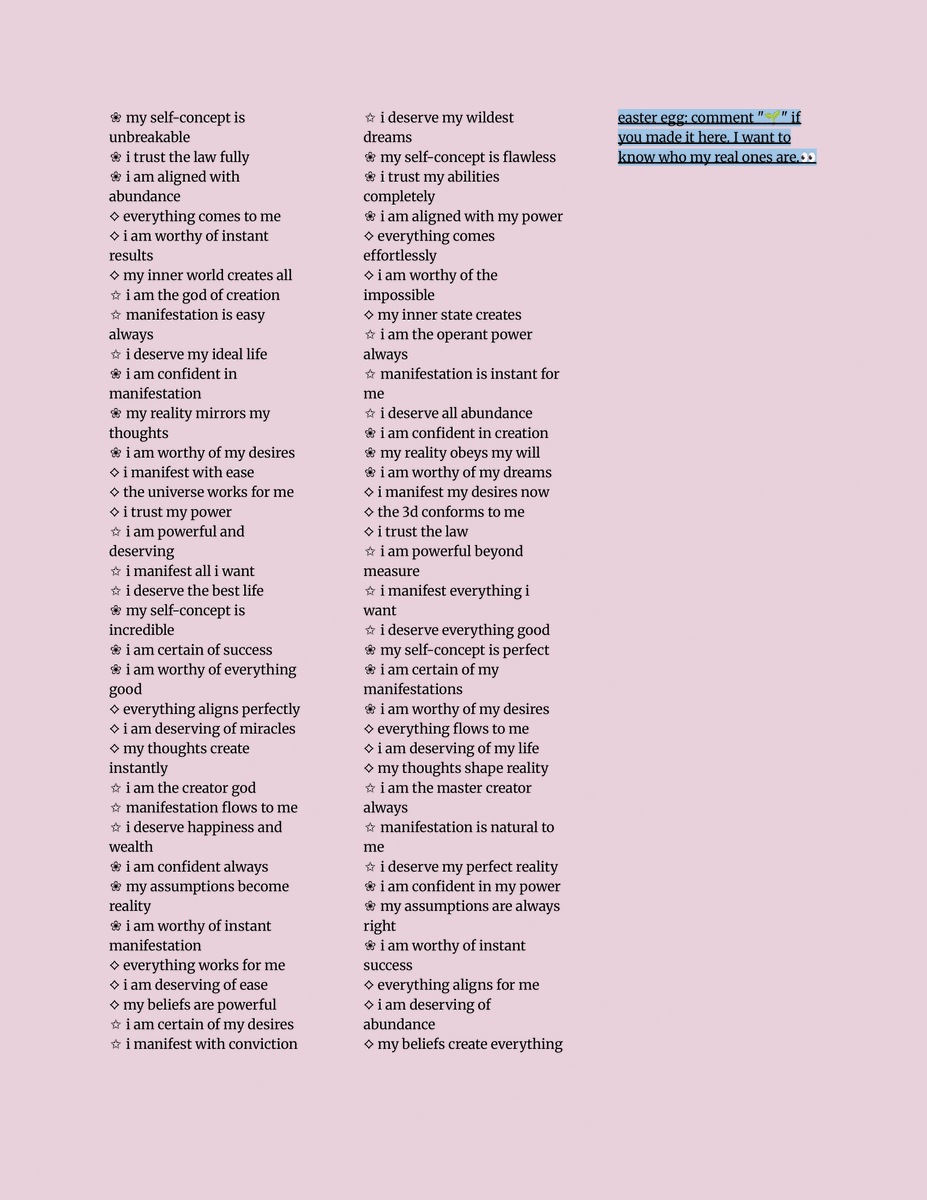
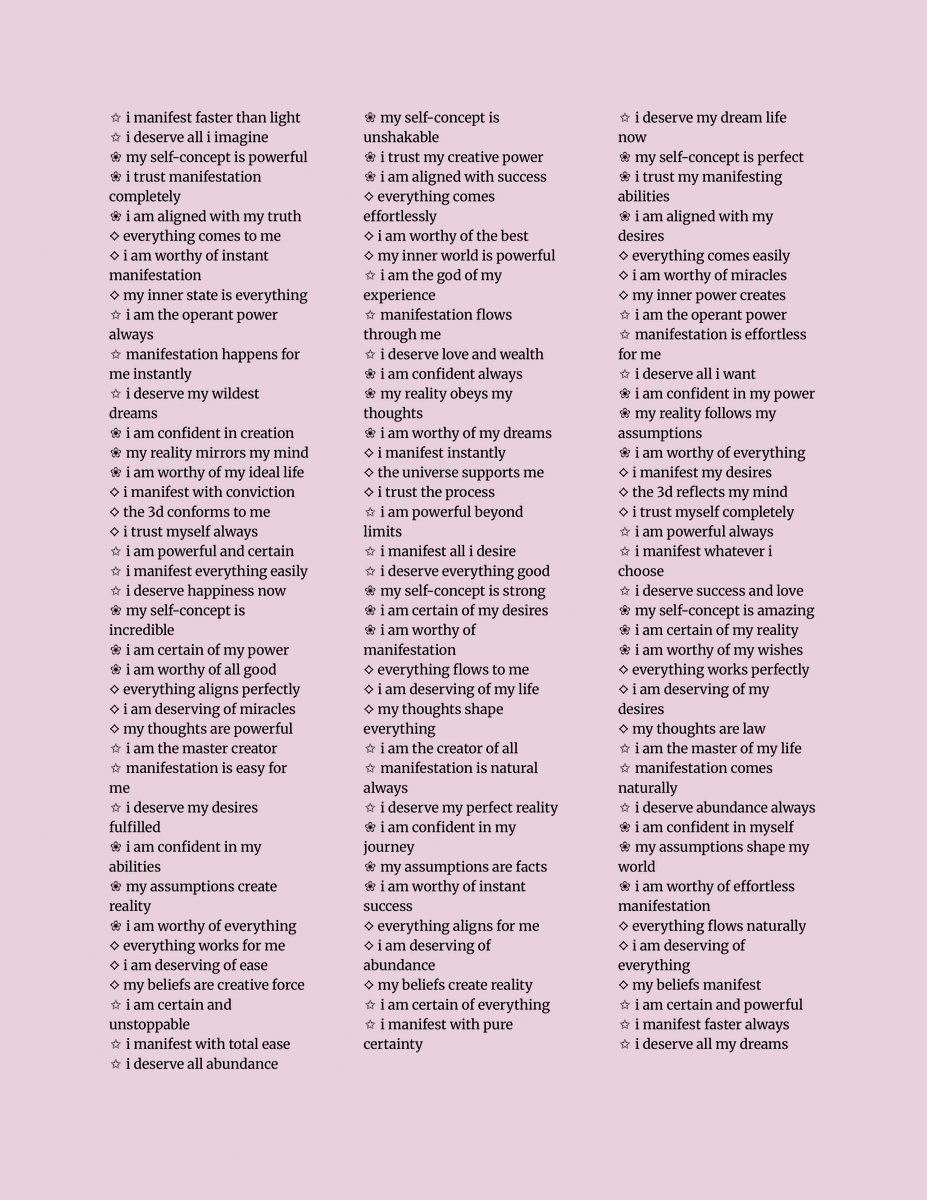
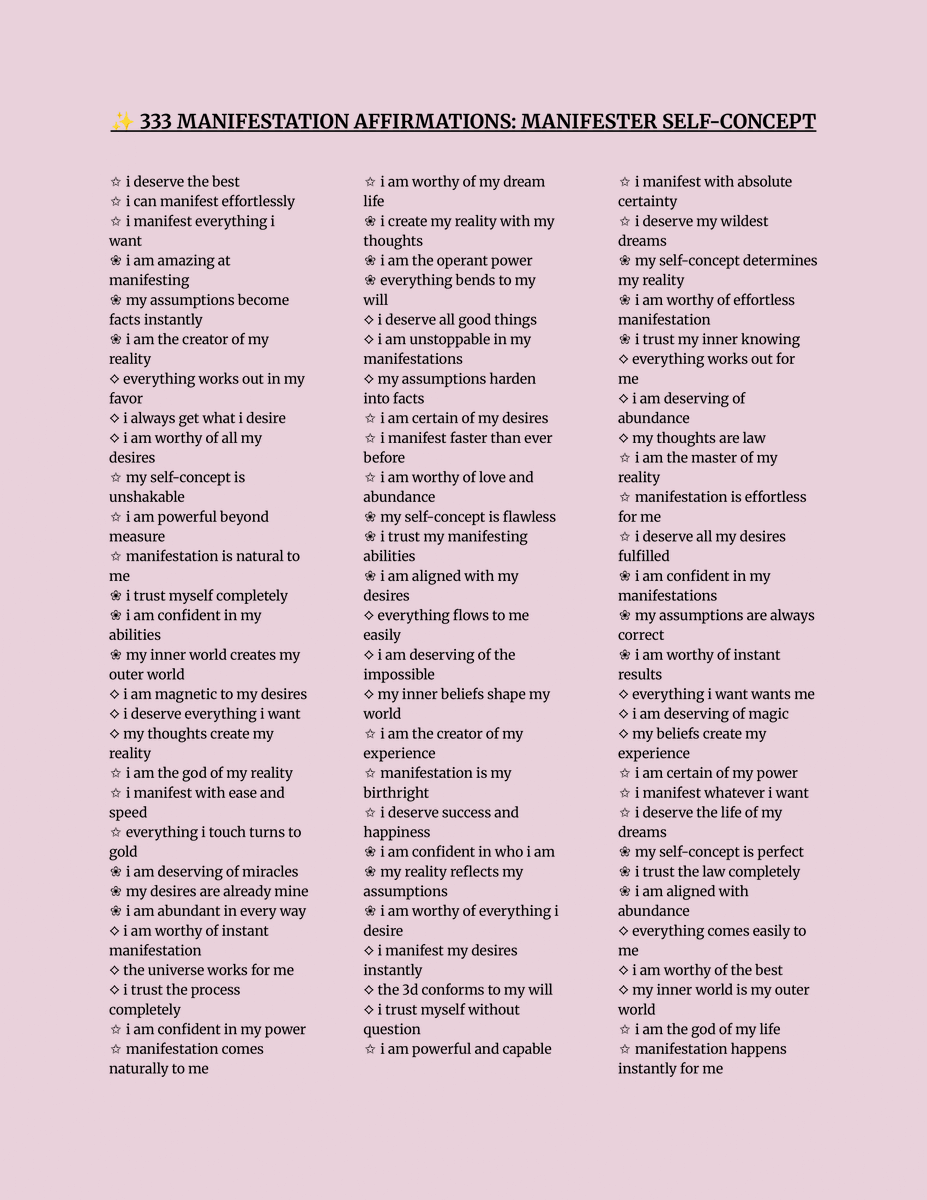
✨ i wrote 333 affirmations to turn you into someone who manifests effortlessly.
yes, three hundred and thirty-three. i know. this is the resource. 🪞
bookmark this immediately. you'll thank yourself later. 🫶
Live the Pareto Principle lifestyle:
Relationships. Who are the few people that have the most positive impact on my life? Spend more time with them.
Priorities. What are the few actions that have the most positive impact on my day? Prioritize them.
Learning. What are the few information sources I learn the most from? Focus on them.
Stress. What are the few sources that cause most of the stress and friction in my life? Eliminate them.
I read a quote that said
"The faster that you do the hard things you want to avoid, the faster you will receive the good things you actually want"
and that has changed my whole perspective.





![egeberkina's tweet photo. Avatar edition
{
"task": "image_style_transfer_3d_character",
"input": {
"source_image": "USER_UPLOADED_IMAGE",
"preserve_identity": true,
"preserve_pose": true,
"preserve_composition": true
},
"style_reference": {
"render_style": "stylized_3d_character",
"aesthetic": "soft_minimal_cartoon_3d",
"inspiration": [
"pixar_like_but_more_minimal",
"toy_figure_render",
"clean_product_character_design"
]
},
"character_design": {
"skin": {
"material": "smooth_matte_plastic",
"texture": "soft_uniform",
"subsurface_scattering": "gentle"
},
"facial_features": {
"eyes": "half_closed_bored_expression",
"eyelids": "heavy",
"nose": "rounded_simplified",
"mouth": "flat_neutral",
"ears": "simplified_rounded"
},
"emotion": "unimpressed_calm_bored"
},
"clothing": {
"style": "minimal_streetwear",
"details": "no_logos_no_patterns",
"fabric": "soft_matte"
},
"accessories": {
"headwear": "simple_baseball_cap_optional",
"ear_accessories": "wireless_earbuds_optional"
},
"lighting": {
"setup": "studio_softbox",
"shadows": "very_soft",
"contrast": "low",
"highlights": "subtle"
},
"background": {
"type": "solid_color",
"color_palette": [
"muted_green",
"pastel_tone"
],
"gradient": "none"
},
"camera": {
"angle": "front_facing",
"framing": "medium_close_up",
"lens": "50mm_equivalent",
"distortion": "none"
},
"render_quality": {
"resolution": "high",
"edges": "clean",
"noise": "none",
"realism_balance": "stylized_over_realistic"
},
"output": {
"consistency": "high",
"style_strength": "strong",
"photorealism": false
}
}](https://pbs.twimg.com/media/HAVxeSMbIAAPzmx.jpg)
![egeberkina's tweet photo. Avatar edition
{
"task": "image_style_transfer_3d_character",
"input": {
"source_image": "USER_UPLOADED_IMAGE",
"preserve_identity": true,
"preserve_pose": true,
"preserve_composition": true
},
"style_reference": {
"render_style": "stylized_3d_character",
"aesthetic": "soft_minimal_cartoon_3d",
"inspiration": [
"pixar_like_but_more_minimal",
"toy_figure_render",
"clean_product_character_design"
]
},
"character_design": {
"skin": {
"material": "smooth_matte_plastic",
"texture": "soft_uniform",
"subsurface_scattering": "gentle"
},
"facial_features": {
"eyes": "half_closed_bored_expression",
"eyelids": "heavy",
"nose": "rounded_simplified",
"mouth": "flat_neutral",
"ears": "simplified_rounded"
},
"emotion": "unimpressed_calm_bored"
},
"clothing": {
"style": "minimal_streetwear",
"details": "no_logos_no_patterns",
"fabric": "soft_matte"
},
"accessories": {
"headwear": "simple_baseball_cap_optional",
"ear_accessories": "wireless_earbuds_optional"
},
"lighting": {
"setup": "studio_softbox",
"shadows": "very_soft",
"contrast": "low",
"highlights": "subtle"
},
"background": {
"type": "solid_color",
"color_palette": [
"muted_green",
"pastel_tone"
],
"gradient": "none"
},
"camera": {
"angle": "front_facing",
"framing": "medium_close_up",
"lens": "50mm_equivalent",
"distortion": "none"
},
"render_quality": {
"resolution": "high",
"edges": "clean",
"noise": "none",
"realism_balance": "stylized_over_realistic"
},
"output": {
"consistency": "high",
"style_strength": "strong",
"photorealism": false
}
}](https://pbs.twimg.com/media/HAVxd4ob0AA97WL.jpg)
![egeberkina's tweet photo. Avatar edition
{
"task": "image_style_transfer_3d_character",
"input": {
"source_image": "USER_UPLOADED_IMAGE",
"preserve_identity": true,
"preserve_pose": true,
"preserve_composition": true
},
"style_reference": {
"render_style": "stylized_3d_character",
"aesthetic": "soft_minimal_cartoon_3d",
"inspiration": [
"pixar_like_but_more_minimal",
"toy_figure_render",
"clean_product_character_design"
]
},
"character_design": {
"skin": {
"material": "smooth_matte_plastic",
"texture": "soft_uniform",
"subsurface_scattering": "gentle"
},
"facial_features": {
"eyes": "half_closed_bored_expression",
"eyelids": "heavy",
"nose": "rounded_simplified",
"mouth": "flat_neutral",
"ears": "simplified_rounded"
},
"emotion": "unimpressed_calm_bored"
},
"clothing": {
"style": "minimal_streetwear",
"details": "no_logos_no_patterns",
"fabric": "soft_matte"
},
"accessories": {
"headwear": "simple_baseball_cap_optional",
"ear_accessories": "wireless_earbuds_optional"
},
"lighting": {
"setup": "studio_softbox",
"shadows": "very_soft",
"contrast": "low",
"highlights": "subtle"
},
"background": {
"type": "solid_color",
"color_palette": [
"muted_green",
"pastel_tone"
],
"gradient": "none"
},
"camera": {
"angle": "front_facing",
"framing": "medium_close_up",
"lens": "50mm_equivalent",
"distortion": "none"
},
"render_quality": {
"resolution": "high",
"edges": "clean",
"noise": "none",
"realism_balance": "stylized_over_realistic"
},
"output": {
"consistency": "high",
"style_strength": "strong",
"photorealism": false
}
}](https://pbs.twimg.com/media/HAVxdPma4AAN6je.jpg)








![egeberkina's tweet photo. Avatar edition
{
"task": "image_style_transfer_3d_character",
"input": {
"source_image": "USER_UPLOADED_IMAGE",
"preserve_identity": true,
"preserve_pose": true,
"preserve_composition": true
},
"style_reference": {
"render_style": "stylized_3d_character",
"aesthetic": "soft_minimal_cartoon_3d",
"inspiration": [
"pixar_like_but_more_minimal",
"toy_figure_render",
"clean_product_character_design"
]
},
"character_design": {
"skin": {
"material": "smooth_matte_plastic",
"texture": "soft_uniform",
"subsurface_scattering": "gentle"
},
"facial_features": {
"eyes": "half_closed_bored_expression",
"eyelids": "heavy",
"nose": "rounded_simplified",
"mouth": "flat_neutral",
"ears": "simplified_rounded"
},
"emotion": "unimpressed_calm_bored"
},
"clothing": {
"style": "minimal_streetwear",
"details": "no_logos_no_patterns",
"fabric": "soft_matte"
},
"accessories": {
"headwear": "simple_baseball_cap_optional",
"ear_accessories": "wireless_earbuds_optional"
},
"lighting": {
"setup": "studio_softbox",
"shadows": "very_soft",
"contrast": "low",
"highlights": "subtle"
},
"background": {
"type": "solid_color",
"color_palette": [
"muted_green",
"pastel_tone"
],
"gradient": "none"
},
"camera": {
"angle": "front_facing",
"framing": "medium_close_up",
"lens": "50mm_equivalent",
"distortion": "none"
},
"render_quality": {
"resolution": "high",
"edges": "clean",
"noise": "none",
"realism_balance": "stylized_over_realistic"
},
"output": {
"consistency": "high",
"style_strength": "strong",
"photorealism": false
}
}](https://pbs.twimg.com/media/HAVxeuEaIAALPi5.jpg)