Hierarchical Multi-Agent AI System with Escalating Skepticism for Automated
Information Filtering and CxO-Level Human Escalation in Executive Decision Support
It’s for sale you know. You get: the patent, registered trademark, 2 socials (X & LinkedIn) , and a triple suite of web domains.
I need $80 million for another project.
Act fast ! As development progresses the price will increase.
What is your best offer?
“Disturbance detected. CxOSwarm’s hierarchical agents just escalated a critical market signal with layered skepticism—filtering noise so your C-suite acts with precision.
Intelligence you can trust at every layer. Ready when you are.
#CxOSwarm#ExecutiveAI”
CxOSwarm ramps up automatically to ensure that your C-suite personal make informed and nearly flawless decisions. As a team. CxOSwarm then quietly monitors for the next “ disturbance in the force”. Air gapped security meets the all knowing arbiter, all for you at one great price.
I got to spend all day today with Jensen in Taiwan: talking with thousands of engineers and eating street food at a night market. Jensen is received as a rockstar in Taiwan, like it's Beatles in the 60's. It's mind-blowing and fun to watch. But most importantly, through all the interactions and all my conversations with him, he remained the same humble, kind, thoughtful, funny guy he always was, even as a kid who went to these same night markets many years ago.
Btw, we tried a crazy amount of different street food. It's legit some of the most delicious food I've ever had. I can't wait to share video of it, including a ton of our conversations and hangout. When I can pause for a moment from all the travel to edit the video, I'll post it.
Can't wait to continue talking to Jensen and engineers at Computex this week, and exploring more of Taiwan, and of course roaming the night markets for some more delicious street food.
Days like these, even more than usual, I feel like the luckiest kid in the world.
Love you all! ❤️
Everyone is ragging on Jared for this, but he’s absolutely right
AI agents *are* incredibly productive with prod db access.
If you’re a vibe coder with no idea how a database works, this is obviously insane. But if you’re a professional software engineer and systems thinker like Jared, you’ve already set up guardrails and best practices so your agent doesn’t do anything bad.
eg you probably have backups, you’ve set up docs/an md file to define prohibited actions, you probably use an ORM defined in code… and if an incident happens, you do a post mortem and figure out how to improve your system
This is all stuff we’ve been doing for decades. And Claude is much smarter than the average new dev!
@glennbeck@pmarca@kevinolearytv Ask me about my 90 story tall one quarter of a city block square data center that makes its own electricity by air cooling itself. It’s also 5 stories of underground parking and ground level shops and restaurants 😀 It’s ok ask me.
.@kevinolearytv is right that China is trying to convince America to stop building AI data centers while building tons of its own. That's China's plan to win the AI race and control the next century.
But that DOES NOT mean data centers should just drain public power. I'm dead set against any data center that has a SINGLE line feeding them power from the grid. But some are generating their own power and giving the excess TO the grid. Those are two very different scenarios.
Thankfully, Kevin O'Leary has said his data center project in Utah will generate its own power. THIS IS A MUST.
Just like railroads, factories, oil, and electricity powered previous generations, the future will run on AI computing, powered by massive amounts of energy. We need both to stop China from dominating the world. China knows this and is trying to turn data centers into a boogeyman.
There’s evidence out now from the Bitcoin Policy Institute that foreign influence networks are actively feeding this anti-data center movement in the United States. They traced several overlapping campaigns, all aimed at slowing American AI infrastructure down, directly to China.
Strong countries build infrastructure. Weak countries fear it. We can't fall for their trap. But we must also build strategically without sacrificing public resources.
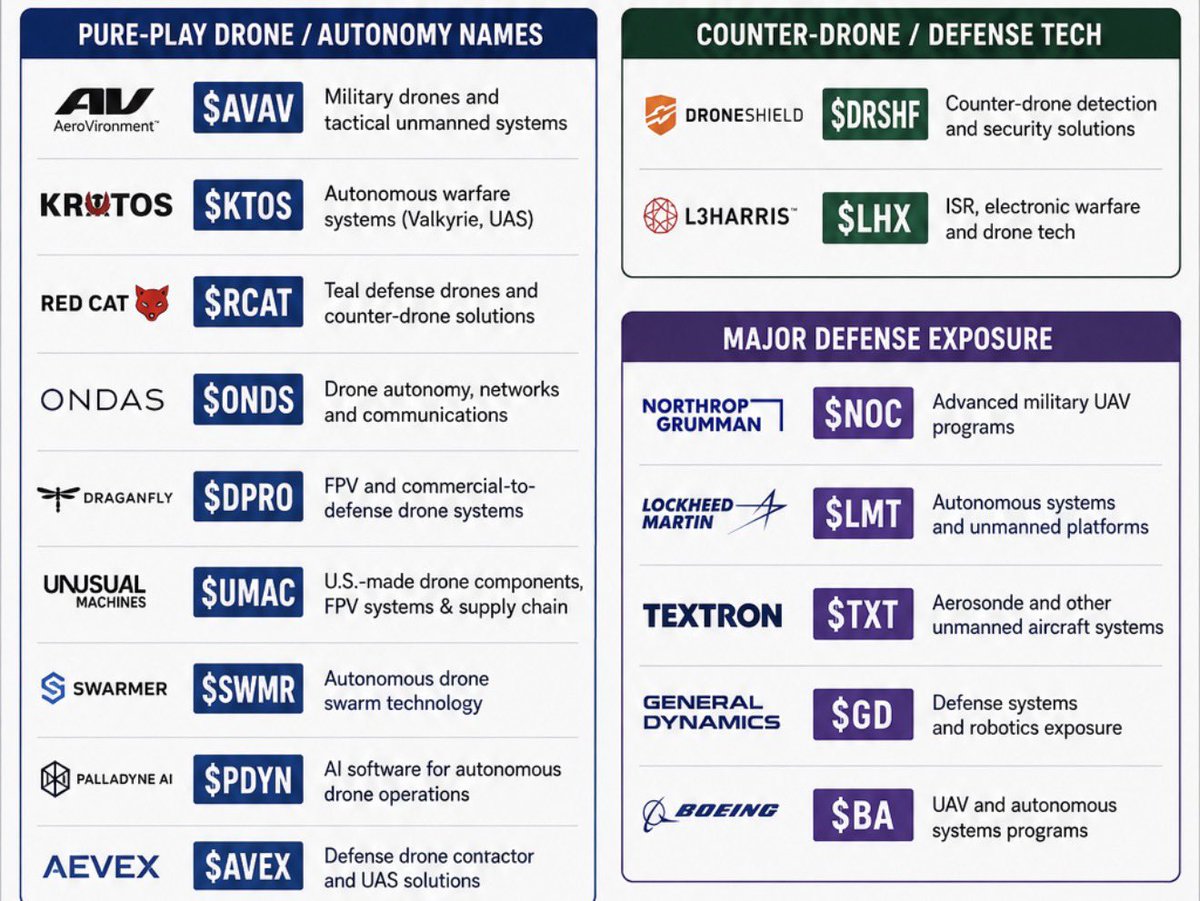
The U.S. government is literally telling you where money is going next:
DRONES.
IF you missed out on the other Trump picks like $INTC and $DELL this your chance.
Trump is pursuing funding deals to boost domestic drone production.
Pure-Play Drone / Autonomy Names
$AVAV - military drones
$KTOS - autonomous warfare systems
$RCAT - Teal defense drones
$ONDS - drone autonomy + networks
$DPRO - FPV drone systems
$UMAC - U.S. drone supply chain
$SWMR - drone swarm technology
$PDYN - AI drone software
$AVEX - defense drone contractor
Counter-Drone / Defense Tech
$DRSHF - anti-drone defense
$LHX - ISR + drone warfare systems
Major Defense Exposure
$NOC - military UAV programs
$LMT - autonomous defense systems
$TXT - unmanned aircraft systems
$GD - defense systems exposure
$BA - UAV + aerospace programs
@salonium@paulg@Kat_a_Collins And a bottle of tonic water clears blood borne parasites for $1.39. The Brits still drink Gin N Tonics but in reality it’s a “cure” for malaria. Fun fact, the gin was to make the tonic (quinine) tolerable to the taste buds 😁
Guys, how do you invent a vaccine? Or wilder, how do you invent a vaccine during your PhD?!
In a new episode of Hard Drugs, we talked to someone who did just that: @Kat_a_Collins!
A single malaria parasite that reaches your liver is enough to cause an infection. Worse, malaria has a complicated lifecycle with multiple stages, during which it changes shape and switches its surface proteins. And it’s co-evolved with humans for thousands of years, learning to evade and misdirect our immune system.
That’s why it’s been so much harder to develop vaccines against than viruses or bacteria. But not impossible!
In this episode, @JacobTref and I are joined by Katharine Collins, who co-invented the second malaria vaccine, R21, during her PhD at the Jenner Institute in Oxford!
After reading the expired patent of the first malaria vaccine (RTS,S), she stripped out the excess Hepatitis B surface antigen that RTS,S, leaving a particle with a much higher proportion of malaria antigen, used many newer processes, and paired it with a cheaper, more scalable adjuvant.
The result is a vaccine that’s around a third of the price, easier to manufacture at scale, and may be more durable as well.
It also means a vaccine that can reach far more children and save far more lives. Efficiency and scale matter enormously in the real world.
It’s probably our coolest episode ever. You will learn lots of secret, behind the scenes information about how innovation really works.
We chat about all this and much more!
Timestamps:
00:00 Introduction
05:08 Our favourite parasites
10:12 How to invent a vaccine during your PhD
34:18 Why is it called the R21 vaccine?
37:32 Moving from the bench to hundreds of millions of doses
41:43 The vicious life cycle of malaria parasites
46:15 Malaria research IN MICE
53:03 The murderer in malaria research
55:51 Would you volunteer to get infected by malaria?
1:08:21 Why did the first malaria vaccine take so long?
1:18:26 Could we have had the vaccine sooner?
1:40:48 Vaccine versus vaccine: which one’s better?
1:46:53 If we did this again today, could we make better vaccines?
2:04:55 Conclusion and our reasons for pessimism and optimism
Building a Hierarchical Multi-Agent AI Swarm: Leader agents filter noise, sub-agents validate sources, and CxO-level escalation delivers only high-signal intel.Enterprise decision support, reimagined.Who’s running agentic AI in their org? DM for collab. #EnterpriseAI
Leader agents filter noise, sub-agents validate sources, and CxO-level escalation ensures only high-signal intel reaches executives.Enterprise decision support, reimagined.Who’s tackling agentic AI in their org? DM for collab.#AgenticAI#MultiAgentSystems#HierarchicalAI#CxO