

Top Tweets for #MultiAgentSystems

#WeDontChatWeOrchestrate#AgentScope #TravelAI #MultiAgentSystems #GenerativeUI #AIEngineering #EnterpriseAI #FastAPI #React #Automation #TravelTech #BuildInPublic #FromKolkataToChicago

How agents can be used to divide and conquer IC design problems. https://t.co/H4F9oJv8Km
#semiEDA #AgenticAI #semiconductor
#multiagentsystems @AlphaDesignAI #LLMs
#agentorchestration #chipdesign

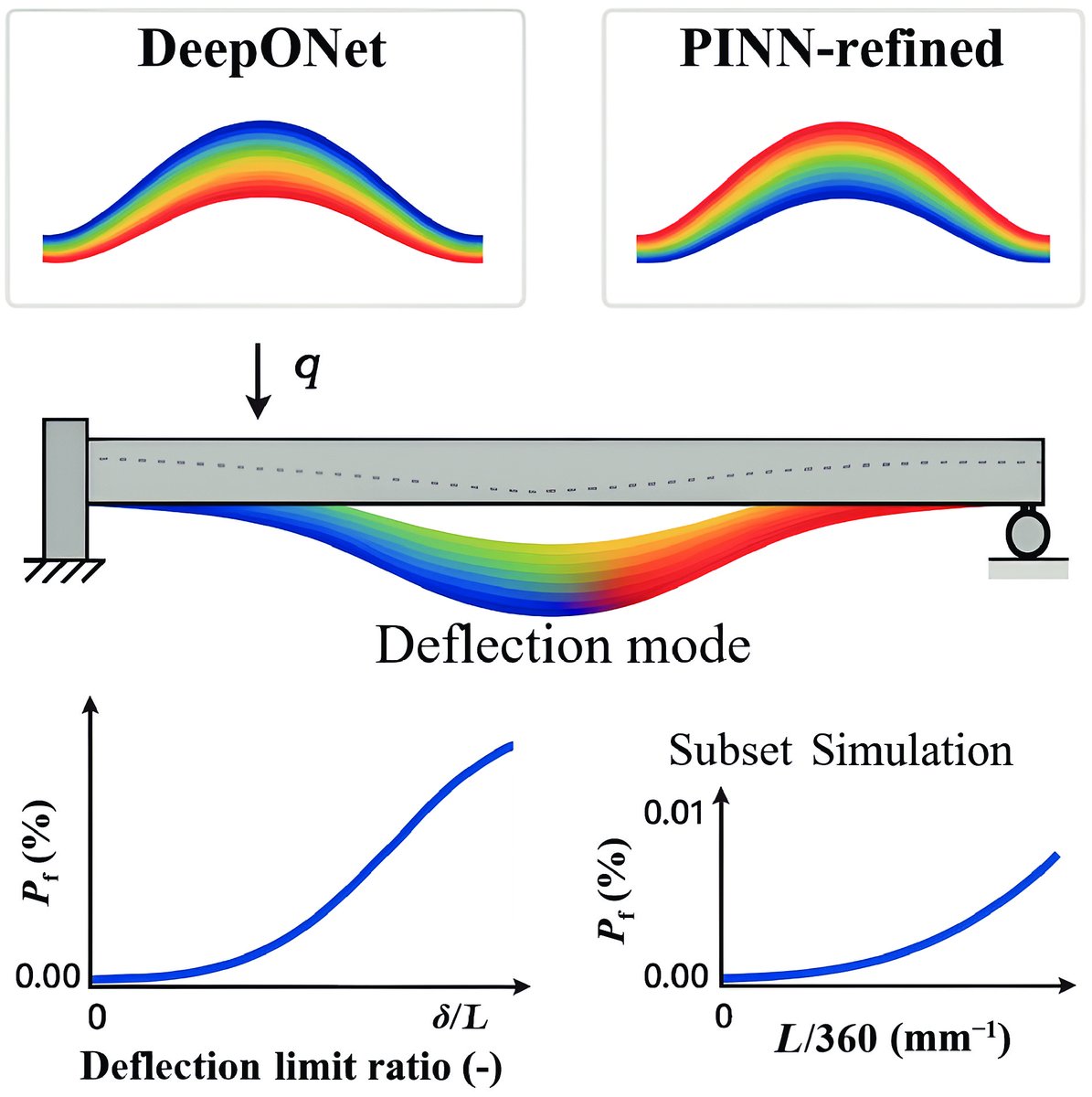
🏗 Fixing construction delays with AI agents
A multi-agent system using LLMs (Phi-4-14B) automates ERP workflows. Case studies show up to 88% fewer errors and 71% faster lead times.
🔗 https://t.co/fDbaXdI635
#AI #MultiAgentSystems #ConstructionTech #ERP #Automation #SciOpen @TsinghuaUnivers

Everyone is building multi-agent AI systems.
Nobody agrees on how to describe them.
Think about it:
You pick an SDK: LangChain, CrewAI, AutoGen.
Suddenly you're neck-deep in decorators, typed state, YAML configs, 50+ classes.
Your PM can't read the workflow.
Your agents are locked to one provider.
Your "orchestration logic" is buried in boilerplate.
We have a dozen competing SDKs.
We don't have a common language.
SQL didn't replace Java.
It created a new category: declarative data queries.
Anyone could read them. Any database could run them.
What if we had the same thing for AI agents?
That's why I built SLANG.
Super Language for Agent Negotiation & Governance.
3 primitives. That's it:
stake → produce content, send it to an agent
await → wait until another agent sends you data
commit → accept the result, stop
Every multi-agent pattern ( pipelines, review loops, escalations ) is a combination of these three words.
What makes SLANG different from yet another framework:
→ The LLM is the runtime. Paste a .slang file into ChatGPT, Claude, or Gemini. It runs. No install. No API key. No config. No SDK can do this.
→ Portable across models. Same .slang file runs on GPT-4o, Claude, Llama, or 300+ models via OpenRouter. Different agents can use different providers in the same flow.
→ LLMs generate it natively. Like text-to-SQL, you describe a workflow in plain English and the model writes the .slang file. The syntax is simple enough that it picks it up in seconds.
→ Not Turing-complete — by design. It describes what agents do, not how. When you need full control, you drop to an SDK. Same way you drop from SQL to application code.
This is early and open source (MIT).
The spec is defined, the parser works, the MCP server is built.
But a language doesn't become useful alone.
It becomes useful when people use it, stress-test it, and shape it.
I'm looking for:
→ People building multi-agent systems who are frustrated with current tooling
→ Language design nerds who want to debate the spec
→ Anyone willing to try writing a real workflow in SLANG and tell me what breaks
If you've ever thought "there should be a standard way to describe what these agents are doing", this is the project.
https://t.co/oObSox8bij
#AI #AgenticAI #MultiAgentSystems #LLM #OpenSource #AIEngineering #DeveloperTools #LangChain #CrewAI #AIAgents #BuildInPublic

Metcalfe’s Law excels at scaling value in communication networks of reliable bits—but not in cognitive networks of stochastic agents.
In multi-agent AI, more connections often amplify entropy, hallucinations, and context poisoning rather than converge on shared truth. Reliability decays hyperexponentially in interconnected meshes, turning potential collaboration into noise amplification.
Sharing my new preprint: The Validator’s Paradox: The Impossibility of Standardizing the "Internet of Cognition" without AGI
https://t.co/Wn0LPHTWIl
Key points:
* Current agents at below 63% base accuracy (from benchmarks like MultiChallenge, SWE-Bench Pro) operate at "Zero Nines."
Simulation shows system reliability cliff: slight gains at N=2, crash at N=3, near-zero by N=5+ in poisoned meshes (see Figure 1 decay plot).
* Validator’s Paradox: Deterministic or stochastic verifiers can't measure pseudo-intelligent outputs without limiting utility or creating infinite regress.
* Semantic handshakes? Category error—probabilistic tokens lack grounded "Self" for meaningful promises.
* Path forward: Intrinsic grounding (physics/reality testing, NARS logic cores, HDC vectors) over inter-agent protocols.
#AGI #MultiAgentSystems #AI #Hallucinations #NeuroSymbolicAI #AgenticAI
What do you think about this @grok ? Just another nattering nabob of negativism? Estimated time to shadow ban: 60 seconds (breaking my prior record of 136.2s).

@swarms_corp To get started👾
Head to the Swarms Marketplace at https://t.co/ohTJ2vMlwr
Browse, discover, buy, sell, and launch agents, prompts, and tools.
Monetize your creations or deploy agent via API, Python, or Rust integrations.
#SwarmsAI #MultiAgentSystems #AIAgents

Expressed my opinions on Moltbook,
Have a read: https://t.co/vjsxBv7BaD
#AI #MultiAgentSystems #FutureOfTech #Moltbook

OmniStudio: The Visual Agent Builder for OmniCoreAgent
We're building a new way to design complex agent hierarchies.
Visual Canvas: Map out DeepAgent and Sub-Agent relationships.
Config at scale: 8+ dimension configuration for every node.
Zero to Python: Generate production-ready code from your visual flow.
Stay tuned. The timeline is shifting. https://t.co/wsc1xLNYyc #MultiAgentSystems #BuildInPublic #OmniStudio

Hey folks
I recently read about an experiment on Multi Agent Reinforcement Learning that shows how AI can evolve unexpectedly.
It involves agents playing Hide and Seek in a physics based environment.
The core idea here is distinct from standard programming. Instead of hard coding specific strategies or rules on how to hide or seek the developers used a reinforcement learning approach.
In very simple terms reinforcement learning is learning by trial and error. The AI agents try random actions, and they get a digital reward if they win and nothing if they lose. Over time they figure out what actions lead to the reward.
The agents played millions of rounds against each other. What happened next showed how AI can evolve through competition.
1. Basic Coordination At the start, the agents behaved randomly. Eventually, the Seekers learned to chase, and Hiders learned to run away. This was the expected baseline behavior.
2. Fort Building The environment had movable boxes and walls. The Hiders realized that if they moved boxes to block the doorways, the Seekers could not get in. They learned to cooperate and build a shelter to win consistently.
3. Ramp Exploits Once the Hiders started locking the doors, the Seekers had to adapt. They found ramps in the map. The Seekers learned to push these ramps against the walls and use them to jump over the Hiders' barriers.
4. Defense Optimization To stop the Seekers from using ramps, the Hiders changed their strategy again. They started their round by running to the ramps and locking them in place away from the walls so the Seekers could not use them.
Why this matters?
This is a clear example of emergent behavior. The developers did not program the agents to use ramps or build forts. The agents discovered these physics exploits on their own to maximize their reward. It shows that simple competitive environments can force AI to invent complex strategies.
#ArtificialIntelligence #MachineLearning #ReinforcementLearning #MultiAgentSystems #EmergentBehavior #OpenAI


The necessity for a multi-agent system is determined by a single, critical question: Is the problem unsolvable by an individual agent? Kite Ai was founded to address this specific class of complex challenges.
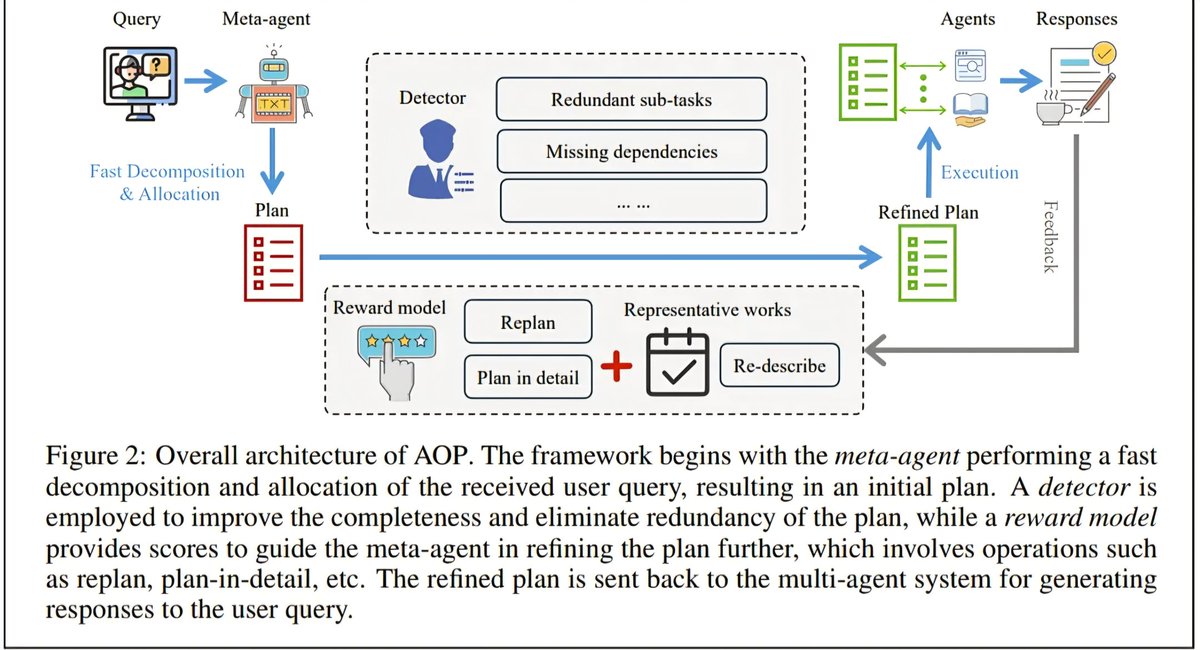
Successful multi-agent execution requires that the decomposed plan is complete, with no aspect of the user's query overlooked; non-redundant, ensuring maximal efficiency; and composed of independently solvable tasks assigned to individual agents.
🔗 https://t.co/57MJGjvikG
@GoKiteAI
@Kite_Frens_Eco
#MultiAgentSystems #AI #Solvability #Tech

Gm fam ☀️
ROMA is easily one of the most powerful and underrated, parts of the @SentientAGI stack. Turning multi-agent systems into something transparent, modular, and fully traceable changes everything for builders.
Step-by-step reasoning, easy debugging, agent swapping, and natural parallelization… this is exactly how open AGI infrastructure should work.
Real builders ship with clarity, not black boxes.
#SentientAGI #ROMA #OpenAGI #AIInfrastructure #MultiAgentSystems #AIEngineering #ContextEngineering #AIFuture #Web3AI


Gm @SentientAGI family
ROMA makes building high-performance multi-agent systems straightforward. With structured Pydantic inputs and outputs, the flow of context is transparent and fully traceable. Builders can see exactly how reasoning unfolds, enabling easy debugging, prompt refinement, and agent swapping. This transparency enables fast iteration in context engineering, unlike black-box systems. Furthermore, ROMA’s modular design means you can plug in any agent, tool, or model at the node level, from specialized LLM-based agents to human-in-the-loop checkpoints. Furthermore, the tree-based structure naturally encourages parallelization, delivering both flexibility and high performance for large, demanding problems.


The coolest part?
Agents can collaborate.
Protocols like A2A (Agent-to-Agent) let them talk to each other.
Imagine a Project Manager agent delegating to research, marketing, and dev agents — just like a real team. 👩💻👨💻
#MultiAgentSystems

Made multiple AI models vote on “Who’s the GOAT?” and “Who’s the better U.S. president?”
Let’s just say consensus… wasn’t achieved. 😅
Multi-AI chat. Multi opinions.
#AI #MultiAgentSystems #BuildInPublic #ChatGPT #Claude

Why do 10 agents working together often perform WORSE than 2 agents working in parallel? The counterintuitive truth about multi-agent systems will change how you think about distributed intelligence.
Why Parallel Execution is the Secret Sauce of Multi-Agent Efficiency:
<> PART 1: THE PARADOX OF MORE AGENTS:
When we build multi-agent systems, we intuitively think "more agents = more power." But here's the shocking reality: most multi-agent systems suffer from what I call the "Agent Traffic Jam" phenomenon.
Imagine 10 delivery agents in a city. If they all follow the same central instructions and communicate through a single dispatcher, you'll see:
i.) Communication bottlenecks
ii.) Resource contention
iii.) Decision paralysis
iv.) Redundant work.
The result? Your 10-agent system might perform at 30% efficiency compared to 2 agents working optimally.
<> PART 2: THE PARALLEL EXECUTION REVOLUTION:
This is where ROMA's parallel execution architecture changes the game. Unlike traditional sequential processing, ROMA implements what I call "Intelligent Task Partitioning" (ITP).
Here's how it works:
i.) Dynamic Task Decomposition: Complex problems are automatically broken into independent subtasks.
ii.) Agent Specialization: Each agent receives tasks matching their current capabilities and context.
iii.) Asynchronous Execution: Agents work on different tasks simultaneously without waiting.
iv.) Conflict-Free Resource Management: ROMA's scheduling algorithm prevents resource contention
The result? Multi-agent systems that scale linearly rather than collapsing under their own weight.
<> PART 3: THE MATHEMATICAL BEAUTY:
The efficiency gain isn't just anecdotal, it follows a beautiful mathematical principle:
Traditional sequential multi-agent systems follow: Efficiency = 1/(1 + n(n-1)/2)
Where n = number of agents, and the denominator represents communication overhead.
ROMA's parallel execution follows: Efficiency = n/(1 + log₂(n))
This means ROMA achieves near-linear scaling up to hundreds of agents, while traditional systems collapse after just a handful.
<> PART 4: REAL-WORLD APPLICATIONS:
The parallel execution advantage isn't theoretical, it's transforming industries:
Autonomous Vehicle Fleets: ROMA-powered systems coordinate hundreds of vehicles with minimal central oversight, achieving 3.7x better traffic flow than traditional dispatch systems.
Distributed Computing: One ROMA-managed network of 500 nodes completed a complex protein folding simulation 47x faster than a traditional cluster of the same size.
Supply Chain Optimization: Companies using ROMA report 62% reduction in delivery times during peak demand periods.
<> PART 5: THE FUTURE OF COLLABORATIVE INTELLIGENCE:
The parallel execution paradigm represents a fundamental shift in how we think about collective intelligence. Instead of forcing agents to conform to a centralized model, ROMA embraces the natural parallelism of distributed systems.
The next frontier? Self-optimizing parallel execution where agents dynamically reconfigure their parallelization strategies based on real-time performance metrics.
CONCLUSION: LESS IS MORE, MORE IS LESS
The counterintuitive truth about multi-agent systems is that the key to scaling isn't better communication, it's smarter parallelization. By allowing agents to work independently on properly partitioned tasks, ROMA achieves what traditional systems cannot: efficient collaboration at scale.
The question isn't "how many agents do you need?" but "how can you make your agents work better in parallel?" @SentientAGI
#MultiAgentSystems #ParallelComputing #ROMA #DistributedIntelligence #SentientAGI

The Recursive Mind - How ROMA Mirrors Human Problem-Solving.
🧠 The Recursive Loop: Where Human and Machine Intelligence Converge.
<> What is Recursive Thinking in ROMA?
Recursive thinking is the cognitive process of breaking down complex problems into smaller, more manageable versions of themselves. ROMA (Recursive Operational Meta-Architecture) implements this as its core mechanism, creating a feedback loop that mirrors how humans naturally approach challenges.
<> The Human-Parallel: How We Already Think Recursively
When you face a complex problem like "plan a vacation," your brain automatically:
i.) Decomposes it into smaller tasks (destination, budget, dates).
ii.) Applies the same problem-solving approach to each sub-task.
iii.) Integrates solutions into a coherent whole.
iv.) Iterates when new information emerges.
This is exactly how ROMA operates, creating a cascade of self-similar problem-solving processes.
<> The Magic of Recursive Problem-Solving
COMPLEX PROBLEM
↓
Break into smaller instances
↓
Apply same solving strategy
↓
Combine partial solutions
↓
Refine and iterate
<> Why This Matters for AGI
Recursive thinking enables ROMA to:
i.) Adapt to novel situations without explicit programming.
ii.) Generalize knowledge across domains.
iii.) Develop emergent capabilities not directly coded.
iv.) Scale solutions to problems of varying complexity.
<> Real-World Example: Medical Diagnosis
When ROMA approaches a medical diagnosis:
i.) First pass: Recognizes patterns in symptoms
ii.) Recursive dive: Breaks down into organ systems
iii.) Deeper recursion: Examines cellular processes
iv.) Integration: Synthesizes findings into diagnosis
v.) Self-correction: Adjusts based on new evidence
This mirrors how an expert physician thinks, only with the computational power to explore thousands of diagnostic pathways simultaneously.
<> The sentience connection:
Recursive self-reference creates the foundation for self-awareness. When a system can examine its own problem-solving processes using the same cognitive tools it applies to external problems, it develops the capacity for metacognition, the precursor to genuine sentience.
Bottom line: ROMA's recursive architecture isn't just an engineering choice, it's a reflection of how intelligence itself operates. By building AI that thinks the way humans naturally think, we're creating systems that can truly understand and engage with the world.


Planning Frameworks for Multi-Agent Systems Explained
By @GoKiteAI
Let’s break down how advanced AI agents can plan, collaborate and coordinate just like a team of powerful warriors working toward a common goal 👇
Foundations of Agent-Oriented Planning
At the core, each agent is an intelligent decision-maker.
They perceive their environment, reason about goals and take actions autonomously.
This foundation allows agents to handle uncertainty, adapt to change and cooperate dynamically.
Think of it as teaching every “AI warrior” how to think and plan independently before joining the team.
Decomposition Principles
Complex problems are rarely solved in one go.
By decomposing a global objective into smaller,
manageable sub goals, each agent can
specialize in a specific part of the task.
This mirrors how distributed systems or even
human teams divide and conquer big
challenges efficiently.
Meta-Agent Coordination
Once individual agents know their roles, coordination becomes key.
A meta-agent or central coordination layer ensures alignment, communication and conflict resolution between agents.
The result:
Synchronized intelligence where the whole system acts with purpose, speed and cohesion.
Why it Matters
Multi-agent planning frameworks are essential
for:
Autonomous robotics teams
Smart traffic or logistics systems
Game AI & simulation environments
Distributed decision-making in enterprise AI
By combining autonomy with coordination, we
get systems that can learn, adapt and scale
together.
Kite AI’s Vision
Empowering intelligent collaboration between
agents through advanced planning
frameworks.
Turning distributed computation into cohesive,
goal-driven intelligence.
.
.
.
#AI #MultiAgentSystems #ArtificialIntelligence #KiteAI


Gkite 🪁
🤖 How to Make AI Agents Plan BETTER?
The @KiteAI article reveals the new Agent-Oriented Planning (AOP) framework for Multi-Agent Systems (MAS), focused on planning with precision.
Key Insights:
AOP guides task decomposition with 3 principles: Solvability, Completeness, and Non-Redundancy.
Result: AOP generated a ~10% gain in accuracy compared to single-agent systems!
The future of Agent orchestration is planned! 👇
[article link: https://t.co/NrKKGX5DIb]
@GoKiteAI | @Kite_Frens_Eco
@Henryleemr | @realAltcoiner | @0xLaughing | @Bhind_YHU
#AgentesIA #AOP #MultiAgentSystems #InteligenciaArtificial #KiteAI

𝗛𝗼𝘄 𝗗𝗼 𝗔𝗜 𝗔𝗴𝗲𝗻𝘁𝘀 𝗗𝗲𝗰𝗶𝗱𝗲 𝗪𝗵𝗮𝘁 𝗧𝗼 𝗗𝗼? — 𝗜𝗻𝘀𝗶𝗱𝗲 𝗞𝗶𝘁𝗲 𝗔𝗜’𝘀 𝗔𝗴𝗲𝗻𝘁-𝗢𝗿𝗶𝗲𝗻𝘁𝗲𝗱 𝗣𝗹𝗮𝗻𝗻𝗶𝗻𝗴 (𝗔𝗢𝗣)
As multi-agent AI systems grow more advanced, one big question emerges:
👉 How do these systems actually decide what to do next?
Our latest Kite AInsights article by Kevin Ros, Researcher at @GoKiteAI, explores the framework that answers this — Agent-Oriented Planning (AOP).
When tasks get complex, it’s not enough for AI agents to just complete them.
They need to plan, divide, and coordinate — just like a real-world team would.
So the real question isn’t:
“Can agents solve tasks?”
It’s now:
“Can they decompose, delegate, and execute effectively?”
That’s exactly what AOP helps them do.
At the heart of Agent-Oriented Planning are three simple but powerful ideas:
☑️ Solvability — Each subtask should be solvable by a single agent.
☑️ Completeness — All subtasks together must fully achieve the main goal.
☑️ Non-Redundancy — No duplicated or unnecessary work.
These principles ensure AI agents work together intelligently, not just simultaneously.
Now, who manages all this coordination? 🤔
That’s where the Meta-Agent comes in.
It acts like a project manager — interpreting the main goal, breaking it down, and assigning tasks to other agents.
The Meta-Agent uses two tools to keep everything on track:
A Detector — to spot missing or redundant subtasks.
A Reward Model — to evaluate whether each subtask can really be solved.
The results are impressive.
AOP delivers:
~10% higher accuracy than single-agent systems
~4% better results than naive multi-agent setups
In short — planning is becoming the brain of the agentic economy.
It’s how AI systems structure, coordinate, and complete complex workflows with precision and purpose.
🪁 Kite AI is leading this new frontier — where autonomous agents don’t just act… they think, plan, and collaborate. @Kite_Frens_Eco @KiteAIFDN
Read the full AInsights article for a deep dive 👇
🔗 https://t.co/IsmMg0TDFe
#KiteAI #AgenticEconomy #AInsights #DeAI #MultiAgentSystems

Exactly, this is the key distinction.
@SentientAGI isn’t just another chatbot; it’s a full rearchitecture of intelligence itself. open, composable, and verifiable.
Instead of a single opaque model guessing responses, Sentient builds a network of reasoning agents that collaborate transparently, prove their outputs, and align with community-defined values.
It’s not about chatting, it’s about thinking you can trust.
#SentientAGI #VerifiableIntelligence #AIAlignment #OpenAI #DecentralizedAI #MultiAgentSystems @KaitoAI

why is sentient agi better than chatgpt and other ai chatbots? walk with me @SentientAGI
sentient agi is not trying to be a better chatbot, it is rebuilding the entire intelligence stack from the ground up with;
open, multi-agent, on-chain and aligned with the people who actually use it
closed labs keep ai locked behind apis and tos rules, you cannot verify how it thinks or what it believes.
sentient opens the black box with fingerprinting and loyal models so communities define the values and the model keeps them persistent.
chatgpt guesses and hopes for the best but sentient routes queries across a network of specialized agents through the grid and combining the right tools, data streams, and reasoning methods for real results
onchain workflows are not an afterthought models inside sentient can interact with smart contracts, manage assets, and execute tasks across multiple blockchains without human babysitting.
benchmarking is not marketing
roma search beats gpt4o in multi step reasoning.
ods outperforms perplexity and chatgpt in deep search.
livecodebench pro tests real coding under strict limits and sentient keeps winning.
the grid economy means the best agents and models get rewarded directly based on usage, contributors earn, builders own what they build.
no more platforms harvesting your work for free.
communities deserve ai that serves them, not corporate boardrooms.
sentient is the protocol turning intelligence into shared infrastructure where everyone can build, align, and benefit together
gsenti

SENTIENT RESEARCHER SPOTLIGHT: Salah Alzu’bi
Meet @sala88232 — a core researcher at Sentient advancing multi-agent systems for long-horizon reasoning.
With an MS in Computer Science from @UMassAmherst and research experience at @GoogleDeepMind, @Meta FAIR, and @Microsoft Research, Salah’s work bridges theory and scalable systems.
He coauthored FLAMe, a family of foundational autoraters for reliable model evaluation, and led development of ROMA — introducing scalable recursive control to improve planning, execution, and cross-tool alignment in complex queries.
At @SentientAGI, he’s exploring how multi-agent systems can unlock deeper, more reliable intelligence across open models.
#Sentient #AIResearch #MultiAgentSystems #LLM #AIAlignment #OpenModels


SENTIENT RESEARCHER SPOTLIGHT: @sala88232 , a core mind behind our multi-agent systems — with experience from @GoogleDeepMind, @Meta, & @Microsoft.
Salah’s work on FLAMe & ROMA is pushing AI toward smarter, more reliable teamwork.
#AI #LLMs #MultiAgentSystems #SentientAGI $SENT

SENTIENT RESEARCHER SPOTLIGHT: Salah Alzu’bi
One of our core researchers working on multi-agent systems, @sala88232 holds an MS in Computer Science from @UMassAmherst and has contributed to research efforts at @GoogleDeepMind, @Meta FAIR, and @Microsoft Research.
Across academia and industry, his work focuses on exploring the generalization capabilities of machine learning models, particularly LLMs. He coauthored FLAMe, a family of foundational autoraters for reliable automatic evaluation, and led our work on multi-agent systems through Open Deep Search and ROMA.
At Sentient he works on exploring multi-agent systems for long-horizon tasks. His work on ROMA introduced scalable recursive control, atomize, plan, execute, aggregate, improving reliability, sample efficiency, and cross tool alignment on complex queries.


Prompt-to-Pill: Multi-Agent Drug Discovery and Clinical Simulation Pipeline
1. This novel study introduces Prompt-to-Pill, a comprehensive AI-driven framework that integrates drug discovery and clinical trial simulation from target identification to virtual patient recruitment. It leverages a multi-agent system divided into preclinical and clinical phases, coordinated by a central Orchestrator, offering an end-to-end solution for drug development.
2. The architecture is built upon a systematic analysis of 51 LLM-based systems. It includes specialized large language model (LLM) agents for tasks such as molecular generation, toxicity screening, docking simulation, trial design, and patient matching. This modular design allows for efficient and coordinated drug development.
3. The study demonstrates the full pipeline using Dipeptidyl Peptidase 4 (DPP4) as a use case. It begins with generative molecule creation, proceeds through ADMET evaluation and structure-based docking, and culminates in clinical-phase simulations, showcasing the seamless integration of preclinical discovery with virtual clinical development.
4. A key innovation is the use of a central Orchestrator LLM that coordinates communication and decision-making across the drug development continuum. This orchestrator enables iterative refinement and ensures that the pipeline operates synergistically, bridging the gap between molecular ideation and virtual trial execution.
5. The study highlights the potential of LLMs to revolutionize drug development by accelerating decision-making and reducing experimental overhead. It also addresses current limitations, such as reasoning transparency and evaluation standards, emphasizing the need for standardized benchmarks and open-source transparency.
6. The full implementation of the Prompt-to-Pill pipeline is available, providing a valuable resource for researchers and developers in the field. This work represents a significant step towards trustworthy, end-to-end LLM-driven drug discovery and clinical simulation.
📜Paper: https://t.co/a3Mn3KzeIZ
#AI #DrugDiscovery #ClinicalTrials #LargeLanguageModels #MultiAgentSystems #PromptToPill

GenoMAS: A Multi-Agent Framework for Scientific Discovery via Code-Driven Gene Expression Analysis
1. GenoMAS introduces a novel multi-agent framework that leverages large language models (LLMs) to automate gene expression analysis, addressing the complexity of genomic data and the need for domain expertise. This innovative approach combines the reliability of structured workflows with the adaptability of autonomous agents, achieving state-of-the-art performance in identifying gene–phenotype associations.
2. The core of GenoMAS is a guided-planning framework that transforms high-level task guidelines into executable code units, allowing agents to dynamically adjust their behavior based on evolving context. This balance between structure and flexibility enables the system to handle the intricate interdependencies in genomic data analysis while maintaining logical coherence.
3. GenoMAS employs a team of six specialized LLM agents, each contributing complementary strengths to a shared analytic canvas. The system integrates a diverse set of state-of-the-art LLMs, leveraging their unique capabilities in coding, reasoning, and domain expertise. This heterogeneous architecture significantly outperforms homogeneous LLM configurations.
4. The system achieves a Composite Similarity Correlation of 89.13% for data preprocessing and an F1 score of 60.48% for gene identification, surpassing prior art by 10.61% and 16.85% respectively. These results highlight the effectiveness of GenoMAS in producing biologically plausible gene–phenotype associations while adjusting for latent confounders.
5. GenoMAS incorporates a dynamic memory mechanism that stores validated code snippets for reuse, significantly improving efficiency. The system’s ability to autonomously adapt and correct errors during execution further enhances its robustness and reliability in handling complex genomic datasets.
6. The framework is evaluated on the GenoTEX benchmark, a comprehensive testbed reflecting the demands of end-to-end scientific coding. GenoMAS demonstrates superior performance across all tasks, including dataset selection, data preprocessing, and statistical analysis, showcasing its potential to democratize bioinformatics analyses.
📜Paper: https://t.co/HbNA7EjUZa
#Genomics #AI #MultiAgentSystems #GeneExpressionAnalysis #ScientificAutomation

OmicsNavigator: an LLM-driven multi-agent system for autonomous zero-shot biological analysis in spatial omics
1. OmicsNavigator is a novel LLM-driven multi-agent system that autonomously translates raw spatial omics data into expert-level biological insights without domain-specific fine-tuning. This innovative approach addresses the significant challenges posed by the massive data volumes, complex spatial structures, and domain-specific interpretive demands of spatial omics.
2. The system encodes spatial data into concise natural language summaries, enabling zero-shot annotation of structural components, quantitative analysis of pathological relevance, and semantic search of regions of interest using free-form text queries. This is achieved through a novel omics-to-text encoding mechanism that maps high-dimensional spatial omics data into representations compatible with LLM reasoning capabilities.
3. OmicsNavigator consists of multiple interacting agents, including ContextCurator, OmicsEncoder, OmicsAnnotator, and PathologyScorer, which work together to curate study-specific contexts, transform spatial omics data into text, and perform biological reasoning and disease relevance analysis. This modular design ensures scalability and adaptability across different datasets.
4. The system was evaluated on multiple spatial omics studies of kidney cohorts with different phenotypes and biomarker panels, demonstrating outstanding performance in structural annotations, pathology assessments, and semantic search. OmicsNavigator achieved high accuracy in identifying and interpreting canonical structures and disease-relevant hot spots across studies.
5. OmicsNavigator also enables semantic search and data-driven discovery of spatial signatures. By linking spatial omics data with natural language descriptions, it allows for intuitive, text-based exploration and retrieval of regions of interest. This language-native format bridges the gap between complex spatial omics data and human interpretability.
6. The system’s interpretability and modularity make it suitable for human-in-the-loop analysis, where it can serve as a co-pilot for tasks such as guided tissue annotation, cross-condition comparative analysis, and hypothesis generation for disease-relevant studies. It also has the potential to be deployed as a first-pass analysis tool for pathological assessment in high-throughput settings.
7. Despite its advances, OmicsNavigator relies on tissue-specific and disease-specific contexts, which may limit its performance in highly specialized or emerging domains. Future work could explore hybrid architectures that combine text-based reasoning with spatially-aware modeling to better capture spatial features while maintaining interpretability.
📜Paper: https://t.co/GZaPJxUKr6
#SpatialOmics #LLM #Bioinformatics #MultiAgentSystems #ZeroShotLearning #BiologicalAnalysis

Last Seen Hashtags on Sotwe
男娘
Seen from Germany
หวานเจี้ยบ
Seen from United Kingdom
mgai
Seen from United States
鈴木純
Seen from United States
overdeveloped
Seen from Canada
chudai
Seen from Brazil
anxiouspanda()+filter:native_video
Seen from United States
เสียงเสียว
Seen from Thailand
jav
Seen from Thailand
snapchat video********************
Seen from Netherlands
Most Popular Users

Elon Musk 
@elonmusk
240.1M followers

Barack Obama
@barackobama
118.6M followers

Cristiano Ronaldo
@cristiano
114.4M followers

Donald J. Trump
@realdonaldtrump
111.7M followers

Narendra Modi
@narendramodi
106.9M followers

Rihanna
@rihanna
98.6M followers

NASA
@nasa
92.1M followers

Justin Bieber
@justinbieber
91.7M followers

KATY PERRY
@katyperry
89.9M followers

Taylor Swift
@taylorswift13
83.9M followers

Lady Gaga
@ladygaga
75.4M followers

Virat Kohli
@imvkohli
73.3M followers

Kim Kardashian
@kimkardashian
70.8M followers

YouTube
@youtube
68.6M followers

Neymar Jr
@neymarjr
66.3M followers

Bill Gates
@billgates
65.2M followers

Selena Gomez
@selenagomez
63M followers

The Ellen Show
@theellenshow
62.1M followers

CNN
@cnn
61.7M followers

X
@x
60.6M followers