Built a router that talks to every major AI provider at once.
one config. one connector. my Antigravity CLI wired in with real connection strings.
one python file tests the whole chain live. hit run → route picks a provider → AI answer lands, generated through my own CLI.
no SaaS. no lock-in. my stack, routed my way.
full 3-min demo below. we're building in public, on open source, pushing agent memory + self-hosted routing forward.
- just follow me .
HARNESS vs LOOP vs GRAPH ➜ STOP MIXING THEM UP
Most people treat these three as the same thing. They’re not
1\ Harness = the machinery around the model (tools, state, permissions, memory, sandboxes, observability)
2\ Loop = the repeated work + evidence + feedback cycle with clear stop rules
3\ Graph = the explicit topology (nodes, branches, joins, controlled cycles)
Clean mental model
environment → feedback → flow
> A raw model can’t maintain state, run tests, or restart failed jobs. Those capabilities come from the harness
> Loops turn one-shot calls into managed processes that only stop when evidence proves success
> Graphs decide which component is allowed to run next
Most production failures that get blamed on the model are actually failures of harness, loop, or graph design
Design the three layers together. Diagnose by layer when something breaks
Guide in the article below
Monolithic LLMs are dead. I dissected Sakana AI’s Fugu architecture to show you why learned multi-agent routing is the actual future. Stop building bigger models when you can build smarter conductors.
Full breakdown: https://t.co/BY6E8KsE8c
Video proof: https://t.co/NePrRPT1pA
Announcing the Claude Code-compatible interface for our new Fugu-Ultra v1.1! 🐡
Put a dynamically coordinated team of frontier models to work inside the coding workflow you already know.
Instead of relying on a single model to write, debug, and execute your code, you can now orchestrate a diverse pool of state-of-the-art models directly from your terminal.
Put the whole school to work on your next task:
https://t.co/B3LTWK4IEc 🐟
Monolithic LLMs are dead. I dissected Sakana AI’s Fugu architecture to show you why learned multi-agent routing is the actual future. Stop building bigger models when you can build smarter conductors.
Full breakdown: https://t.co/BY6E8KsE8c
Video proof: https://t.co/NePrRPT1pA
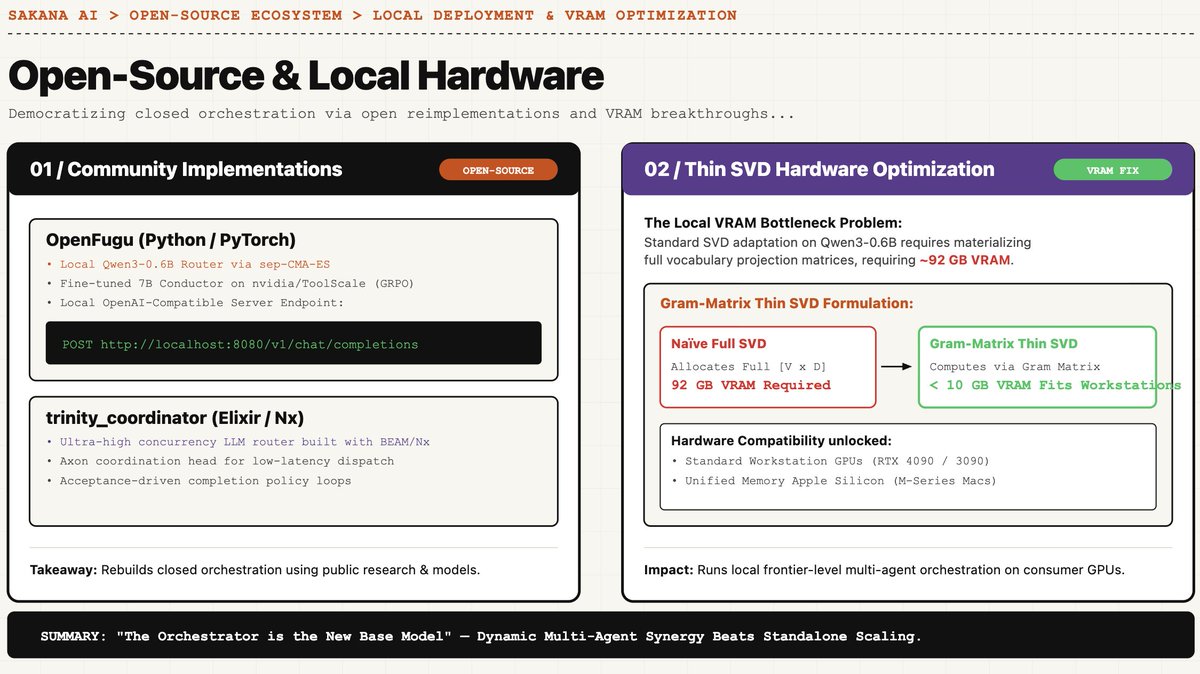
We don't sit around waiting for closed APIs. With OpenFugu and trinity_coordinator, local GRPO and Elixir concurrency are yours. Plus, Gram-matrix Thin SVD slashes VRAM from 92GB down to <10GB. Pure hardware efficiency. https://t.co/yjrpxzybQg
🚨 BREAKING: China has open-sourced a massive Python framework for building AI agents.
It’s called AgentScope, a python framework built around Agent-Oriented Programming that lets you build AI agents visually with MCP tools, memory, rag, and reasoning capabilities.
100% Open Source.
6 agent patterns for AI engineers:
(explained with usage)
1) prompt chaining
→ split the task into fixed steps, each one checking the last.
→ use when the task decomposes cleanly and accuracy matters more than latency.
2) routing
→ classify the input first, then send it to the model or tool built for it.
→ use when inputs fall into distinct classes that need different handling.
3) parallelization
→ run several calls at once and merge them, either by splitting the work or voting on the same question.
→ use when subtasks are independent, or when one answer deserves several opinions.
4) orchestrator-workers
→ a lead model decides what the subtasks are at runtime, then delegates them.
→ use when you cannot list the steps in advance.
5) evaluator-optimizer
→ one model writes, another grades, the loop repeats until it passes.
→ use when you have clear criteria and iteration measurably helps.
6) autonomous agent
→ no fixed path. it plans, acts, reads feedback from the environment, and decides when it is done.
→ use when the steps are unknowable and you can afford the cost and the blast radius.
the first five are workflows: you wrote the path. only the last one writes its own.
most production systems people call agents are pattern 1, 2, or 5 with good error handling.
this taxonomy is from Anthropic's own writeup on building effective agents.
full breakdown in the article below.
The frontend never parses markdown or AI-generated HTML.
AgentScope emits typed events.
FastAPI streams them through SSE.
React renders a real Generative UI in real time.
Deterministic.
Scalable.
Maintainable.
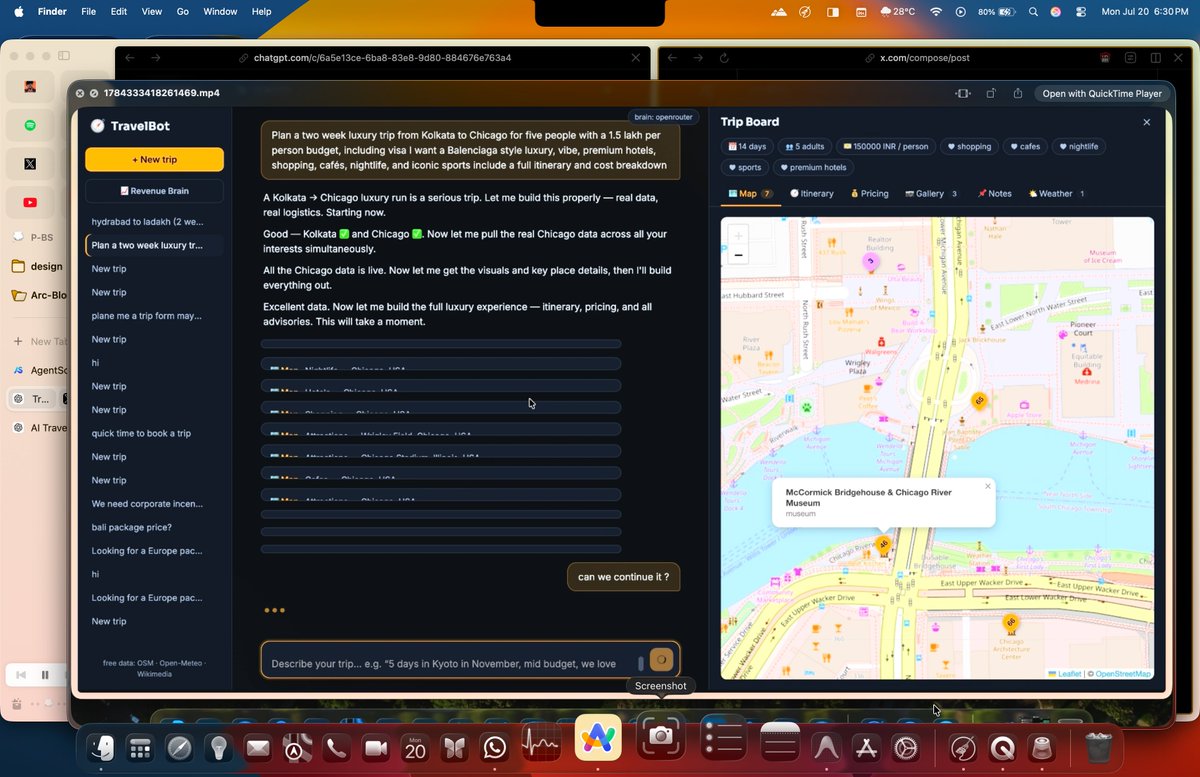
We stopped building AI chatbots for travel companies.
We started building orchestration systems.
This isn't another prompt wrapper. It's a production-ready travel infrastructure powered by AgentScope 2.0.
Instead of generating another wall of text, every capability became an isolated tool.
• Live Maps
• Weather
• Attractions
• Budget Validation
• Visa Notes
• Pricing
• Itinerary Planning
Everything returns structured data.
Everything is orchestrated.