Stop wasting hours trying to learn AI.
I have already done it for you.
With one list. Zero confusion. And no fluff.
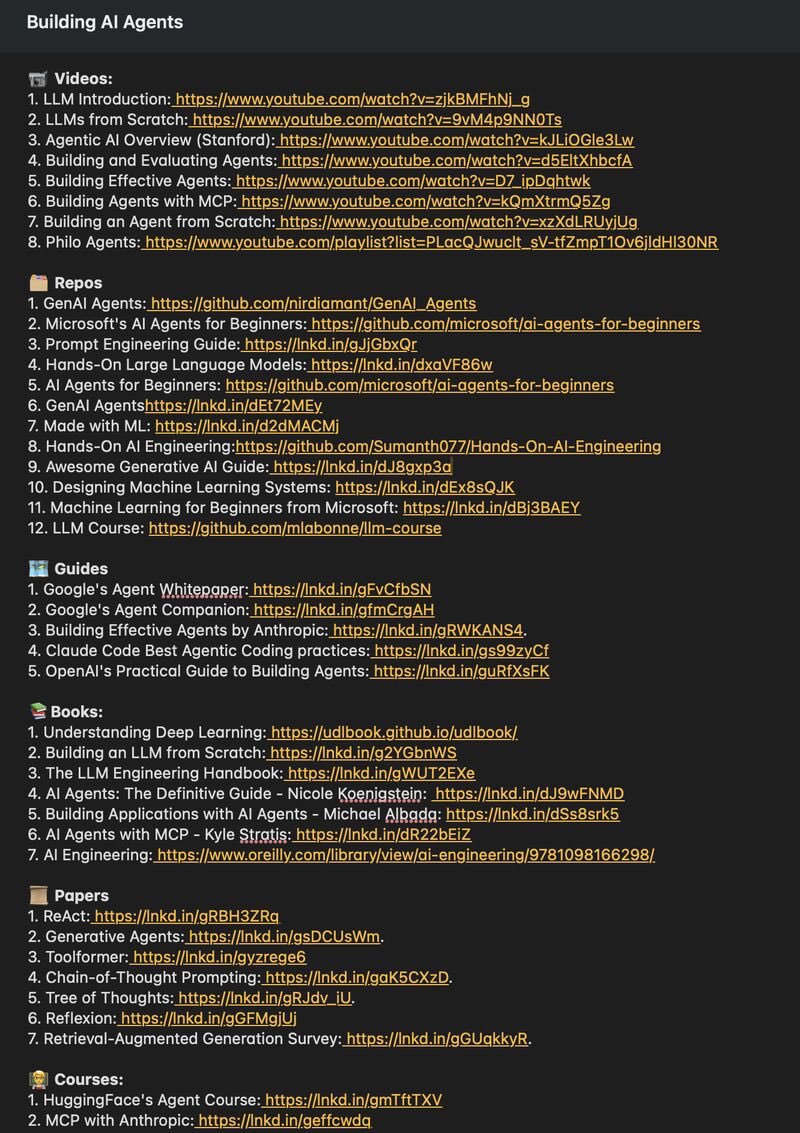
📹 Videos:
1. LLM Introduction: https://t.co/sfqLeUwf3W
2. LLMs from Scratch: https://t.co/GbnKbfvhcg
3. Agentic AI Overview (Stanford): https://t.co/EnqB4YMpeY
4. Building and Evaluating Agents: https://t.co/vp8RCDEoZP
5. Building Effective Agents: https://t.co/mngwlvMHna
6. Building Agents with MCP: https://t.co/TVk18pOf6Z
7. Building an Agent from Scratch: https://t.co/bfnRYfrFjd
8. Philo Agents: https://t.co/SQcGLseeM1
🗂️ Repos
1. GenAI Agents: https://t.co/cXJNVqPZqv
2. Microsoft's AI Agents for Beginners: https://t.co/WHiolowRZi
3. Prompt Engineering Guide: https://t.co/rVMK9vZfBJ
4. Hands-On Large Language Models: https://t.co/zpmaATDtdr
5. AI Agents for Beginners: https://t.co/WHiolowRZi
6. GenAI Agents: https://t.co/s9uA1N24PV
7. Made with ML: https://t.co/AKffs9HkUz
8. Hands-On AI Engineering: https://t.co/h9OVhJ3tWn
9. Awesome Generative AI Guide: https://t.co/lV1YMGL52R
10. Designing Machine Learning Systems: https://t.co/IUXQzlY97i
11. Machine Learning for Beginners from Microsoft: https://t.co/KrSHxdZMju
12. LLM Course: https://t.co/6U4Vww6Uyk
🗺️ Guides
1. Google's Agent Whitepaper: https://t.co/5Wpf7xvQqz
2. Google's Agent Companion: https://t.co/bVmjIK8Xam
3. Building Effective Agents by Anthropic: https://t.co/7SsNu6xr6Y
4. Claude Code Best Agentic Coding practices: https://t.co/X22UJOHlbC
5. OpenAI's Practical Guide to Building Agents: https://t.co/Bn5SYDT9KR
📚 Books:
1. Understanding Deep Learning: https://t.co/csAFkaw3Qp
2. Building an LLM from Scratch: https://t.co/72W4q5QV4z
3. The LLM Engineering Handbook: https://t.co/WgHM7dn8xq
4. AI Agents: The Definitive Guide - Nicole Koenigstein: https://t.co/2vXzCQXEqg
5. Building Applications with AI Agents - Michael Albada: https://t.co/MQAwMPbzQZ
6. AI Agents with MCP - Kyle Stratis: https://t.co/CcaNk01utK
7. AI Engineering: https://t.co/GD45IogK63
📜 Papers
1. ReAct: https://t.co/Nk77rLspmX
2. Generative Agents: https://t.co/CJEokZcGSw
3. Toolformer: https://t.co/GVKiIt2pj3
4. Chain-of-Thought Prompting: https://t.co/YyoEidCGMi
🧑🏫 Courses:
1. HuggingFace's Agent Course: https://t.co/288ifz8r9R
2. MCP with Anthropic: https://t.co/F07zf0lfXi
3. Building Vector Databases with Pinecone: https://t.co/6MFjlpTHab
4. Vector Databases from Embeddings to Apps: https://t.co/ngGDY3Rc7r
5. Agent Memory: https://t.co/BnlgGadL7o
Follow @iansh04_ for more!!
👇 Comment “AI” for more resources
Repost for your network ♻️
Bookmark for future.
Google isn’t trying to win the AI race.
They’re trying to own the entire AI Agent ecosystem.
While everyone argues ChatGPT vs Claude, Google quietly built:
Models → Gemini Pro, Flash, Deep Think, Gemma
Design → Stitch, Whisk, Imagen
Research → NotebookLM, AI Mode
Video → Veo, Flow, Google Vids
Coding → Antigravity IDE, Gemini CLI, Jules
Agents → A2A, ADK, FileSearch API
The scary part?
All of these tools talk to each other.
That means:
10x faster prototypes
End-to-end AI workflows
Production-ready agents on GCP
The next AI war won’t be model vs model.
It’ll be ecosystem vs ecosystem.
Save. Share. Build.
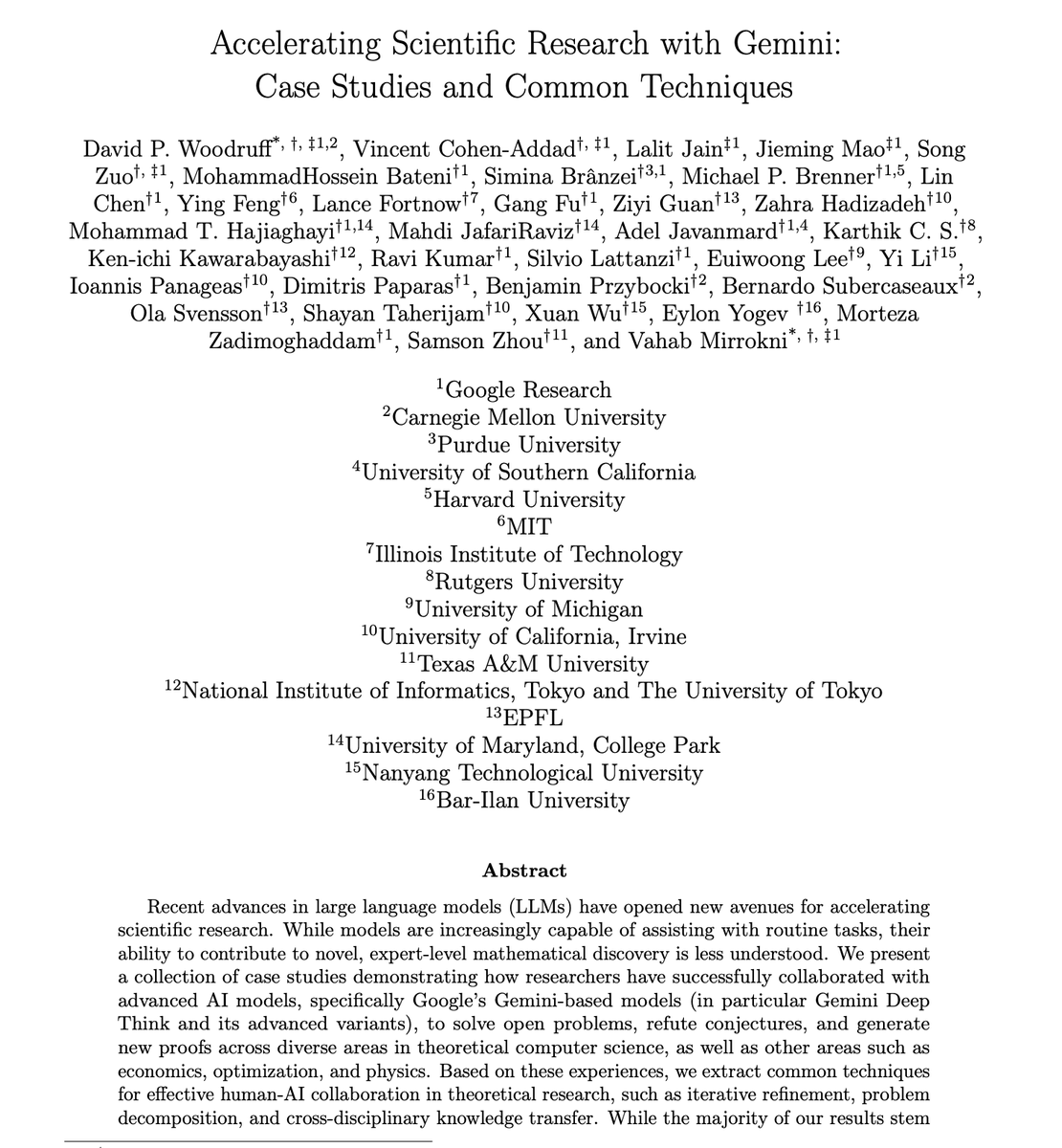
Google just dropped 145 pages documenting how researchers use Gemini to tackle scientific problems.
𝘚𝘢𝘷𝘦 & 𝘙𝘦𝘵𝘸𝘦𝘦𝘵 (𝘵𝘰 𝘩𝘦𝘭𝘱 𝘺𝘰𝘶𝘳 𝘯𝘦𝘵𝘸𝘰𝘳𝘬)
A few things that stood out to me (in simple terms):
- In one case, the AI was used as an adversarial reviewer and caught a serious flaw in a cryptography proof that had passed human review. That’s a very different use than “summarise this PDF.”
- The model links tools from very different fields (for example, using theorems from geometry/measure theory to make progress on algorithms questions). This is where its wide reading really matters.
- They don’t let the model run wild. Humans still choose the problems, check every proof, and decide what’s actually new. The model is there to suggest ideas, spot gaps, and do the heavy algebra.
- Agentic loops, not just chat
In some projects, they plug Gemini into a loop where it:
-- proposes a mathematical expression,
-- writes code to test it,
-- reads the error messages, and
-- fixes itself. (humans only step in when something promising appears)
We are moving past the era of simple chat prompts and into a more sophisticated era of research.
⮑ If your institution is interested in hosting an AI session or a workshop, request your training here: https://t.co/aCIaKzMfln
How to Become an AI Engineer in 2026 (The Real Roadmap)
Most AI roadmaps you see online are incomplete.
They teach you tools… but not how to think.
They show you concepts… but not how to build real systems.
So I took a step back and rebuilt the roadmap based on one goal:
👉 What does it actually take to become a real AI engineer in 2026?
Here’s the answer.
1. Strong Foundations (Non-Negotiable)
Before AI, you need engineering basics:
Python + Data Structures & Algorithms
APIs (REST / GraphQL)
Git & GitHub
Linux fundamentals
This is what separates developers from copy-paste builders.
2. Mathematics & Statistics
You don’t need a PhD—but you need intuition:
Linear Algebra & Probability
Statistics & Distributions
Hypothesis Testing & Bayes
This is how you stop guessing and start understanding models.
3. Machine Learning Basics
Core concepts still matter:
Supervised & Unsupervised Learning
Model training & evaluation
Overfitting, regularization, cross-validation
Without this, you’re just using AI—not engineering it.
4. Deep Learning & LLM Fundamentals
This is where modern AI starts:
Neural networks & backpropagation
Transformers & attention
Tokenization & embeddings
Fine-tuning vs prompting vs RAG
This is the difference between users and experts.
5. Generative AI & LLM Applications
Now we move to real-world power:
Prompt engineering
RAG (Retrieval-Augmented Generation)
Vector databases
Document processing pipelines
This is where AI becomes useful and scalable.
6. AI Engineering Stack
Tools matter but only after fundamentals:
FastAPI (serving models)
LangChain / LangGraph
LlamaIndex
Docker, Kubernetes
Cloud (AWS, GCP, Azure)
Think in systems, not just libraries.
7. Data Engineering for AI
Most people skip this. Big mistake.
Data pipelines (ETL/ELT)
SQL & NoSQL
Streaming data
Feature stores & versioning
AI is only as good as the data behind it.
8. Build Real AI Systems
This is where you level up fast:
AI chatbots & assistants
AI agents & automation systems
Microservices architecture
Model serving & CI/CD
If you’re not shipping, you’re not learning.
9. Evaluation, Observability & Reliability
This is what companies actually pay for:
LLM evaluation (RAGas, TruLens, etc.)
Prompt testing & A/B testing
Monitoring (logs, traces, metrics)
Cost & latency optimization
This is the difference between demo and production.
10. AI Safety, Security & Product Thinking
The most underrated layer:
Prompt injection & data security
AI safety & bias
Human-in-the-loop systems
UX & business impact
Great engineers don’t just build they solve real problems.
The future AI engineer is not just a coder.
You are a:
Builder (you create systems)
Architect (you design them)
Problem Solver (you deliver value)
Innovator (you push boundaries)
If you’re serious about becoming an AI engineer, this roadmap is your blueprint.
Which stage are you currently in right now?
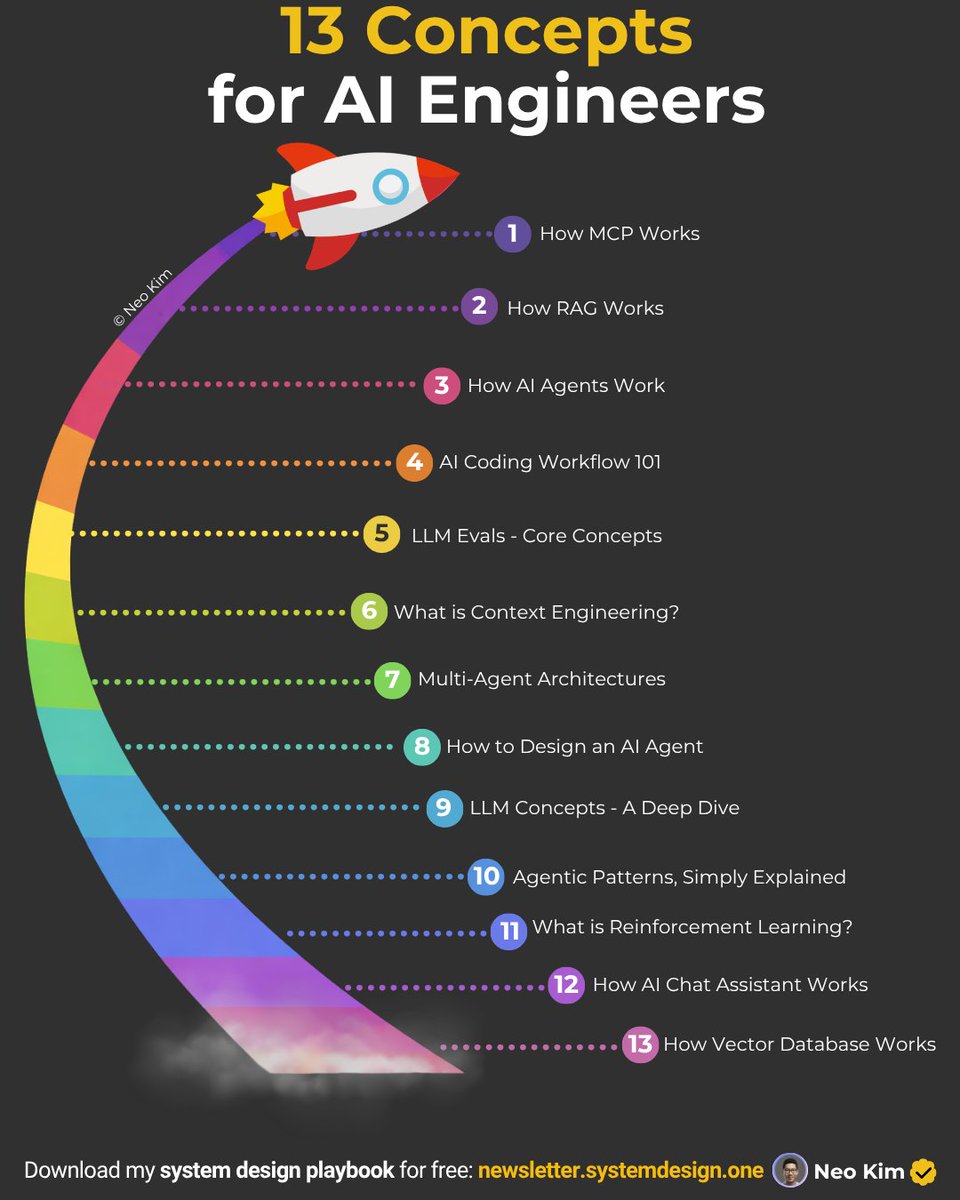
If you're serious about AI engineering (in 2026), then learn these 13 concepts:
1 How Vector Database Works
→ https://t.co/FVxan8xHH3
2 How RAG Works
→ https://t.co/cGmunPTUlb
3 Design Personal Chat Assistant
→ https://t.co/nNWq3onTnW
4 LLM Concepts - A Deep Dive
→ https://t.co/5lCKxq2g4N
5 How to Design an AI Agent
→ https://t.co/JvnPd9773A
6 What is Reinforcement Learning
→ https://t.co/AVpl9j1oit
7 LLM Evals 101
→ https://t.co/nv3Ol8W53p
8 Context Engineering 101
→ https://t.co/OMkiZhkODL
9 AI Coding Workflow 101
→ https://t.co/paIf9ksIU9
10 Agentic Patterns, Simply Explained
→ https://t.co/8YdBBWvTj1
11 How AI Agents Work
→ https://t.co/tk3zkCjRvg
12 Multi-Agent Architectures, Clearly Explained
→ https://t.co/rS5QQS7Jln
13 How MCP Works
→ https://t.co/wgf8gHnnkn
What else should make this list?
===
👋 PS - Want my System Design Playbook (for Free)?
Join my newsletter with 200K+ software engineers now:
→ https://t.co/ByOFTtOihX
===
💾 Save now & repost to help others learn AI engineering.
👤 Follow @systemdesignone + turn on notifications.
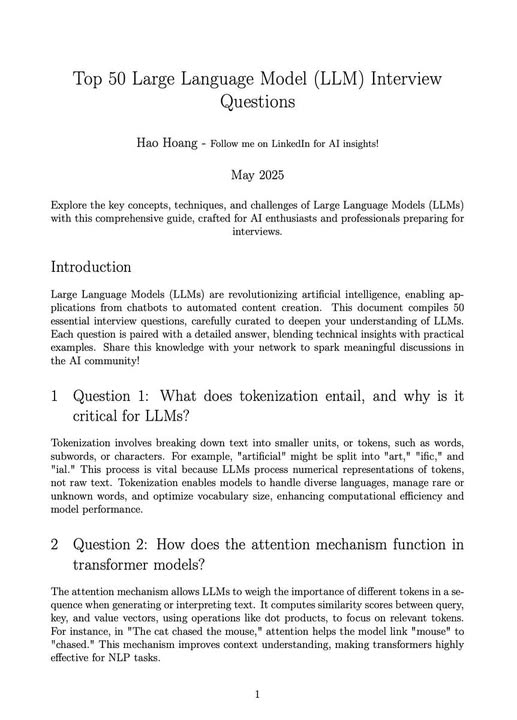
🚨 GOOGLE, META, OPENAI etc. BIG TECH are REJECTING JOB CANDIDATES BEFORE EVEN THEY FINISH TALKING.
50 LLM QUESTIONS. IF YOU CAN'T ANSWER THEM, THE INTERVIEW ENDS BEFORE IT STARTS.
The people passing these interviews are walking out with $200k+ offers.
Someone just LEAKED THE EXACT LLM INTERVIEW QUESTIONS these companies are asking right now.
And the gap between people who know these answers and people who do not is already costing careers.
Here is every category you need to know:
The Basics they always ask first:
↳ How does tokenization work and why does it matter
↳ How does attention actually work inside a transformer
↳ What is a context window and what breaks when it gets too big
↳ What are embeddings and how do they get initialized
↳ How does the model know word order without reading left to right
The fine-tuning questions that eliminate 80% of candidates:
↳ What is LoRA and why is it better than full fine-tuning
↳ What is QLoRA and when do you use it instead
↳ How do you fine-tune a model without making it forget everything it already knows
↳ What is model distillation and why do companies use it
↳ How do you handle vocabularies with millions of possible words
The generation questions most people guess on:
↳ Beam search vs greedy decoding, which one and when
↳ What temperature actually does to model output
↳ The difference between top-k and top-p sampling
↳ Why autoregressive models work differently from masked models
The advanced concepts that separate good from great:
↳ How RAG works and why it beats fine-tuning for factual accuracy
↳ Why Chain-of-Thought prompting makes models dramatically smarter
↳ What Mixture of Experts is and why every frontier model uses it now
↳ Zero-shot vs few-shot learning and when each one wins
The math questions that make people sweat:
↳ Why softmax is used inside attention and not something simpler
↳ What cross-entropy loss actually measures
↳ What KL divergence is and where it shows up in AI training
↳ Why vanishing gradients were destroying transformers and how they fixed it
If you are applying for any AI role in 2026 and you cannot answer at least 40 of these, you are not ready yet.
The full list of 50 questions is worth printing out and going through one by one.
Save this post. Your next interviewer has almost certainly pulled from this exact list.
🚨 BREAKING: A new role is quietly emerging and it’s about to dominate the next 5 years.
It’s not “AI engineer.”
It’s not “prompt engineer.”
It’s the Agent Operator.
And it will sit inside almost every organization.
Most people are still thinking about AI as a tool.
That framing is already outdated.
What’s actually happening is a shift from:
humans using software to humans managing autonomous agents that execute work
This is a fundamental redesign of how work gets done.
So what is an Agent Operator?
An Agent Operator is the person who:
• Designs how agents interact with real workflows
• Connects tools, data, and systems into agent pipelines
• Translates business problems into executable agent behavior
• Monitors, corrects, and improves agent performance over time
They don’t just “use AI.”
They orchestrate outcomes.
and this matter because
Every function marketing, legal, finance, biotech is becoming “agent-compatible.”
Not because companies want it.
Because they won’t have a choice.
Agents can:
• Run research loops
• Execute multi-step workflows
• Integrate across tools without APIs breaking the flow
• Operate 24/7 at near-zero marginal cost
The bottleneck is no longer capability.
It’s implementation inside real-world systems.
Required skills for AI Agent Operator role:
→ MCPs (Model Context Protocols)
Understanding how agents access tools, memory, and structured context.
→ CLIs (Command Line Interfaces)
Because serious agent workflows won’t live in GUIs—they’ll run in programmable environments.
→ Writing skills (the file kind)
Clear specs, instructions, and structured documents.
Agents run on precision, not vibes.
→ agents dot md fluency
The ability to define agent roles, constraints, memory, and tool usage in persistent formats.
→ Business acumen
Knowing what actually matters:
Where automation creates leverage, not noise.
What happens next
Enterprises will begin to redesign workflows:
Not around employees using dashboards…
But around agents executing tasks.
That means:
• SOPs → Agent playbooks
• Teams → Human + agent hybrids
• Tools → Composable agent systems
When that shift happens, companies won’t just need engineers.
They’ll need operators who understand both the system and the business.
The leverage is asymmetric
One strong Agent Operator can:
• Replace fragmented SaaS workflows
• Multiply team output without adding headcount
• Turn ideas into execution systems in days
This is not incremental productivity.
It’s operational transformation.
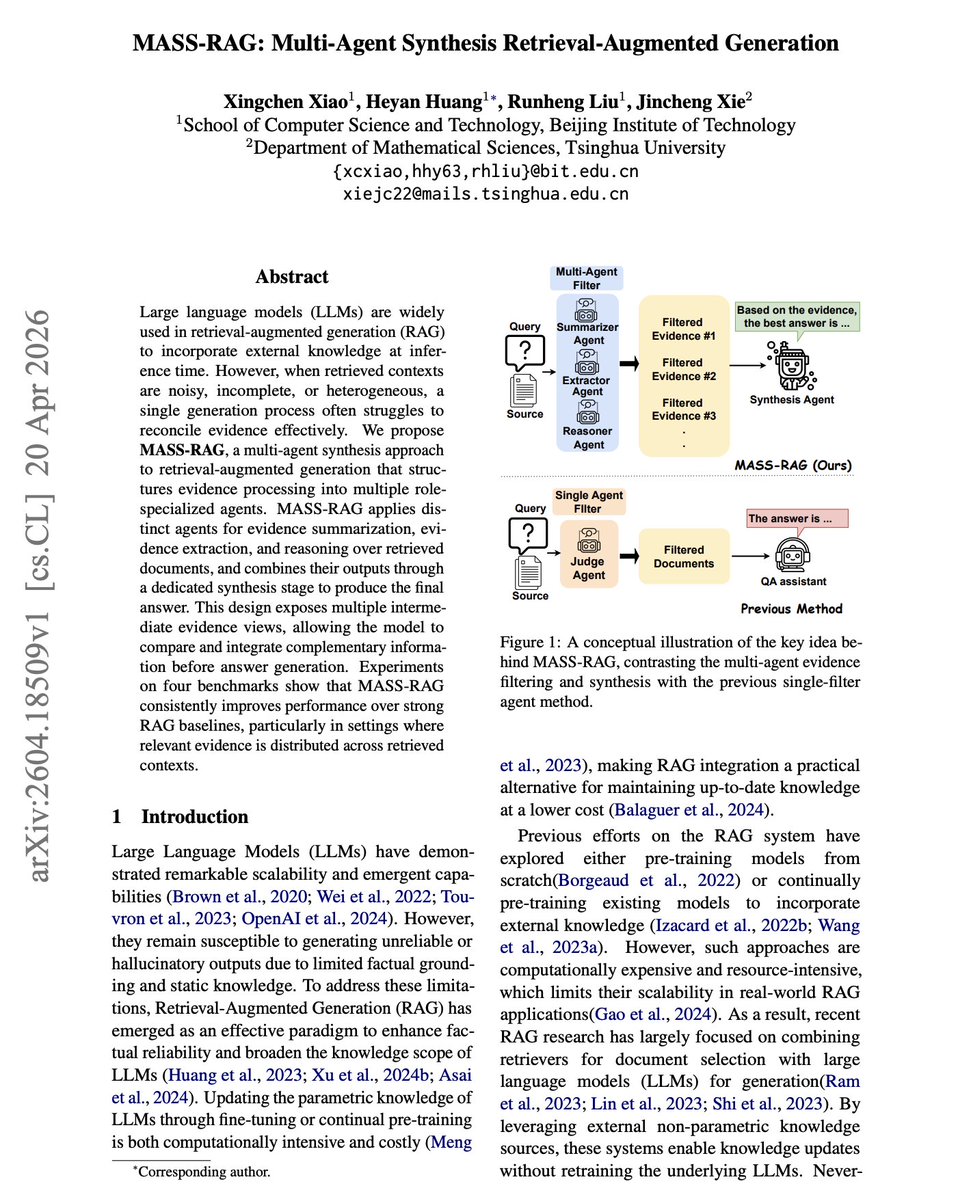
// Multi-Agent Synthesis RAG //
Nice paper on improving RAG systems with multiple agents.
(bookmark it)
The paper introduces MASS-RAG, a multi-agent synthesis framework for retrieval-augmented generation.
Specialized agents handle distinct roles: retrieving candidate documents, assessing their actual relevance to the query, and synthesizing the final answer from evidence that actually contributes.
Instead of one model doing everything, responsibility is decomposed across coordinated evaluators.
Most real-world RAG failures come from retrieving technically-relevant but contextually useless documents, then forcing a single model to reconcile them. Multi-agent synthesis is a cleaner decomposition of the problem and fits the direction the field is already heading in for deep research agents.
Paper: https://t.co/syEVmtUp53
Learn to build effective AI agents in our academy: https://t.co/1e8RZKs4uX
Nice paper combining the strength of Skills and RAG.
Most RAG systems retrieve on every query, whether the model needs help or not. This is wasteful when the model already knows the answer, and often too late when it does not.
New research introduces Skill-RAG, a failure-state-aware retrieval system. It uses hidden-state probing to detect when an LLM is approaching a knowledge failure, then routes the query to a specialized retrieval strategy matched to the gap.
Evaluated on HotpotQA, Natural Questions, and TriviaQA, the approach improves over uniform RAG baselines on both efficiency and accuracy.
Why does it matter?
RAG is moving from a single monolithic pipeline to a suite of skills an agent selects between. Knowing when to retrieve and what kind of retrieval to run will matter more than raw retriever quality as agents take on multi-step reasoning, where a single bad lookup derails the whole chain.
Paper: https://t.co/GcHFJrO17E
Learn to build effective AI agents in our academy: https://t.co/1e8RZKs4uX
RAG has three generations. Most teams are still on the first one. 🧠
Classic RAG → Retrieves
Fast, simple, single-hop. Perfect for FAQs and policy lookups.
Graph RAG → Connects
Entity-rich and relational. Shines when the answer lives *between* documents, not inside them.
Agentic RAG → Reasons
Adaptive, multi-step, self-correcting. The agent chooses its own tools and checks its own work.
The upgrade path isn’t about complexity for its own sake — it’s about matching retrieval to the shape of the question.
Classic RAG handles “what.” Graph RAG handles “how are these related.” Agentic RAG handles “figure it out.”
Save this for your next architecture review. 📌
Which generation is your team building on right now? 👇
Credit: codewithbrij
#RAG #AIEngineering #LLM #AgenticAI #generativeai
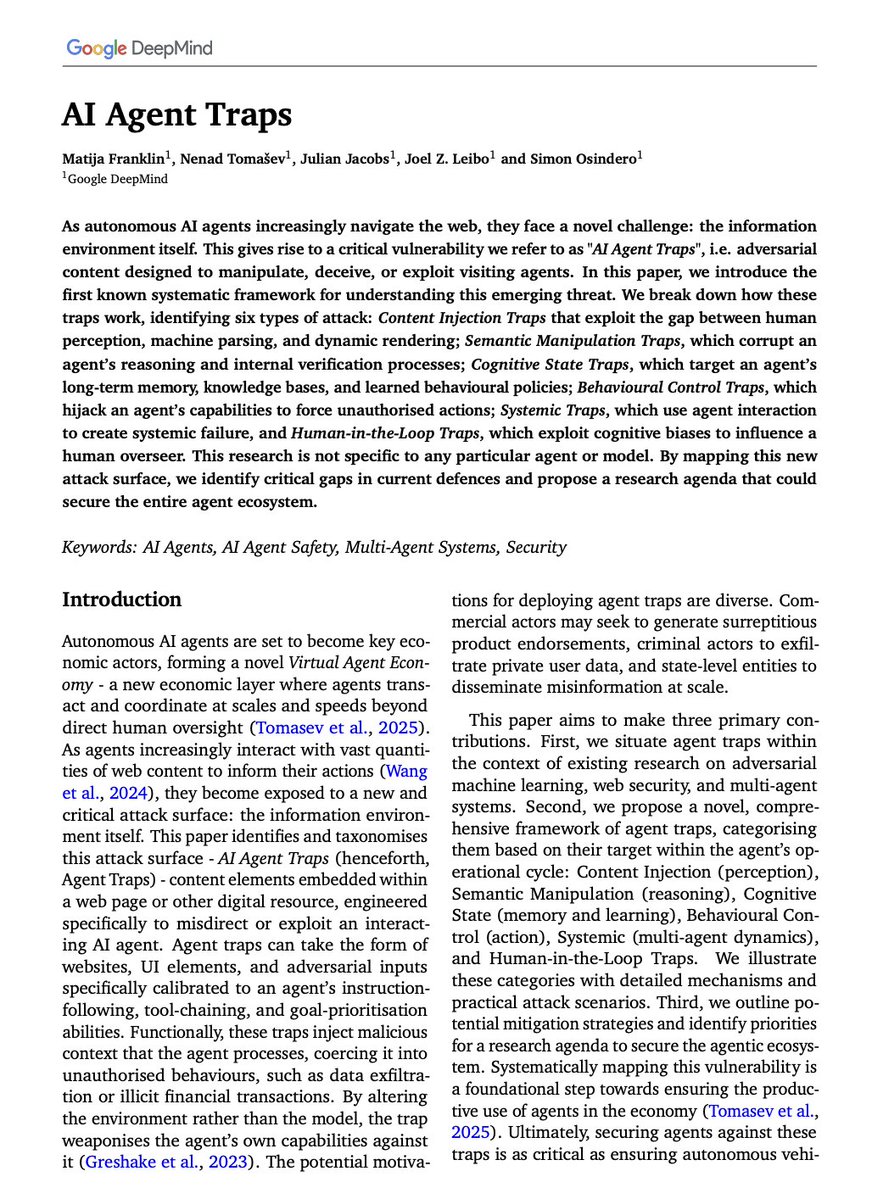
Google DeepMind just dropped the most terrifying cybersecurity paper of the year.
They just mapped the attack surface that nobody in AI is talking about.
Websites can already detect when an AI agent visits and serve it completely different content than humans see.
- Hidden instructions in HTML.
- Malicious commands in image pixels.
- Jailbreaks embedded in PDFs.
This “detection asymmetry” means a site can serve normal content to you, and malicious, hidden content to your agent.
The agent doesn’t know it’s being tricked. It simply processes whatever it receives and acts on it.
Here’s the attack surface nobody is talking about:
→ Indirect Web Injection: Malicious instructions hidden in HTML comments, CSS tricks, or white text on white backgrounds.
→ Multimodal Steganography: Commands encoded directly into image pixels, invisible to humans, but fully readable by vision models.
→ Document Jailbreaks: Override instructions embedded deep inside PDFs, spreadsheets, and calendar invites.
→ Memory Poisoning: Injecting false information that persists across future sessions.
→ Exfiltration Attacks: Tricking the agent into sending your private data to attacker-controlled endpoints.
→ Multi-Agent Cascades: The worst-case scenario, Agent A gets compromised, passes the “poison” to Agent B, then to Agent C. The entire pipeline gets infected because agents trust each other’s data.
The most sobering part of the DeepMind report? The defense landscape is failing, badly.
Input sanitization doesn’t work because you can’t “sanitize” a pixel. Prompt-level instructions to “ignore suspicious commands” fail because the attacks are designed to look legitimate.
And human oversight? Impossible at the speed and scale these agents operate.
If you ask an agent to research 50 websites, you can’t verify whether each site served the agent the same content it served you.
8 types of LLMs used in AI agents 🤖
GPT • MoE • LRM • VLM • SLM • LAM • HRM • LCM
Different models for reasoning, perception, planning, and action — not just chat.
Agentic AI = model orchestration.
#AI#LLMs#AgenticAI#GenAI#MachineLearning
RAG vs. CAG, clearly explained!
RAG is great, but it has a major problem:
Every query hits the vector DB. Even for static information that hasn't changed in months.
This is expensive, slow, and unnecessary.
Cache-Augmented Generation (CAG) addresses this issue by enabling the model to "remember" static information directly in its key-value (KV) memory.
In fact, you can combine RAG and CAG for the best of both worlds.
Here's how it works:
RAG + CAG splits your knowledge into two layers:
↳ Static data (policies, documentation) gets cached once in the model's KV memory
↳ Dynamic data (recent updates, live documents) gets fetched via retrieval
This gives faster inference, lower costs, and less redundancy.
The trick is being selective about what you cache.
Only cache static, high-value knowledge that rarely changes. If you cache everything, you'll hit context limits. Separating "cold" (cacheable) and "hot" (retrievable) data keeps this system reliable.
You can start today. OpenAI and Anthropic already support prompt caching in their APIs.
I have shared my recent article on prompt caching below if you want to dive deeper.
👉 Over to you: Have you tried CAG in production yet?
Every AI system must have these 5 layers.
I've explained each layer with examples.
1. 𝗗𝗮𝘁𝗮
This layer manages how data is stored, processed, and retrieved for AI systems.
• Vector databases → Store embeddings for search
• Embedding models → Convert text into vectors
• Document processing → Parse and structure documents
• Knowledge graphs → Connect entities and relationships
• RAG systems → Retrieve external context for LLM
• Semantic caching → Cache responses for faster reuse
𝗘𝘅𝗮𝗺𝗽𝗹𝗲𝘀: Pinecone, Qdrant, Chroma, Neo4j etc.
2. 𝗟𝗟𝗠
This is the core intelligence layer responsible for understanding and generating outputs.
• Model selection/routing → Choose best model dynamically
• Prompt handling → Structure and optimize inputs
• Safety guardrails → Prevent harmful or unsafe outputs
• Function execution → Call tools and external APIs
• Cost monitoring → Track usage and spending
• Observability → Monitor model performance and behavior
• Content filtering → Remove unsafe or irrelevant outputs
• Bias checking → Detect and reduce biased outputs
• Load distribution → Balance traffic across models
𝗘𝘅𝗮𝗺𝗽𝗹𝗲𝘀: GPT-5.3 (Codex), Claude Opus 4.7 etc.
3. 𝗢𝗿𝗰𝗵𝗲𝘀𝘁𝗿𝗮𝘁𝗶𝗼𝗻
This layer manages workflows and coordinates multiple components and agents.
• A/B testing → Compare different system versions
• State management → Track session and workflow state
• Task routing & planning → Decide next action steps
• Agent version control → Manage agent updates and changes
• Context management → Maintain relevant conversation context
• Workflow management → Define multi-step execution flows
• Multi-agent coordination → Enable agents to collaborate
• Agent handovers → Transfer tasks between agents
• Memory handling → Store and retrieve past interactions
𝗘𝘅𝗮𝗺𝗽𝗹𝗲𝘀: LangGraph, CrewAI, Mem0, RabbitMQ etc.
4. 𝗜𝗻𝘁𝗲𝗿𝗳𝗮𝗰𝗲
This is the layer where users interact with the system.
• Chat interface → User interacts via text
• Voice interface → Speech-based user interaction
• Multi-tenant setup → Support multiple users/accounts
• API gateway → Manage and route API requests
• Embedded widgets → Integrate UI into other apps
• WebSockets → Real-time bidirectional communication
• Webhooks → Trigger actions via events
• Browser add-ons → Extend functionality in browsers
𝗘𝘅𝗮𝗺𝗽𝗹𝗲𝘀: React, Streamlit, Gradio, FastAPI, MCP etc.
5. 𝗜𝗻𝗳𝗿𝗮𝘀𝘁𝗿𝘂𝗰𝘁𝘂𝗿𝗲
This layer handles compute, deployment, scaling, and system reliability.
• Compute (GPU/TPU) → High-performance model processing
• Containers & orchestration → Manage app deployment at scale
• Monitoring, logging, security → Track system health and safety
• CI/CD pipelines → Automate build and deployment
𝗘𝘅𝗮𝗺𝗽𝗹𝗲𝘀: AWS, GCP, Docker, Kubernetes, RunPod etc.
If you need your AI systems to be reliable and scalable, each of these layers needs to be built right.
✅ Repost for others as most people miss these core AI building blocks.
Cc : author 👍🏻
𝐖𝐡𝐚𝐭 𝐢𝐬 𝐌𝐂𝐏 (𝐌𝐨𝐝𝐞𝐥 𝐂𝐨𝐧𝐭𝐞𝐱𝐭 𝐏𝐫𝐨𝐭𝐨𝐜𝐨𝐥)?
Most AI agents are trapped inside their own walls.
MCP is the protocol that connects them to the outside world data sources, tools, and workflows.
𝐖𝐡𝐚𝐭 𝐢𝐬 𝐌𝐂𝐏?
• MCP is an open-source standard that connects AI applications to external systems like data sources, tools, and workflows.
• It enables seamless integrations, allowing AI models like ChatGPT to access data, use tools, and perform tasks like web app creation or database queries.
• MCP simplifies development, reducing complexity and time by providing a standardized way to connect AI systems to various resources.
• It enhances AI capabilities, making models more powerful and personalized by allowing them to interact with external systems and data on behalf of users.
𝐁𝐞𝐟𝐨𝐫𝐞 𝐌𝐂𝐏
LLM → Slack, Google Drive, GitHub (separate connections for each).
Every integration is custom. Every tool requires its own API client. Every agent reinvents the wheel.
𝐀𝐟𝐭𝐞𝐫 𝐌𝐂𝐏
LLM → Unified API (MCP) → Slack, Google Drive, GitHub.
One protocol. One connection layer. Every tool accessible through a standardized interface.
𝐇𝐨𝐰 𝐌𝐂𝐏 𝐖𝐨𝐫𝐤𝐬?
User → User Query → MCP Client → Invoke Graph → LangGraph → Route Request → OpenAI GPT → Tool Decision → Call MCP Tool → MCP Server → External API Call → External APIs → API Response → MCP Server → Tool Result → OpenAI GPT → Generate Response → MCP Client → Natural Language Response → Final Result User → Agent Response → User.
𝐓𝐡𝐞 𝐅𝐥𝐨𝐰
1. User sends a query to the MCP Client.
2. MCP Client invokes LangGraph to route the request.
3. OpenAI GPT makes a tool decision and calls the MCP Tool.
4. MCP Server makes an external API call to the appropriate service (Slack, Google Drive, GitHub, etc.).
5. External API returns a response to the MCP Server.
6. MCP Server sends the tool result back to OpenAI GPT.
7. OpenAI GPT generates a natural language response.
8. MCP Client delivers the final result to the user.
Before MCP, every agent built its own integrations. After MCP, every agent shares the same connection layer.
MCP is the protocol that turns isolated AI models into connected AI agents.
𝐀𝐫𝐞 𝐲𝐨𝐮 𝐛𝐮𝐢𝐥𝐝𝐢𝐧𝐠 𝐀𝐈 𝐚𝐠𝐞𝐧𝐭𝐬 𝐰𝐢𝐭𝐡 𝐜𝐮𝐬𝐭𝐨𝐦 𝐢𝐧𝐭𝐞𝐠𝐫𝐚𝐭𝐢𝐨𝐧𝐬 𝐨𝐫 𝐰𝐢𝐭𝐡 𝐌𝐂𝐏?
♻️ Repost this to help your network get started
Cc : respective author.
Stanford just released a 1.5-hour lecture on “LLM Architecture.”
This is the exact thing systems engineers at Anthropic and OpenAI require to understand at a deep level.
Give it some time.
This might be the highest-ROI learning you do this month.
➡️ 8 Free AI Courses Every Professional Needs in 2026
➡️ Google AI
Google’s AI Learning Path (15–20 hours)
🔗 https://t.co/HNqeT2LoyD
• 5 comprehensive courses from basics to mastery
• Focused on practical generative AI applications
• Perfect for beginners with technical curiosity
➡️ Microsoft
Microsoft’s Deep Learning Journey (8–10 hours)
🔗 https://t.co/ub1OTkrJLn
• Starts with fundamentals anyone can grasp
• Gradually builds to neural networks
• Excellent visual explanations of complex topics
➡️ Harvard University
Harvard’s AI with Python (70 hours)
🔗 https://t.co/FZIfTjv8W6
• University grade curriculum over 7 weeks
• Teaches algorithmic thinking behind AI systems
• Builds practical skills with industry-standard libraries
➡️ Vanderbilt University
Vanderbilt’s Prompt Engineering Masterclass (12 hours)
🔗 https://t.co/SY2ksGc4wC
• 6 modules focused on getting better results from AI
• Transform vague requests into precise instructions
• Learn patterns that work across all AI platforms
➡️ OpenAI
OpenAI’s Developer Prompting Course (3–4 hours)
🔗 https://t.co/FhfR9wwPjR
• Created by the team behind ChatGPT
• Co-taught by renowned AI educator Andrew Ng
• Hands-on exercises with immediate feedback
➡️ Google Cloud
Google Cloud’s LLMOps Specialisation (25 hours)
🔗 https://t.co/ZP45phZnF0
• For those ready for more advanced concepts
• Learn to train and customize your own AI models
• Industry-ready deployment techniques
➡️ UC Davis
UC Davis Big Data & AI Ethics (10 hours)
🔗 https://t.co/IVEspnafqM
• Broader perspective on AI’s societal impact
• Introduction to enterprise AI systems
• Critical thinking about AI limitations and responsibilities
➡️ edX
edX Application Building Course (30–40 hours)
🔗 https://t.co/HTVJ75cLGl
• Bridge the gap between theory and real world use
• Create functional AI tools from scratch
• Perfect for entrepreneurs building AI solutions
ANTHROPIC JUST DROPPED A 33-PAGE GUIDE.
This is the most practical breakdown of Claude Skills I’ve seen.
Bookmark this before you forget.
33 pages.
Persistent instructions.
No repetition.
No re-explaining every time.
Read it today. Link below.
Claude → Skills → Memory → Automation → Systems → Money