@Telegraph@AndrewOrlowski Most companies lay off workers because AI is cheaper. In reality, AI is more expensive and the actuality might be that they are simply just cutting costs to increase revenue
@Telegraph@AndrewOrlowski As a developer, I concur. Grok just shut down all their cheap models (without notice) leaving only its flagship (and most expensive) model as the single API option. Our costs in May just decupled. Still degrees of magnitude cheaper than humans but the trend aint good.
@Telegraph@BrathBonespurs@AndrewOrlowski CATCH-UP!
This #energy issue says that for centuries "modern" post-industrial-revolution folks have used way too much energy, in our normal lifestyles!
We MUST #DOWNsize!
Ireland’s explosive data centre growth triggers shocking rise in electricity bills https://t.co/dnnGvHn5TZ
@Telegraph@AndrewOrlowski They don't care. The brief is wider albeit maybe not all knew. Ai Data Facilities were always built to destroy. Population water supply/Food production and remove cash!
@Telegraph@AndrewOrlowski It also doesnt help the matters that, one top-notch (?) AI company honcho insists that all coders will cease to exist in a matter of year!.Another however insists that the way AI industry is shaping up..more software engineers are required!🤷♂️🤷♂️
@Telegraph@AndrewOrlowski All the Elites that push for Net Zero soon forget about their commitments when they construct their data centres and want to farm your data.
Our information is worth more than the rare minerals in the earth and they know it.
Do not give them what they want.
@Telegraph@AndrewOrlowski The current generation of finance eggheads have an self destructive obsession with pushing all payroll but their own to zero. The returns generated by hiring and retaining to best workforce is lost on them. Their AI fantasy has always been based on erasing payroll.
@Telegraph@AndrewOrlowski What's interesting is how little attention the economics receive compared to the capabilities. We spend endless time discussing what AI can do and far less time discussing what it costs to do it
https://t.co/03M8Z2SJlo
'The free lunch is over. Google says demand has risen sevenfold over the past year. But now the real cost of AI is finally beginning to emerge, and the consequences are cataclysmic' I Writes @AndrewOrlowski
'The AI bubble will burst, and how that will happen is becoming discernible' 👇
https://t.co/kMlIa9RVzI
🚨Are you KIDDING me? Treasury Sec. Scott Bessent reveals the bubble he lives in:
“Someone, maybe your parents for their retirement have bought 5, 10, 12 homes.”
I can’t underscore how completely fucking out of touch this entire administration is.
@USronaldcarter The US calls it GDP.
The stock market calls it valuation growth.
The central bank socialises the losses and privatises the gains.
We’ve seen this story before.
You are the product.
The AI Bubble, DeepSeek & The New Global Order
https://t.co/J4eXdCrjzI
I warned about the dot-com bubble beginning in 1998. People thought I was bonkers for not believing them when they said, "Earnings don't matter! The rules have changed!"
They were wrong, of course. And many lost their life savings.
This time around it's going to get even more interesting. A major, MAJOR crash is coming... and it will make the dot-com crash look like child's play.
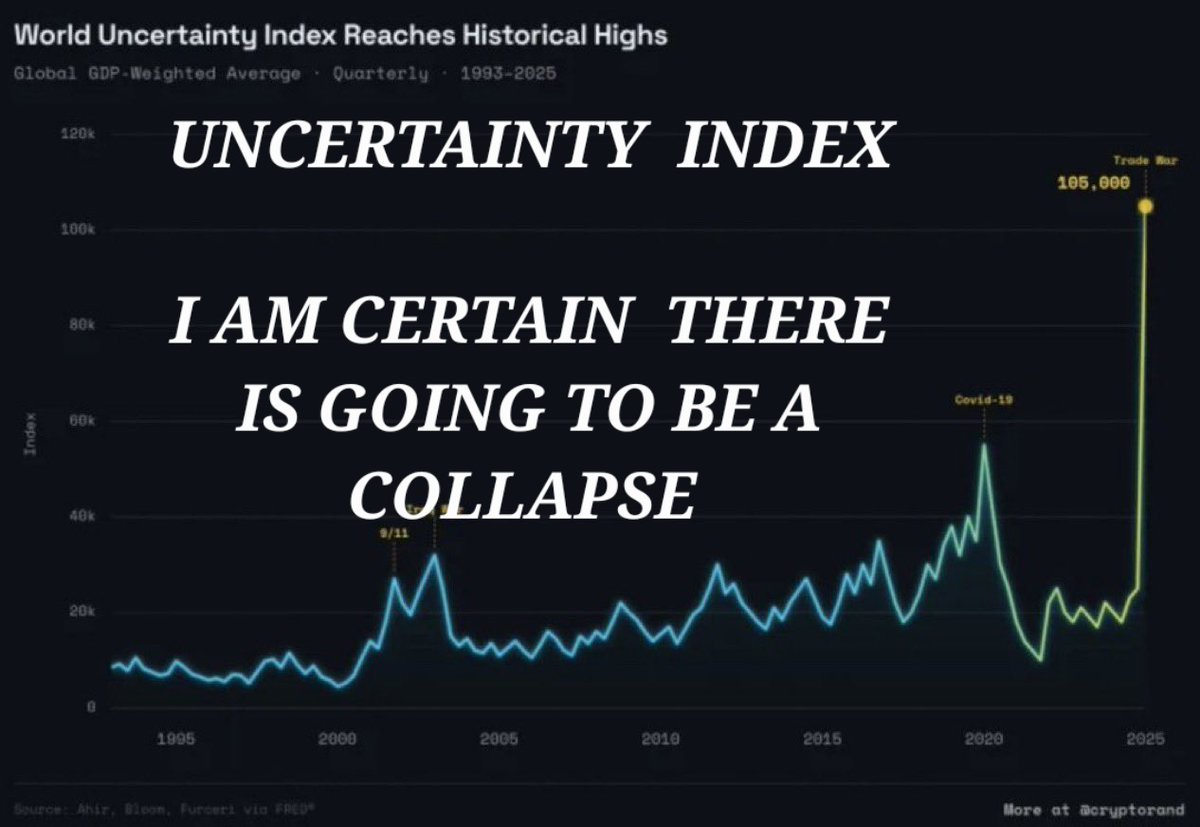
🚨🚨 UNCERTAINTY INDEX 🚨🚨
I think the jig is up.
The masses that have been ignoring the alarm bells are waking up.
The bubble is about to pop IMO.
WE ARE LIVING IN HISTORIC TIMES
🚨 THIS IS HOW AI BUBBLE ENDS
The S&P 500 keeps hitting all-time highs.
But almost nobody sees the systemic crisis brewing.
Wall Street has built a giant debt pyramid.
Just like in 2000.
How the scam works:
Nvidia pours money into AI startups.
Those startups borrow billions from Apollo, Athene and Blackstone using Nvidia chips as collateral.
Then they give that money right back to Nvidia to buy more chips.
On paper, it's a masterpiece:
Nvidia reports record sales.
Startups show explosive growth.
Tech stocks skyrocket.
In reality, a big part of the demand is fake. It's a circular loop.
And it only works as long as the chip shortage lasts.
When Nvidia drops new chips, the old ones used as collateral will lose value fast.
Even worse: most companies still aren't making enough money from AI to justify these huge costs.
This is not "if". It's already starting.
Remember, I warned about the BTC $82k bull trap and Saylor's sell-off before it happened.
My next call will be the biggest one this cycle.
Turn on notifications. Most people will follow me too late.
If I were Trump and about to announce a deal with Iran, I’d time it alongside the SpaceX and OpenAI IPOs.
If I were Goldman Sachs, I’d want to collect my fees at the highest valuation possible.
This is the biggest bubble since the 1999 dot-com era.
Bond yields are at levels last seen in 2007, pushing mortgage rates to unsustainable levels.
I think they can pump this bubble much further by timing the announcement of a deal with Iran.
Don’t get me wrong.
This bubble still has a long way to go.
But it is a bubble, and China knows how to pop it if they want to.
There’s also a massive money print waiting on the other side of this bubble.
This will be the largest wealth transfer in modern history.
And the financial-industrial complex knows it.
If you don’t own assets, you only experience the higher energy prices.
The K-shaped economy is pushing both sides to their extremes.
Timing this market is not going to be easy, but the FIC wins and Main Street looses.
By design.
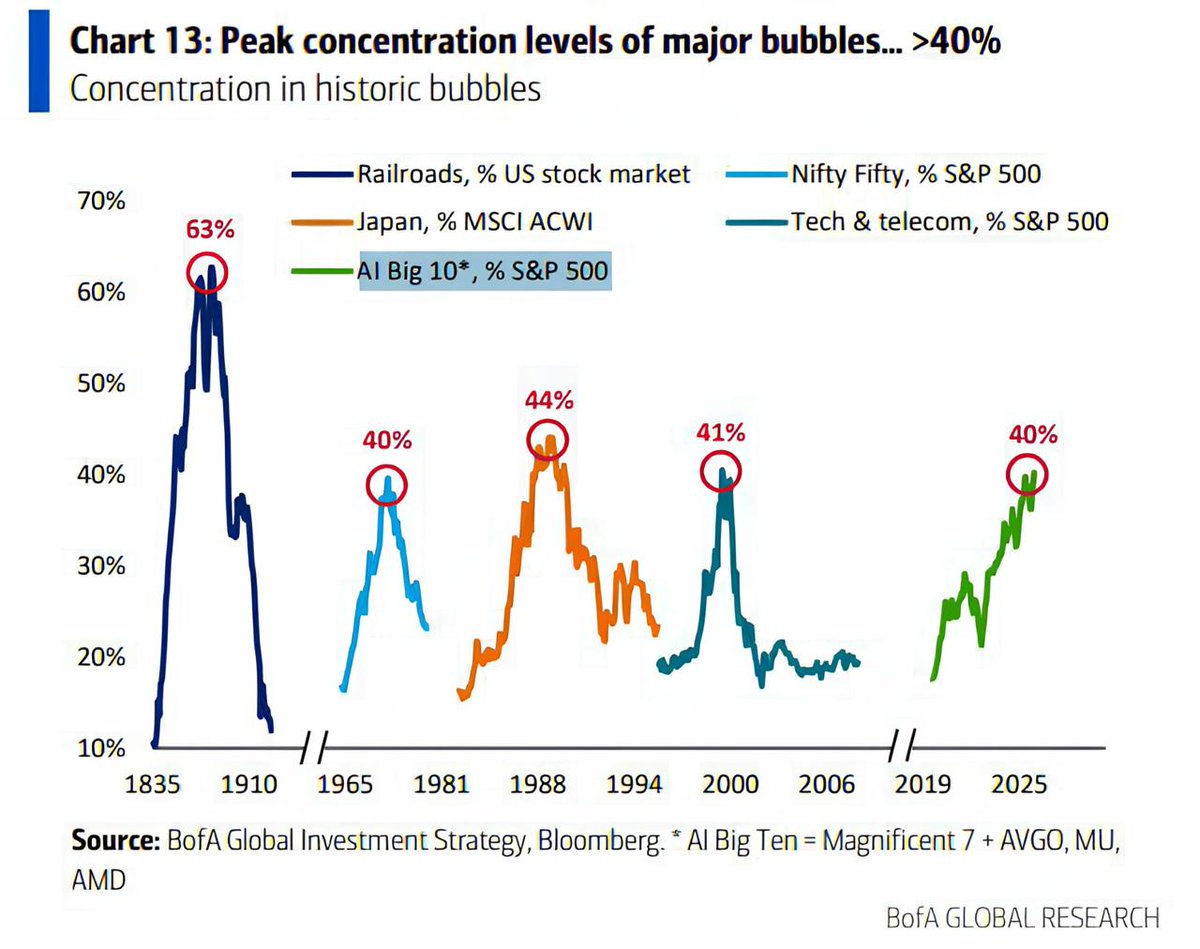
The 40% bubble concentration rule just triggered for the first time since the dot-com crash.
If history repeats, the entire market could be at risk.
Every time the top 10 stocks have made up 40% or more of the total market, a major crash has followed soon after. This pattern holds across nearly 200 years of market history.
In 1929, the top 10 stocks hit 44% of the market. The Great Crash followed.
In 1965, they hit 40%. The "Go-Go Bubble" burst followed.
In 2000, they hit 41%. The dot-com crash followed.
Today, the top 10 stocks make up 40% of the market once again. Apple, Microsoft, Amazon, NVDA, and Google alone make up 25%.
This level of concentration has only been seen at the peak of the largest bubbles in history. And each time, the entire market has suffered, not just the top stocks.
In 2000, while the Nasdaq lost 80%, the S&P 500 still fell 50%. In 2008, while banks led the plunge, the S&P 500 fell 58%. When the top gets this heavy, it drags everything down with it.
40% concentration has been a clear and consistent red flag. It doesn't mean a crash will happen tomorrow. But it does mean the risk level in the market is at an extreme.