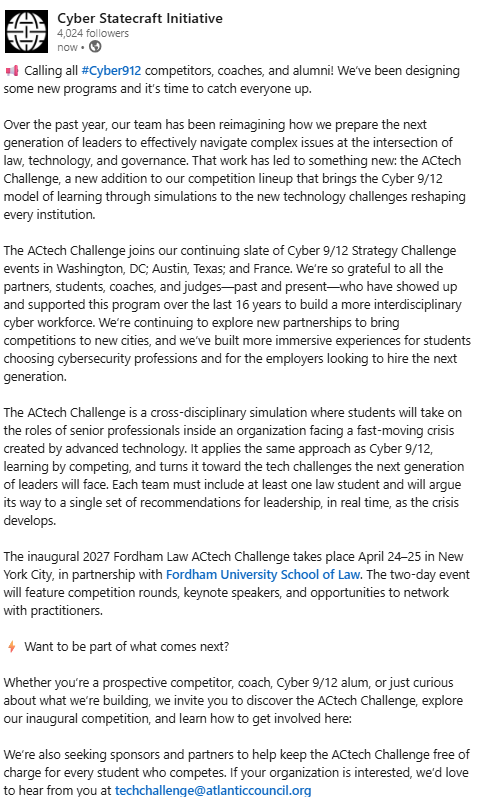
From the makers of #Cyber912: the Fordham Law ACtech Challenge, a cross-disciplinary simulation competition at the intersection of law, technology & governance.
Join us on April 24–25, 2027 at @FordhamLawNYC
Learn more and register⬇️
https://t.co/V7yOOhB9vZ
Browsers that allow users to store their passwords directly in the browser offer convenience and efficiency, but also expose users to the risks of information-stealing malware. Learn more about design pressures and systemic cyber risk https://t.co/J93jvtTmcP
Software liability -- as called for in the US National Cybersecurity Strategy -- could reshape the landscape of incentives between software users and software vendors. How could such a regime be designed? A good starting place is here: https://t.co/K8UFsguKOH
Deter This!
Lessons from counter-terrorism hold more value for US policymakers and public-private cooperation on cybersecurity than thinking shaped around nuclear escalation or conventional warfare. See more from @SimonPHandler, @emmacs26, & Trey Herr.
https://t.co/ceVhbRmdSl
Hacking isn't one activity but a series of related ones. We break down how generative AI systems might be able to help with hacking, from Reconnaissance to Impact, in our report “Hacking with AI.” https://t.co/MMFPT3riCd
Cybercrime is so appealing for criminals and criminal groups due in large part to the ability to create mass profit with relatively small resource input. Criminal syndicates in Myanmar have used forced labor to conduct global cyberscam operations
https://t.co/J4Xg1vlriz
What’s the secret to developing our cyber workforce?
Rob Duhart thinks the key might be to “expand the definition of what qualifications mean, and opening that door to people that may be traditionally ignored.”
Watch the #NCWES launch here:
https://t.co/jzThEtAGDK
How might we respond in a crisis after a criminal group has targeted a rural hospital system? At the 14th annual #Cyber912, teams tackled this scenario head-on.
Read the takeaways of competitors and judges here: https://t.co/sotM5xhw4t
Framing spyware as both a human rights and natural security issue and applying pressure to venture capital firms to enact due-diligence processes may decrease the proliferation of spyware and other surveillance technology. More recs in: https://t.co/Iu4U5gJvBB
Access-as-a-Service companies sell offensive cyber capabilities to states worldwide. Who sets the rules for their operation? Our report analyses this industry to develop actionable policies for the US & allies: https://t.co/Jsmh9uZ4cE
“This might be one of the most important takeaways of the competition.”
In this 5x5, Gabriel Cajiga presents the benefits of having a diverse team for a Cyber 9/12 competition. https://t.co/kS7m58ISpj
Intermediaries don't just facilitate transactions; sometimes they are the only reason it is possible. Read how intermediaries have been leveraged to facilitate OCC transactions that bypass export controls and trade bans in https://t.co/RtpaCNfFPg
For this 5x5, we brought together Tobie Langel, Aeva Black, Fiona Krakenbürger, Stewart Scott, and Christopher Robinson to discuss the XZ backdoor’s implications for the OSS community and policymakers. https://t.co/PSQ542tGay
In the EU, AI in healthcare = high-risk by default. That means stricter rules on data, models, and oversight. “Regulation-by-design” is no longer optional—it’s a competitive edge. Read it here 👇 👇 https://t.co/GsLF0NCvv7
A strong security culture starts with understanding human behavior, not blaming it. Read the insights from Elizabeth Cartier, Helen Patton, Liisa Past, Michelle Chia, Megan Samford about humans being considered as the weakest link in cybersecurity here: https://t.co/miKE9xnijp
Are you a fan of quantitative cybersecurity research? A fiend for p-values? Check out our report looking at whether funding for OSS projects correlates with improved security practices! https://t.co/MrEpZloBZU
Our report “Critical Infrastructure and the Cloud” covers how different critical infrastructure sectors are adopting cloud computing and explains what implications that has for how policymakers should think about cloud security. https://t.co/l7bph29VPY
🧠 Brain drain alert: Over 100,000 Russian technologists have fled the country since the Ukraine war began. Learn how this impacts Russia’s tech industry here 🏃♂️🧳 https://t.co/QhIomZAwEk
Spyware vendors continue to operate from jurisdictions with limited corporate transparency. The report argues for structural reforms to global registry systems: https://t.co/seHnXhVf0K