How I unslop any app before sharing:
After every change, run a polish pass on the screens and flows it touched. Work through sections 1–5 in order
1. Test every main screen:
- Widths: 375, 768, 1280, 1920. Plus 200% zoom.
- Touch emulation on. No hover-only interactions. Tap targets ≥ 44px.
- Slow 3G + 4x CPU throttle. Every async action shows a loading state, no layout shift, no double submits.
2. Check every state:
- Empty, loading, error, and 1,000+ rows.
- Long names, long emails, missing avatars, null fields.
- Network failure mid-action. App should recover with a clear message.
3. Remove slop:
- Decorative gradients, glows, heavy shadows, emoji in UI.
- Vague copy ("Seamlessly", "Unlock", "Supercharge"). Rewrite to be short and specific.
- Inconsistent spacing, font sizes, radii. Use one scale for each.
- Leftover placeholder or fake data.
4. Interaction and accessibility:
- Clear hover, focus, active, disabled states.
- Escape and outside click close modals and menus.
- Full keyboard navigation with visible focus rings.
- Text contrast meets WCAG AA.
- Zero console errors or failed network requests.
5. Rules:
- Don't refactor unrelated code or change product behavior without asking.
- Save a before/after screenshot for every fix.
- When done, send a summary: what you fixed (grouped as broken / feels off / polish) and anything you found but didn't fix, with the reason.
A toothpaste company has quietly killed the entire market research industry and nobody is talking about it.
Colgate published a paper showing you can predict real purchase intent by simply asking LLMs to roleplay customers.
And this is beyond insane.
If you ask an AI, "Rate this product from 1 to 5," it gives safe, middle-of-the-road garbage.
So researchers invented a method called Semantic Similarity Rating (SSR).
Instead of asking the AI for a number, they asked it to roleplay.
They gave the LLM a demographic profile. They showed it a product concept. And they asked it to write down its raw, unfiltered thoughts.
Then, they used a semantic model to translate those written thoughts into a numerical score.
The results are staggering.
Tested against 57 real personal care product surveys and 9,300 human responses, the synthetic consumers hit 90% of human test-retest reliability.
They perfectly mirrored how different age brackets and income levels react to price changes.
And they provided detailed, qualitative feedback that was deeper and more critical than what actual humans wrote.
This destroys the economics of traditional market research.
You don't need to wait a month to see if a product will sell.
You can simulate 1,000 hyper-targeted customer interviews overnight.
You can A/B test pricing across every demographic instantly.
@cdcole55@Michael_Fabiano Yeah, the only "problem" is if people don't want to watch the games those QBs start in. And who wouldn't want to watch the #1 OVR's first game?
Half the QBs on this list are watchable.
@lookingglass401@SeifertESPN They spent 6 years in Minnesota. <1 in Vegas. Probably pretty sick when you get to move back to where your friends are lol.
@MacroMate8 My experience is 9x out of 10, the people who ask this question are people who want to tell you what THEY do.
Real estate, sales, brag about their “important” or “cool” job, etc.
People want products that save them money, save them time, or help them get laid.
Model Y's $40K price tag is in the save them money and save them time bucket.
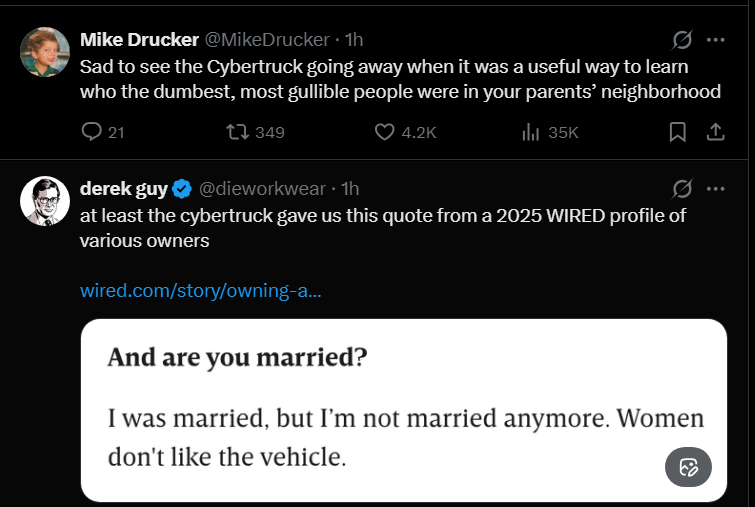
$100K vehicles are 'help me get laid' products. But today it only attracts Laura Loomer types. Nobody wants that.
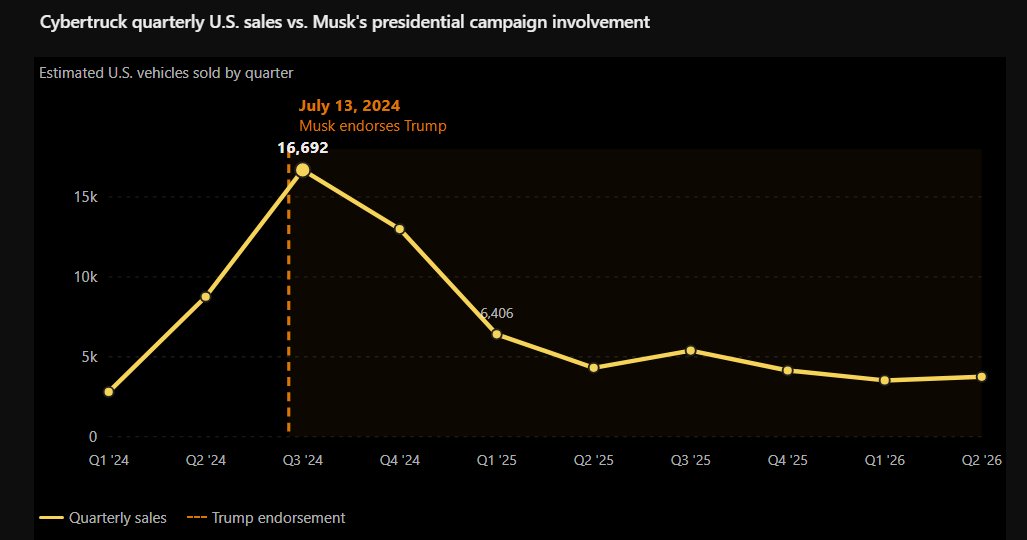
The Cybertruck's design was a cultural play. If people see 'different' as 'cool' it sells. Then Elon joined politics, and politics is not cool. Who wants to spend $100K when it comes with political baggage?
Tesla will wind down Cybertruck production around mid-2027, CEO Elon Musk says, after years of persistently weak sales for a futuristic model once touted as a rival to legacy pickup trucks. https://t.co/8NC8pDGsKs