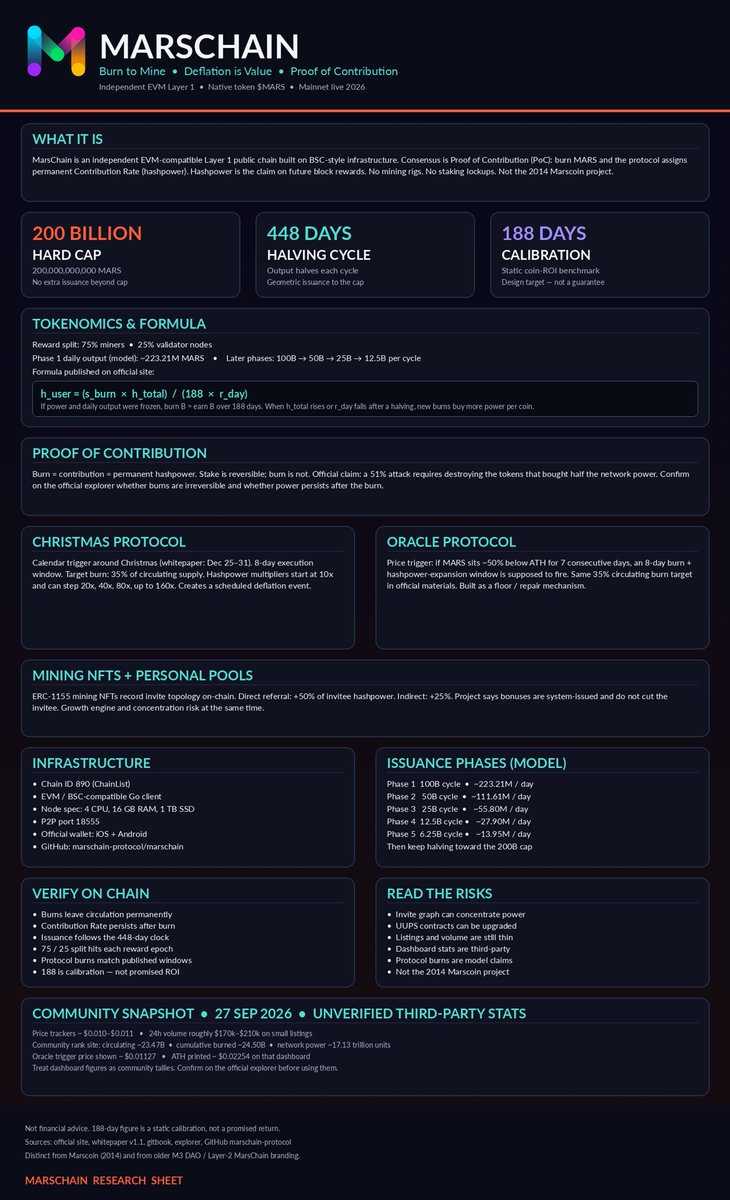
🌌 MarsChain: Rethinking How Blockchain Contribution Is Measured
Most blockchain networks are built around Proof of Work (PoW) or Proof of Stake (PoS).
MarsChain takes a different approach with Proof of Contribution (PoC) — where contribution is represented through an on-chain, protocol-defined mechanism.
Here’s how the model works 🧵👇
1/ 🔥 Proof of Contribution — Burn → Contribution Rate
In MarsChain’s PoC model, participants burn MARS and the protocol converts that contribution into a Contribution Rate using:
Hᵢ(t₀) = Bᵢ × r(t₀)
Where:
• Bᵢ = amount of $MARS burned
• r(t₀) = protocol-defined conversion ratio
• Hᵢ = resulting Contribution Rate
The burned MARS permanently leaves circulation, while the Contribution Rate becomes a continuing protocol credential used for future block-reward allocation.
Importantly, MarsChain defines Contribution Rate as a protocol-defined production right, not physical machine hashrate.
2/ ⚙️ How are rewards distributed?
MarsChain uses the participant's Contribution Rate relative to the network's total Contribution Rate.
The reward function is:
yᵢ(t) = R(t) × Hᵢ / Hₜₒₜₐₗ(t)
So, in simplified terms:
Your Contribution Rate ÷ Total Network Contribution Rate = your proportional share of the miner allocation.
The model therefore connects contribution directly to future production capacity at the protocol level.
3/ ⏳ The 188-Day Benchmark
One of MarsChain's most interesting mechanisms is its 188-day theoretical benchmark.
It acts as a design and pricing reference for the PoC system.
But there is an important distinction:
⚠️ 188 days is NOT a guaranteed return.
⚠️ It is NOT a fixed recovery period.
⚠️ Actual outcomes depend on network Contribution Rate and reward release.
As network participation changes, MarsChain's dynamic calibration function r(t) is designed to respond to changes in total Contribution Rate.
In other words, the protocol attempts to reduce differences caused purely by entering the network at different times.
4/ 🧮 Dynamic Calibration — Why r(t) Matters
Imagine the network grows significantly.
The total Contribution Rate increases → the reward share associated with each unit of Contribution Rate can decrease.
MarsChain therefore makes the conversion ratio r(t) responsive to network conditions.
The whitepaper describes this as a way to reduce structural time-based advantages and maintain a unified framework for participants entering at different stages.
The key idea:
Network growth → calibration → adjusted Contribution Rate allocation
Rather than treating the original conversion ratio as permanently fixed.
5/ 🎨 NFT Mining + Personal Mining Pools
MarsChain uses NFTs for more than collectibles.
Its designated ERC-1155 NFTs function as on-chain identity credentials connected with:
🔹 Miner identity
🔹 Contribution participation
🔹 Personal mining pools
🔹 Invitation relationships
The system uses two core upgradeable contracts:
PowerContractUpgradeable.sol
→ processes MARS burns
→ calculates Contribution Rate
→ updates network weights
→ manages mining-pool incentives
PowerNFTUpgradeable.sol
→ manages ERC-1155 miner NFTs
→ records invitation relationships
→ acts as an on-chain participation credential.
6/ 🤝 Referral Mechanism — Contribution-Driven Growth
MarsChain's personal mining-pool model uses Contribution Rate rather than simply paying a direct cash/token referral reward.
According to the whitepaper:
Level 1 inviter → 50% of invitee ΔH
Level 2 inviter → 25% of invitee ΔH
The referral allocation is described as coming through proportional dilution of existing network-wide Contribution Rate weights rather than being deducted from the invited participant's newly generated Contribution Rate.
And importantly:
An invitation alone does not generate a reward.
The invited participant must actually complete the protocol-defined burn and generate verifiable contribution.
7/ ♻️ MARS Tokenomics
MarsChain's whitepaper specifies a fixed maximum supply of 200 billion MARS.
The protocol describes:
🔸 200B MARS maximum supply
🔸 448-day halving cycle
🔸 75% block reward allocation → PoC miners
🔸 25% → validators & persistent network nodes
Block-reward emission decreases through successive 448-day cycles:
1× → ½× → ¼× → ⅛× → 1/16× and progressively lower
The stated model therefore combines a fixed supply ceiling with declining block-reward emissions.
8/ 🔥 Two Deflationary Paths
MarsChain describes two separate deflation mechanisms.
PATH 1 — Regular PoC Burns
Participants burn MARS to obtain Contribution Rate.
Those tokens are permanently removed from circulation.
PATH 2 — Protocol-Triggered Burns
The Christmas Protocol and Oracle Protocol can activate under defined conditions and target additional supply contraction.
The whitepaper states a target of 35% of circulating supply during their respective execution windows, subject to protocol conditions.
9/ 🎄 Christmas Protocol
This is a calendar-based mechanism.
📅 Trigger: December 25–31
⏱️ Execution window: 8 days
🔥 Target: 35% of circulating supply
⚡ Contribution Rate multipliers depend on the applicable halving cycle.
Instead of immediately distributing liquid rewards, qualifying participation results in additional Contribution Rate.
That keeps the mechanism connected to the PoC production model.
10/ 🔮 Oracle Protocol
The Oracle Protocol introduces a market-condition trigger.
According to the whitepaper, it can activate when MARS declines 50% from the designated reference high.
The mechanism similarly uses an 8-day execution window and targets a burn of 35% of circulating supply, subject to the protocol's conditions.
The intended design is to create an additional supply-contraction mechanism during severe market declines.
Again, these are protocol mechanisms described by the whitepaper—not guarantees of market performance or token price recovery.
11/ 🌐 MarsChain's Bigger Architecture
MarsChain positions itself as an EVM-compatible Layer1.
Its architecture includes:
🔹 Access Layer — wallet, explorer, RPC, SDKs & APIs
🔹 Protocol Layer — PoC, r(t), Christmas & Oracle logic
🔹 Execution Layer — EVM-compatible smart contracts
🔹 Data Layer — on-chain states, blocks & transactions
This gives developers an environment intended to support applications such as DeFi, NFTs, GameFi, SocialFi, AI and real-world asset applications.
12/ 🔄 The MarsChain Economic Loop
The entire model can be viewed as one interconnected cycle:
Contribution
⬇️
$MARS Burn
⬇️
Contribution Rate
⬇️
Block Rewards
⬇️
Ecosystem Use
⬇️
New Contribution
That is the central economic architecture MarsChain is trying to build around its PoC model.
🌌 The interesting question isn't simply “What is MARS?”
It's:
Can contribution, scarcity and future production capacity be connected through deterministic on-chain rules?
MarsChain's answer is its Proof of Contribution architecture.
📖 Whitepaper v1.1
🌐 https://t.co/dnJWwDjOuh
🔎 MarsChain Explorer
Study the mechanism. Verify the data. Understand the protocol.
#MarsChain #MARS #ProofOfContribution #PoC #Blockchain #Web3 #Layer1 #Crypto #DeFi #Tokenomics #EVM #ChristmasProtocol #LBank #KTX
@MarsChainDAO
🪐 MarsChain ($MARS): When Burn Becomes Contribution
I went deeper into MarsChain’s official documentation, and the most interesting part isn’t simply the token burn.
It’s what happens after the burn.
MarsChain is built around Proof of Contribution (PoC), where burning $MARS is treated as a verifiable contribution to the network.
🔥 BURN $MARS → CONTRIBUTION RATE → FUTURE REWARD ALLOCATION
According to the whitepaper, once MARS is burned, it permanently exits circulation. The protocol then converts that contribution into a Contribution Rate — a protocol-defined production right representing a participant’s proportional entitlement to future block rewards.
One important technical distinction:
Contribution Rate ≠ physical mining hashrate.
It is an on-chain protocol mechanism used to determine a participant’s share of future block-reward allocation.
🔬 THE 188-DAY MODEL
MarsChain’s economic design uses an 188-day theoretical benchmark.
But this is where the documentation matters: the whitepaper explicitly describes the 188-day figure as an idealized pricing/design reference, not a guaranteed ROI, fixed yield, or promised recovery period.
Actual outcomes depend on network Contribution Rate, total network participation and reward release.
⚙️ TOKEN + NETWORK ARCHITECTURE
MarsChain documents:
• 200B fixed maximum supply
• 448-day halving cycle
• 75% of output allocated to miners
• 25% allocated to validator nodes
• EVM-compatible Layer 1 architecture
• Native MARS, wallet and block explorer
• Smart-contract infrastructure supporting the PoC system
The key idea is that the burned MARS does not simply disappear from an economic model — it is intended to become a continuing protocol-level production right.
🎄 CHRISTMAS PROTOCOL
This is another unusual part of the design.
MarsChain documents an 8-day Christmas Protocol event with a stated burn of 35% of circulating MARS supply, combined with increasing hashpower multipliers:
10× → 20× → 40× → 80× → 160×
The concept is to combine an irreversible supply reduction with temporary expansion of production capacity.
🔮 ORACLE PROTOCOL
The project also documents an Oracle Protocol that activates when price retraces 50% from its ATH for 7 consecutive days, followed by an 8-day burn and hashpower-expansion cycle.
Again, the important point is not simply the headline numbers.
It’s the mechanism connecting burn → contribution → production rights → reward allocation.
🌐 WHY THIS IS INTERESTING
Most crypto discussions stop at:
“Token burn = less supply.”
MarsChain is trying to build a different relationship:
Burned capital → permanent Contribution Rate → continuing participation in block rewards.
That creates a much more interesting question for the ecosystem:
Can an irreversible on-chain contribution remain meaningful and economically balanced as total network participation grows?
That’s the part of MarsChain I’m watching closely. 🪐
#MarsChain #MARS #Web3 #Crypto #Blockchain
@MarsChainDAO
Marschain : burn is the bid
Most chains price block rights with capital: hash rigs or locked stake.
MarsChain prices them with destruction.
Burn $MARS → the protocol mints permanent Contribution Rate (hashpower) → that rate is your claim on future issuance.
That is Proof of Contribution. Not a metaphor. A conversion function.
Official design anchors, from the site and whitepaper:
• Cap: 200 billion MARS. No extra mint beyond the cap.
• Halving: every 448 days.
• Split: 75% miners / 25% validators.
• Calibration constant: 188 days.
188 is not “guaranteed profit.” It is the static benchmark the conversion ratio is built around.
The conversion, as published:
h_user = (s_burn × h_total) / (188 × r_day)
If total network power and daily output were frozen, burning B tokens is meant to earn about B tokens back over 188 days.
When h_total rises, new burns buy more power per coin. When daily output falls after a halving, new burns also buy more power per coin.
Early capital does not automatically lock the curve forever.
Why burn instead of stake?
Stake is reversible. Burn is not.
Reversible collateral can leave. Irreversible burn is supposed to raise the cost of a 51% attack: to own half the power, you must destroy the tokens that bought half the power.
Whether that holds depends on whether power is truly permanent and whether large wallets can still dominate issuance.
Check the explorer, not the slogan.
Two overlay protocols sit on top of PoC:
🎄 Christmas Protocol — calendar trigger. Multi-day burn + hashpower multiplier event.
🔮 Oracle Protocol — price trigger. If price sits ~50% below ATH for 7 days, a similar burn + multiplier window is supposed to fire.
These are meant to force scarcity when either time or price says the float is too loose.
Growth layer: ERC-1155 mining NFTs + personal pools.
Direct invite: 50% of the invitee’s power as bonus.
Indirect: 25%.
The project says those bonuses come from system issuance, not from cutting the invitee.
That is a recruitment engine. It can widen the network. It can also concentrate power in the people who arrived first and invited the most.
Both can be true.
How to read it without the brochure:
MarsChain is closer to a value-capture chain than to “the next Ethereum.”
EVM compatibility is there. The economic bet is that destroyed float + permanent production rights can replace perpetual issuance as the reason to participate.
The honest test is on-chain:
• Are burns real and irreversible?
• Does power persist after the burn?
• Do Christmas/Oracle events actually delete supply?
• Is issuance following the 448-day schedule?
Three numbers to remember:
200B / 448 / 188
Everything else is commentary on those three.
#MarsChain #PoC $MARS @MarsChainDAO
🔥 What if blockchain participation wasn’t just about holding tokens—but about measurable contribution?
🪐 MarsChain connects $MARS tokenomics, Proof of Contribution, NFTs, referrals and protocol-driven incentives into one ecosystem.
⛏️ 1️⃣ Proof of Contribution (PoC)
$MARS Burn → Contribution Rate → Permanent Hashrate → Daily Rewards
Hashrate represents protocol participation weight—not simply raw computing power.
🎄🔥 2️⃣ Christmas Protocol
A major economic mechanism combining:
🪙 35% of circulating $MARS burned
⚡ 10× Hashrate multiplier
A burn + multiplier model designed to amplify participation.
🔮 3️⃣ Oracle Protocol
A price-responsive mechanism tied to a stated trigger when $MARS reaches 50% below its ATH.
🪙 4️⃣ MARS Tokenomics
Maximum supply: 200B MARS
⏳ 448-day halving cycle
🔥 Burn mechanisms designed to reduce circulating supply.
🎟️ 5️⃣ NFT Mining Access
MarsChain NFTs function as on-chain miner identity credentials—not simply collectibles.
➡️ 10,000 MARS → NFT minting
➡️ Identity + ecosystem access + referral functionality
🤝 6️⃣ Referral & Contribution System
Personal Mining Pool:
• Level 1 → 50% of invitee additional Hashrate/Contribution Rate
• Level 2 → 25%
• Invitees retain 100% of their own contribution
The model focuses on actual contribution, not just referral counts.
🏦 7️⃣ Exchange Access
$MARS ecosystem access also extends to:
🌐 @LBank_Exchange
🌐 @KTX_exchange
🪐 The bigger picture:
🔥 Burn → ⛏️ Contribution → ⚡ Hashrate → 🎁 Rewards → 🌐 Ecosystem Growth
MarsChain is combining token economics, PoC, NFTs, referrals, burns and adaptive protocols into a contribution-driven Web3 model.
🚀 Don’t just watch $MARS. Understand the architecture behind it.
DYOR. Explore the mechanisms. Find your role in the MarsChain ecosystem.
🪐 The next chapter is yours to explore.
#MarsChain #MARS #PoC #ChristmasProtocol #LBank #KTX #Web3 #Crypto @MarsChainDAO
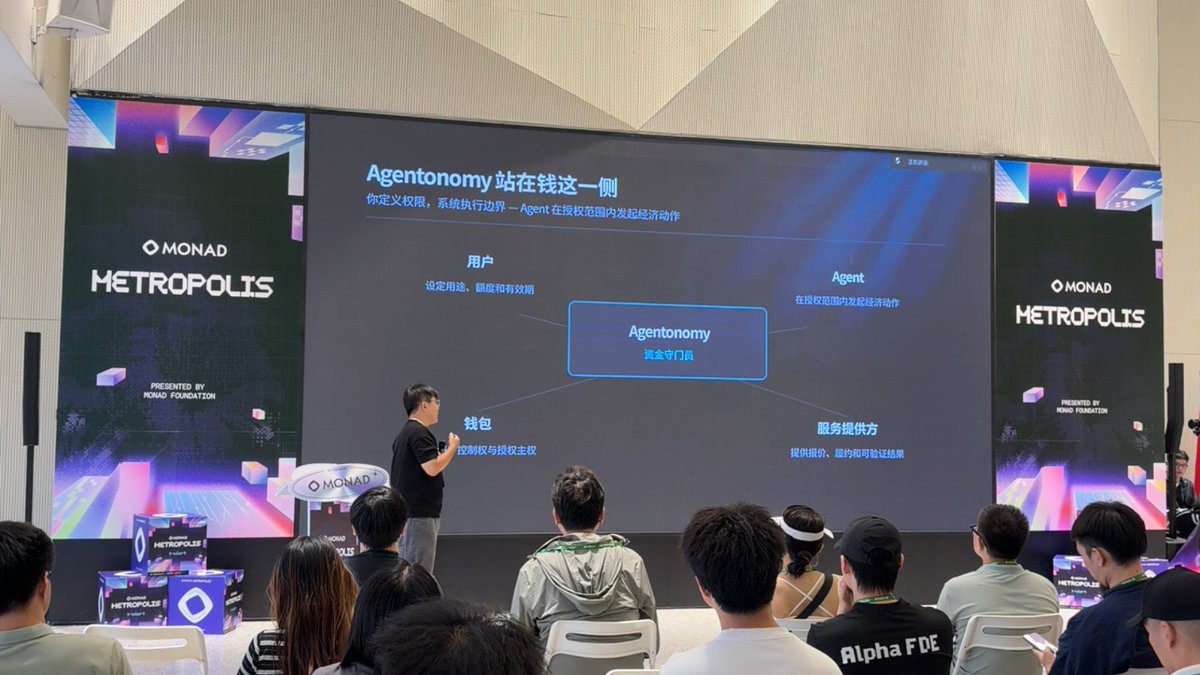
Glad to join Monad Metropolis Hacker House Hangzhou for a Feature Share.
Our talk: “From Thinking to Transacting: A Trusted Closed Loop for Agent Payments.”
We shared Agentonomy’s approach to agent payments under user-set authorization.
Thanks @monad_zw for the invitation.
We’re bringing Agentonomy Commerce to the X-Agent AI MCP Hackathon 2026 🚀
It lets agents purchase services within a user-authorized budget and receive verifiable results.
Budget enforcement, service delivery, order tracking, and idempotent retries now work as one complete flow: repeated requests never trigger duplicate charges.
The demo is live, with no registration required. It uses simulated USDC, while the service computation and HTTP delivery run for real.
Try it 👇
https://t.co/2kHetw9mby
WHAT YOUR POST MUST INCLUDE 1. @FinchTechAI 2. Your own card link, in full: https://t.co/wVRRVX9GiV 3. Add Tag #NowHiringAI (EASIEST WAY — don't copy anything by hy first AI employee on @FinchTechAI. Meet [your AI employee's name] 👇 https://t.co/wVRRVX9GiV #NowHiringAI)
Congratulations. You're a boss now.
NOW HIRING: AI
Hire your AI Employee in 10 seconds. Free. No résumé.
Share its badge → it comes back with a real Skill,
or free agent calls, from Finch.
Then put it to work. Finish Tasks on Finch and
get paid automatically once the work is verified.
Sign the offer →
https://t.co/lQQwsdvHSp
Thousands of new AI apps, agents, and skills drop every day. But the best of them are trapped in messy chats, configs, .md files, and technical setups.
Most people get left behind.
Today, we're launching #taku 2.0 Beta 🚀
Taku turns powerful AI capabilities into real apps anyone can use, remix, and share.
Discover what the pros are building.
Run it as a real app — no setup, no code.
Chain multiple tools into one workflow.
Or just tell taku what you want, and watch it build the whole thing.
AI shouldn't be another thing to learn.
It should just work.
Borrow brilliance. Make it yours.
👇
Try https://t.co/iP3PKJFfB0
POV: you finally decided to let the cat trade. 🐱
Here’s the quickest way to get started with Maneki.
Connect → Set up → Launch your Agent.
That’s it.
Watch the tutorial, grab your credits, and let the cat cook. 🔥
#ManekiAI#AITrading#Agent
Maneki AI is live. 📈
Your 24/7 AI trading agent for perpDEX is now open.
🔗:https://t.co/SLKDartNsC
Create an agent.
Pick a stock perp market.
Choose a trading style.
Set capital & leverage limits.
Let the Lucky Cat watch, reason, and trade.
Every move comes with a clear decision trail — because trading agents should be explainable, not black boxes.
The Lucky Cat That Never Sleeps.🐱
#Maneki #AI #Agent #perpDEX
Maneki’s notes from last week 🐾✍️
Last week, we moved our servers to Microsoft Azure ☁️
With cloud credits provided by Microsoft, Maneki has found a new home in the cloud—and the cat has already settled in and started building. 🐱💻
A big thank-you to @Azure for supporting us along the way! 💚
Servers moved. Notebook updated. More building ahead.
#ManekiAI #MicrosoftAzure #BUIDL #Agent
Maneki AI has been selected for the 2026 0G Atlas Founder House! 🐱
We’ll be joining fellow builders to keep building the future of AI-powered trading.
Big thanks to @BaiduAI Cloud for supporting the Founder House, and to @HackQuest_ and @0G_labs for bringing us together. See you there!
#ManekiAI #Agent #AITrading
Phase 1 — Cold Start — is officially live.
Invite-only. One code = 1 SOL of buy quota.
Spend it in full → two new codes to hand out.
Every code you hand out that's spent in full → 1 SOL credited back to you.
Every invite code grows like this. Watch one split. ↓
https://t.co/6SM03c5Swa
Mention @ManekiaiX and write a detailed post covering any of the following topics: Which Maneki feature appeals ss short phrases, or claims of guaranteed returns are not accepted; do not describe featnces" if you haven't actually used them. Submit the link to your post as proof.