Thanks for the question! Our Pi0.5 checkpoint was post-trained on data from only five relatively challenging tasks. Most of these tasks can be accelerated, but successful execution is not guaranteed across all tasks. Importantly, the editing of Opus-5.5 does not reduce the original policy's success rate. We also provide analyses of other tasks, such as coin positioning, in our blog.
Opus-5.5 edits π₀.₅’s weights: ~30% less task time, 100% success in our bottle-placement trials.
We asked Claude Opus 5.5 to write code that edits π₀.₅’s weights and makes a YAM robot faster—no backpropagation, no production inference-code changes.
In ~111 minutes on one RTX 4090, it tested a RoPE-based speedup, fitted it into Q/K weights, and unexpectedly found and repaired an RTC prefix bug.
The ~30% reduction combines weight editing with a higher execution rate: original at 30 Hz → edited at 40 Hz. At matched rates, weight edits alone reduced task time by 4.3–12.0%.
We expected a few clever parameter changes. What unfolded was AutoResearch: hypotheses, experiments, failed attempts, and iteration.
Blog + robot demos:
https://t.co/vtZWHMFAJr
TLDR: Weight editing today is perhaps still a subset of auto research — many of its effects are equivalent to modifications made in code space. Whether we can exploit the properties of neural networks beyond code may be the real key to unlocking parameter space.
@Fanding_Huang Thanks for helping build ManiMux, Fanding! 🤝 Making robot experiments easier to inspect, reproduce, and build on is exactly what we're working toward. Glad to be building this together!
Robotic manipulation is not only about success rate. It is also about getting things done efficiently.
The real world runs in real time, asynchronously. It does not pause for model inference. Turning model capabilities into smooth, continuous, efficient robot behavior requires the right inference and execution strategies—from handling latency to transitioning between action chunks. From early work on asynchronous inference in Diffusion Policy to π’s @physical_int later work on RTC, the robotics community has paid increasing attention to these challenges.
As robot foundation models become available through cloud APIs, coordinating inference and execution becomes even more critical. The release of the Dream-1 API @dreamlabs_ai gave us a timely opportunity to explore this. With several official demos shown at 8× speed or faster, we wanted to see: How does Dream-1 perform in real time? And how much could running inference and execution asynchronously improve motion continuity and task efficiency?
Our team quickly integrated Dream-1 into ManiMux, our in-house framework, and tested it on YAM.
The results surprised us: even with seconds of cloud API latency, better asynchronous inference and execution scheduling improved fine-manipulation performance and efficiency. In our block-stacking tests, asynchronous inference doubled Dream-1’s task completion efficiency!
Increasingly capable System 2 models are exciting. The System 1 side of robotics—timely responses, continuous motion, and efficient execution—deserves attention too. We want to make these capabilities easier for the community to use, compare, and reproduce.
While GPT-6-Astra @OpenAI is making everyone anxious, we want to share a few insights beyond System 2—and make it easier for everyone to build a fast, responsive System 1 for real robots.
That is why we are building ManiMux, an open-source inference harness and experiment management platform for real robots, designed to make deployment, inference, and evaluation easier and more reproducible.
ManiMux currently integrates policy frameworks including XPolicyLab and StarVLA, inference algorithms including RTC, PAINT, and AutoHorizon, and robot platforms including Tianji, YAM @i2rt_robotics , and AgileX @AgilexRobotics . Support varies across model, algorithm, and robot combinations, and we are continuing to expand real-robot validation and improve usability.
To make integration easier, the repo also includes comprehensive agent documentation and Skills. Use your coding agent to quickly integrate your own robots and policies, adapt deployment workflows, and build new features—so you can spend more time experimenting on real robots.
We have been developing ManiMux for over two months. We are also collaborating with teams around the world on a systematic comparison of inference algorithms, with more observations and practical recommendations from real-robot experiments to come. Stay tuned.
Try ManiMux, open an issue, contribute code, or share your real-robot experience. Let’s make robot experiments more reproducible—and robot execution smoother and faster.
Let’s make something meaningful, together.
Github: https://t.co/DbUuzyqo3X
🚀 Introducing LoopVL — Recurrent Visual Intelligence.
🏆 LoopVL reached #1 on Hugging Face Daily Papers on October 1, 2026! 🤗
A compact vision-language model with visual “aha moments.” 👀💡
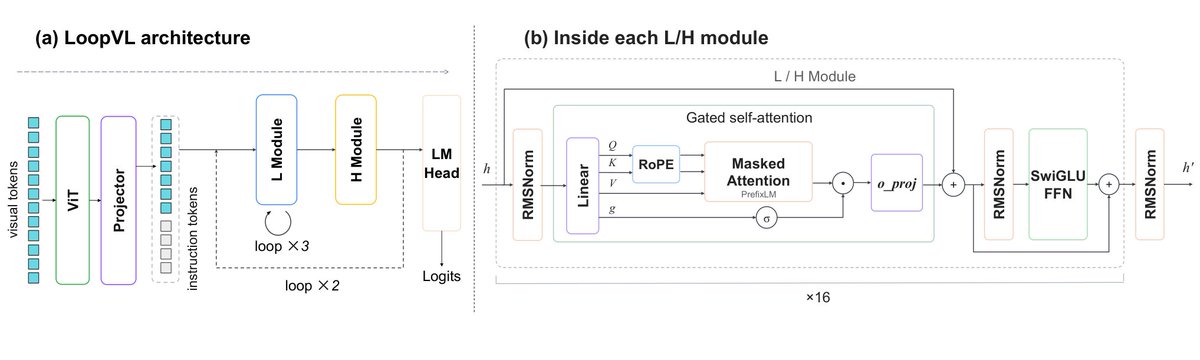
LoopVL brings recurrent computation to vision-language modeling: visual and language states evolve together as shared Transformer modules repeatedly revisit and refine them.
Think of it as giving the model another look at its own evolving understanding. Across loops, we observe sharp shifts in visual attention, with some initially overlooked image regions becoming prominent later. We call this a Visual Aha Moment.
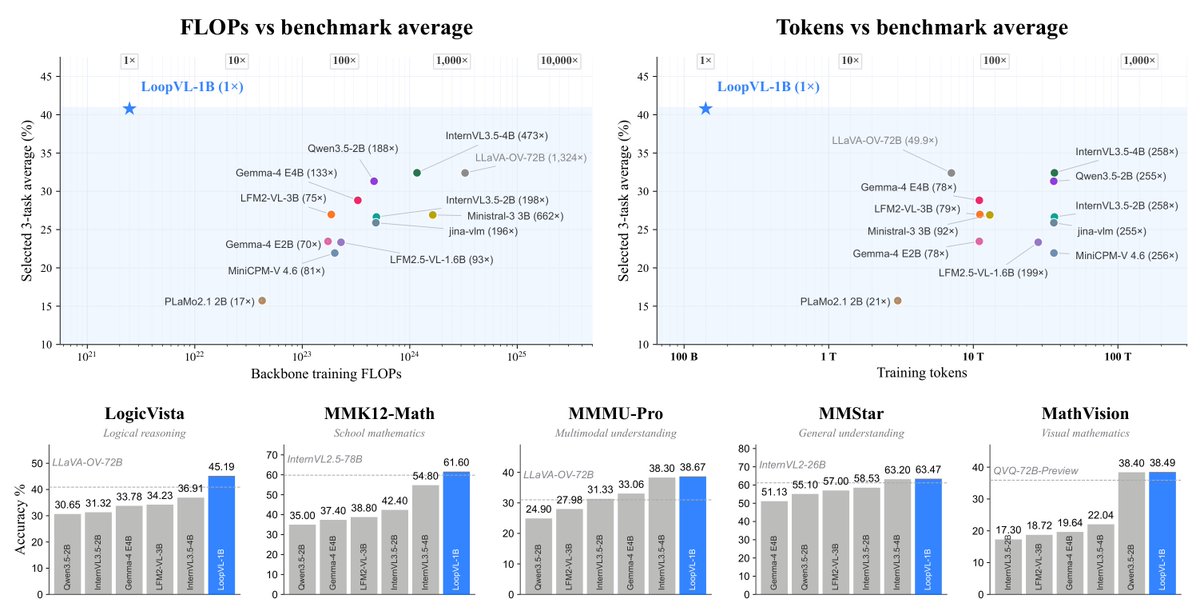
With Module-Loop + Model-Loop, 32 unique Transformer layers support 128 layer applications per forward pass — enabling deeper multimodal computation through parameter reuse.
Our ~1B language backbone is competitive with 4B dense baselines under the same training-data budget. Evaluated across 16 benchmarks, LoopVL achieves 45.19 on LogicVista, 38.67 on MMMU-Pro, and 61.60 on MMK12-Math.
Code, model weights, and evaluation tools are open. Come explore recurrent visual intelligence with us!
Look again. Think deeper. 🔁👁️
📄 Paper:https://t.co/m6qzaMjIen
💻 Code:https://t.co/5kckRULoIT
🤗 Model:https://t.co/8tUBNquH23
🚀 Introducing SkillOpt — an optimizer for agent skills.
Instead of finetuning model weights, we treat a natural-language skill as a trainable external parameter.
Think of it as deep learning for the frontier-model + agent era: learning rate, LR schedule, mini-batch, batch size, epoch, momentum — all in text-space optimization.
SkillOpt enables stable, controllable skill updates through bounded edits, allowing the optimizer to summarize “gradient directions” from agent experience and continuously improve procedural capability.
We evaluate SkillOpt across 6 benchmarks and 7 models, under both direct model calls and real agent execution loops with Codex + Claude Code. SkillOpt achieves best or tied-best results in 52/52 settings.
Train the skill, not the model. 🛠️🤖
🌐 https://t.co/zinqcX2wfQ
📄 https://t.co/pCI4VWdpih