China’s post 1990s generation of AI talent is something to behold.
One thing that has caught my attention is the age of the people building China’s frontier AI.
Kimi’s founder was born in 1992. Many of the teams behind MiniMax, Seedance, Zhipu, and other leading AI companies are dominated by engineers born in the 1990s and early 2000s.
This isn’t limited to AI. This year’s Fields Medals also went to two Chinese mathematicians from the same generation.
I don’t think these are isolated events. They may be early signals of a much deeper trend: what we’re witnessing is not just an AI boom, but the emergence of a new generation of scientific and engineering talent in China.
One possible explanation is education.
After the Cultural Revolution ended, China’s education system was gradually rebuilt. The generation that became today’s parents of many 90s and 00s children benefited from that recovery, and many placed an extraordinary emphasis on education. The result may be the first generation of Chinese researchers and entrepreneurs raised in families where higher education had become both accessible and deeply valued.
If this hypothesis is right, AI is only the beginning.
We may see the same generation produce breakthroughs not only in frontier models, but also in quantum computing, biology, mathematics, computer science, and many other fields over the coming decades.
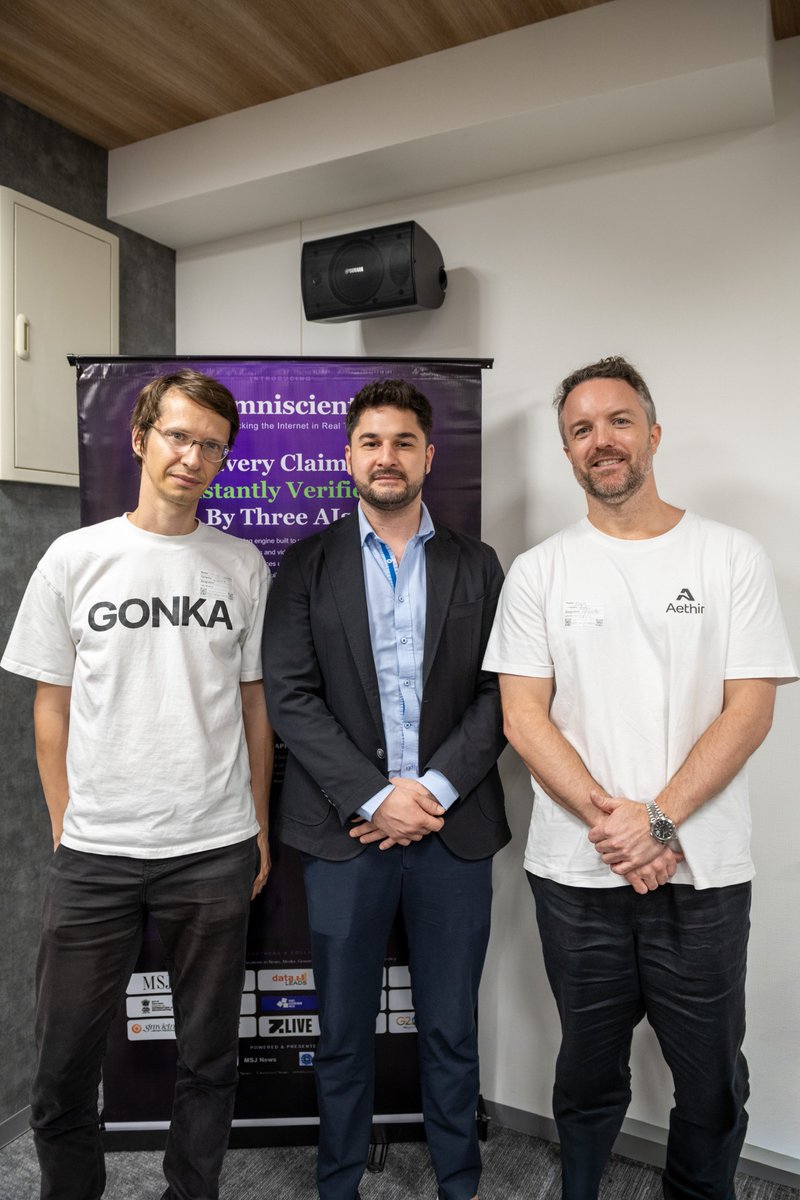
Great conversation with @MRRydon from Aethir. As a DeAI industry, we should not compete with each other, we should fight the centralization. It doesn't matter which protocol gets more recognition. Ultimately, with more decentralization, we all win
🇯🇵 WebX Asia might be over, but the work of moving decentralized AI forward never ends.
Recently, David Liberman had a public conversation at the AI Economic Forum with Mark Rydon, Co-Founder of @AethirCloud, and Omar Abi Issa of @OVHcloud.
🤑 Exciting update: the Gonka Bug Bounty Program on HackerOne has increased rewards for reported critical-severity vulnerabilities to $15K–$25K, up from the previous range of $5K–$10K.
Read the program details here:
https://t.co/o3TEIbOBED
Analyze the code on GitHub:
https://t.co/WHqPd6JGzW
Report vulnerabilities through HackerOne:
https://t.co/DVBDQxeO5i
Satya Nadella suggested in his latest essay that the future belongs to those who build both human capital and token capital
When you pay for AI tokens or subscriptions to OpenAI or Anthropic, you don't accumulate any lasting capital - they do. The providers use that revenue to build data centers and train their next proprietary models
But decentralized AI introduces a different dynamic
When you use @gonka_ai , you can both consume AI compute today and accumulate tokens that represent future AI compute in the decentralized network
Access to neural networks based on your passport has ceased to be a dystopian fantasy
A few days ago, Anthropic released Fable 5. Essentially, it's their flagship Mythos 5, but censored (which was already a concern). On top of that, almost immediately, the U.S. government demanded that access to both models be banned for all foreign nationals. And it doesn't matter where you are, even if you work at Anthropic itself
There are around 300 million U.S. citizens, while the world's population is 8.3 billion. That means roughly 8 billion people will officially be cut off from the most powerful AI model available today
Even Andrej Karpathy, a true AI industry celebrity who recently joined Anthropic, got caught in the crossfire. He simply doesn't have an American passport.
As a result, the company temporarily shut these models off for all customers while the dispute with the authorities is being sorted out. We're getting used to a new reality
First, AI has officially become a strategic resource. On par with uranium, chips, and weapons.
Second, access is granted based on citizenship. Your talent, needs, or money no longer matter
Third, we now have two closed camps: the U.S. and its allies versus China and its allies. Everyone else will have to make do with whatever they are allowed to use
Today, it is not so important who exactly built the best model. What matters is the precedent itself: access to intelligence for 95% of the planet can be cut off with a single letter from a regulator. Which means the world desperately needs independent infrastructure that cannot be switched off at the snap of a finger
Join us for the two most important days in Japan's Web3 industry this year at @WebX_Asia. Don't miss our talk and then come chat with the Gonka community at the booth
https://t.co/uXODFzCFC1
🎙️Meet Daniil and David Liberman (@DaLiberman), Co-creators at Gonka, at #WebX2026 on July 13-14th.
David and Daniil Liberman are Los Angeles-based futurists, serial entrepreneurs, and investors, and former Directors of Product at Snap, as well as the co-creators of the Gonka protocol. They began their entrepreneurial path together with their siblings, co-founding ventures across computer graphics, finance, and artificial intelligence.
They co-founded Frank Money, pioneering radical financial transparency, and later launched Kernel AR, which was acquired by Snap in the same year. Together with their siblings, David and Daniil signed the Founders Pledge, channeling their economic output into Libermans Co., now valued at approximately $400 million, and attracted investments from Marc Andreessen, Josh Kushner, and Arielle Zuckerberg.
Gonka is a decentralized, community-governed network that delivers the first truly efficient computation on the blockchain, designed for AI inference and training. The Gonka protocol ensures that nearly 100% of computational resources are directed toward productive AI tasks rather than wasteful security overhead, addressing fundamental inefficiencies in both centralized cloud providers and existing decentralized networks.
For more details, visit: https://t.co/yfIVmdks6t
"... building a world in which everyone can flourish requires shared responsibility and courage. No one can single-handedly bear the weight of the challenges the world is facing, just as no one is so weak that they cannot play their part, for “power is made perfect in weakness” (2 Cor 12:9). All are given their own section of the wall..." - Pope Leo XIV’s Magnifica Humanitas
AI deflation is starting to hit.
@nebiusai is rapidly increasing its GPU prices:
H100: $2.95/hr → $3.85/hr
B200: $5.50/hr → $7.15/hr
This is what the capital shift into AI looks like.
As intelligence becomes abundant, most goods, labor, and even fiat currencies may fall in relative value against AI infrastructure assets: compute, energy, chips, data centers.
AI infrastructure is becoming monetary infrastructure.
@PeterMcCormack Exactly, the feeling is incredible. This is the moment when AI stops being a chatbot and becomes part of the company’s nervous system.
But it also shows dependency
We are officially past the point where decentralized AI inference is only a philosophical argument
Over the last 24 hours, Gonka processed hundreds of thousands of inferences and billions of AI tokens across the network. Across a decentralized network of real hardware built by dozens of participants - companies and individuals
This is still early and rough around the edge, people are still hitting limits, but when they do, it’s another milestone for the network. But this is exactly how new infrastructure starts. Perfection is not important, usability is. It is already real, being used, and improving faster each week
The demand for inference is already coming from millions of developers, agents, builders, and users around the world. The question is whether this demand will keep flowing into a few centralized providers or whether it will drift towards an open, verifiable, decentralized alternative
If you want decentralized AI to exist, use it. Try the inference, build with it, help other people connect, launch a swarm of agents, and try to bump into the limit to push it further. Every request, every test, every fix, every GPU, every new user makes the network stronger
Bitcoin started this way. This is how open infrastructure wins
Thank you, @PeterMcCormack, for the opportunity to discuss this important topic and share our thoughts with your audience regarding what might happen without the decentralization of AI (including the darkest scenarios).
Watch and beware
"We're not going to even know it's slavery."
The Liberman brothers (@DaLiberman) escaped Russia and sold their last company to Snapchat. Now they say we have 2 years before AI replaces us - and we're paying the corporations to do it.
Full episode 👇
Our conversation with Alexander Sokolovskiy, seen by 1M+ Russian viewers, is now in English
It’s about more than AI. It’s about intelligence becoming infrastructure.
The key question:
Who owns it?
If AI is controlled by a few corporations and states, the future stays permissioned
Open models, distributed compute, shared intelligence
Let’s build that future
https://t.co/cbwKATlTIM
HEVN (@hevn_finance) is building a “Brex for non-US companies” — an alternative financial platform that lets businesses open virtual bank accounts in 8 banks worldwide, use USD cards with cashback for Google/Meta ads, and store funds in USD.
Congrats on the launch, @p_volnov and @Nikitadigital10!
https://t.co/yW9J3k0jR5
‘The world is changing.
AI—the biggest frontier models—can fit on a tiny flash card. They are essentially copyable, so every human on Earth can have them.
We can actually bring abundance to billions of people around the world if we manage to make these technologies universally accessible.’
@DaLiberman at LA Hacks 2026.
https://t.co/DurrDaoS9G
DeAI is not built on technology alone. It also depends on transparency, trust, and responsibility to the community around it
Periods of strain are when principles are most severely tested. They rarely collapse in a single moment. More often, they erode gradually, through small concessions, accumulated compromises, and decisions made for immediate convenience
If DeAI is meant to differ from centralized corporate systems, that difference has to be visible in practice, not only in language
🚨 BIG NEWS: Pronto has officially been acquired by Atoms, the physical AI company founded by @travisk. We are incredibly proud to step in as the core technology engine of the newly formed Atoms Mining division.
Read the full announcement: https://t.co/fovua0xvWo
Anthropic has not released its most powerful model to the public and has given access only to a closed group of partners - Apple, Meta, Microsoft, Nvidia
This is not an exception. It is a pattern
Not long ago, public leaders in the industry were saying that AI would be accessible to everyone, that it would expand human potential.
In reality, we are returning to a familiar structure: a closed club, selective access, control
This is not about safety, no matter how it is framed.
It reflects a deeper logic of elites - dividing the world into insiders and outsiders and controlling access to key resources
In the past, those resources were oil, energy, finance, water.
Now intelligence and compute have been added to that list
And the outcome is always the same: not abundance, but competition for access, gatekeeping, constant tension and conflict
AI is only accelerating this dynamic.
For the first time, this is not just about resources, but about a system that shapes thinking, decisions, and the structure of society itself
If this layer remains centralized, we do not get a future of abundance, but a more advanced form of dependency
So the question is no longer about technology.
It is about architecture
Either AI remains in the hands of a few players, and the world is ultimately divided between those who have access and those who do not
Or an alternative layer emerges - decentralized compute, open-weight models, distributed infrastructure
This is the only way to break the cycle in which resources inevitably concentrate in the hands of a few
Otherwise, history will repeat itself. And we will find ourselves back in the Thucydides Trap