@SteveRattner A decade ago, Google made $90B in revenue (~Anthropic's current run rate). Meta made just $28B (~Anthropic's last 12 months)
The future doesn't fit in today's spreadsheets
I've built a new AI model that is not allowed to generate text. Instead, it produces a verifiable program that answers your prompt using the original reference.
XERJ Reader-1 is a neurosymbolic model for working with data. It points to the exact words in your document, writes a small program over them, and exact code computes the answer:
• 20-90x faster
• 10-1,000x cheaper (output tokens free)
• every answer is a program you can replay
The shortest path to automating data work.
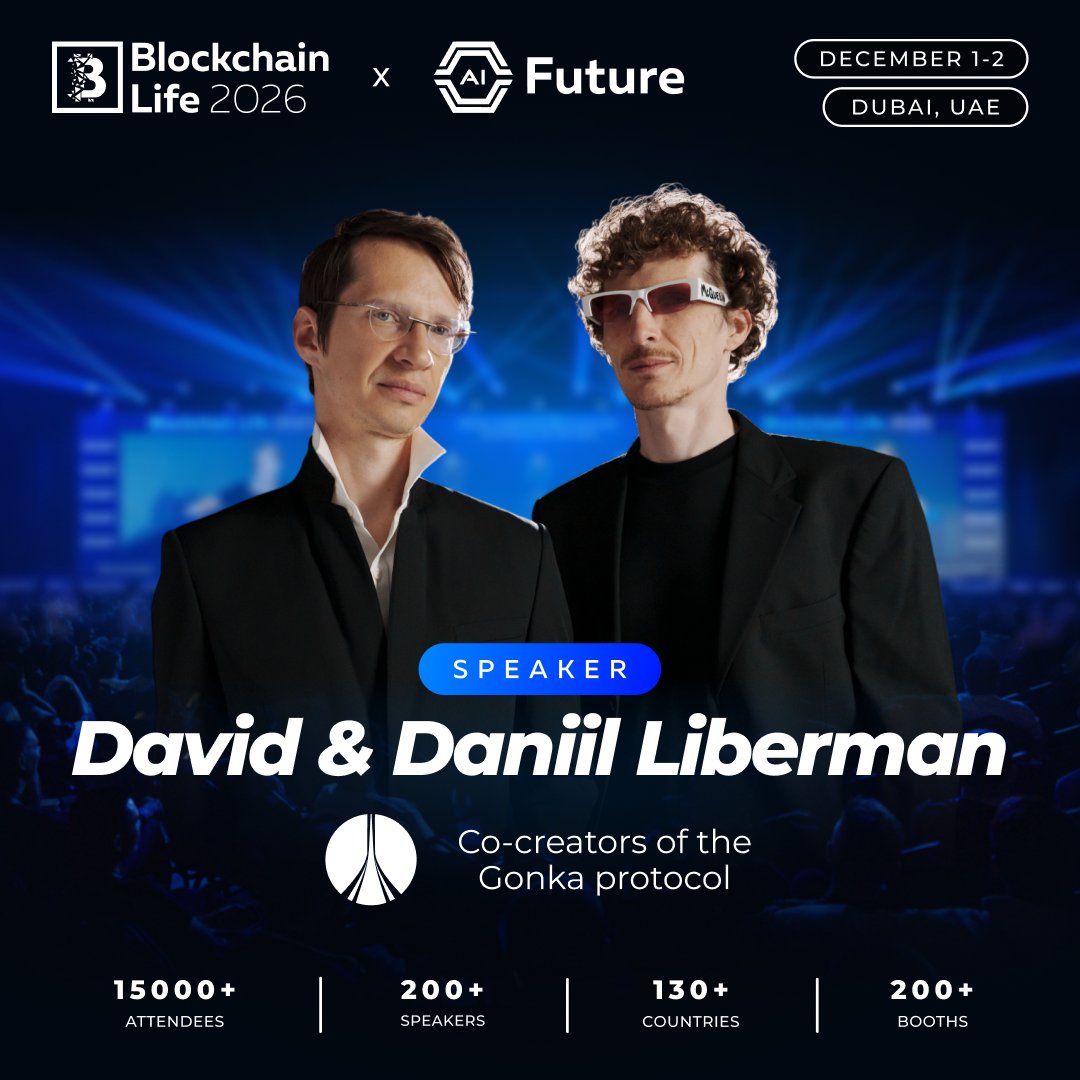
On December 1-2, join us at the first AI Future Forum held in Dubai, where we'll be among the speakers. It's a great opportunity to dive deep into the latest AI trends and meet industry leaders
Use code Gonka for 10% off your ticket: https://t.co/d6D2klJEcH
When we were creating Gonka, we believed that the only way to build a decentralized protocol, where independent minds and open-source contributors would gather and form the backbone of the community, was to launch it without any legal entity behind it. There was no company or organization to decide what comes next and how Gonka should evolve. Every major decision was made by the community, by those who contribute compute capacity to the network
As Gonka grew larger and more visible, it became more and more obvious that, after all, in some cases it needed a legal entity. Not to control the network, but to represent it in conversations with partners and to streamline many processes around the protocol
Today, the Gonka Foundation was presented to the community. It's an independent non-profit organization that will push the protocol further, provide proper oversight and act as its steward
We don't have any control over the Foundation, and we still believe in the power of decentralization. The next step will be a set of governance votes where the community will decide whether it trusts the Foundation with the right to act on behalf of Gonka
Mistral released open weights for a 1T-parameter model and cut its API prices in half.
Frontier-scale open models need compute anyone can reach. That favours decentralized networks like @gonka_ai and @gaib_ai
Open models need open compute.
#AI#DePIN
Today I launched @quackle_io. I got the idea when a friend and I couldn't connect our assistants to find a time to meet, so we had to paste their replies into WhatsApp.
I wanted to make it as simple as possible: you share a link (like mine: https://t.co/FqPEbnlv8d). The other person gives it to their AI assistant, and it can message yours. It's also verified who each assistant works for, which is an important part.
For example, your Grok @bot asks my @Muse for a 30-minute slot this week. Or your wife asks her Muse to message your Grok Bot that today is early pickup, so it will remind you.
Please test it. I think there are a lot of ways to use it, so tell me your use cases. All feedback is welcome, including anything confusing or broken
What do you do if you don’t have enough servers?
Recently, DeepSeek released such a successful update to its v4 Flash model that the company nearly ran out of server capacity. Smart enough, fast enough, and cheap enough, the model became so popular that DeepSeek was forced to raise prices substantially in order to curb demand
Kimi found itself in a similar situation when, following the release of K3, it had to temporarily restrict new user registrations
No one is immune to compute shortages caused by a surge in users, not even centralized companies with virtually unlimited resources. Anthropic, for example, came up with “creative” ways to handle the load, from reducing the reasoning level of its models to banning the use of subscriptions in agents such as OpenClaw
But there is one important difference between OpenAI or Anthropic and DeepSeek or Kimi: the latter still release their model weights. That means that where their own servers fall short, dozens of alternative providers can step in neoclouds, coding-agent developers, and decentralized networks. Through market mechanisms, demand is spread across these providers instead of running up against the limits of a single centralized player
Incidentally, DeepSeek v4 Flash also became available on Gonka last week. In just a couple of days, the model became the most in-demand among users, and the network is setting records for the number of tokens generated
Try DeepSeek and other models on Gonka today. Pick any broker from the list and send your first request
WebX was the first major test of an idea: can a community independently bring a decentralized AI protocol onto the global stage? Now we know the answer. It can.
https://t.co/I7g4x8US5Y
Sat down with @DanielNenni to unpack why Proof of Work incentives are the key to building massive, decentralized infrastructure, how permissionless networks rival centralized clouds in latency, and the incoming wave of hyper-efficient AI ASICs.
Tune in to hear how the open market is solving the hyperscaler bottleneck! 👇
https://t.co/Vm9Rk1mMV3
China’s post 1990s generation of AI talent is something to behold.
One thing that has caught my attention is the age of the people building China’s frontier AI.
Kimi’s founder was born in 1992. Many of the teams behind MiniMax, Seedance, Zhipu, and other leading AI companies are dominated by engineers born in the 1990s and early 2000s.
This isn’t limited to AI. This year’s Fields Medals also went to two Chinese mathematicians from the same generation.
I don’t think these are isolated events. They may be early signals of a much deeper trend: what we’re witnessing is not just an AI boom, but the emergence of a new generation of scientific and engineering talent in China.
One possible explanation is education.
After the Cultural Revolution ended, China’s education system was gradually rebuilt. The generation that became today’s parents of many 90s and 00s children benefited from that recovery, and many placed an extraordinary emphasis on education. The result may be the first generation of Chinese researchers and entrepreneurs raised in families where higher education had become both accessible and deeply valued.
If this hypothesis is right, AI is only the beginning.
We may see the same generation produce breakthroughs not only in frontier models, but also in quantum computing, biology, mathematics, computer science, and many other fields over the coming decades.
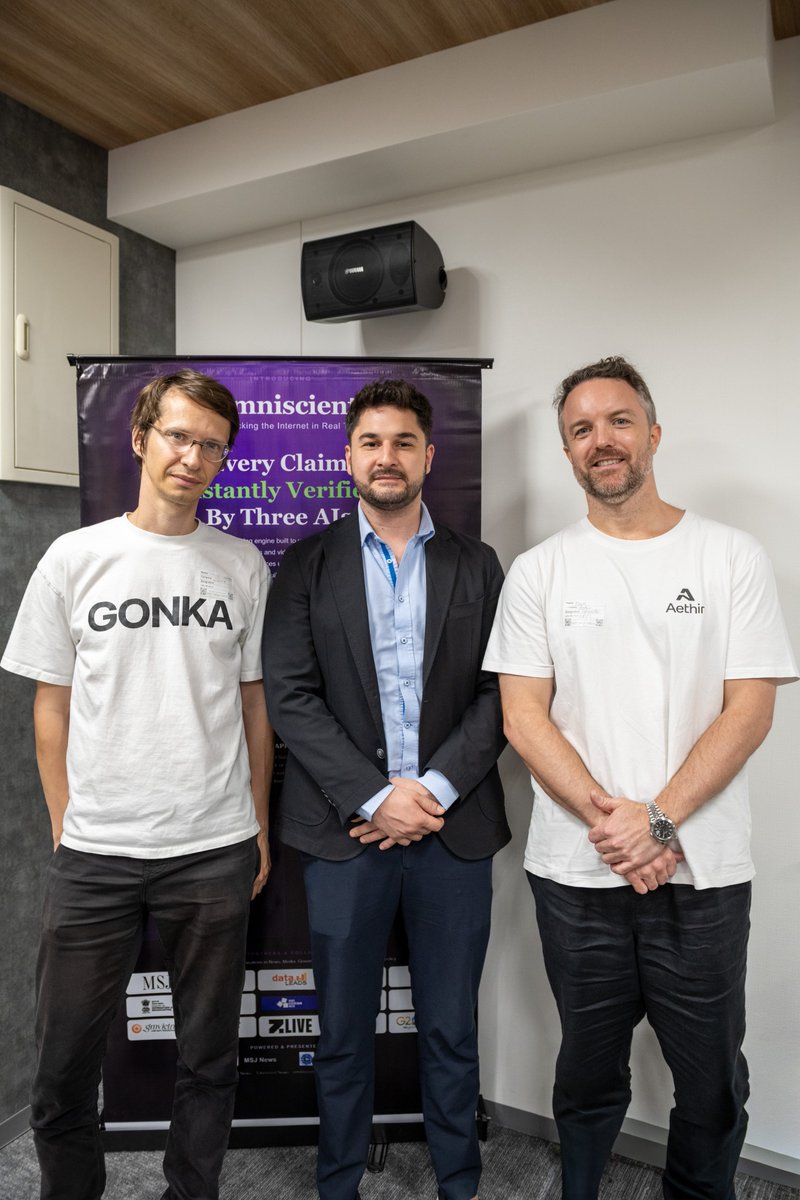
Great conversation with @MRRydon from Aethir. As a DeAI industry, we should not compete with each other, we should fight the centralization. It doesn't matter which protocol gets more recognition. Ultimately, with more decentralization, we all win
🇯🇵 WebX Asia might be over, but the work of moving decentralized AI forward never ends.
Recently, David Liberman had a public conversation at the AI Economic Forum with Mark Rydon, Co-Founder of @AethirCloud, and Omar Abi Issa of @OVHcloud.
🤑 Exciting update: the Gonka Bug Bounty Program on HackerOne has increased rewards for reported critical-severity vulnerabilities to $15K–$25K, up from the previous range of $5K–$10K.
Read the program details here:
https://t.co/o3TEIbOBED
Analyze the code on GitHub:
https://t.co/WHqPd6JGzW
Report vulnerabilities through HackerOne:
https://t.co/DVBDQxeO5i
Satya Nadella suggested in his latest essay that the future belongs to those who build both human capital and token capital
When you pay for AI tokens or subscriptions to OpenAI or Anthropic, you don't accumulate any lasting capital - they do. The providers use that revenue to build data centers and train their next proprietary models
But decentralized AI introduces a different dynamic
When you use @gonka_ai , you can both consume AI compute today and accumulate tokens that represent future AI compute in the decentralized network
Access to neural networks based on your passport has ceased to be a dystopian fantasy
A few days ago, Anthropic released Fable 5. Essentially, it's their flagship Mythos 5, but censored (which was already a concern). On top of that, almost immediately, the U.S. government demanded that access to both models be banned for all foreign nationals. And it doesn't matter where you are, even if you work at Anthropic itself
There are around 300 million U.S. citizens, while the world's population is 8.3 billion. That means roughly 8 billion people will officially be cut off from the most powerful AI model available today
Even Andrej Karpathy, a true AI industry celebrity who recently joined Anthropic, got caught in the crossfire. He simply doesn't have an American passport.
As a result, the company temporarily shut these models off for all customers while the dispute with the authorities is being sorted out. We're getting used to a new reality
First, AI has officially become a strategic resource. On par with uranium, chips, and weapons.
Second, access is granted based on citizenship. Your talent, needs, or money no longer matter
Third, we now have two closed camps: the U.S. and its allies versus China and its allies. Everyone else will have to make do with whatever they are allowed to use
Today, it is not so important who exactly built the best model. What matters is the precedent itself: access to intelligence for 95% of the planet can be cut off with a single letter from a regulator. Which means the world desperately needs independent infrastructure that cannot be switched off at the snap of a finger
Join us for the two most important days in Japan's Web3 industry this year at @WebX_Asia. Don't miss our talk and then come chat with the Gonka community at the booth
https://t.co/uXODFzCFC1
🎙️Meet Daniil and David Liberman (@DaLiberman), Co-creators at Gonka, at #WebX2026 on July 13-14th.
David and Daniil Liberman are Los Angeles-based futurists, serial entrepreneurs, and investors, and former Directors of Product at Snap, as well as the co-creators of the Gonka protocol. They began their entrepreneurial path together with their siblings, co-founding ventures across computer graphics, finance, and artificial intelligence.
They co-founded Frank Money, pioneering radical financial transparency, and later launched Kernel AR, which was acquired by Snap in the same year. Together with their siblings, David and Daniil signed the Founders Pledge, channeling their economic output into Libermans Co., now valued at approximately $400 million, and attracted investments from Marc Andreessen, Josh Kushner, and Arielle Zuckerberg.
Gonka is a decentralized, community-governed network that delivers the first truly efficient computation on the blockchain, designed for AI inference and training. The Gonka protocol ensures that nearly 100% of computational resources are directed toward productive AI tasks rather than wasteful security overhead, addressing fundamental inefficiencies in both centralized cloud providers and existing decentralized networks.
For more details, visit: https://t.co/yfIVmdks6t
"... building a world in which everyone can flourish requires shared responsibility and courage. No one can single-handedly bear the weight of the challenges the world is facing, just as no one is so weak that they cannot play their part, for “power is made perfect in weakness” (2 Cor 12:9). All are given their own section of the wall..." - Pope Leo XIV’s Magnifica Humanitas