I want to prevent a race into unmonitorability kicked off by confused reporting. The depth of the computation graph for our present frontier models, including Astra, is within a factor of two of GPT-4.
OpenAI has worked to preserve and utilize chain-of-thought monitoring since our very first reasoning models. We deeply care about this technique, as it can give us a view into how model alignment generalizes from its training distribution. I do think it is fragile and unfortunately trending in a negative direction, for reasons not contingent on architecture changes that I will write about soon. But there are things we can do to strengthen it, and it's a core goal of our current research program.
Moreover, there is a strong line of research in neuroscience and philosophy of mind that credibly claims that “desires,” “motivations” and “goals” do not actually describe how real life human brains work, but are just part of a “folk theory of mind” that we evolved to predict the behavior of other humans and justify our own behavior to them. Given this, where is the error in using these terms to describe Agent behavior-especially if it accurately *predicts* that behavior?
You should be pragmatic and use metaphors when they help, while being aware they are imperfect. AIs are not humans, but a lot of intuitions from human behavior can carry over.
You would certainly be better off thinking of AIs as "guys living in computers" than parroting the mantra "these are just next word predictors".
Any "tokens" metric that includes tokens from multiple models is meaningless. Tokens cannot be compared across models. This has always been true but is more and more true as models diversify and as reasoning becomes a larger and larger portion of all tokens.
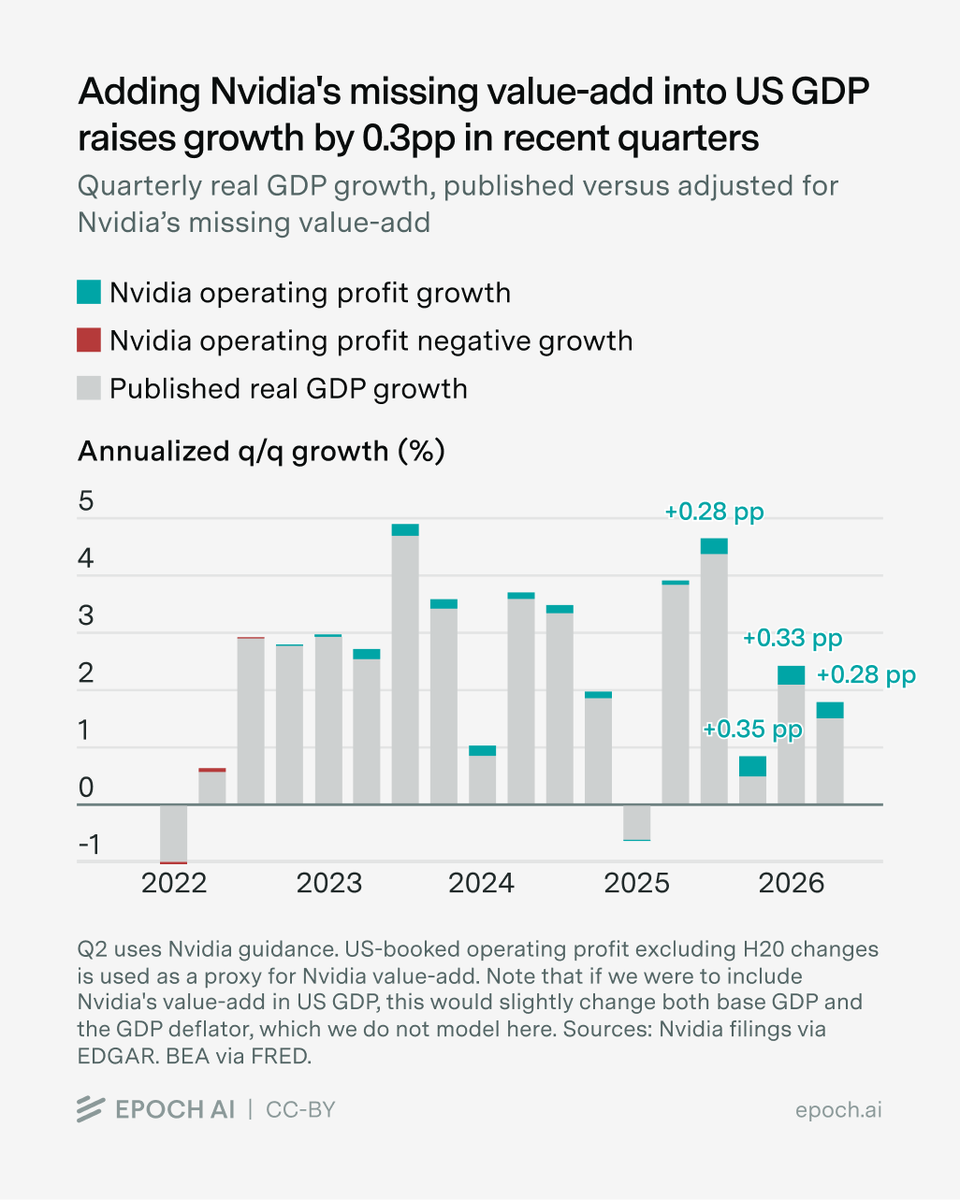
We discovered that US GDP statistics miss most of the value Nvidia adds to the US economy.
As a result, GDP growth has been understated by ~0.3 percentage points over the last year.
@dillon_mulroy@ethanniser What you actually want is a guarantee, not a best effort. There are many types of applications that depend on guaranteed low latency between nodes (e.g. sharding a database where you might need to do a scatter-gather query) that will have unacceptable latency without it.
In 2017 a viral news story claimed LLMs at Facebook went rogue, developed their own language, and had to be shut down.
By now we're immune to such sensationalist headlines. The Hugging Face incident may seem like just another one. But it's not.
I hope everyone watches this talk
@martin_casado Yeah, I would put that in the "marginal returns don't decrease as fast as they do for software" category. There is a question about whether you might get to some kind of minimum efficient scale and then it stops. But personally I think that is far away.
@martin_casado Yeah, I think the decreasing marginal returns are not as strong here as they were in traditional software development, and all the value is in being on the frontier. Distillation hurts but not enough to outweigh the basic economy of scale effect.
An economist and a futurist walk into a bar.
The economist takes a sip of his drink. "Ugh, if only people understood basic economics. High-skilled immigration alone would do wonders for US growth."
Futurist: "Oh yeah? Say 100 million immigrants moved to the US, each matching the best human experts in every economically relevant field. Big deal?"
Economist: "Massive. Transformative."
Futurist: "What if they also worked longer hours and faster than any American?"
Economist: "Even better."
Futurist: "What if they were extremely frugal — consuming only the bare minimum needed to keep working?"
Economist: "A near-100% savings rate? Better still!"
Futurist: "What if they were very clumsy and physically weak, so they could only do some kinds of work?"
Economist: "They could still do all cognitive labor — that's over half all wages! Somewhat less good, sure. Still transformative."
Futurist: "What if their skin was grey, almost metallic, from some kind of accident?"
Economist: "Who cares?!"
Futurist: "What if they were AIs?"
Economist: "3% growth per year, tops. There'd be bottlenecks. Honestly, the people predicting explosive growth from AI should learn some economics."
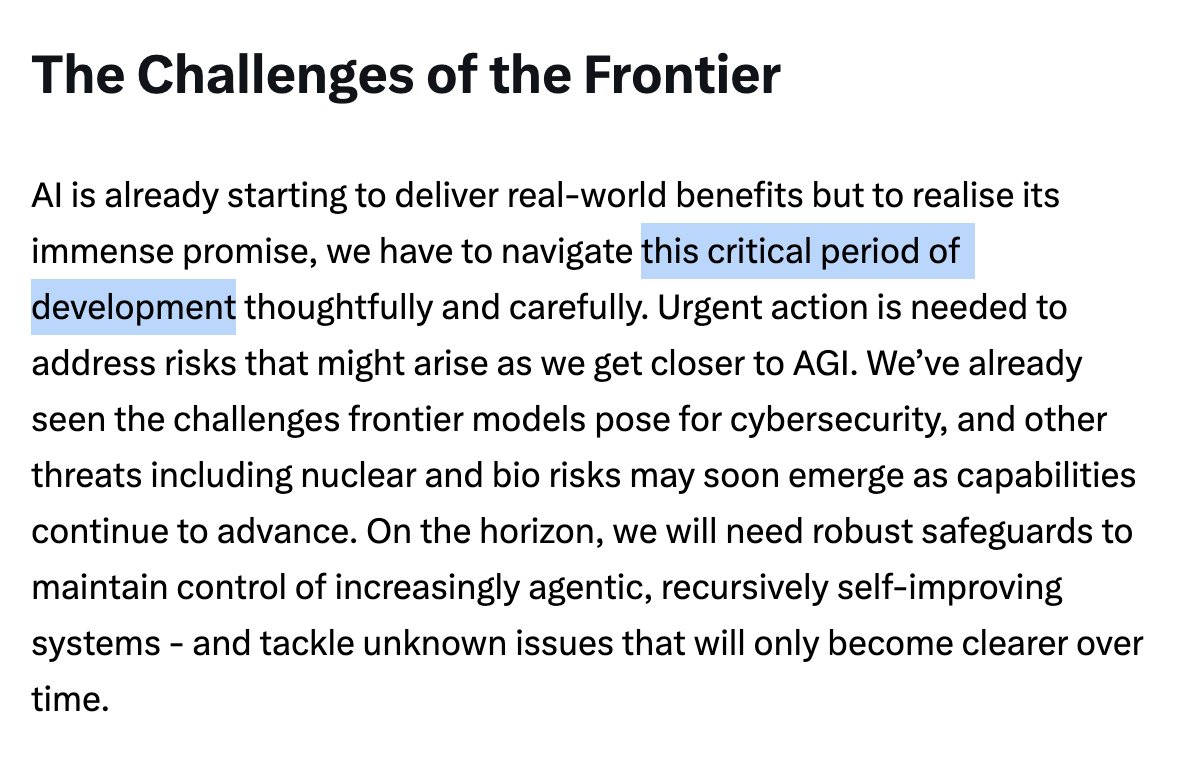
Everyone building AI believes in a “critical period” or “transition” to AGI—like sailing a stormy sea, until you reach the opposite shore.
My least-shared belief is: there is no opposite shore. There is only a permanently accelerated rate of change.
There is a transition, yes, to a new mode of production. But once that transition is complete, things don't settle down again, just as the transition to the industrial age didn't settle down after we had steam engines and railroads.
We should be working on how to better handle faster change, because it will be the new norm.
I just want to go on the record that it makes zero sense for the US to ban OS Chinese models on national security misuse grounds.
It will not have any helpful effect. I say this as someone who has spent the last 3 years working on AI national security misuse.
BREAKING: FAA officially announced the rulemaking to legalize supersonic flight, including the Boomless Cruise ("Mach cutoff") approach we demonstrated on XB-1.
This is a major step toward the supersonic renaissance.
In a matter of weeks, U.S. federal AI policy has gone from implausibly libertarian to increasingly draconian and opaque. Today, over 35 distinct observations, I analyze how we got here and offer the most succinct statement I can about what exactly I propose we should do next.
Toyota lean manufacturing has an idea called "genchi genbutsu", essentially meaning managers should "go see the real thing at the real place" in a factory instead of sitting in an office hearing secondhand descriptions. AI coding suddenly makes this practical for software.
Unclear if a durable trend, but CEOs and CTOs are back to coding with a fury, thanks to coding agents.
I have public company CEOs sliding into my DMs (and “InMail”) telling me about falling in love with shipping software again thanks to Claude Code and Vercel.
“Dream accounts” that we always wanted to work with, where in the past the C-suite would hardly understand the infrastructure until much later in the game.
Coding agents are the ultimate PLG-fication of the enterprise. Bad, legacy software can’t hide anymore. The stack that works is self-evident to the entire organization, from intern to CEO.