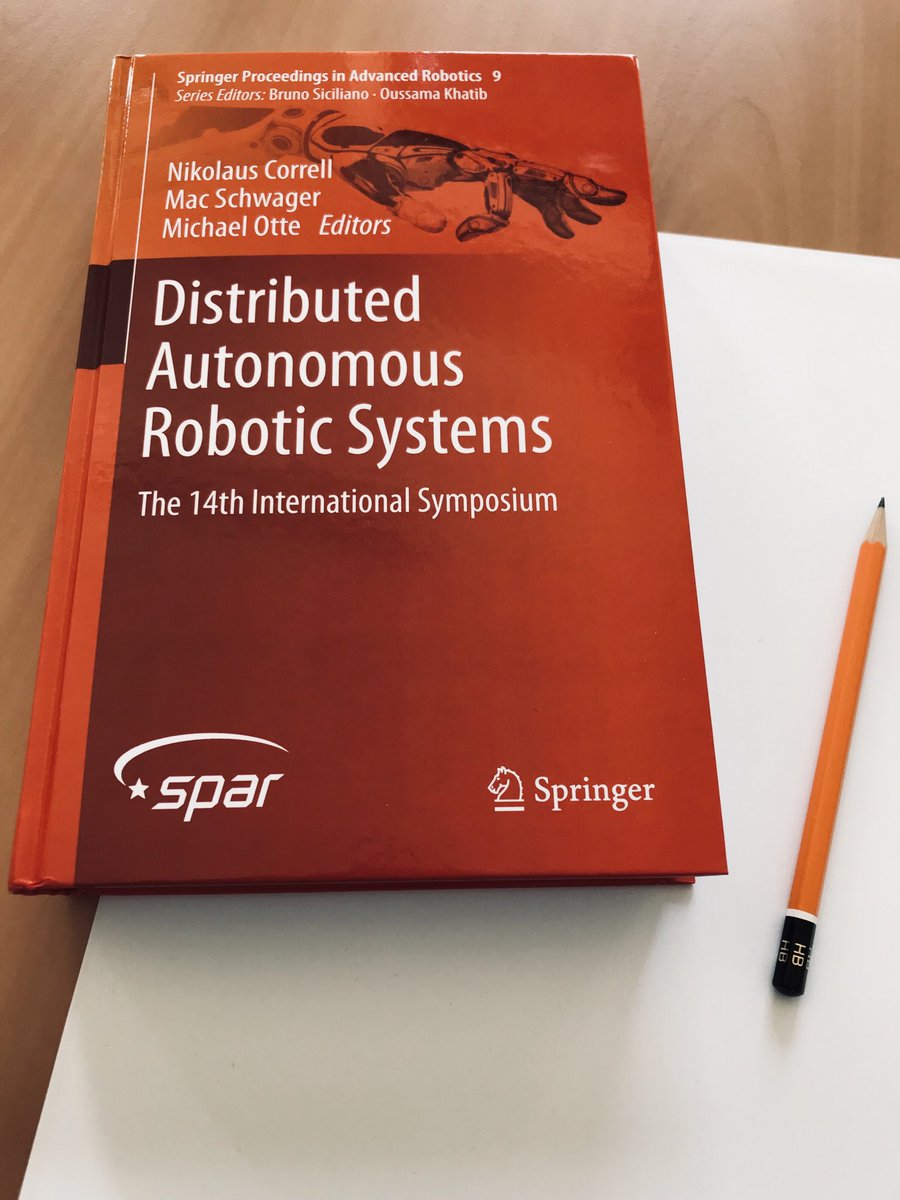
Back home.
Many, many thanks to the organizers of @DARS2018Boulder@correlllab for a great and successful conference.
Looking forward to meeting you in Kyoto, Japan, 2020!
I’m recruiting a #postdoc to study collective decisions in dynamic environments. Requirements: Not scared by maths, multi-agent systems and programming! RT please! https://t.co/KeJ4aZdSrw #swarm
As everyone concludes #DARS2018 and starts looking for a place to pack your new fleece, think about another great winter southwest robotics conference where you won't need a fleece -- @swrs2019 at the end of January. Registration is *free.*
#SWRS2019: https://t.co/TRYHCkPJtb
From what I remember from the shape-memory talk, things are really taking shape with programmable matter, as reported at #DARS2018 by Florian Pescher in "Molding a Shape-Memory Polymer with Programmable Matter."
The publicity chair, @TedPavlic, has to head to the Denver airport soon, and so the last few talks may not get the tweets that they deserve. Please help and post a #DARS2018-tagged tweet for them so he/I can retweet!
Thanks!
We now know the names of the #DARS2018 best paper and best student paper winners! You'll have to wait until tonight to find out who won -- There are no @MarkRuffalo's on the selection committee!
#MarkYoureFired#Avengers4AtDARS2018
Hiroshi Kawano brings #DARS2018 "Distributed Tunneling Reconfiguration of Sliding Cubic Modular Robots in Severe Space Requirements". It's the last session, which is always hard to get through, but this talk will tunnel through it!
From honeybees earlier to termites now. Andrew Vardy from @MemorialU tells us how to use landmarks to make it easier for swarms of robots to form shapes. If you want to find him later to ask him questions, you should look for the Aspen room.
Here, @mrsminirobot shows how shocking self assembled structures can emerge from neutral networks evolved to detect and minimize their surprise. Unexpected? Not to the neutral networks.
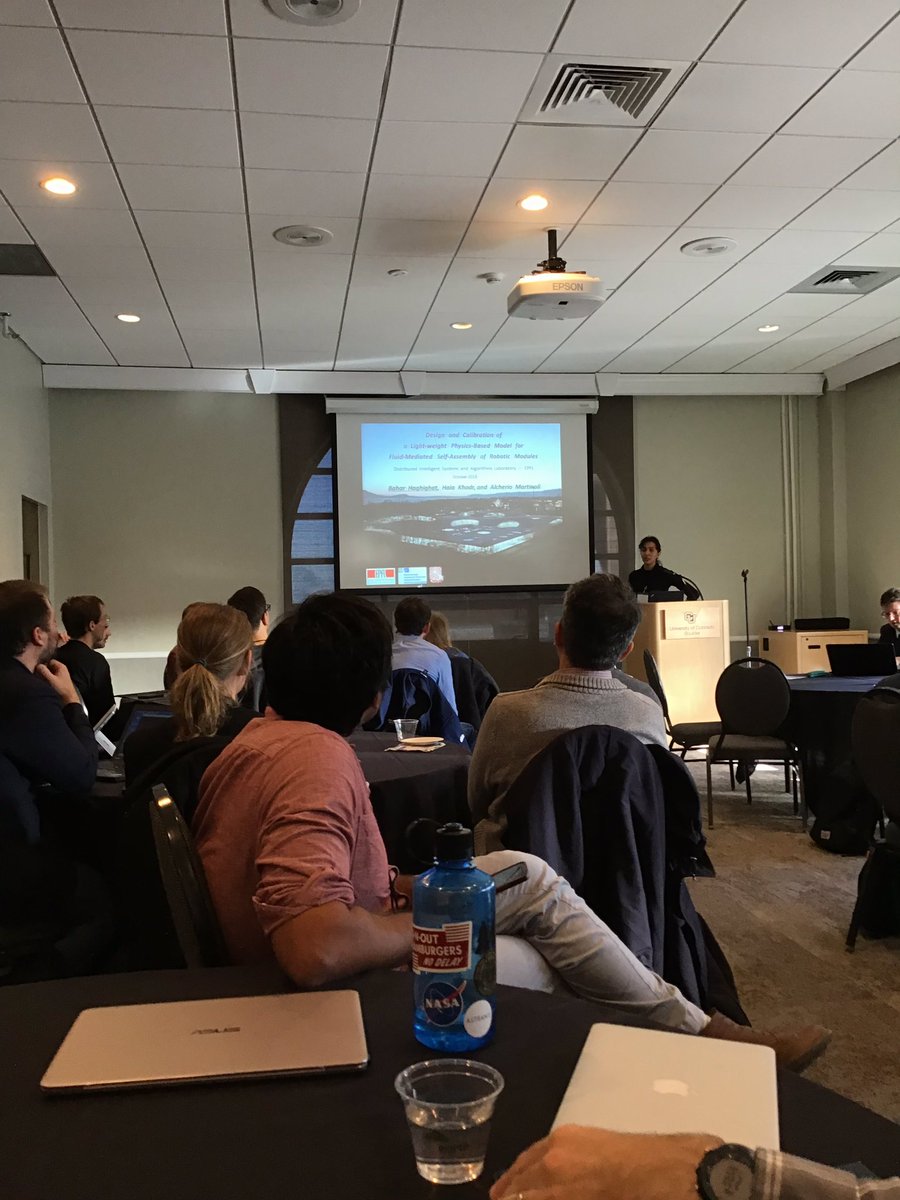
Bahar Haghighat from @EPFL shows #DARS2018 robotic "lillies" that self assemble in turbulent fluid flows. Don't worry - her talk is much smoother than the water the robots float in, and I'm sure our understanding of the content will be as tight as the structures the robots build.
Kirstin Petersen comes to #DARS2018 from @Cornell to present a new *scalable* compiler that assembles assembly rules for #TERMES robots that respects all of their operational constraints. Are you satisfied? The robots' constraints are.
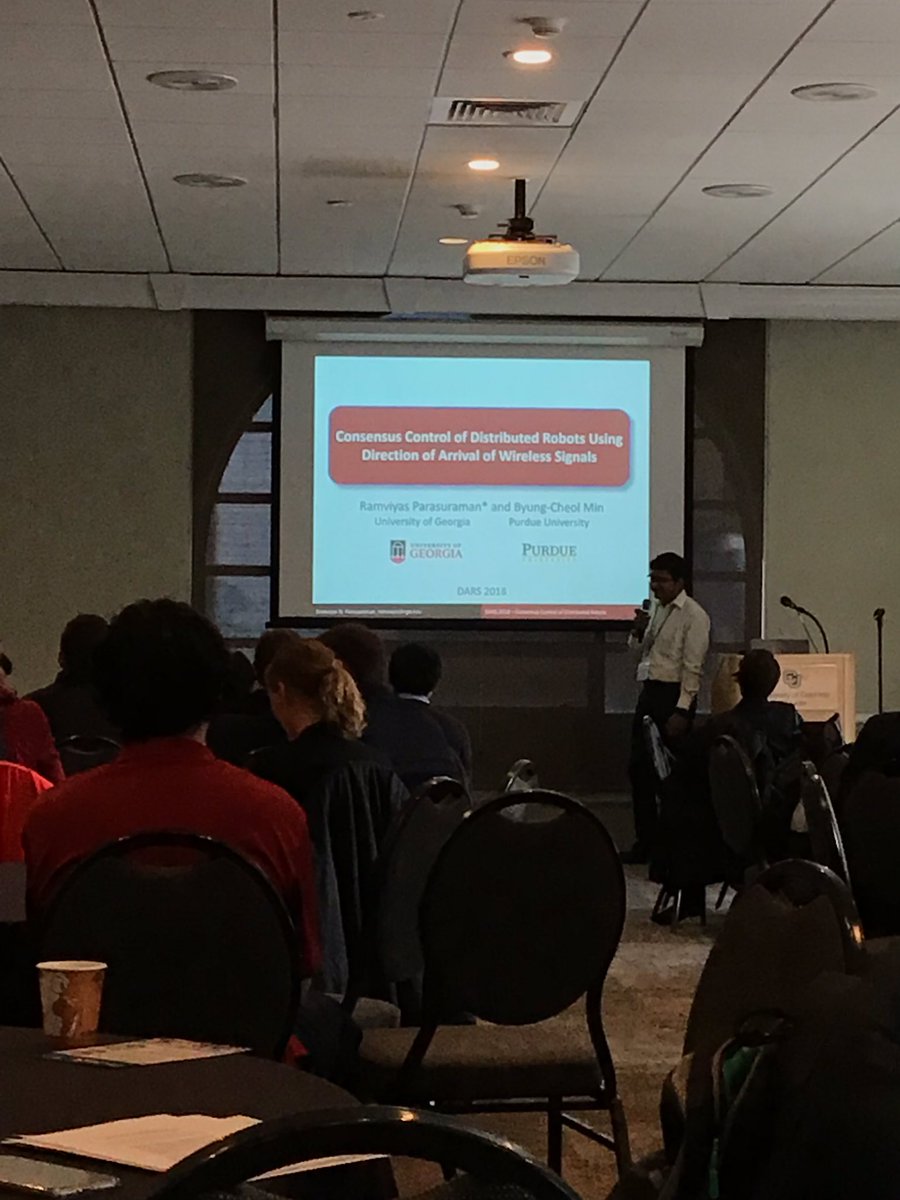
Ramviyas Parasuraman from @UGA-Athens shows #DARS2018 that wireless signal arrival direction can be used to achieve weighted bearing-based consensus. This is a useful angle on the problem.
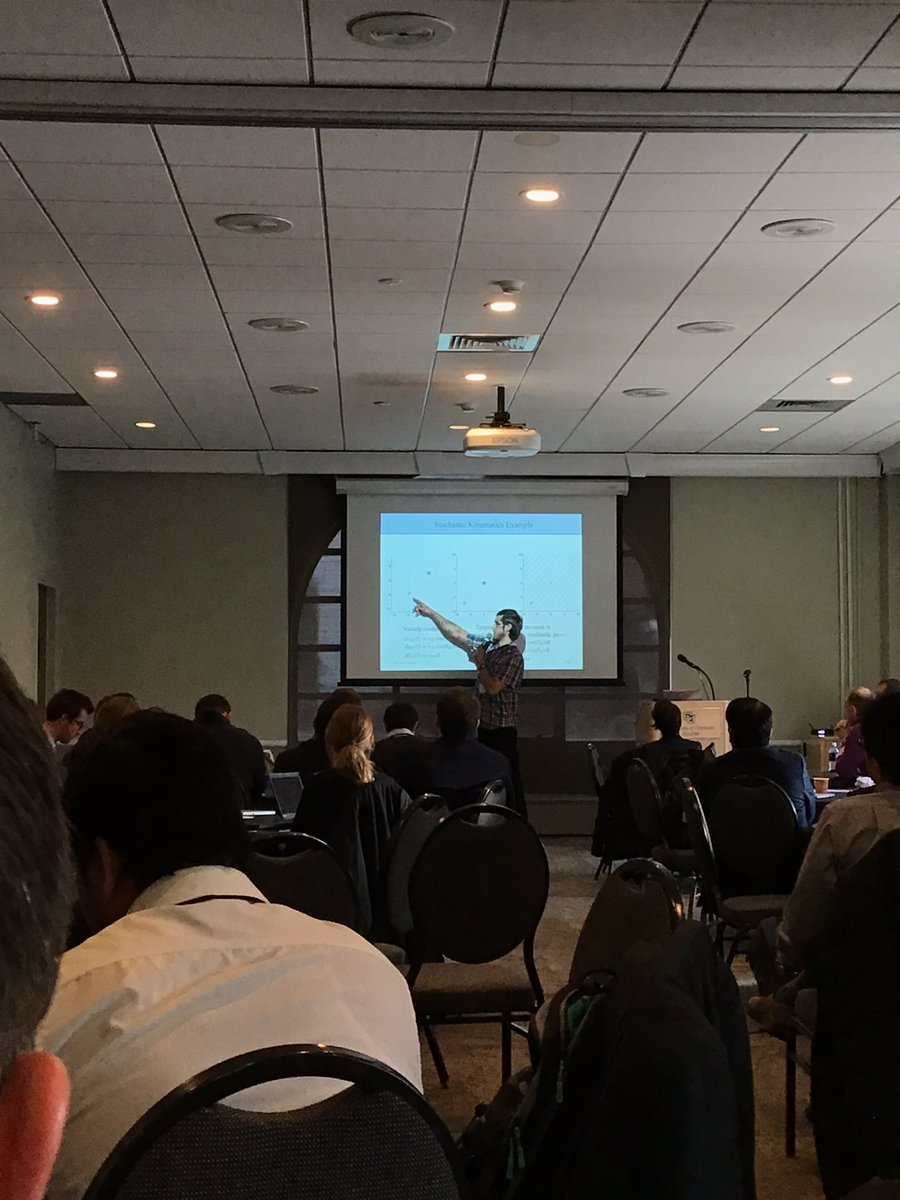
"Time Efficient Inspection of Ground Vehicles by a UAV Team Using a Markov Inequality Based Rule" from Alexey Munishkin (@ucsc) at #DARS2018. Don't worry, Alexey, our attention is focused on you -- we won't switch away, regardless of how stochastic our kinematics might seem.
.@CUBoulder@correlllab at #DARS2018: John Klingner presents "Fault-Tolerant Covariance Intersection for Localizing Robot Swarms". Non-Gaussian behavior is more *normal* than you might think. If that pun blew your mind, consider that their algo invokes Covariance Union (CU!!).