Nuclear impressionistic imagery and objects artisan, archeologist of mid-twentieth century nuclear culture. Nuclear technology, history and weapons provocateur.
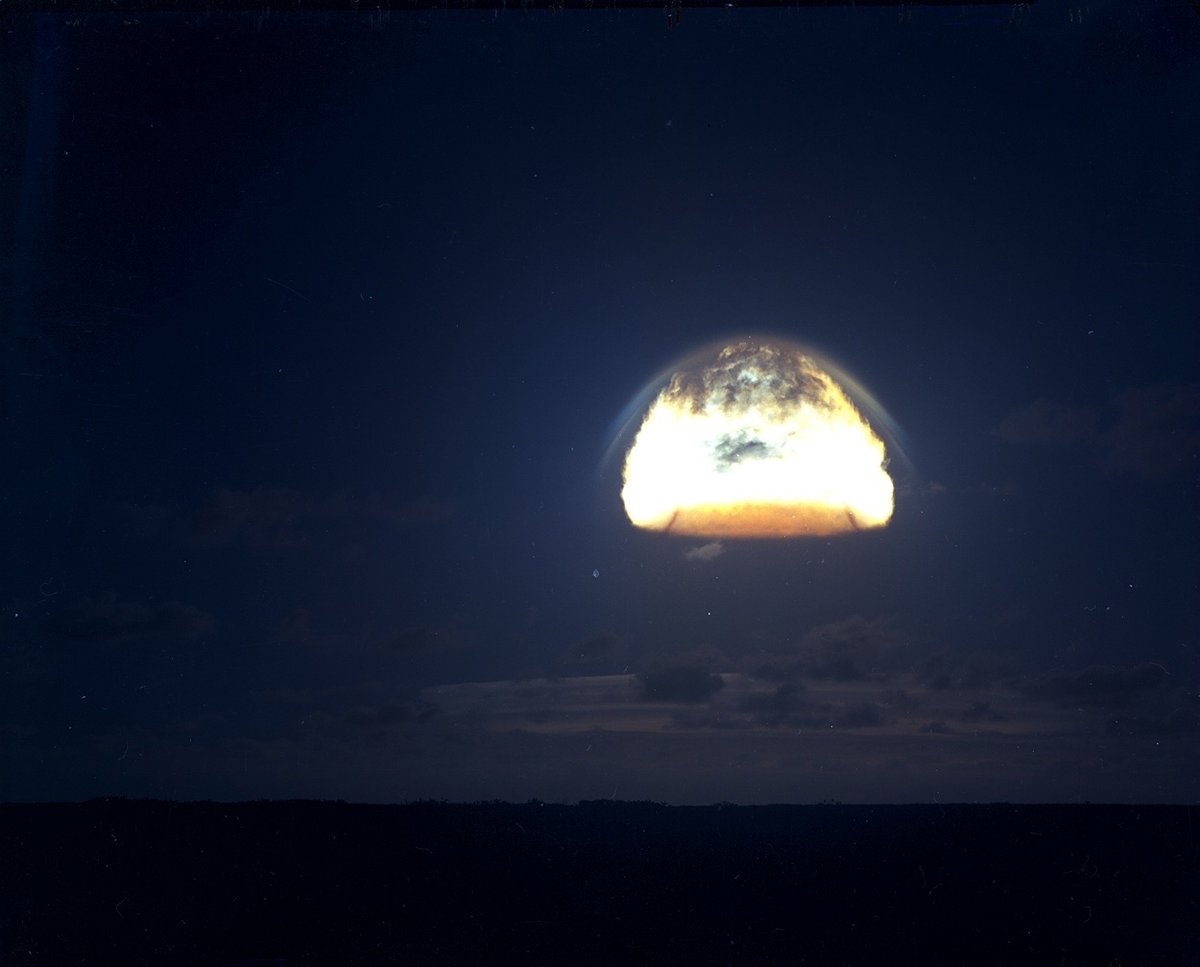
«Minor Scale» explosion utilized 4744 tons of ANFO to simulate 8-kiloton air-burst nuclear device. With a total energy release of 4.2 kilotons this test was reported as "the largest planned conventional explosion in the U.S. history". New Mexico. June 27, 1985.
Experimentalist Chien-Shiung Wu & theorists Chen Ning Yang & Tsung-Dao Lee each played pivotal roles in demonstrating that some weak interaction decays violate parity (mirror image) symmetry.
Yang & Lee shared the 1957 Nobel Prize in Physics.
Sadly, Wu wasn't awarded a Nobel.
On Michael Cohen’s @MeaCulpaPodcast, @EmLBelcher sat down for a frank interview with the former Trump lawyer about the misunderstandings around nuclear weapons, the state of global nuclear threat, and Iran—and why diplomacy will always prevail.
https://t.co/OjIOn8lbiX
One of Niels Bohr's mantras was what we can call "relentless politeness". He was extremely polite, but he was "terrifyingly relentless" (in Heisenberg's words), not stopping for an instant before he satisfactorily resolved an argument and left no stone unturned. Science for Bohr was a forever dialogue, extending not just across race and nationality but past the lecture hall into walks, dinners, train trips and the halls of government. It seems like his formula is one we should all embrace. Always be polite and civil. But relentlessly so. All the way until the end.
‼️Nuclear-affected communities need recognition, accountability, redress, better healthcare, environmental remediation, and a meaningful role in decisions that affect their lives.
Join the online launch of the Policy Paper "From Harm to Justice" for more: https://t.co/Xy5qPvP5TC
The three fundamental figures of quantum mechanics.
Theoretical physicists Paul Dirac, Werner Heisenberg, and Erwin Schrödinger at Stockholm railway station in December 1933, during the Nobel Prize celebrations.
Which of these three physicists do you think had the biggest impact on our understanding of reality?
Living within walking distance of both Harvard (15 minutes) and MIT (20 minutes) for almost seven years was an unforgettable experience for me, in significant part because of the bookstores.
Remembering Prof. Peter B. Littlewood, a renowned physicist whose research transformed our understanding of condensed matter physics and whose leadership advanced scientific discovery worldwide.
Learn more: https://t.co/Xo6axhrji6
ACA IN THE NEWS | 6/25/26
Director of Nonproliferation @KelseyDav quoted in article by RadioFreeEurope @RFERL: 'UN Monitors ‘Have A Plan’ For Verifying Iran’s Nuclear Program But Iran Has Not Signed Up.'
Read online now: https://t.co/MQ1lyGexhg
"The Contamination Age Begins: Operation Crossroads and the Nuclear Lesson the World Almost Missed"
by David A. Wargowski
On July 1, 1946, nearly a year after the atomic bombings of Hiroshima and Nagasaki, the United States detonated an atomic bomb over a fleet of surplus warships anchored in the lagoon of Bikini Atoll in the Marshall Islands. Twenty-four days later, a second bomb was exploded underwater beneath the same fleet.
Known collectively as Operation Crossroads, the tests were intended to answer a straightforward military question: How vulnerable were naval fleets to atomic attack? The answers would prove far more consequential than planners anticipated.
Eighty years later, Operation Crossroads deserves remembrance not merely as the first postwar nuclear weapons test series, but as one of the earliest demonstrations that radioactive contamination, not blast effects alone, would become the defining challenge of the nuclear age.
The Fleet at Bikini
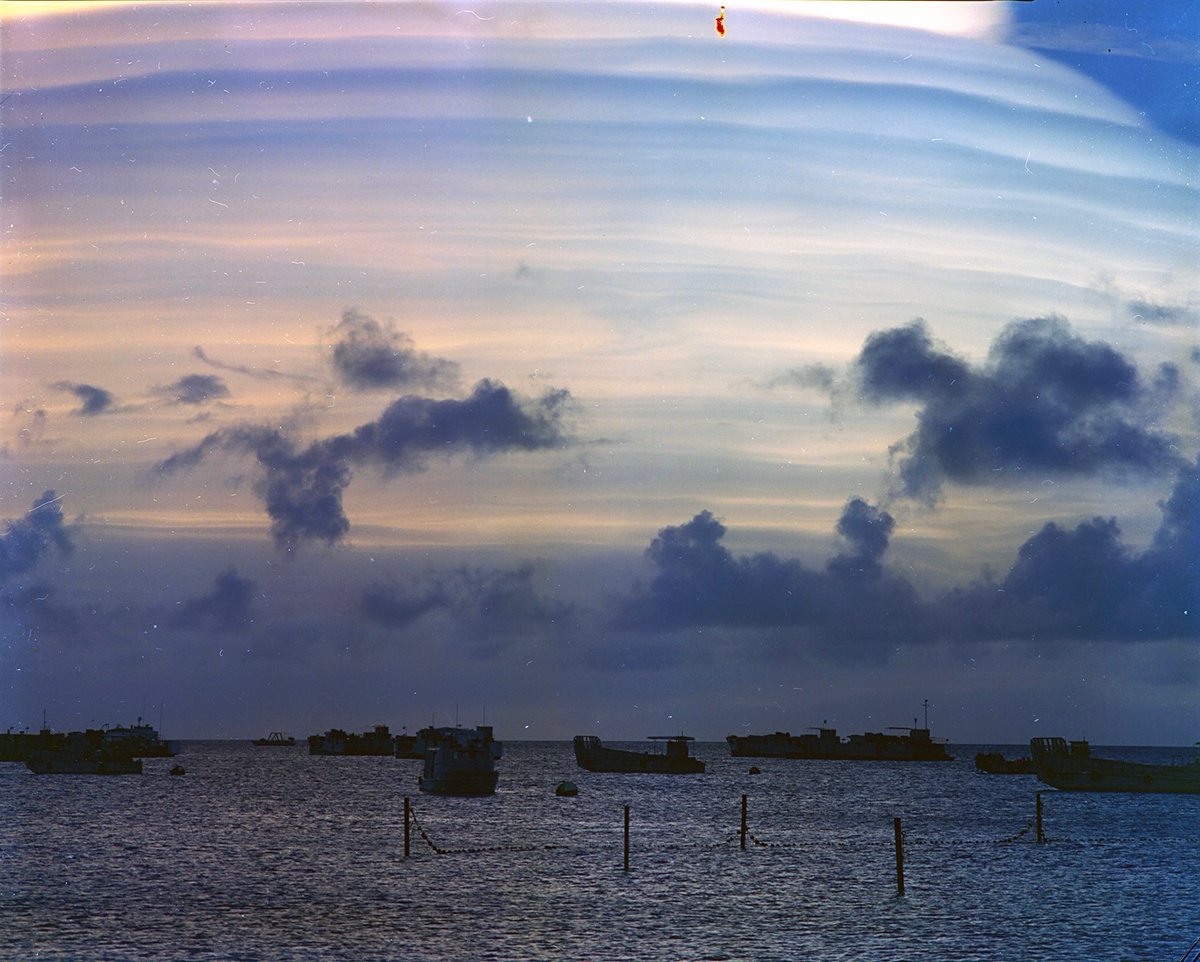
Operation Crossroads assembled an extraordinary armada. More than 240 ships, including battleships, aircraft carriers, cruisers, submarines, and captured German and Japanese vessels, were positioned in Bikini Lagoon. Thousands of animals were placed aboard selected ships to study the biological effects of nuclear explosions. More than 40,000 military and civilian personnel participated in the operation.
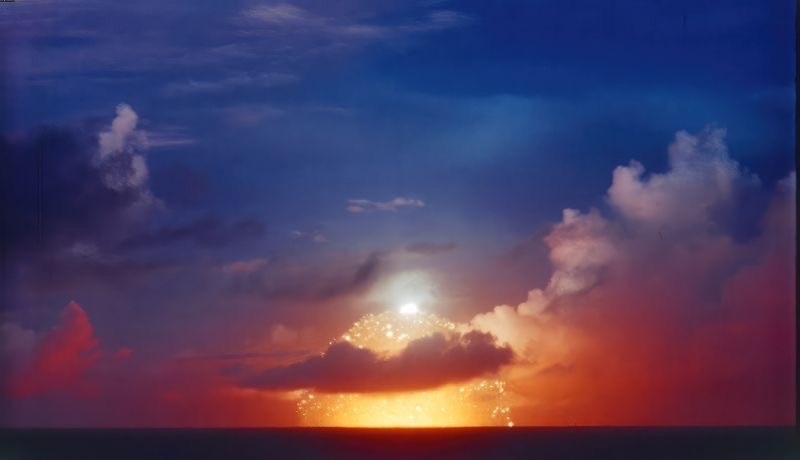
The first test, Able, was detonated 520 feet above the target fleet on July 1, 1946. The bomb missed its intended aim point by more than half a mile. Although several vessels were sunk or heavily damaged, many survived. Military observers concluded that fleets at sea might be less vulnerable to atomic attack than wartime predictions had suggested.
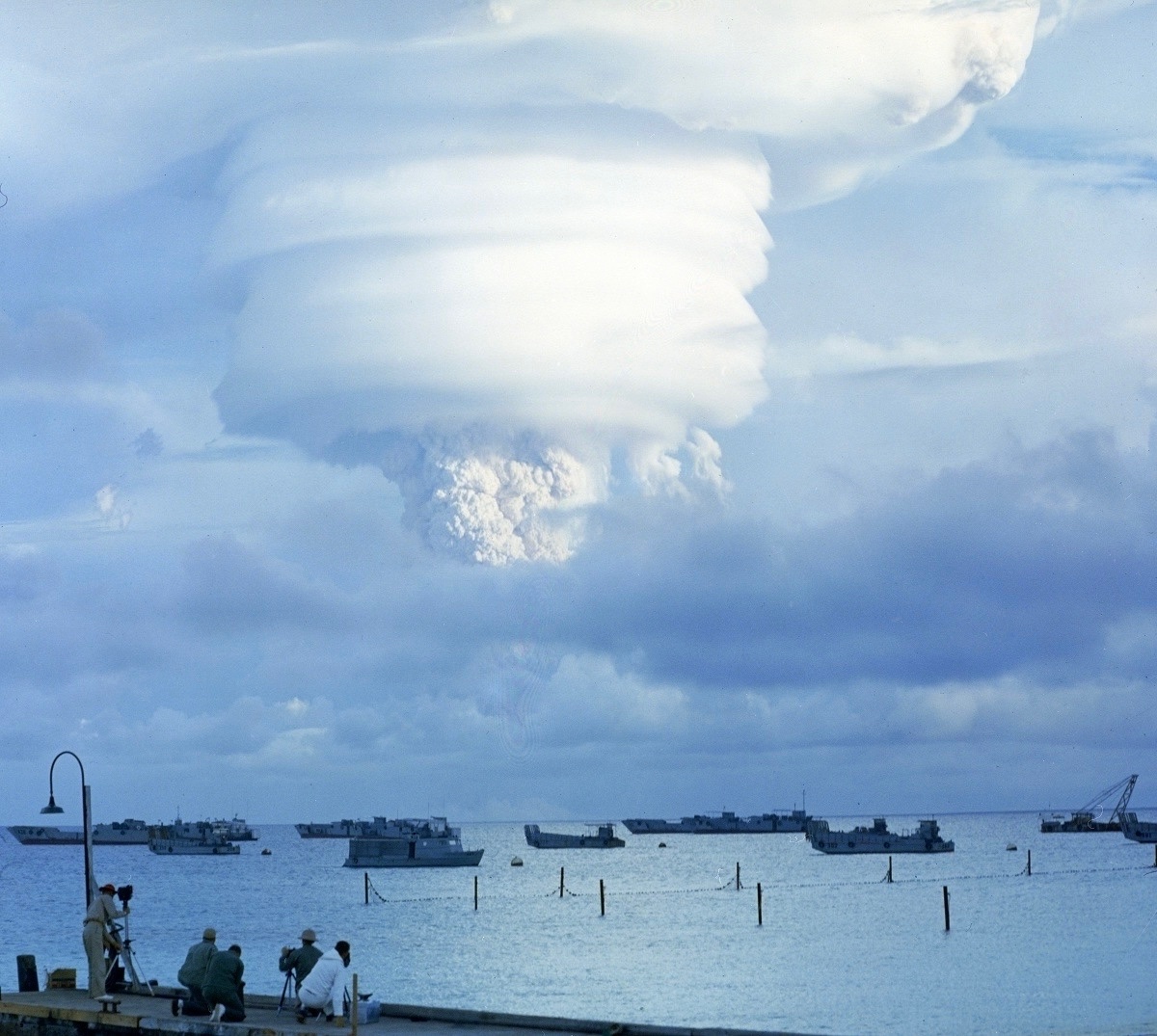
The second test, Baker, conducted on July 25, produced a dramatically different result. Detonated 90 feet beneath the lagoon surface, the explosion generated a towering column of water nearly a mile high. Ships near ground zero were crushed or sunk. Yet the most important effect was largely invisible. The explosion transformed millions of tons of seawater into radioactive spray and mist. Water contaminated with fission products rained down across the target fleet. Radioactive sludge coated decks, equipment, and interiors. Vessels that had survived the blast became dangerously contaminated. Military planners had expected physical destruction. They had not anticipated contamination on this scale.
The Discovery of a New Battlefield Hazard
The Baker test introduced a problem that would recur throughout the Cold War: radiation could render equipment, infrastructure, and entire environments unusable long after the explosion itself had ended.
Decontamination crews scrubbed ship surfaces with soap, lye, and seawater. They attempted to remove radioactive residues from compartments, machinery spaces, and ventilation systems. Their efforts largely failed. Radioactivity penetrated cracks, piping, insulation, and inaccessible spaces. Even ships that appeared structurally intact remained hazardous to crews. Several vessels were eventually scuttled because effective decontamination proved impossible.
The target fleet had survived the bomb. It could not survive the contamination. For many participants, this realization was startling. During World War II, military planners had naturally focused on blast, fire, and shock. Operation Crossroads demonstrated that the most persistent consequences of nuclear weapons could remain long after the visible destruction disappeared. In effect, Baker transformed radiation from a scientific concern into an operational reality.
The Environmental Legacy
The contamination generated by Operation Crossroads extended beyond the target ships. Bikini Atoll had been home to a Marshallese community for generations. Prior to the tests, residents were relocated under assurances that the displacement would be temporary and that they would eventually return. That promise was never fulfilled.
Although Operation Crossroads itself was only the beginning of nuclear testing in the Marshall Islands, it established a pattern that would continue throughout the Pacific Proving Grounds. Between 1946 and 1958, the United States conducted 67 nuclear tests in the Marshall Islands, including the 1954 Castle Bravo detonation, the largest nuclear explosion ever conducted by the United States.
The environmental consequences persisted for decades. Radioactive contamination affected land, food supplies, and traditional ways of life. Many displaced communities faced prolonged exile and uncertainty. Today, the history of Bikini Atoll serves as a reminder that the impacts of nuclear weapons extend far beyond military targets.
Lessons for the Modern Nuclear Era
Operation Crossroads occurred at a moment when many military leaders still viewed atomic weapons primarily as larger conventional bombs. The tests challenged that assumption. The implications extended well beyond naval warfare.
The contamination problems observed at Bikini foreshadowed later concerns about fallout from atmospheric testing, radioactive contamination from nuclear accidents, and the long-term consequences of nuclear war itself. They anticipated lessons reinforced by incidents ranging from Castle Bravo to Chernobyl and Fukushima.
Modern analyses of nuclear conflict often emphasize blast casualties and thermal destruction. Yet Crossroads reminds us that radioactive contamination can transform landscapes, disrupt societies, and create hazards that persist for years, decades, or longer.
This lesson remains relevant as nuclear-armed states modernize their arsenals and arms control agreements continue to erode. The expiration of the last remaining strategic arms control constraints between the United States and Russia has heightened concerns about a renewed arms competition. At the same time, public understanding of nuclear weapons often remains focused on mushroom clouds and immediate devastation.
Operation Crossroads revealed a more complicated reality. The nuclear age would not be defined solely by the destructive power of the explosion itself. It would also be defined by what remained afterward.
Eighty years later
The iconic photographs of Baker's immense water column remain among the most striking images of the twentieth century. They capture the spectacle of the atomic age in a single frame. What they do not show is the contamination that settled back onto the lagoon, the ships, and the surrounding environment. That invisible residue became one of the most important discoveries of the tests.
Eighty years after Operation Crossroads, the enduring lesson of Bikini Atoll is not simply that nuclear weapons can destroy. It is that their consequences can outlast the moment of detonation, persist across generations, and reshape entire environments. The blast lasted seconds. The contamination lasted far longer.
And in many ways, it is contamination, not destruction, that became the defining challenge of the nuclear age.
References
Johnston, Robert. Operation Crossroads: The Atomic Tests at Bikini Atoll. Washington, DC: Defense Nuclear Agency, 1946–1947.
U.S. Department of Energy. Operation Crossroads, Bikini Atoll, July 1946. Office of Scientific and Technical Information.
Weisgall, Jonathan M. Operation Crossroads: The Atomic Tests at Bikini Atoll. Annapolis: Naval Institute Press, 1994.
Hacker, Barton C. Elements of Controversy: The Atomic Energy Commission and Radiation Safety in Nuclear Weapons Testing, 1947–1974. University of California Press, 1994.
National Security Archive. “Bikini A-Bomb Tests, July 1946.” George Washington University, July 22, 2016.
U.S. Naval History and Heritage Command. “Operation Crossroads: Bikini Atoll.”
Defense Threat Reduction Agency. Operation Crossroads Fact Sheet.
Johnston, Barbara Rose and Barker Holly M., eds. Consequential Damages of Nuclear War: The Rongelap Report. Left Coast Press, 2008.
United Nations Human Rights Council. Report of the Special Rapporteur on the Implications for Human Rights of the Environmentally Sound Management and Disposal of Hazardous Substances and Wastes: Mission to the Marshall Islands, 2012.
Wellerstein, Alex. Restricted Data: The History of Nuclear Secrecy in the United States. University of Chicago Press, 2021.
Roger Bloomquist is a colleague and friend of mine. He is a Navy submarine veteran, nuclear engineer and spent 44 years working at Argonne National Laboratory.
Roger recently began writing a column for Positively Naperville called Nuclear Notes.
Here is Rogers article from June 14, 2026.
NUCLEAR NOTES – COMMERCIAL NUCLEAR POWER IN ILLINOIS
by Roger Blomquist (Published in Positively Naperville, June 14, 2026)
Illinois produces more nuclear electricity than any other state—most of the state's electricity, year-in and year-out. In our area, it reaches 100% during low-demand periods—night-time, weekends, etc. Because it burns nothing, it is zero-emission, and about 80% of our clean electricity.
Illinois pioneered nuclear power. The first entirely commercial U.S. nuclear plant was Dresden-1, located about 35 miles south of Naperville. Built in 1960, it was the follow-on to a series of successful experiments at Argonne National Laboratory. In 1970 and 1971, it was replaced by two larger reactors.
Others followed in Illinois. In the early 1970s, two reactors were built on the Mississippi at Quad Cities and two more at Zion (shut down in 1998 for a variety of reasons). Then there were two more each at LaSalle County near Ottawa, at Byron near Rockford, and at Braidwood (ironically in Coal City), plus one at Clinton. Once ComEd reactors, these are now owned and operated by Constellation Energy (CEG).
CEG's reactors run about 100% of the time, except for brief refueling shutdowns every 18 or 24 months. Those are scheduled for periods of low electricity demand—like getting your car repaired while you take a winter break at Cancun.
For decades, our policymakers have ignored basic common sense: Don't shut down reliable coal, gas, and nuclear generators until you have something better actually operating. What's worse, demand is now increasing. The result is an emerging electricity supply crunch, much higher electricity prices, and a 7-fold increase in CEG's stock price.
Long-overdue major federal and Illinois policy shifts finally reflect the tremendous economic and environmental assets that are our commercial reactors. In Illinois, we have a deeply experienced engineering and operating nuclear workforce and host communities that understand and appreciate the development and prosperity their plants bring. The rest of us need to note the broader environmental and economic benefits of nuclear power. We would be foolish to discard these assets or prevent their expansion.
Roger Bloomquist is a colleague and friend of mine. He is a Navy submarine veteran, nuclear engineer and spent 44 years working at Argonne National Laboratory.
Roger recently began writing a column for Positively Naperville called Nuclear Notes.
Here is Rogers introductory article.
NUCLEAR NOTES – WHY NUCLEAR POWER?
by Roger Blomquist (Published in Positively Naperville, May 9, 2026)
In my introductory column, I said that I’m writing this series because I owe you. You, the taxpayers, have funded my education, training, and career. But there is a second reason – people need to understand why we should be using a lot more nuclear electricity.
And here are the reasons:
Nuclear energy is released in a nuclear reaction, not a chemical one. Nothing is burned, so there are no toxic or greenhouse gas emissions. That’s why submarines use it.
Nuclear reactors run flat-out, 24/7 except that they need to be refueled every – but only every 18 or 24 months. They do not depend on the weather.
Use of nuclear energy is another step in the natural evolution from low-density fuels (wood, dung, etc.) to better fuels (coal, oil, & gas) to zero-emission fuel (uranium). A 1,000-megawatt coal plant requires a 100-car trainload of coal every single day. (Naperville’s average electrical load is about 150 megawatts.) The equivalent reactor needs just a single railcar load of fuel every two years.
The tiny amount of uranium fuel needed means there is a million times less waste than combustion fuels – small enough to contain and manage.
Nuclear is mature. We have been using nuclear for over 60 years, and on submarines for 70 years. We are now developing new, improved reactors, based on these decades of experience.
Fuel supplies are plentiful. Uranium is available in a wide range of friendly countries, including in North America.
Nuclear power has been demonstrated to be quite affordable, if it is deployed at large scale. France, South Korea, Russia, China, Japan, and the U.S. have demonstrated this. There are more than 30 countries now generating nuclear electricity. We can make it expensive, but we don’t need to.
Nuclear power plants can operate for at least 80 years before they wear out.
If, without any prior information, we listed the characteristics of an ideal power source, it would look an awful lot like nuclear power.