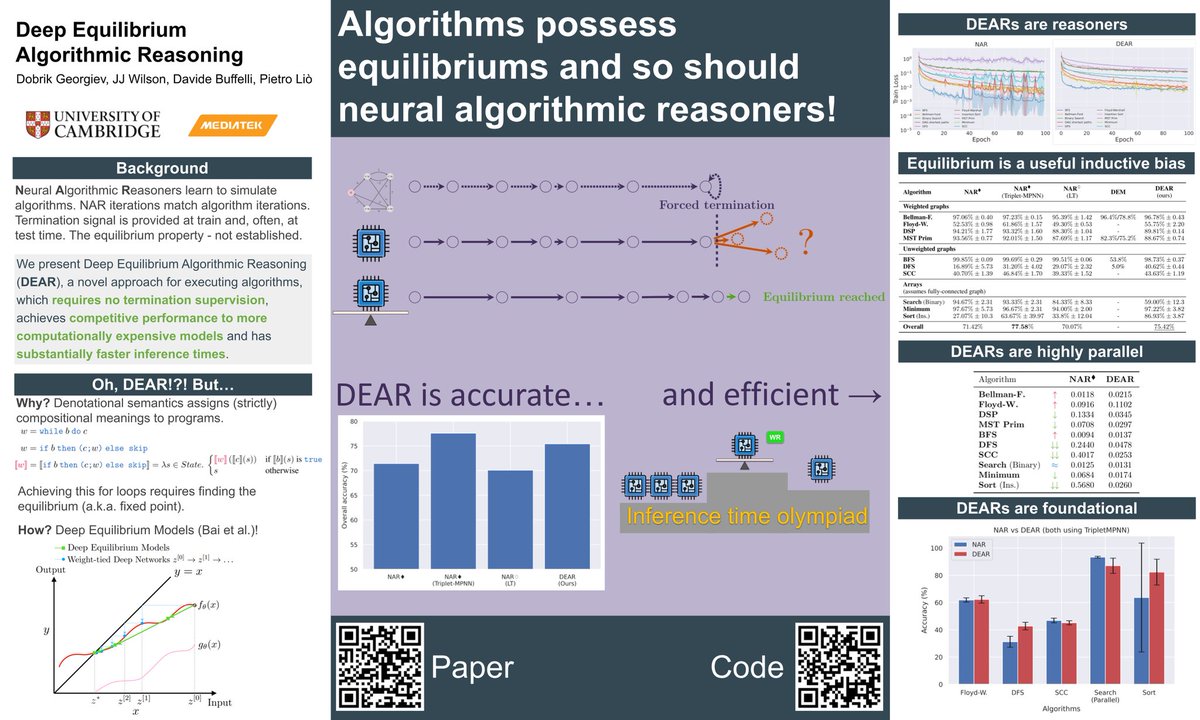
I will be presenting our paper on deep equilibrium algorithmic reasoning (poster sess 3)
Feel free to swing by, say hi, have a coffee break with me in between sessions or suggest me good locations for a photo
#NAR#NeurIPS2024#NeurIPS
I'll be at NeurIPS next week presenting two papers (on the generalization of 2nd order methods, and on a new model for Neural Algorithmic Reasoning). Feel free to reach out if you'd like chat about optimization, graphs, foundation models for time series, or AI 4 chip design
In < 1h, we will be taking the LoG stage for the new and improved version of our NAR tutorial 🔢!
Hope you can join us -- it is open for all, publicly streamed on YouTube, and will feature a fun discussion of great reasoning research over both graphs 🕸️ and language 💬!
📢 Exciting News! Our paper, “Bayesian Computation Meets Topology,” has just been published in TMLR! 🎉
👉https://t.co/WW5WprJ3V5 👈
Here’s a deep dive into how #topology and #bayes(ian) computation come together to enhance parameter inference:
📌 Why Topology?
Topology provides powerful descriptors like persistent homology that capture the “shape” of data across scales. Our approach leverages these topological features in Bayesian inference—crucial for scenarios where data is scarce or structurally complex.
📎 The Gap We Address
Topological methods are robust for capturing the overall shape of data but don’t integrate into Bayesian frameworks in a straight-forward fashion. We’ve developed a method that fills this gap, incorporating topology-based loss functions for Bayesian parameter estimation.
🛠️ Core Methodology
Our framework uses topological loss functions based on persistent homology for inference, enabling us to construct a comparison-based posterior. This allows for uncertainty quantification without needing explicit likelihoods—essential for chaotic systems where the likelihood is analytically intractable.
🚀 Applications & Experiments
We validate our approach on models with inherent complexity, such as the Vicsek swarm model and Lattice Boltzmann simulations. In these cases, topology-driven Bayesian inference produced significantly more accurate parameter estimates than standard geometry-based ones.
🧩 Implications
This work brings Bayesian computation and topology closer together, paving the way for robust, simulation-based inference. Applications extend to fields like biology and physics, where data often exhibit complex, multi-scale structures that benefit from this topologically-informed approach.
👀 Check It Out!
📜 https://t.co/PMJF5mTlmY
💻 https://t.co/JFA2eVAhI6
Joint work with @JRohrscheidt and @SeBayesian!
If you're curious, you can check out the preprint to read how we take advantage of persistent homology to provide higher-order information to GNNs https://t.co/pYWFzNJbar
Very happy that our paper "CliquePH: Higher-Order Information for Graph Neural Networks through Persistent Homology on Clique Graphs" has been accepted at @LogConference ! a huge thanks to my co-authors @csfarzin@Pseudomanifold
In this paper we introduce DEAR, a new equilibrium-based way to decide the termination, both during training and inference, in the setting of neural algorithmic reasoning. We provide a theoretical motivation for DEAR, and show it leads to great empirical performance. [5/6]
#neurips2024 will be very DEAR to me this year!
Deep Equilibrium Algorithmic Reasoning has also been accepted at NeurIPS after its selection for an oral presentation at MAR@CVPR 2024. Special thanks to my collaborators @DBuffelli@pl219_Cambridge and, my lucky charm, @sonjj74!
Next week I’ll be at #NeurIPS presenting our paper on GNNs and size generalization ✌️ if you want to have a chat about GNNs, research, or tv series, feel free to DM me!
Have you ever wondered how we can use prior knowledge expressed in symbolic form to guide the training of deep learning models? Then check out our preprint here: https://t.co/r4Qls2PSkf
@brunofmr Thanks @brunofmr! That’s definitely an interesting direction to think about. Do you think it could make sense to define a causal model with variable representing spectral properties of the graphs (and their coarsened versions)? As many coarsening methods act on these