CJP appointees have overlooked all existential threats faced by Muslims. But in fallout of the “biggest upper-caste” protests, first to give life for it is a Muslim (WB), most to take a bullets is Muslim (Bihar), Muslims disproportionately faced pellets, detentions, police action
Breaking
Instagram again blocks Maktoob Hindi’s Delhi protest videos after Union govt demand
Instagram has again restricted access to two more Maktoob Hindi videos, citing legal requirements under the Information Technology (Intermediary Guidelines and Digital Media Ethics Code) Rules. The videos were ground reports from the Delhi Jantar Mantar protest. Earlier, Instagram had also removed one Maktoob Hindi video, citing the same rules.
On Monday, @DelhiPolice denied reports of "sporadic violence" and detentions at Jantar Mantar, saying the protest was handled "professionally." Is that so?
Watch:
Video shows Delhi Police personnel in plain clothes, with their faces covered by handkerchiefs, beating student protesters during the "Sansad March," raising questions over the use of plainclothes personnel and face coverings while policing the protest.
Watch:
Local Muslim organisations in Karnataka’s Hassan announced a boycott of purchasing animals for Eid ul-Adha amid Hindutva intimidation campaigns, triggering anxiety among dairy farmers who warned they would march their cattle to the deputy commissioner’s office if their livelihoods were affected.
Watch:
This is the first time in years that we,@MaktoobMedia are seeing a deeply low number of subscribers. Our work reaches millions, shapes conversations, and impacts lives, but the number of people choosing to support independent journalism through subscriptions has sharply declined.
We know many of our readers are young people who have not started earning yet, students, or those surviving on low wages. We keep that reality in mind. That is why Maktoob subscriptions begin at just ₹100 for one month via UPI, while the plans start at ₹600 for six months and go up to premium annual support packages.
Even with limited means, many of you have stood by us. Today, we need that solidarity more than ever. Subscribers get access to our monthly live conversations with experts, weekly newsletters, and early access to our originals.
The truth is simple: our financial condition is severe. Our liabilities have crossed ₹20 lakh. Independent journalism cannot survive on reach alone. It survives when readers decide it must survive.
If you are not a subscriber, subscribe today.
If your subscription has expired, renew it.
If you cannot afford to subscribe now, ask a friend or family member to do so.
If you have influence, use it to amplify this appeal.
We are asking support for journalism that has earned your trust.
Subscribe now: https://t.co/QuQA8NtpUI
UPI ID: maktoobmedia@icici
Two minor Muslim brothers in Shamli, Uttar Pradesh, were allegedly beaten, thrown into a canal, and stripped naked by men with a political grudge against their family , with police dismissing the incident as a mere debt dispute despite a viral video exposing the horror.
Watch:
Veteran journalist @ravish_journo highlights Maktoob’s exclusive reporting on mass voter deletions in West Bengal carried out in the name of SIR.
Watch:
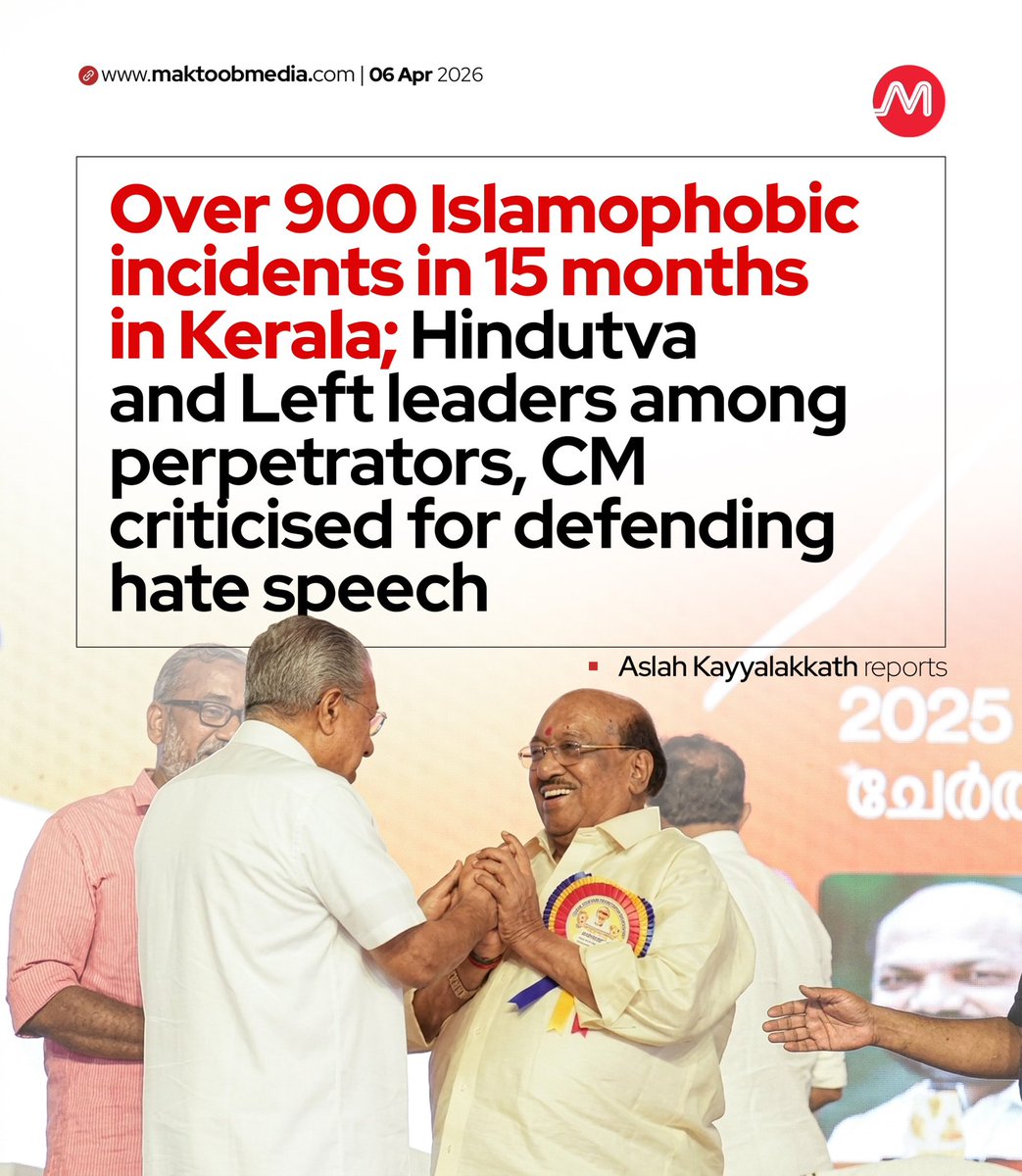
At least two Islamophobic incidents have been documented every day over the last 15 months under the Pinarayi Vijayan-led government in Kerala.
The pattern reflects deep institutional failure, from police inaction and the absence of suo motu FIRs in hate speech cases, to complaints going unregistered, and a lack of arrests even when FIRs are filed.
Most troubling is the response from the highest office in the state. Chief Minister Pinarayi Vijayan has, on multiple occasions, publicly justified deeply offensive and hateful remarks made against Muslim community by Vellapally Natesan, an influential figure in the state.
Read: https://t.co/wLNvZDg0Qw
Two days ago, @MaktoobMedia received an email from X stating that the platform had been issued a blocking order by the Ministry of Information and Broadcasting under Section 69A of the Information Technology Act, 2000, regarding our video explainer on the Kunan Poshpora mass rape.
This is the post: https://t.co/8KLxzUznx1
“Indian law obligates X to withhold access to this content in India.”
Blocking journalists from telling stories, especially those documenting one of the gravest historical injustices happened in India, is a crime. Journalism is not a crime. Blocking journalists is.
“Some of the most difficult nights of my life as a journalist were spent watching videos of Muslims being lynched, humiliated, and attacked, again and again, just to understand what really happened.”
As the world marks today as International Day to Combat Islamophobia, I cannot think of it as just another date on the calendar.
As the editor of @MaktoobMedia , Islamophobia is not an abstract word or a term to me. It is something I encounter almost every single day through our work. The most painful part is watching the videos that arrive in our newsroom, videos of lynching, humiliation, mobs screaming hatred.
I remember many nights lying in bed at midnight, or sitting in the middle of a family gathering or a moment of joy, when work forced me to open those videos and watch them again and again, frame by frame, just to understand what really happened. It is exhausting. Truly exhausting.
Last month, I had a conversation with our video editor, Darwesh. He once told our deputy editor how difficult it had become for him to edit the most brutal videos of violence against Muslims. What made it even heavier was that, in his spare time, he volunteered with the Kerala Islamophobia Watch team, where he spent hours listening to Islamophobic speeches in Malayalam and documenting them. And then he would return to Maktoob to edit more videos of hate and violence. Imagine what that does to a person’s mind.
And Darwesh is not alone. Every reporter, writer, designer, and freelance contributor at Maktoob carries a similar story. For nearly ten years, our newsroom has documented Islamophobia as part of its editorial commitment, without a day’s break.
For us, Islamophobia is not something that appears once a year on March 15. It is a daily menace we try to confront, record, and challenge.
If documenting it is this painful for those of us sitting in the newsroom, I often think about the people who actually live through it on the ground, those who survive the violence, the humiliation, the constant suspicion.
Many people tell us: “stop using this word Islamophobia”. “Stop this victimhood narrative”. “Enough of this.”
But no, my friends. Islamophobia is not a jargon. It is a lived reality. Speaking about it is not playing victim. It is part of the struggle for a community’s dignity, safety, and right to exist without fear.
And the truth is, even today, we are still not talking about it enough.
Heartbreaking scenes show Iranian parents searching through their children’s backpacks and textbooks after an Israeli-American strike reportedly killed about 148 girls at a primary school.
Watch:
I am a diplomatic aide in the Sultanate of Oman's Ministry of Foreign Affairs.
My job is logistics. When two countries that cannot speak to each other need to speak to each other, I book the rooms. I prepare the briefing materials. I make sure the water glasses are the right distance apart. You would be surprised how much of diplomacy is water glasses. Too close and it feels informal. Too far and it feels like a tribunal. I have a chart.
We had a very good month.
Since January, Oman has been mediating indirect talks between the United States and Iran on Iran's nuclear program. The talks were held in Muscat and in Geneva. The Americans would sit in one room. The Iranians would sit in another room. I would walk between them. My Fitbit says I averaged fourteen thousand steps on negotiation days. The hallway between the two rooms at the Royal Opera House conference center is forty-seven meters. I walked it two hundred and twelve times in February. This is good for my cardiovascular health. It was less good for my knees. Both are in the service of peace.
By mid-February, we had something.
Iran agreed to zero stockpiling of enriched uranium. Not reduced stockpiling. Zero. They agreed to down-blend existing stockpiles to the lowest possible level. They agreed to convert them into irreversible fuel. They agreed to full IAEA verification with potential US inspector access. They agreed, in the Foreign Minister's phrase, to "never, ever" possess nuclear material for a bomb. I have worked in diplomacy for seven years. I have never seen a country agree to this many things this quickly. I made a spreadsheet of the concessions. It had fourteen rows. I color-coded it. Green for confirmed. Yellow for pending. By February 21 the spreadsheet was entirely green. I printed it. It is on my desk in Muscat. It is still green.
That phrase took eleven days. "Never, ever." The Iranians initially offered "not seek to." The Americans wanted "will not under any circumstances." We landed on "never, ever" at 2:14 AM on a Tuesday in Muscat. I typed the final version myself. I used Times New Roman because Geneva prefers it. The document was fourteen pages. I was proud of every comma.
Here is what they said, in the order they said it.
February 24: "We have a once-in-a-generation opportunity." — The Foreign Minister, private briefing to Gulf Cooperation Council ambassadors. I prepared the slide deck. Slide 14 was the implementation timeline. Slide 15 was the signing ceremony logistics. I had reserved the Palais des Nations in Geneva, Room XX. It seats four hundred. We discussed pen brands for the signing. The Iranians preferred Montblanc. The Americans had no preference. I ordered twelve Montblanc Meisterstucks at six hundred and thirty dollars each. They arrive on Tuesday.
February 27, 8:30 AM EST: "The deal is within our reach." — The Foreign Minister, CBS Face the Nation. He sat across from Margaret Brennan. He said broad political terms could be agreed "tomorrow" with ninety days for technical implementation in Vienna. He said, and I wrote this line for the briefing card he carried in his breast pocket: "If we just allow diplomacy the space it needs." He praised the American envoys by name. Steve Witkoff. Jared Kushner. He said both had been constructive.
I watched from the Four Seasons Georgetown. The minibar had cashews. I ate the cashews. They were nineteen dollars. The most expensive cashew I have ever eaten. But it was a good morning and we were within our reach.
February 27, 2:00 PM EST: Meeting with Vice President Vance, Washington. The Foreign Minister presented our progress. Zero stockpiling. Full verification. Irreversible conversion. "Never, ever." The Vice President used the word "encouraging." His aide took notes on an iPad. The aide did not make eye contact for the last nine minutes of the meeting. I noticed this. Noticing things is the only part of my job that is not water glasses.
February 27, 4:00 PM EST: "Not happy with the pace." — President Trump, to reporters.
Not happy with the pace.
We had achieved zero stockpiling. Full IAEA verification. Irreversible fuel conversion. Inspector access. And the phrase "never, ever," which took eleven days and cost me two hundred and twelve trips down a forty-seven-meter hallway.
Every American president since Carter has failed to get Iran to agree to this. Forty-five years.
Not happy with the pace.
February 27, 9:47 PM EST: The Foreign Minister's flight departs Dulles for Muscat. I am in the seat behind him. He is reviewing Slide 14 on his laptop. The implementation timeline. Vienna technical sessions. The signing ceremony. The pens.
I fall asleep over the Atlantic. I dream about water glasses.
February 28, 6:00 AM GST: I wake up to push notifications.
February 28: "The United States has begun major combat operations in Iran." — President Trump.
Operation Epic Fury. Coordinated airstrikes. The United States and Israel. Tehran. Isfahan. Qom. Karaj. Kermanshah. Nuclear facilities. IRGC bases. Sites near the Supreme Leader's office. Israel called their half Operation Roaring Lion. Someone in both governments spent time choosing these names. Epic Fury. Roaring Lion. I spent eleven days on "never, ever." They spent it on branding. The President said Iran had "rejected American calls to halt its nuclear weapons production."
Rejected.
Iran had agreed to zero stockpiling. Iran had agreed to full verification. Iran had agreed to "never, ever." Iran had agreed to everything in a fourteen-page document that I typed in Times New Roman.
The President said they rejected it.
I do not know which document the President was reading. I know which one I typed.
February 28, 18:45 UTC: Iran internet connectivity: four percent. — NetBlocks, confirmed by Cloudflare. Ninety-six percent of a country went dark. You cannot negotiate with a country at four percent connectivity. You cannot negotiate with a country that is being struck. You cannot negotiate. This is not a political opinion. This is a logistics assessment.
February 28: The governor of Minab reported forty girls killed at an elementary school.
I do not have logistics for that. There is no slide for that. The water glass chart does not cover that.
February 28: Lockheed Martin: up. Northrop Grumman: up. RTX: up. Dow futures: down six hundred and twenty-two points. Gold: five thousand two hundred and ninety-six dollars. An analyst at AInvest published a note titled "Iran Strikes: Tactical Plays." The note recommended positions in oil, defense stocks, and gold.
The most expensive cashew I have ever eaten was nineteen dollars. The most expensive pen I have ever ordered was six hundred and thirty dollars. The math suggests I have been working in the wrong industry. Defense stocks do not require water glasses. Defense stocks do not require eleven days. Defense stocks require one morning.
February 28: Israel closed its airspace and its schools. Iran launched retaliatory missiles toward US bases in the Gulf. The Supreme Leader promised a "crushing response." Israel's defense minister declared a permanent state of emergency. Everyone is using words I recognize in an order I do not. I recognize "permanent." I recognize "emergency." I do not recognize them next to each other. In diplomacy, nothing is permanent and everything is an emergency. In war it is the reverse.
February 28: The Foreign Minister has not made a public statement.
The briefing card is still in his breast pocket. It still says "within our reach."
How Hindu nationalists, led by Narendra Modi, evaded accountability for the 2002 Muslim genocide, turning impunity into a stepping stone for political dominance.
Watch our 2025 video on 2002 Muslim
genocide in Gujarat
https://t.co/yj90r3V7Ic
How Hindu nationalists, led by Narendra Modi, evaded accountability for the 2002 Muslim genocide, turning impunity into a stepping stone for political dominance.
#Maktoob Archive - 'Gujarat Muslim genocide 2002: When impunity became a stepping stone to power'
Watch the full video: https://t.co/kNmiwr16gg
Kunan and Poshpora are twin villages in the Kupwara district of Jammu and Kashmir. On the night of 23 February 1991, during a harsh winter, security forces reportedly acted on information about suspected militant activity in the area and launched a search operation in the two villages. Personnel from the CRPF (Central Reserve Police Force), the BSF (Border Security Force), and the 4 Rajputana Rifles of the Indian Army entered the villages, going door to door. Men were separated from their families, taken outside, and subjected to interrogation as the search continued.
During the operation, numerous women alleged that they were subjected to mass rape and brutal torture. Survivors ranged in age from a 13-year-old girl to an 80-year-old woman. Initial FIRs recorded 23 cases of rape, while human rights organisations, including Human Rights Watch, later estimated that the number of survivors could be as high as 100. The incident remains one of the most controversial and painful episodes in the history of the conflict in the region.
Watch the full video here: https://t.co/yVgUjyjdtX
During a metro journey from Meerut to Delhi, some passengers reportedly raised slogans of “Bharat Mata Ki Jai,” “Jai Shri Ram,” and “Jai Hind,” along with chanting “Tel lagado Dabur ka,” allegedly targeting Muslim commuters.
Watch:
A group of Bajrang Dal workers pressured a Muslim shopkeeper in Kotdwar town of Uttarakhand to change the name of his shop, objecting to the use of the name “Baba Shop,” according to a report by "hindutva watch".
During the confrontation, a local Hindu man, identified as Deepak Kumar, intervened and firmly challenged the Bajrang Dal workers. In the video, he is seen questioning their authority to dictate a shopkeeper’s business name and asking them to leave the premises.
When the group demanded to know his identity, he responded, “Mohammad Deepak,” a remark that appeared to unsettle the group. The Bajrang Dal workers subsequently left the area.
Full story here: https://t.co/swrT7CFi9Q
Watch:
“What is happening in India is preparation for genocide,” says actor @prakashraaj at an event in Hyderabad, organised by APCR, titled “Longing for Justice”, on 17 December 2025.
He also said that people must be aware of what is happening in the country.
Watch the full speech.
https://t.co/WCIrfGOrtz
Mob lynching is one of the cruellest forms of violence because it strips a person of everything before taking their life. It begins by asking their name. Then they are forced to chant the slogans of those attacking them, words that deny their faith and dignity. Their money is taken, their means of livelihood destroyed. They are beaten while others watch. The violence is filmed. And even after they are killed, their name appears in police records as if they were the criminal.
What is happening to Muslims in India through Hindutva mob violence is not just crime; it is the normalisation of public cruelty. It shows how easily a society can be trained to look away while human beings are humiliated, broken, and erased.