Cockroach Janta Party announces three spokespersons who will speak on behalf of the protest movement to the public and the media.
Investigative journalist Saurav Das will take on the role of Chief Spokesperson. Political researcher, author and filmmaker Vijeta Dahiya, and an alumnus of IIT Kanpur and the global management consulting firm McKinsey, Ashutosh Ranka, will also take on the role of Spokespersons along with Das. CJP is committed to changing the political discourse of India, and this will be led by a new generation of leaders.
@SauravDassss@VijetaDahiya@AshutoshRanka@CJPComms
Life was slow but peaceful in Lakshadweep until the Indian government appointed Praful Khoda Patel as its Administrator in December 2020. The new regime brought several policies that have since created a climate of fear and fatalities on the islands. Islanders say Patel is trying to expel them from their homeland.
As Patel remains in office for an extraordinary tenure of over five years, people say he has become an existential threat to their lives and livelihoods.
Watch @MaktoobMedia documentary “Stranded in Sea” by @shaheenjournal
https://t.co/AGndGjpk4p
Cover reveal of my forthcoming book "What to do with Political Sadness, and Other Essays on Death, Destruction and Hauntology"! So proud to be published again by #YodaPress@arpitayodapress and @SimonSchusterIN
Israeli settlers today forced the family of Hussein Asasa, buried hours earlier in the Asasa cemetery south of Jenin, to dig up their father as Israeli security forces stood by. According to the family, they moved his body to another cemetery under a hail of stones from settlers.
"This is appalling and emblematic of the dehumanisation of Palestinians that we see unfolding across the OPT. It spares no one, dead or alive," Ajith Sunghay, head of @OHCHR_Palestine.
The cemetery sits 300 meters from Sa Nur settlement, re-established in 2025. Palestinians must now obtain Israeli permits to bury their dead there, as Hussein's family had done that same morning.
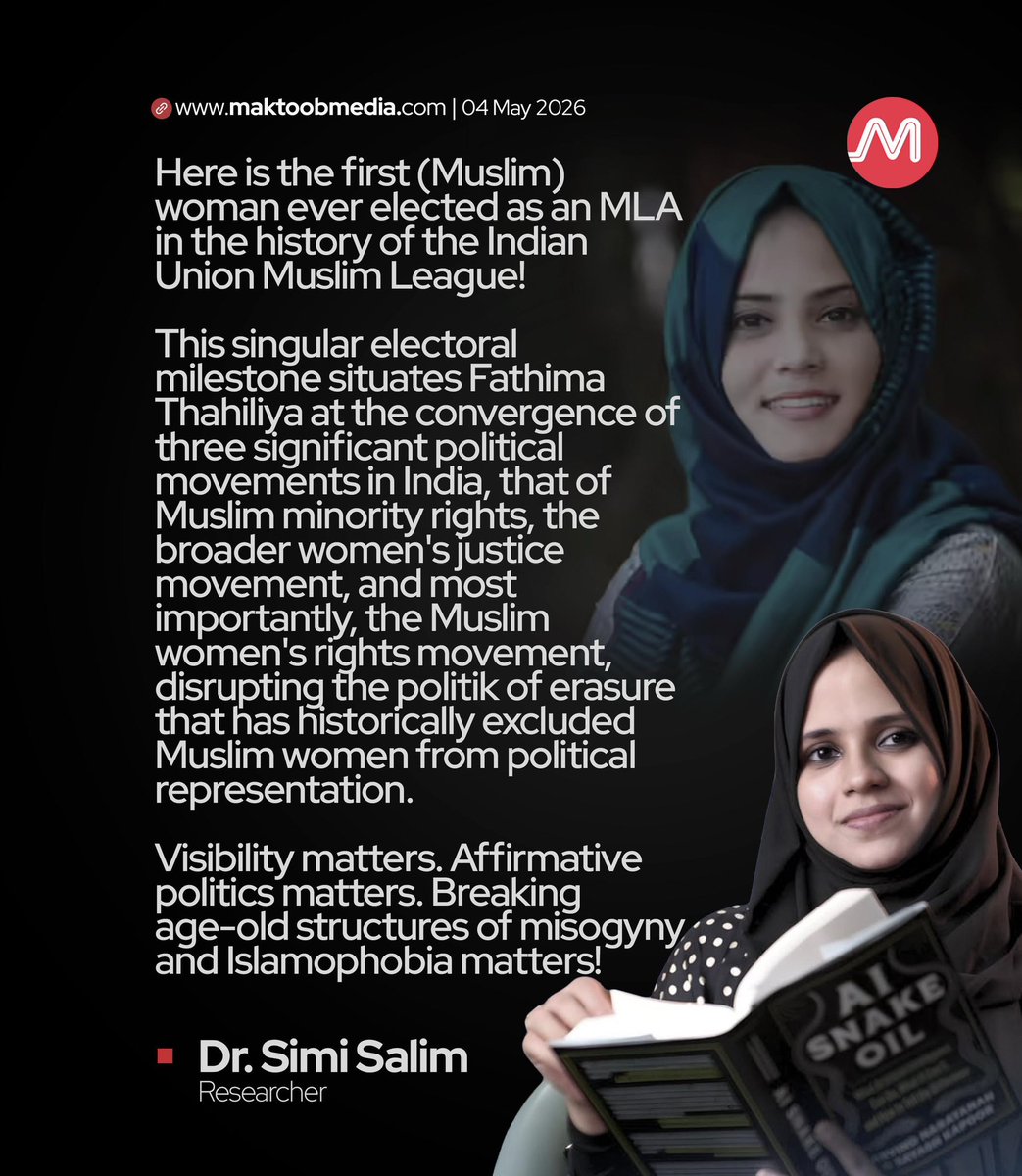
“Here is the first (Muslim) woman ever elected as an MLA in the history of the Indian Union Muslim League!
This singular electoral milestone situates Fathima Thahiliya at the convergence of three significant political movements in India, that of Muslim minority rights, the broader women's justice movement, and most importantly, the Muslim women's rights movement, disrupting the politik of erasure that has historically excluded Muslim women from political representation.
Visibility matters. Affirmative politics matters. Breaking age-old structures of misogyny and Islamophobia matters!”
Dr. Simi Salim
Researcher
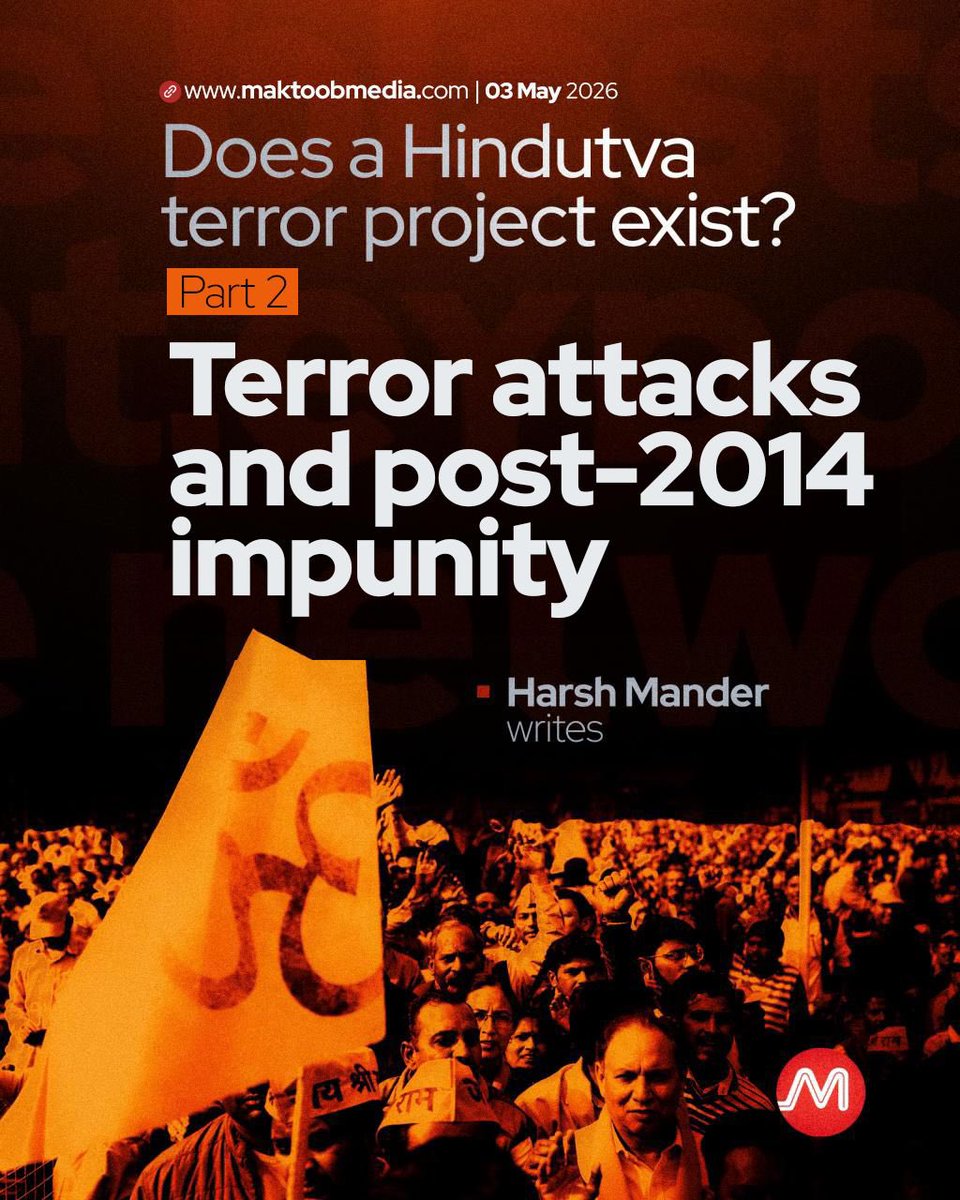
Part 2 of @harsh_mander ’s two-part series details Hindutva-linked terror attacks, repeated acquittals and the post-2014 weakening of key prosecutions, arguing that impunity for powerful accused stood in stark contrast to the harsh treatment of jailed and falsely framed Muslims.
https://t.co/ceJkgHHOS0
To pull a Ravi Shastri, no matter who wins, one winner is already decided: @SabarInstitute_.
A tiny research institute based out of Kolkata helped unpack the massive disenfranchisement exercise that was the SIR.
It is difficult to imagine reporting on the SIR without Sabar.
A woman, believed to be around 52, from the eastern fringes of Kolkata, could barely speak when she walked in. Somehow, she managed to climb the narrow staircase of an old building that now serves as a legal aid desk for deleted voters in West Bengal.
She had taken a day off from work to reach the centre, nearly 10 km from her home. The journey, along with the loss of a day’s wages, cost her around Rs 600, a sum that weighs heavily on her modest means.
Ummair Alam, a Research Associate at @SabarInstitute_ writes:
https://t.co/w2lcn19F9M
"Open the door.."
Palestinian children in the occupied West Bank village of Um al-Khair staged a protest at barbed wire erected by Israeli settlers, demanding the right to reach their school and move freely in their own village.
Watch:
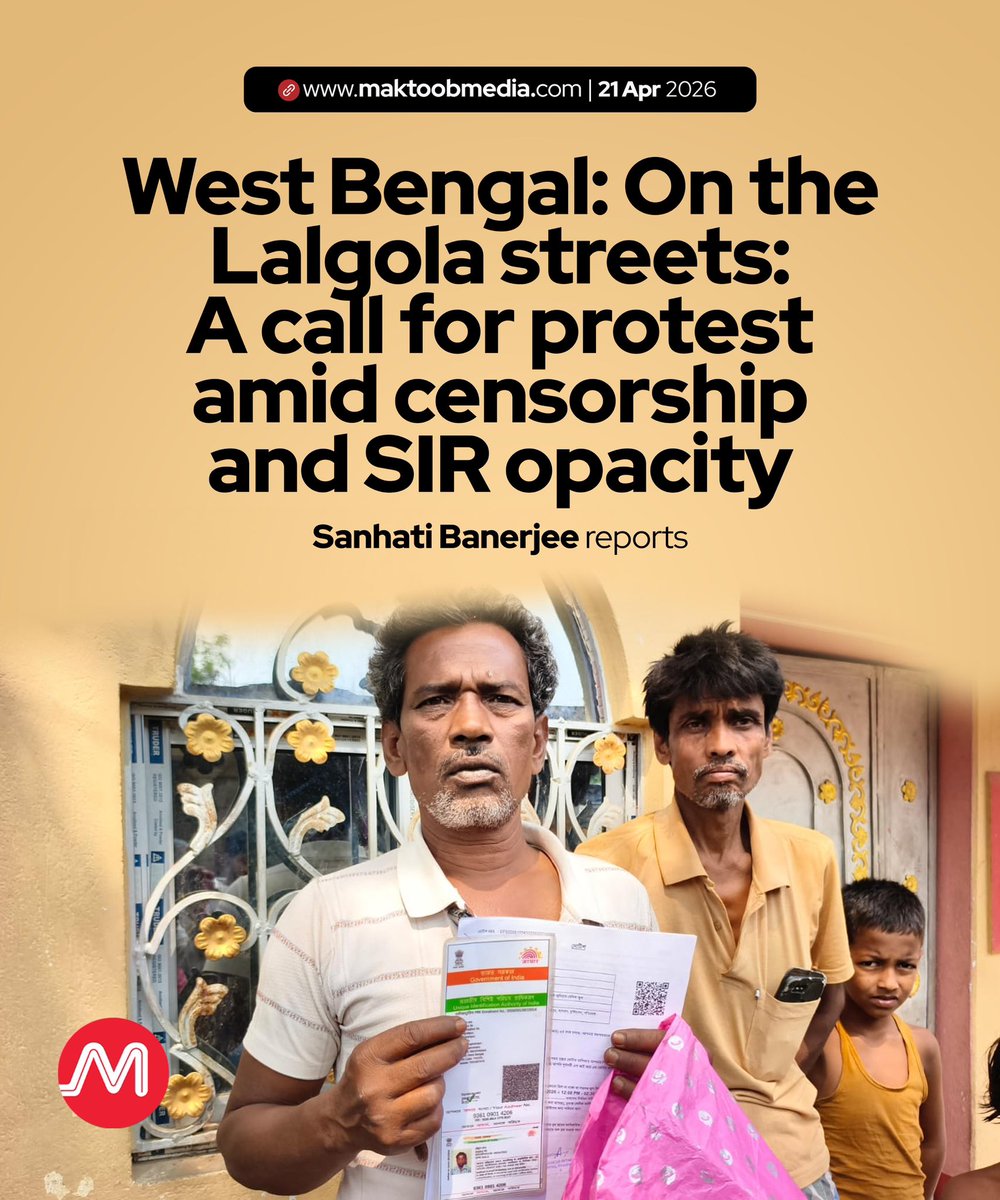
In Murshidabad, from Samsherganj to Lalbagh to Beldanga to Lalgola, people are not just losing their names from voter rolls. These are people from the most deprived sections, already struggling to meet daily needs. Now, they are losing certainty, dignity, and the basic right to belong.
They are carrying decades of documents, only to be told they do not exist. They are lowering their voices, afraid even to ask why.
“If we have to live, we will live here; if we have to die, we will die here.”
This is not just a bureaucratic exercise. This is a human crisis unfolding in real time, an institutional erasure of entire communities.
Read these ground reports by Sanhati:
• Samsherganj: https://t.co/5WhanQb1PF
• Lalbagh: https://t.co/04ZsrAVWG6
• Beldanga: https://t.co/lyPNSH66y9
• Lalgola: https://t.co/ttuMVQmMWM
Independent journalism ensures these stories are witnessed, documented, and not erased.
Support @MaktoobMedia . Subscribe today
https://t.co/EleVBWjKZc
A new analysis published by @UN_Women today shows that more than 38,000 women and girls were killed in #Gaza between October 2023 and December 2025.
That is an average of at least 47 women and girls killed per day.
https://t.co/6S7FGcG8Vz
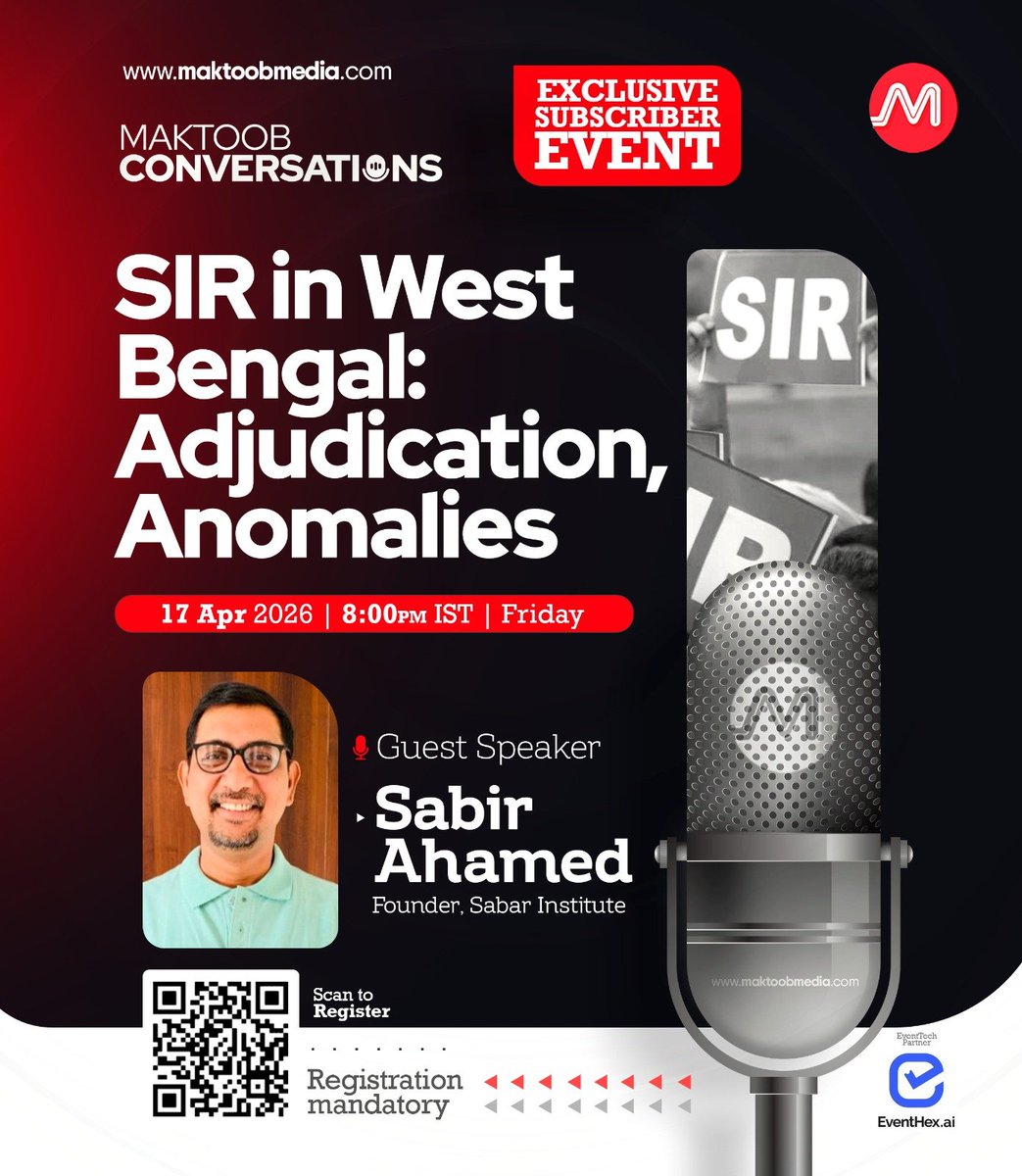
@sabirahamedgd , founder of the org, will unpack anomalities around SIR in WB, in conversation with @MaktoobMedia this Friday, April 7th. Register now: https://t.co/cR7xQClwQA
✊ Data belongs to the people. Democracy runs on transperancy
West Bengal's Special Intensive Revision (SIR) 2026 data ie. the data that determines whether your name stays on the voter list, is technically "public." But try accessing it. You'll hit CAPTCHAs. Download limits. Scanned PDFs that no machine can read. Data buried so deep it may as well not exist.
So we did something about it.
Sabar Institute, with the help of our researcher @Souptik_H and support from our team of @sabirahamedgd, @Ashin_econ and @mallick_so63507 has built free, open, interactive maps of SIR 2026 data across all 294 West Bengal Assembly constituencies and we're making them available to every journalist, researcher, activist, and citizen who needs them.
🪦 ASDD Deletion Map — See exactly where voters are being deleted as Absent, Shifted, Dead, or Duplicate. Track overall deletion %, gender ratio, death counts, untraceable voters — assembly by assembly, on a live map.
⚖️ Supplementary Adjudication Map — Follow the adjudication trail: who's under review, how many were added or deleted, what percentage are still pending — across every single constituency.
Why does this matter?
Because mass deletions from voter rolls don't affect everyone uniformly. They happen in specific places, to specific communities, in patterns that deserve scrutiny. You cannot scrutinize what you cannot see.
🔗 Link to explore the map is in the next tweet
If this work matters to you, support us using the link below👇
#DataForBetterLives
International law expert, who served as Senior Trial Attorney and Chief of Prosecutions at the International Criminal Tribunal for Rwanda, Stephen Rapp, outlined the findings of a panel he was part of, which found credible evidence of widespread and systematic human rights violations against Muslims in India.
https://t.co/zl8rEOhgGz
I have spent six years in journalism, and three years ago, I started The Observer Post with a belief that our stories deserve to be told, even when the world chooses to ignore them. In doing so, I knowingly slowed down my own personal growth. My freelancing work almost came to a halt because I wanted to build something bigger than myself. Along the way, there were people who stood with this mission, some even working for half salaries just to keep this platform alive. I remain deeply grateful to all of them. From scratch, we built The Observer Post, expanded into Hindi, and grew into a team of 13 people committed to fearless, ground-level journalism. We were not just reporting news, we were documenting realities that many would rather look away from.
Then came the hardest phase. Two months ago, we had to shut down our office. Our team collapsed from 13 to just 4 people. Our Hindi channel went silent. Everything we had built started slipping away. I reached out to organisations, to those who speak loudly about supporting independent media and the community, hoping someone would step in and help us survive.
No one did.
So I made a choice. I refused to let this platform die.
I went back to the ground alone. I reported stories myself, shot videos, edited some of them, and published them, all while doing a part-time job just to keep The Observer Post alive. From Haryana to Uttam Nagar to Bihar, I have tried to reach every place where stories were being ignored and voices were unheard. I have pushed myself beyond limits because I know if we do not tell these stories, no one will.
But the truth is this fight is not easy.
It is exhausting. It is isolating. It breaks you mentally, emotionally, and financially. Still, I have not given up, and I do not want to.
Today, I am asking you not as an organisation, but as someone who has given everything to keep this alive.
If just 1000 people contribute ₹500 monthly by taking a subscription, we can rebuild. We can bring back our team, hire reporters, bring in video editors, restart our Hindi platform, and strengthen independent journalism that actually reaches the ground. ₹500 may feel small, but together it can bring back an entire newsroom.
This is not just about The Observer Post. This is about making sure our stories are not erased, that truth is not buried, and that voices from the ground are heard, documented, and remembered.
If you have ever watched our work, trusted our reporting, or believed in what we are trying to do, this is the moment to stand with us.
Because if we stop, these stories disappear.
And we cannot afford that.
Pls RT : Folks, IFF runs on a lean budget. We do our work with passion, integrity, and belief in the Constitution of India. The best part? It is funded by people like you, the citizens of India. Unfortunately, we have been running a budget deficit over the past three months. Please donate. Even better, do it on a recurring basis and become an IFF Member. Donate : https://t.co/LV0gywytjh