China's economic engine is grinding to a halt under the weight of severe structural failures that state propaganda can no longer hide.
A deep look at the hard data reveals the sheer scale of the crisis ripping through the country across six distinct areas:
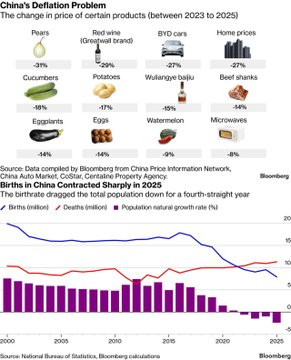
1. The property collapse: Residential housing prices have cratered roughly 30% from their 2021 peak, obliterating the primary source of household wealth for families.
2. Systemic deflation: The broad GDP deflator has turned negative, locking the country into its longest continuous deflationary streak in decades.
3. Price freefall: Domestic consumer demand is so weak that prices for everything from BYD electric vehicles to basic groceries have dropped up to 31%.
4. Demographic implosion: Births plummeted to just 7.93 million in 2025, the lowest level since 1949, driving a fourth consecutive year of total population decline.
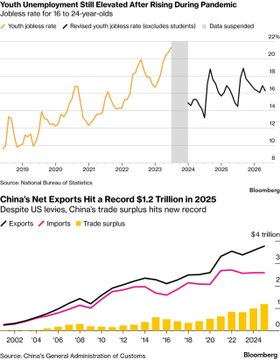
5. Stranded youth: The youth unemployment rate remains trapped in the high teens, leaving millions of university graduates locked out of the workforce.
6. Extreme export reliance: A record $1.2 trillion trade surplus proves Beijing is desperately forcing products into foreign markets because its own citizens cannot afford to buy them.
Relying on Western consumers cannot mask this deep internal decay, and the CCP cannot simply command its way out of a simultaneous consumer and demographic collapse.
#ChinaEconomy #GlobalMarkets #EconomicSlowdown #Macroeconomics #GlobalTrade
https://t.co/9et7YGNrEF
@Sunanda_Iam THE UPI-UNITED PRESS INTERNATIONAL - REPORT SHOWS THE CCP HAS 50,000 MILLION HOMELESS
JUST FOR CONTRAST THE US HAS 750,000 HOMELESS!
The US homeless is "Zero point two one four three percent"
3.5% of China's population is homeless!
@masaminabruh@TripInChina That is literally gutter oil swine !
You have the audacity to call me swine ?
LMAO
Dog was in CCP food menu u til a few years ago
You are disgusting and you know it !
👇👇👇👇👇👇👇
From July 1, Criticizing China Becomes a Crime
China has just passed the “Ethnic Unity and Progress Promotion Law,” and its content is chillingly authoritarian:
It criminalizes any criticism of policies toward Uyghurs, Tibetans, and other ethnic minorities, as well as religious issues.
Worst of all is Article 63’s “extraterritorial application” it explicitly targets the speech and actions of foreigners outside China, including in Japan and other countries.
Support for Taiwan independence? A single critical post online? Or even commenting the food of Panda Express is a bit salty. Perhaps you don’t like the way your your Neighbour’s Chinese EV is parked.
If you ever set foot in China , even for a layover and the risk of detention skyrockets.
The Xi regime is attempting to silence ideas and speech worldwide using domestic law. This is extreme authoritarian overreach that should terrify everyone.
Will you still dare to visit China?
#GreatTranslationMovement #China #FreedomOfSpeech #Uyghurs #Tibet #Taiwan
China's labor market in 2026 presents Beijing with a problem it cannot solve through messaging, and the leadership's reliance on statistical concealment rather than structural reform suggests it already knows that.
The headline numbers are bad enough on their own terms. Urban youth unemployment for those 16 to 24, excluding students, climbed to 16.9 percent in March, a four-month high that reversed six months of declines the state had pointed to as evidence of stabilization. The 25-to-29 cohort hit 7.7 percent, its highest reading since March 2025. Overall urban unemployment reached 5.4 percent, a 13-month peak. A record 12.7 million university graduates, roughly half a million more than the prior year, are entering this market, into an economy whose nominal growth has been depressed by a year of falling prices and whose private sector hiring appetite has shrunk in lockstep.
The official figures, in any case, understate the condition of the labor market by design. China classifies anyone working one hour per week as employed; the United States uses fifteen hours, France twenty. Peking University economist Zhang Dandan calculated in 2023 that the true youth unemployment rate, once discouraged workers who had exited the labor force were counted, was as high as 46.5 percent, more than double the official figure at the time. Nothing in the structural picture since has plausibly improved that ratio.
The drivers are not cyclical. Fixed asset investment grew only 1.7 percent in the first quarter, down from 4.2 percent a year earlier. The property sector, which at its peak accounted for roughly thirty percent of economic activity, remains in a multi-year contraction that has stranded construction workers and the supply chains built around them, and with them the cohort of migrant laborers in their forties and fifties who carry no pension, no portable benefits, and no obvious second act.
The major platform companies, Alibaba, Tencent, ByteDance, JD, have spent years trimming headcount in the aftermath of the 2020 to 2022 regulatory campaign that left private capital feeling politically exposed. Deflation, now entrenched, completes the feedback loop: weaker pricing power compresses margins, hiring slows, household precautionary saving rises, demand softens further. Each link reinforces the next, and none is the kind of problem stimulus alone can resolve.
The state's response has been instructive. When the youth unemployment rate hit a record 21.3 percent in June 2023, the National Bureau of Statistics suspended publication of the series entirely. When the figures returned months later, the methodology had been quietly revised, students excluded and age brackets adjusted, in ways that produced a lower headline and broke comparability with what came before. The pattern is consistent across other indicators: where the data embarrasses the leadership, the data is changed, delayed, or removed. This is not a communications strategy in any conventional sense. It is the substitute for one.
Three things follow.
First, the tang ping (躺平) or "lying flat" disposition that Beijing has spent years denouncing is a rational response to a labor market in which effort and credentials no longer reliably convert into stable employment or affordable housing, and the leadership's framing of it as a cultural failure rather than a market failure tells against any near-term policy correction.
Second, the credibility cost of statistical opacity compounds. Foreign investors, domestic households, and even mid-level cadres are now operating without reliable employment data in the world's second-largest economy, which raises the risk of misallocated capital and miscalibrated policy at every level of decision-making.
Third, the political economy is shifting in a direction the Party has not yet acknowledged. The cohort entering the workforce in 2026 has no memory of double-digit growth and no expectation of upward mobility. Whatever social contract underwrote the reform era is being renegotiated, quietly, by people who have stopped registering as unemployed because they have stopped expecting the system to find them work.
Aric Chen | Insights
There are 15.2 million people doing food delivery in China,among them 3.34 million are college graduates, 68K have Master's, and 1200 have Ph.D.
There are 8.6 million college graduates doing full-time streaming on streets, 6.82M of them are college graduates, 52K have Master’s and 37K have Ph.D.
Eight out of 10 streaming hosts have college degrees. 24 million college graduates never worked in offices
Anything wrong?
Elon just created 4,400 millionaires in a single day.
400 of them are now worth over $100 million.
These aren't VCs. They're SpaceX employees, and the list includes welders, technicians, and cafeteria staff, because for two decades the company paid every level of the workforce in stock instead of higher salaries.
Juan Hernandez immigrated from Mexico and took a $28 an hour contractor welding job in 2015. He says he didn't even know what SpaceX was. The company gave him a $10,000 equity grant and let him buy more shares through payroll deductions. That stake is now worth $880,000.
Trevor Hise's parents wanted him to take a stable job at General Electric. He picked SpaceX instead, stayed 12 years, and accumulated over 100,000 shares. At the $135 listing price that's $13.5 million. He's 37 and semiretired. His words: "The magnitude of this has been ridiculous."
The most telling detail came before the listing. Over 100 employees quietly banded together and negotiated a group wealth management deal covering up to $5 billion, because none of them had ever needed a wealth manager before.
Software IPOs have minted millionaires for 30 years. This is the first one where the money went to the factory floor.