Papers to define and explain relationship with the notion of constitutionalisation of the digital era. An initiative of Legal Informatics Pakistan @LinfoPk
In Dec-2021 - Pakistan’s Parliament passed 33 m bills in a single day during the joint session, In Aug-2023, 72 bills in just one week, including , laws like the Army Act Official Secrets, election & NAB. But we cannot have laws on Cybersecurity, Data Protection, Digital Rights.
The concept of pre-crime, once just a sci-fi idea popularized by movies such as "The Minority Report," is steadily becoming a reality, especially with the advent of Artificial Intelligence. The Department of Defense has already deployed their AI "Argus" to augment crime prevention strategies.
Utilization and integration of AI "has enabled DoD to identify, track, and map illicit activities at a speed and scale that is three times faster than what human analysts could perform," while ensuring levels of accuracy consistent with past efforts carried out by DoD personnel.
However, this seems to be going largely unnoticed and unchecked by the American people. The weaponization of AI has already begun and is quickly advancing faster than anyone can keep up with.
Whilst regulators on Capitol Hill squawk about unregulated AI and the dangers of open-source technology that cannot be controlled. Behind the scenes, alphabet agencies are employing and weaponizing AI to do a multitude of police work for them.
The collection of data and the ability to actually utilize the data collected in a cohesive way is an important distinction that needs to be made.
With the current biases we are seeing in our political sphere, and the DoD stating that this AI is tasked with the prevention of viral disinformation. We must seriously sit down and think to ourselves if we want something like this to be deployed against the American people or how long it will be until it is.
This content was 100% human-generated.
Follow me; let's discuss the world and ideas together.
Researchers from MIT and Technion have developed a new algorithm that can automatically and independently determine when a machine should follow its teacher and when it should learn on its own.
This research could have a significant impact on the future of machine learning. By combining two existing techniques, the researchers have created a new algorithm that is more powerful and versatile than either technique alone.
Today in A.I:
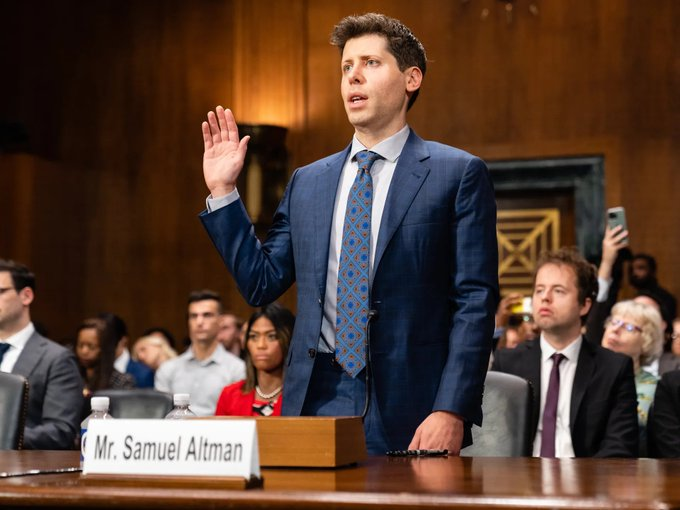
Sam Altman, the CEO of OpenAI and founder of ChatGPT is facing a senate hearing over the safety and regulation of A.I
Here's the summary:
This Thursday 20 April, we will welcome @paul_scharre for a talk on his book Four Battlegrounds during our online Zoom seminar series! Join us live for the discussions: https://t.co/svjflAgbg4
In the meantime, tools are becoming available to enable sophisticated risk-based decision-making about software vulnerabilities and security patches—contributing to more strategic and proactive enterprise attack surface risk management overall. ... https://t.co/qUq8p5XsuD
AI, its systems and its processes have the potential to alter the human experience fundamentally. But many sets of AI governance principles produced by companies, governments, civil society and international organizations do not mention human rights at all. Need urgent correction
We are very pleased to announce our collaboration with the @HTLGIFestival, the world's leading festival of ideas and music hosted by @IAI_TV! From tomorrow on, we will unveil some of the speakers announced for the festival, brilliant minds on topics very close to DigiCon!
// NEWS //
We're thrilled to announce that the first confirmed speakers for the EU Cybersecurity conference on 22 June are the brilliant Lee Bygrave, Renate Verheijen, Rocco Bellanova, Christian D’Cunha, Cristina Del-Real, Massimo Marelli & Bart Jacobs!
https://t.co/znKLnCVNcA
Today we present our last appointment with #TransparencyinAIsystems before the holidays break but, just in case you miss your weekly dose of #Transparency, take a look at this 🧵 with all the publications up to now from our symposium coordinated by @FPalmiotto and @MarcoAlmada:
On Thu 22 Sep from 16:00-17:00 (CET), we continue our online seminar series with Richard Harknett as our next guest, presenting his book Cyber Persistence Theory, co-authored w/ Michael P. Fischerkeller & Emily O. Goldman - more info & sign-up link: https://t.co/S9S8lgIyPn
Constitutionalism is contextual because power is contextual. The constitution as a site of contest between civil & military politics means that our struggle is to make de facto power comform to the de jure framework of the Constitution. *Arms slicing the air in an imaginary wave*
The Justice in Forensic Algorithms Act aims to ensure that when algorithmic analyses are used as evidence in court, defendants get to know how the tools reached their conclusions with an access to source code and other necessary info. https://t.co/teTStnpYMc