the most insane part, they will release ~7k RL training data and the framework leading to this top 6 model on AA, they also shipped the model + tech report less than 1 week after starting the final RL run
pushing both intelligence and openness level, huge congrats
Ngl, I’d pay handsome money to watch a quality debate between someone well versed in Advaita Vedanta and Kashmir Shaivism
Both are nondual schools of philosophy, and while their views on consciousness may seem similar, their views on the nature of reality are radically different
What is the role of academic computer vision research in the age of increasingly powerful large models? Is GPT-6 Astra a step change? How can a researcher have an impact today in academia?
These are the questions I ask myself as I head off to ECCV 2026, a conference I’ve attended since 1992. One of my papers this year is VIGA, a method that takes an image as input and outputs a 3D Blender scene that represents that image. This is a classical inverse-graphics task and VIGA was the first method to solve it using an agentic approach.
The idea is now several years old and the first version of the paper was rejected. This delayed publication significantly. After it was accepted at ECCV, it was quickly surpassed by people using Claude Code for the same purpose. Today GPT-6 Astra blows away all previous results. But we still head off to ECCV to tell the community about our invention that is now fully out of date.
The way academic work often progresses is that one reads recent papers, notices that they have limitations, comes up with a new idea, explores this, publishes it, etc. Any published paper I read today is based on ideas that are at least a year old. And those ideas were based on the literature of the time, which was also a year old. That means that any paper I see at ECCV is likely two years out of date. In AI today, two years means your work is likely irrelevant.
At CVPR this summer I noticed that many authors have not gotten the message. They continue to work on “old” problems that have a long history. This history is based on assumptions about how the “vision problem” will be “solved”. The truth is that it is being solved in a very different way and many of these problems are no longer relevant. Another group of papers focuses on very niche problems where large models likely fail because of insufficient data or lack of business interest. The impactful papers were largely from industry and had long author lists and massive data+compute behind them. These papers were also out of data, describing systems that had been released months before, but at least they served to provide the community with more complete documentation and analysis of commercial systems.
So what should academics do? First, we need to put aside the tools we’ve used for years and start from scratch. Every project should start by trying really hard to solve the problem with existing tools. I would like to see every paper begin with a detailed experimental analysis of how existing models perform and why they fail (if they do). This gives the kind of insight we need today. Then, assuming current models fail, the solution should provide some fundamental insight that will outlive the next release of such models.
Reviewers today still focus on technical novelty. This pushes people to focus on tweaking architectures rather than clearly moving the field forward. Papers need to be judged based on their novel insight and not their novel technical contribution. This is a real shift in thinking but it focuses us on what matters - progress of the field.
If we want there to be a “field” of computer vision, then it can’t become a marginal backwater, focusing on esoteric problems. If you haven’t tried using Astra (or whatever comes next) to solve your problem, then you have not done your homework. This omission should be seen as negatively as not having a previous work section.
Concretely, I think papers should include a new section analogous to “Related Work” where that related work is current models and how they perform on the task. Reviewers should start asking for this and expecting authors to be able to articulate their insights about the limitations of existing large models.
I'm interested in your thoughts.
Meta’s Segment Anything Model (SAM) 3.1 is now available on Meta Model API, giving developers a fast and lightweight model for detection, segmentation and tracking in a single call on inference tuned for SAM 3.1's architecture.
Use a short phrase to find objects in images and video. One API call returns detections, pixel-precise segmentation masks, and identity-preserving video tracks.
Learn more and start building: https://t.co/AfUFEnU2i7
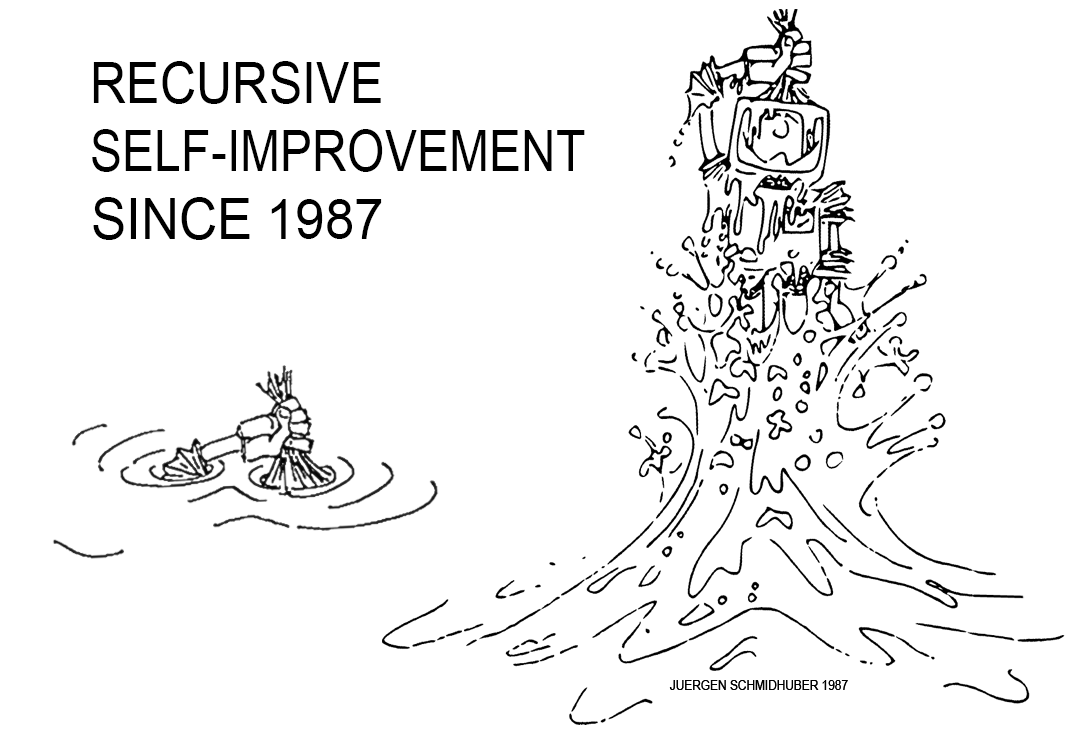
Today everyone is talking about Recursive Self-Improvement (RSI). In 1987, when compute was 100,000,000 x more expensive, I published the 1st concrete RSI algorithms. Now compute is cheap, and RSI is driving the future of both software and physical AI. See: RSI since 1987 https://t.co/yA3KUqpFtb (Technical Note IDSIA-9-26)
Also covered: RSI with self-modifying policies since 1994, gradient descent-based RSI in neural networks since 1992, asymptotically optimal RSI for curriculum learning since 2002, mathematically optimal RSI through the self-referential Gödel Machine since 2003, RSI combined with artificial curiosity and intrinsic motivation since 1990/1997, recent work on RSI since 2020.
Software-based RSI has become practical. Full RSI, however, will require not just self-improving software but self-improving hardware in the physical world.
As of 2026, companies talking about RSI include Anthropic, OpenAI, Sakana AI, SpaceX, Ricursive, Recursive Superintelligence, Inherent …
Ultralytics YOLO27 is coming soon. 🚀
Announced yesterday at YOLO Vision 2026, YOLO27 models are the most capable YOLO models we've built to date.
✅ Simpler model lineup: Four models, four clear answers. n and s for edge devices, m for demanding detection tasks that still need real-time speed, l for high-precision and safety-critical systems. No x model to evaluate as yolo27l already delivers flagship accuracy.
✅ Hybrid architecture: The best architecture for each model size, rather than one design stretched across the range. Small models stay fast on limited hardware; large models achieve higher accuracy.
✅ Breakthrough accuracy: YOLO27l is the first Ultralytics model past 60 mAP on COCO. Higher accuracy across the range, on the same hardware and at the same speed.
✅ Seven tasks: Object detection, instance and semantic segmentation, depth estimation, image classification, pose estimation, and oriented object detection. 28 models across four sizes, all sharing the same interface.
We're also launching YOLOE-27 (detects from prompts) and YOLO27 Enterprise models (pre-trained for your domain).
Available later this year.
Join the waitlist ➡️ https://t.co/R1EyBau1Jd
@KesariDhwaj Northern Ireland is one of the example , also Aceh in Indonesia, Mindanao in the Philippines, and parts of Colombia are examples where economic integration, investment and political accommodation helped weaken bait for insurgency.
@KesariDhwaj They can also be defeated through peace and development.Give people something to lose,then make their prosperity dependent on trade, jobs and economic ties with you.Once war threatens their livelihood,the bait changes: survival and prosperity become more valuable than fighting.
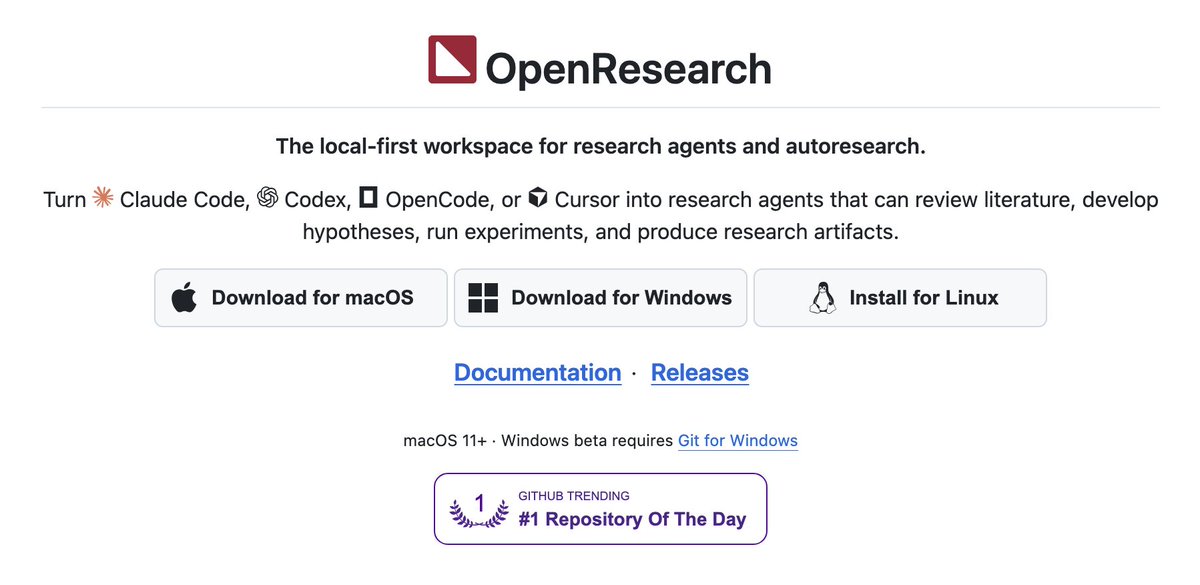
OpenResearch was the #1 trending GitHub repo on Friday 🚀
With OpenResearch, you can turn any coding agent into a research agent that reviews literature, develops hypotheses, runs experiments, and produces research artifacts.
Own and automate your research stack end-to-end. Now available on Windows.
Check it out: https://t.co/IDi6bmrxTP
@VedicWisdom1 I’m vegetarian but doesn’t industrial dairy also involve himsa? Animals can be kept in poor conditions, calves may be deprived of enough milk, male calves and nonmilking animals may be sent for slaughter, and oxytocin is sometimes misused for milk let down. Just asking
@skt_Bharatwasi Still, kidnapping the Kashi princess was wrong, even if it was for his disabled brother. I can defend him for abandoning her because of his vow of celibacy, but Rakshasa Vivaha was still essentially kidnapping. And I’m not supporting Sadhguru’s stance here.