The market is increasingly voting for AI routing/exchange layers.
@OpenRouter, @AskVenice, @AntSeedAI and @Kong are all making variations of the same big bet:
- Intelligence will be superabundant.
- So smart routing becomes critical.
They aggregate:
90-95% of frontier capability.
With 10-100x lower cost.
No model lock-in.
Less mandatory data surrender.
The winning architecture increasingly looks like:
🫵Your data.
🫵 Your memory.
🫵 Your workflows.
🫵 Your policies.
👉Someone else’s models.
My three predictions:
1/ The routers veer towards GPUs.
Margins migrate downward until today’s exchanges become tomorrow’s inference providers + sovereign compute utilities.
2/ They help Chinese frontier models become a permanent fixture in Western enterprise AI.
Organizations want access to Kimi, GLM and DeepSeek-class intelligence without sending their data offshore.
The obvious answer is local and sovereign hosting.
3/ AI gateways actually become the control plane of the enterprise.
Routing.
Policy.
Observability.
Identity.
Economics.
The winners won’t be the companies (only) building models.
They will be the companies that decide which models run where, on whose infrastructure, under whose rules.
I actually believe prediction #3 is the strongest and most durable of the three. The control plane historically captures a disproportionate amount of value in technology markets. The cloud control plane did. The network control plane did. The API gateway layer did.
AI may be about to repeat the pattern.
A4. I sometimes wish I worked with the world's most advanced firms, but the reality is that in 2030 most firms will still be laden with #TechnicalDebt, #ShadowIT, poor IT/biz alignment, lax governance.
Thank goodness, because that's how a #TurnaroundCIO makes a living
#CIOchat
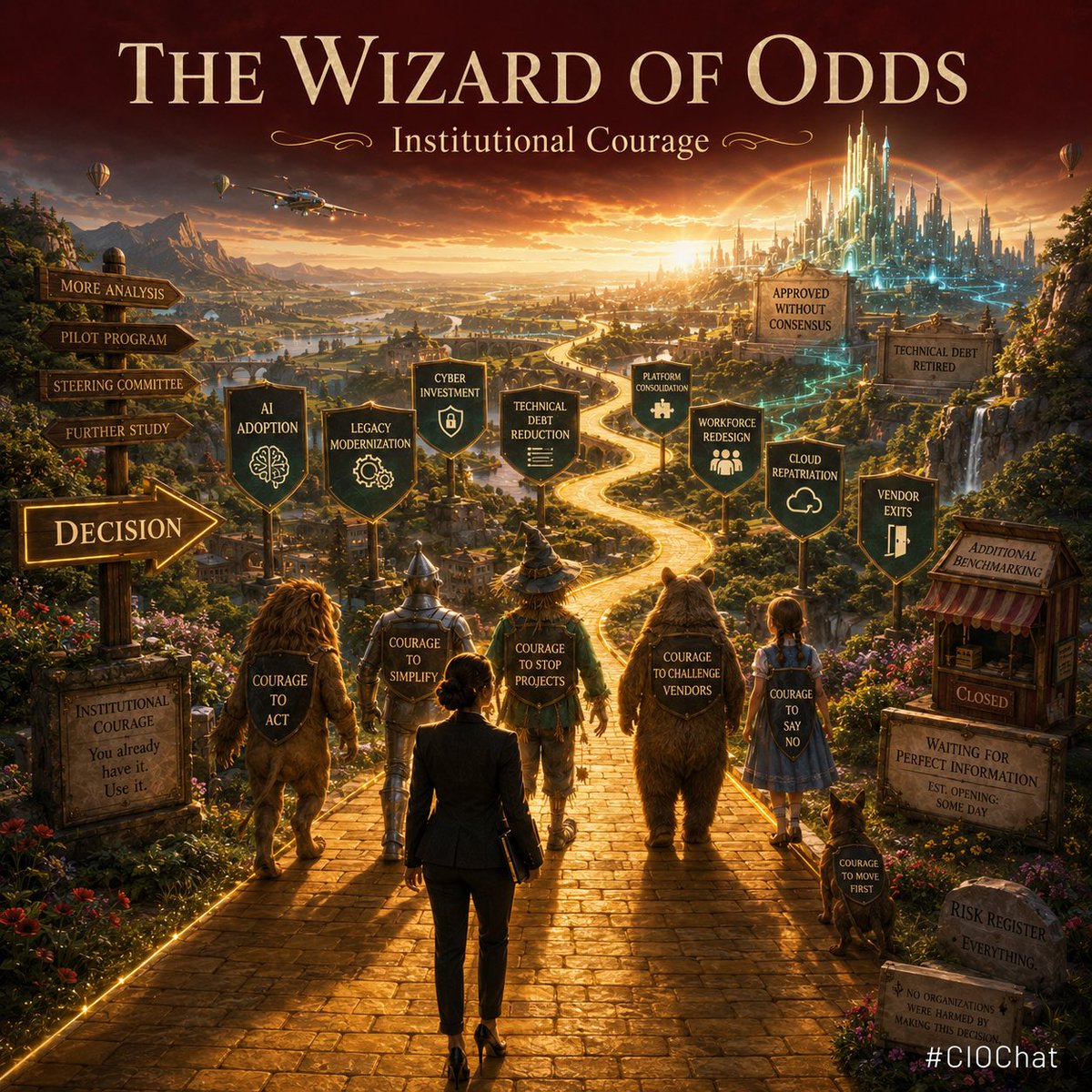
#CIOChat Great chat today with lots of familiar faces. Join us at 2pm ET next Thursday. Topic: Institutional Courage
Hope you enjoy our movie tie-ins to intro next week’s topic.
Please suggest topics and invite your IT colleagues. Every Thursday at 2pm ET.
A3) Continuous, large and small a agile processes, and process improvement at every level. A #DataDriven enterprise is always surfacing new insights and exploring new introspection methods. Holistic, global optimization is a never-ending process. #CIOChat
#BoDs shouldn't be telling management "how." (Noses in, fingers out). But more than ever, Boards should understand enough tech to drive strategic disruption--that might just need some novel technology from an astute #CIO.
#CIOchat
#CIOChat Q4: Imagine it’s 2030. Will we still talk about digital transformation at all? Or only reimagined outcomes, new biz models, and strategic capabilities? (“NewCos” I’ve heard them called.)
What language and mental models might replace our the defining concept of DT?
A3. I agree that 'transformation' has gone from episodic to continuous as the world moves faster and chaos increases.
Funding model = tighter biz alignment
Governance = adaptive rather than static
Architecture = more AI than ever (which means more 'data' than ever)
#CIOchat
@joannefriedman And bingo, Joanne. 15 years on and we have more fragmentation in many cases that we started out with, due to tech proliferation.
Core integration is the best I’ve ever seen, however, but most orgs still have a good ways to go.
#CIOChat
@joannefriedman And bingo, Joanne. 15 years on and we have more fragmentation in many cases that we started out with, due to tech proliferation.
Core integration is the best I’ve ever seen, however, but most orgs still have a good ways to go.
#CIOChat
#CIOChat Q1: With global DX spend approaching $4T, many CIOs now ask:
If virtually every initiative is digital today, does “digital transformation” still mean anything?
Has it become business as usual and if so, what replaces it?
@dhinchcliffe#CIOChat A2: Apples and cumquats. AI is driving process and business model redesign. Priorities are shifting from tech "cost" to business value.
A2: AI is another tool, yes it has big implications, and news ways of transforming, but its still a tool. You work out how to use it and you apply it to change the business.
#CIOChat
@waynesadin Very interesting, Wayne. The “how” of DT is coming second at last. “What” seems to be the priority. I do see boards are demanding AI transformation to beat their peers, but little these days on “how.” #CIOChat
@waynesadin Very interesting, Wayne. The “how” of DT is coming second at last. “What” seems to be the priority. I do see boards are demanding AI transformation to beat their peers, but little these days on “how.” #CIOChat
A2. #DX is still about changing the way we do business, whether it's using #AI or RPG on an AS/400 :)
AI definitely gives us better tools to transform (+ better tools to optimize).
When I talk to a #BoD "Digital Transformation Committee," I talk about new ways to operate: revenue streams, customer experiences, etc. Tech 'per se' is secondary.
#CIOchat
#CIOChat Q3: For many CIOs, transformation is no longer a standalone program but a permanent operating condition they must foster + oversee.
Are you evolving funding models, governance, architecture, and operating models for continuous vs. episodic change? If so, how?
@dhinchcliffe#CIOChat A1: After 15 years the Digital Transformation promise remains unfulfilled. We connected and or digitalized systems but we didn't connect data to decisions, actions or business outcomes. What replaces DX is operational transformation
@waynesadin Well, as you know, lumping is quite common when it comes to IT spend stats and I suspect that’s the case there. Virtually everything in business is digital experience in some form now, so that’s the tent pole these days. #CIOChat