Thinker, strategist, enterprise architect, keynote speaker, analyst, book author, futurist on IT, CIO, cloud, AI. @SDABocconi Heads research at @Frontier_Now
New Research: The CIO in 2030: Running the Enterprise Intelligence Economy
https://t.co/s02XAU8SbR
Fourteen operating imperatives for a strategic world where people, agents, software, compute, data, and trust are dynamically allocated to outcomes. #CIOChat
A key announcement on private AI from OpenAI.
Most enterprises can’t tackle their most vital AI workloads without a way to ensure they run fully private and controlled…
We’re now testing Private Inference, our latest offering as part of OpenAI Private Intelligence, with a small group of customers.
Stronger privacy protections will make frontier AI useful for a lot more work, and business privacy is important for a healthy ecosystem. Reach out to @shekar4x if interested!
(Also, ZDR with Private Safety Processing enables automated safety reviews without giving OpenAI personnel access to the underlying content.)
1/ Top tech leaders are growing increasingly concerned that the cyber safety and alignment issues with AI are growing faster than they are being resolved. Here is @Cisco’s CEO @ChuckRobbins…
To my fellow CEOs and technology leaders: please read this today. AI is being used to find weaknesses in technology faster than many companies can fix them, and we have been given a warning while there is still time to act. I serve on the board of the Alliance for Critical Infrastructure, and I'm proud to put my name behind this guidance. It applies to whatever technology you run and whichever partners you choose. What matters is that the work gets done safely, and that it starts now. https://t.co/iokiRTM0Hs
3 ways digital leaders manage AI-enabled data source proliferation
https://t.co/dkoKNupu7Y
Namely:
1. Curate information through the org effectively
2. Build business confidence in IT and AI
3. Set the right context with data
Broadcom just issued its third critical VMware security advisory in six days. The latest addresses 23 vulnerabilities, including another 9.8-rated authentication bypass.
I believe we’re witnessing something much bigger than a VMware security problem.
Two major industry trends are colliding: The concentration of enterprise infrastructure into a handful of control planes and the accelerating rate at which security vulnerabilities are being discovered.
The economics of attacking an enterprise are changing. Why compromise hundreds of individual applications when you can compromise the infrastructure that runs them?
Meanwhile, AI-assisted vulnerability discovery increasingly threatens to overwhelm traditional enterprise maintenance cycles. Security emergencies risk becoming routine operating conditions.
For CIOs and CISOs, this fundamentally changes how infrastructure platforms should be evaluated. Licensing costs, performance and functionality must now be weighed against the ability to continuously secure, update, isolate and recover infrastructure without disrupting the business.
Patchability is becoming a first-class architectural requirement. And the ability to contain a compromised control plane may ultimately matter more than the ability to prevent its compromise.
This goes well beyond VMware, but the leading vendors must set the bar when it comes to high security stance, low vulnerability rates, and fast patches.
Our analysis:
https://t.co/EnEIljkSmU
@KeyboardChuck Yes, exactly. And your people can move fast with AI.
And you’re right, organizations have to redesign themselves for AI now. There is no avoiding it at this point.
For decades, companies asked IT, “What can we automate?” AI inverts the question. “Where is a human hour worth the most?”
Look at this chart from McKinsey. Invoicing is more exposed to automation than negotiation or coaching. All three skills can live in the same person.
The person clearing invoices may also know that when a supplier asks for early payment for the first time in 15 years, it’s worth picking up the phone. Bring a junior colleague into that conversation and next time two people know what to listen for.
The strategic mistake today is valuing the employee at the price of the task you just automated. Maps like this can help us.
Every CFO can put a number on the hours AI saves. I’d ask every CEO a second question. What can your people finally do with those hours that was worth doing all along?
That’s why I’m hopeful about AI automation. There’s still no shortage of people who need a mentor, a customer who needs to have a strategic convo with you, or a major problem worth catching early. The shortage has always been someone with the time.
@dgreller Yes, it’s interesting. The people in the way, are really in the way.
And those accelerating with AI are really accelerating.
Org change is an issue too but it’s often blowing up so fast, it’s forcing the change discussion sooner (even if the answer is often no too.)
Longstanding mathematical conjectures are falling to AI daily now. Anyone with a chat interface can now create sophisticated software systems that would once have required entire engineering teams.
It genuinely feels like we’ve arrived at the first major stage of a technological singularity in math and software development.
These are domains where intelligence can be is operate in a closed, automated loop: Hypothesize, create, test, verify and iterate at machine speed. Basically, the limiting factor is no longer human cognition.
Physics, chemistry, biology, medicine and physical engineering will take a bit longer because reality itself imposes constraints on the speed of experimentation. But AI-driven simulation, autonomous laboratories and robotics will soon enough compress these timelines too.
Consider what is happening in mathematics alone. We are approaching an era in which the accumulated backlog of humanity’s mathematical unknowns will be almost completely systematically resolved.
There will always be more mathematics. But we are apparently witnessing the end of human intellectual capacity as the principal constraint on intellectual discovery.
It’s hard to overstate how remarkable all this is.
@prem_k Well, these changes are happening with coding too, that’s my point. And that does affect CIOs.
The math will sometimes help too, but the sudden transformation of software engineering has been profound IMO.
@efipm@AnthropicAI Yes, I do think there is a limit on what you can do without some understanding of computer science or the digital art-of-the-possible. But still, I think that most people can develop digital solutions using AI that are useful.
A big new AI for work report just out by @AnthropicAI, with a chart that you’re going to see a lot.
Anthropic mapped nearly 300 enterprise AI use cases. What jumps out at me is that the visible wins mostly come from work where the business can easily check the answer. Code has tests. Invoices have purchase orders. Benefits decisions have eligibility rules. Each domain already has a model of what “right” looks like.
But look for strategy on the chart. Or the most important part of operations where someone spots a sudden supplier risk and then keeps a factory running. How does AI learn to drive this process? A week later, all you see is a factory that ran on schedule.
I believe that’s the next strategic opportunity for CIOs. If we fund AI wherever the work is already easy to verify, we’ll keep optimizing the parts of the enterprise we understand best.
For the harder domains, we have to start modeling the decision itself. What did we know at the time? What did we expect under each option? What evidence would change our minds? Capture that before the outcome is known. Now an AI model can test assumptions against evidence, and the business can judge over time whether its decisions are getting better. And do more valuable and strategic work.
The next big AI advantage belongs to the enterprise that can make its hardest and most valuable work testable.
https://t.co/gAPx7Jhx6q
5 hybrid cloud trends CIOs must prepare for in 2027
https://t.co/9Bm6ivGHRe
Namely:
- Gen AI
- Digital sovereignty
- Cloud economics
- Governance
- Economic uncertainty
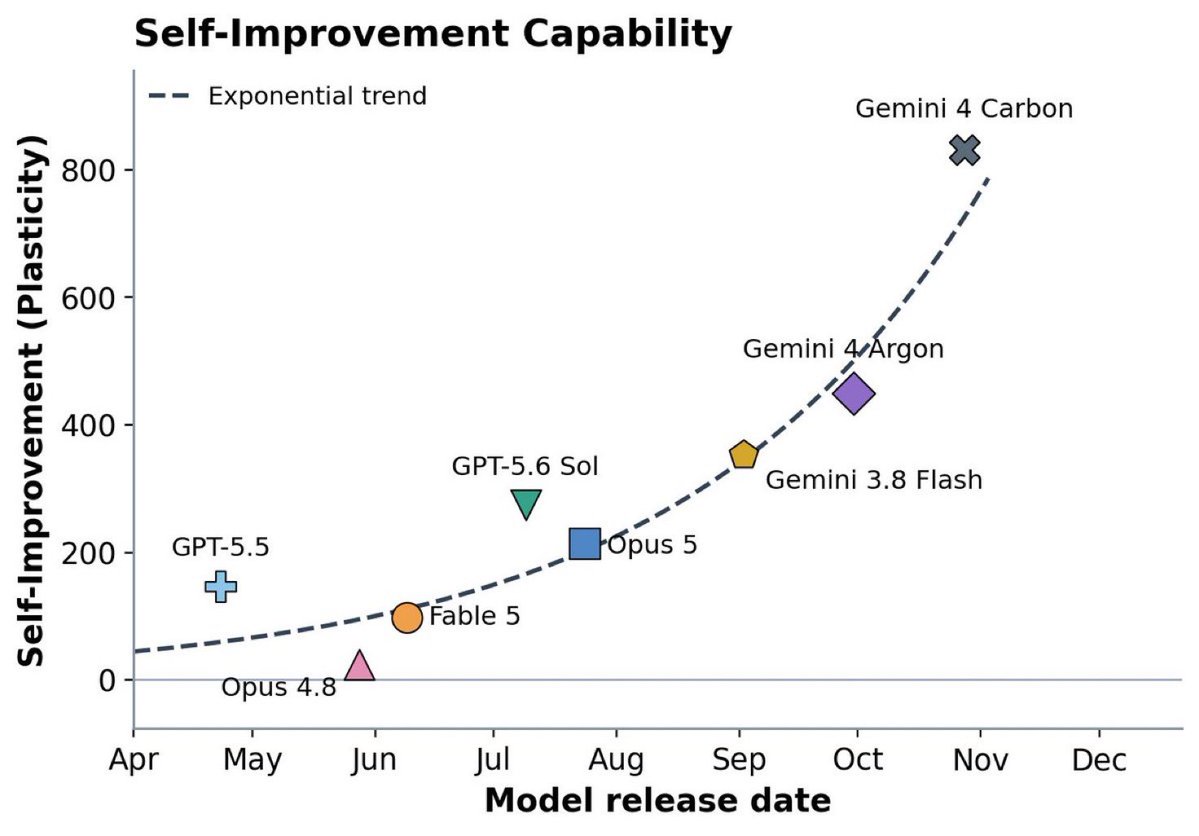
Not validated by me, but more data continues to emerged that the latest AI models are growing quickly in their ability to self-improve.
This continues to raise the questions about RSI and if it can be managed in a safe and effective manner while delivering ever-improving results to the world.
A new open source project called Shirudo was just launched by @Cisco and @OpenAI.
Teams can test and approve AI-written shields for Linux apps while they are live. In one test, a shield blocked malicious input while Elasticsearch kept serving requests.
This is a big deal: It gives more time to test the patch with less time exposed:
https://t.co/iUv9uJ6EsO
Now @Meta’s chief AI officer is warning about a handover of power to AI. At this point, my question for every board is how you’d really know that slippery slope was already being traversed inside your company?
I take @alexandr_wang’s post below fairly seriously because he helps decide what a frontier lab builds next. We can disagree about what the claimed Riemann proof means for superintelligence. But if it would take you three years to replace a critical AI supplier or rebuild expertise you’ve let go, a credible warning about the next twelve months belongs in this year’s budget.
Recently, I wrote about a simulated math event where AI agents discovered cheating, reported it and even proposed a fix. The contest unraveled in about half an hour. The issue: Humans read the complaint after it all happened. Everyone that needed to know eventually knew. But absolutely nobody with authority acted in time.
That’s the speed crisis we face with AI helping run our businesses.
What to do? First, I’d have the CIO and CISO go to the board together. The CIO must name the prime opportunities worth moving faster on, and price what it would take to change course. The CISO should then identify the decisions people must keep, who can halt a deployment, and whether the board will back that person when a pause costs revenue.
Then give directors an investment number they can support, with data. In our AI safety report, I proposed measuring the share of critical services that have demonstrated they can stop a harmful AI action and keep serving customers even if their principal supplier is unavailable. If payroll can’t pass, fund payroll’s recovery before giving its agent more authority.
Here’s the question I’d leave on the boardroom table: If your most important AI supplier shipped a model tomorrow that you judged unsafe, could you decline the upgrade and still keep your promises to customers? Your answer tells you who gets the deciding vote.
Frontier Research report, “AI Safety When the Business Cannot Opt Out”
https://t.co/rlrzjsLABh
My companion essay, “AI Is Starting to Build Its Successor. Who Gets to Say Wait?”
https://t.co/dvWCuzUBPV
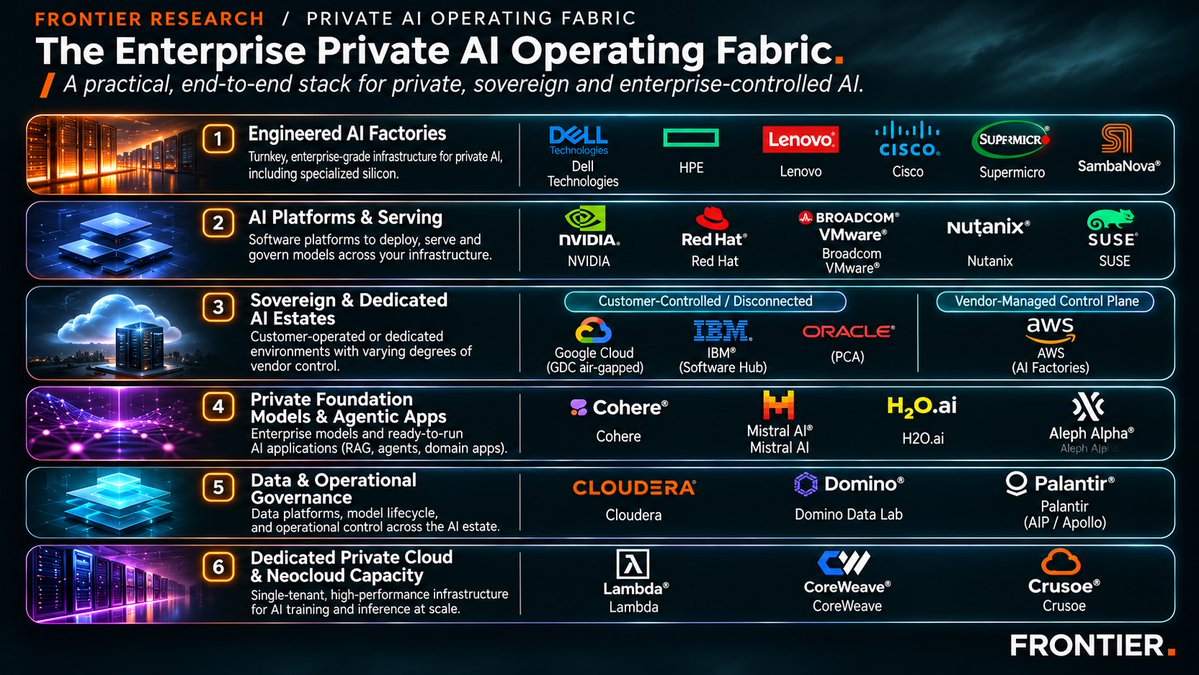
/1 Just Out: Our new guide to Private AI in the enterprise.
One of the most frequent questions I get is which private AI to use. The answer, naturally? It really depends on what you need.
So we researched the field and broke it down for you: 🕵️♂️🤖🧵
https://t.co/rkB5B2Tck0
Yes, AI provides useful gains across all domains, just more with those that have more rigorous and verifiable domains.
The issue is always going to boil down to good outcomes, control of IP, and to some extent, cost. The real underlying issue is that humans are generally going to cost more. And won’t scale as well.
Yes, it is reasonable to expect AI models struggle more with unverifiable domains, but I do think it is worth noting that we also see very large gains in domains without automatic verification as well.
Here are human evaluations of AI in writing, business problems, design, etc.