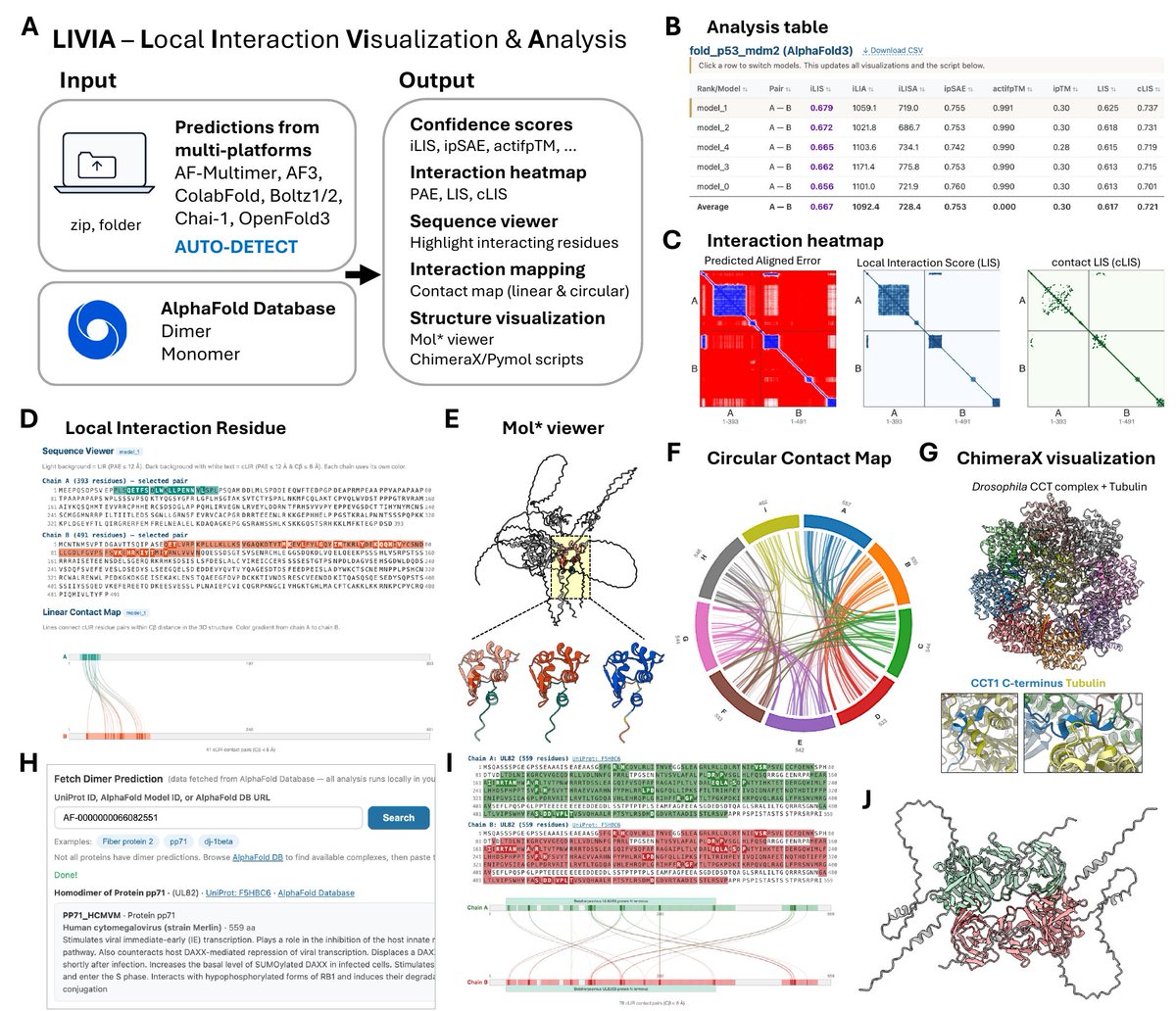
🚀 New tool out! LIVIA (Local Interaction Visualization and Analysis) — a browser-based tool for assessing and visualizing predicted protein-protein interactions.
Drop in a prediction from AlphaFold-Multimer, AF3, ColabFold, Boltz-1/2, Chai-1, or OpenFold3 (ZIP or folder, auto-detected) and LIVIA answers the two questions you actually care about:
▸ Do these proteins interact?
▸ Which residues form the interface?
What you get:
▸ Interface confidence scores — iLIS (our local metric), ipSAE, actifpTM, ipTM
▸ Interaction interface heatmaps (PAE, LIS, cLIS)
▸ Sequence viewer + linear & circular contact maps highlighting Local Interaction Residues (LIR) and contact LIR (cLIR)
▸ Embedded Mol* 3D viewer
▸ Downloadable ChimeraX & PyMOL scripts
Also fetches dimers directly from the AlphaFold Database — adding the interface annotations AFDB doesn't provide.
Everything runs locally in your browser. No install, no upload.
LIVIA started as a personal tool — I built it with Claude Code and used it to make every structure figure in our FlyPredictome preprint (Kim et al., 2026). (Claude Code is truly insane...) Along the way I realized it could be useful for others, too.
If you have a favorite color palette for structure visualization, please let me know — happy to add it as a preset 🎨
🔗 LIVIA tool: https://t.co/qSaedW3yka
🐍 iLIS / batch CLI: https://t.co/jYN3yg3l6a
📄 LIVIA preprint: https://t.co/uHwEbAMBGH
📄 FlyPredictome preprint: https://t.co/O3mAOzF2GD
Today, we are launching our research blog!
We’ll use it for technical notes from our work building tools for enzyme and biomolecular design.
Our first post is about The Unreasonable Redundancy of Nature's Protein Folds.
TLDR: Please don't fold more sequences (1/n)
New-found immune cells called ‘ruptoblasts’ explode when triggered, ejecting toxic chemicals capable of delivering death to surrounding cells in just minutes. The cells’ discoverers say that this process, which they call ruptosis, seems to be a new form of cell death.
https://t.co/6JtcC1HjY0
ESMfold2 is fantastic! But learned the hard way that even though it will accept SMILES for ligand binding, CCD is recommended for a reason.
Comparing to Boltz-2, outputs are fairly consistent making ESMfold2 a great replacement for broad/large/fast screening.
Great to see that we are not the only ones doing this. Using tools like proteinMPNN, boltz2 and AF2 to improve protein stability . New pub from the Liu lab shows how these AI tools complemented PACE in the new design of their reverse transcriptase
Predictions from Deep Learning Propose Substantial Protein–Carbohydrate Interplay
1. The study introduces PiCAP, an equivariant graph neural network that predicts whether a protein noncovalently binds carbohydrates, aiming to approximate protein–carbohydrate interactomes at proteome scale where direct glycome-vs-proteome screening is hard.
2. A key claim is quantitative: PiCAP predicts ~35–40% of proteins across six proteomes (E. coli, yeast, fly, worm, mouse, human) have carbohydrate-binding potential—far above common estimates (<5%)—and ~75% of extracellular/cell-surface proteins are predicted binders.
3. The work also introduces CAPSIF2, a residue-level predictor of carbohydrate-interacting residues, designed to scale to proteins of any size (EGNN on residues) and trained with Dice loss to handle the strong class imbalance (~95% residues are nonbinding).
4. Dataset innovation: the authors build NoCAP, a large curated binder/nonbinder structural dataset because “true nonbinders” are not available in standard resources. NoCAP totals 30,429 structures (9,509 binders; 21,339 putative nonbinders), and DR contains 6,263 bound protein–carbohydrate complexes for site-level learning.
5. Two-stage training strategy: models are first pretrained on small-molecule binding interfaces, then fine-tuned on carbohydrate-specific data; training also mixes experimental structures with AlphaFold2-predicted structures to improve robustness to prediction noise.
6. Performance highlights: PiCAP achieves 89.6% balanced accuracy on a sequence-clustered holdout test (TPR 96.3%, TNR 82.8%), supporting protein-level discrimination between carbohydrate binders and likely nonbinders drawn from diverse functional classes.
7. CAPSIF2 performance: on the TS-90 benchmark it is competitive (Dice 0.616), while on the broader DR test set it outperforms PeSTo-Carbs (Dice 0.573 vs 0.493), suggesting improved generalization under higher diversity and less curated test conditions.
8. External validation: PiCAP agrees nearly perfectly with LectomeXplore lectin calls on AF2 human/mouse proteomes (99%–100% agreement) and with confirmed human lectins (109/109), indicating strong recall for canonical lectin-like carbohydrate binders.
9. Cross-checking high-throughput experiments: comparing to a published human ganglioside interactome (873 candidates), PiCAP predicts 60% as carbohydrate binders and shows a monotonic relationship between “number of experiments detecting a protein” and PiCAP’s binder fraction, while flagging plausible experimental false positives/ambiguous cases.
10. Biological interpretation from GO enrichment: predicted binders are enriched in extracellular/cell-surface compartments and functions/processes tied to growth factor receptor binding, transmembrane signaling, inflammation, cell–cell adhesion, glycolipid/proteoglycan metabolism, and glycosylation; predicted nonbinders are enriched in nuclear/cytoplasmic roles (e.g., RNA/DNA-associated processes).
💻Code: https://t.co/HjZ3IloErh
📜Paper: https://t.co/Or7egMBzRB
#ComputationalBiology #DeepLearning #StructuralBiology #Glycobiology #Proteomics #ProteinInteractions #Glycans #Bioinformatics #MachineLearning
TNG961: An HBS1L Molecular Glue Degrader for FOCAD-Deleted Cancers
Presented by Hilary Nicholson of Tango Therapeutics at the AACR Annual Meeting 2026 New Drugs on the Horizon session, TNG961 is a potential first-in-class CRBN-mediated molecular glue degrader of HBS1L for FOCAD-deleted cancers, a subset of chr9p21-deleted tumors.
FOCAD loss impairs SKI complex–mediated mRNA quality control, creating dependence on the HBS1L/PELO ribosome-rescue pathway. By selectively degrading HBS1L while sparing the closely related CRBN neosubstrate GSPT1, TNG961 disrupts this compensatory pathway and triggers translational stress in FOCAD-negative cells.
Preclinically, TNG961 shows ~100-fold selectivity for FOCAD-deleted vs. WT cells and induces tumor regressions in pancreatic and NSCLC xenograft models, including tumors progressing on PRMT5 inhibitor treatment.
Read more: https://t.co/s44pN0QppZ
Many experiments in biology happen one protein at a time, which means synthesizing DNA one gene at a time. This is fine for tens of genes. For thousands, the cost is unsustainable.
Introducing uSort-M: a method to isolate and sequence-verify thousands of genes at low cost
De novo binder design is now available on our GUI! Run full binder workflows with integrated backbone generation (RFdiffusion, BoltzGen), sequence design (PoET-2, ProteinMPNN), and structure validation, bringing end-to-end binder design into a single interactive workflow.
β-catenin is often synthesized to be immediately degraded... and defects in its degradation predispose to cancer.
Why are key signaling mechanisms regulated by protein degradation ?
Introducing Genie 3, a generative protein model that substantially advances the state-of-the-art for binder design, increasing in silico success rates by up to 20x on hard multimeric targets. It also debuts a form of inference-time scaling unobserved in other design models. 🧵1/8
mTM-align2: A Server for Real-time Protein Structure Database Search and Alignment
1. mTM-align2 is presented as a real-time web server that searches structurally similar proteins across ~3 million structures (experimental + predicted) in seconds, while supporting both monomeric proteins and multimeric complexes.
2. The key idea is to replace expensive all-vs-all structural alignments with fast cosine-similarity search over precomputed structural fingerprints (embeddings), then optionally run detailed pairwise/multiple alignments with mTM-align for interpretability and validation.
3. For monomers, the server encodes a query using residue-level embeddings from the pretrained inverse-folding protein language model ESM-IF, aggregates them into a protein-level vector (sum pooling), and uses contrastive learning so cosine similarity correlates with structural similarity.
4. For multimers, it combines (a) chain-wise monomer embeddings and (b) a rotation-invariant global shape descriptor based on 3D Zernike moments; the final similarity (Q-score) is a weighted sum of chain similarity (IF-score) and shape similarity (ZP-score), with weights α=1 and β=0.3.
5. mTM-align2 integrates multiple major databases in one interface: PDB (including large monomer and multimer sets), SCOPe and CATH domain databases, BFVD viral structures, plus several AlphaFold DB subsets (Swiss-Prot, organism set, global health set), enabling cross-database retrieval rather than siloed searches.
6. The server offers two search modes: a high-accuracy mode that adds a fast TM-align-based filtering step to improve precision, and a high-speed mode that skips filtering for near-instant results; results are returned as ranked hits (top 1000) and can be emailed as CSV for batch workflows.
7. Beyond retrieval, the output workflow is designed for downstream analysis: users can launch pairwise superposition with TM-align metrics (TM-score, RMSD) and residue-level correspondence, or run multiple structure alignment (up to 10 selected hits via the UI) to identify conserved cores and generate a structure-based phylogenetic tree.
8. A practical annotation feature is included for PDB hits: after superposition, the server transfers ligand context from Q-BioLiP and marks query residues within 5 Å of the aligned ligand as putative binding residues, providing fast template-based binding-site hints (with the paper noting it is not meant to replace specialized binding-site predictors).
9. Benchmarks against Foldseek variants suggest complementary strengths for monomer search (mTM-align2 wins on more test cases by summed true-positive TM-scores in top-100, while Foldseek leads on others), and stronger multimer retrieval performance versus foldseek-multimer (top-50 recall ~82.4% vs 77.7%; precision ~35.08% vs 27.66%).
10. A case study on the MscL mechanosensitive channel highlights sensitivity to remote homologs and conformational diversity: against AFDB-SwissProt, mTM-align2 retrieves many more true positives than Foldseek, and multiple alignment of top hits reveals strictly conserved transmembrane helices linked to gating architecture.
💻Code: https://t.co/s8OWvC8JsF
📜Paper: https://t.co/aTEFV1XORR
#ProteinStructure #StructuralBioinformatics #AlphaFold #ProteinComplexes #StructureSearch #BioinformaticsTools #ESM #ContrastiveLearning #ZernikeMoments #TMAlign