There is a peculiar sadness in watching teaching, one of the most intellectually demanding professions in public life, slowly presented as something much smaller than it is.
Teaching asks a human being to know a subject deeply, understand how novices encounter it, anticipate misconception, respond to emotion, build culture, sustain attention, interpret evidence, make ethical decisions and adapt in real time. It is intellectual, relational, practical and moral work. Yet in too many schools, teaching has been flattened into the performance of approved moves: Use this questioning strategy. Start with retrieval. Show a model. Circulate. Check for understanding. Use cold call. Give feedback. Exit ticket. The problem is not the existence of techniques. The problem is what happens when techniques are severed from thought.
https://t.co/UOG0zTFLVh
My new blog post is an essay by Gordon Wood. I thought it was worth remembering what an insightful historian he was, after the news of his recent death.
His focus is on why the American colonies produced such a remarkable set of republican thinkers and leaders. And he attributes of lot of this to their modest position in the English social hierarchy.
https://t.co/0xbH5pAfOg
My new blog post is an essay by Gordon Wood. I thought it was worth remembering what an insightful historian he was, after the news of his recent death.
His focus is on why the American colonies produced such a remarkable set of republican thinkers and leaders. And he attributes of lot of this to their modest position in the English social hierarchy.
https://t.co/0xbH5pzHYI
I love inequality in America. Now, before half of you clutch your oat-milk lattes, let me explain. Part of the reason is probably that I come from a country where, less than fifty years ago, the government tried to engineer equality with bullets, starvation, and labor camps. That tends to make you a little skeptical whenever someone starts talking about equality as though it’s the highest political virtue. The other reason is that I look around the developed world and notice something. Europe seems to have perfected the art of making sure nobody gets too rich, too poor, too ambitious, or too interesting. Every few years, they invent another regulation. Every decade they invent... well... I suppose they did give us Spotify, and for that I remain grateful.
America, on the other hand, has always seemed perfectly comfortable with the idea that people won’t end up in the same place.
https://t.co/b8tcB941sq
This natural experiment started in 1992 when three shipping containers lost about 30,000 rubber ducks in the middle of the ocean. Over the years the ducks were sighted across the globe allowing scientists to better understand ocean currents. Source: https://t.co/DSj3vyMbFF
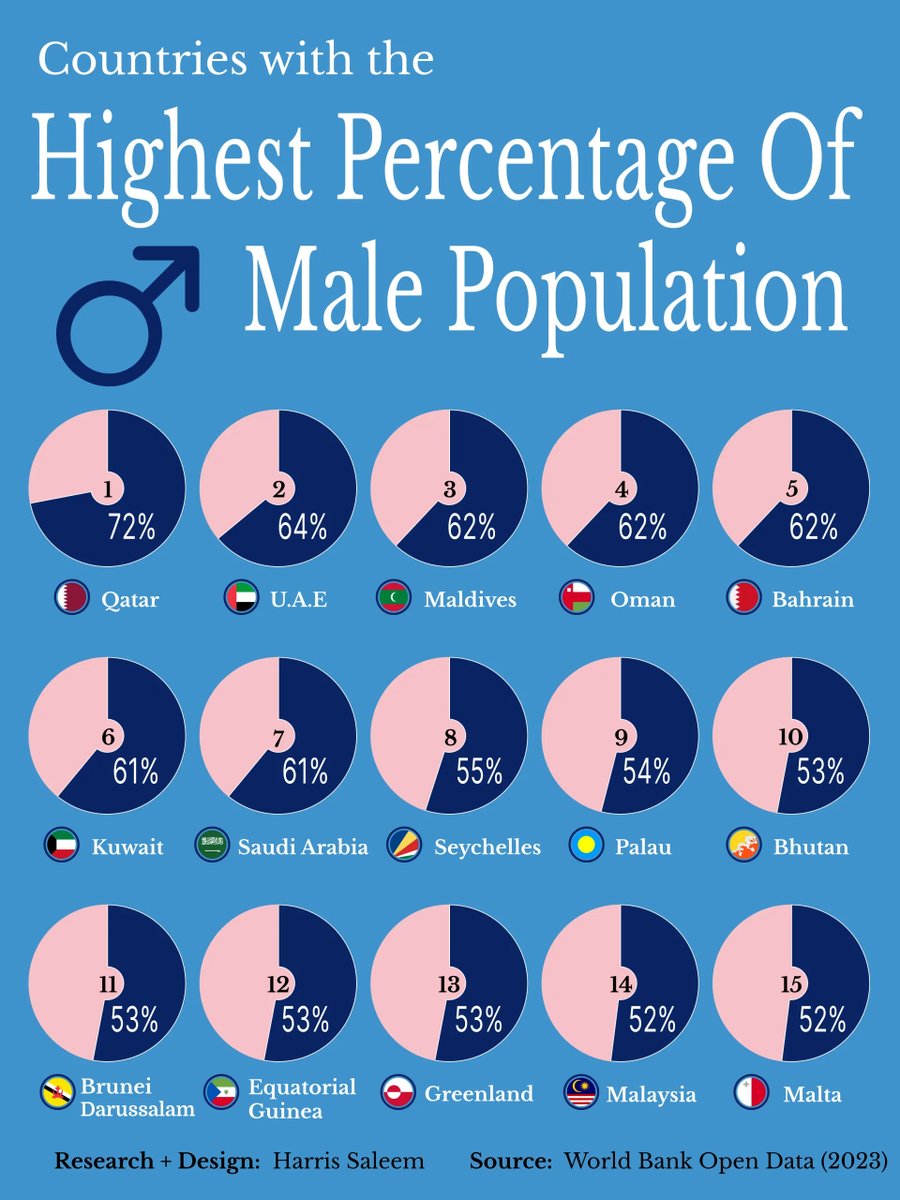
Countries With the Highest Percentage of Male Population 👨
This graphic by Harris Saleem is one of the many incredible data-driven charts and stories from creators featured on our @VoronoiApp. ✅
https://t.co/ZHRnPP3yGg
One reason the Industrial Revolution happened in England and not France, the Netherlands, or Germany was that its land, infrastructure, and capital markets had already been transformed.
In 1650, it was difficult to raise capital for a factory, or to transport raw materials from mine to factory and finished goods to customers. There was not nearly enough food to sustain the workers to procure these materials at scale. If the steam engine, the gas lamp, and the spinning jenny had been conceived at this time, it would have been far harder for their inventors to manufacture and sell them.
https://t.co/nOVDSuMW5h
In the end, legitimacy is not inherited. It is earned. It does not arise from ancestry, mythology, chronology, or blood. It arises from competence, justice, liberty, opportunity, and the rule of law. The question is not who was here first. The question has always been, and will always be, who governs well.
https://t.co/yEfbLWhMnP
However much we may disagree on who or what is to blame for the fractious state of our universities, surely if the norms of the well-led classroom, the open classroom, the liberal classroom — taking hard questions seriously, thinking before speaking, honoring the right of others to speak and be heard — were to supplant the hissing and howling that now pass for public discourse, and such a classroom were to become a model for a whole society, we would all be better off. Who can argue with that?
https://t.co/k349AMSZkh
Campbell’s law states that “the more any quantitative social indicator is used for social decision-making, the more subject it will be to corruption pressures and the more apt it will be to distort and corrupt the social processes it is intended to monitor.”
https://t.co/sLCt86z0Yv
Campbell’s law states that “the more any quantitative social indicator is used for social decision-making, the more subject it will be to corruption pressures and the more apt it will be to distort and corrupt the social processes it is intended to monitor.”
https://t.co/sLCt86z0Yv
My new blog post is Schools Should Focus on Producing More Hustlers than Scholars
Maybe the lesson from this is that it is dangerous to take school too seriously, for both individuals and societies. The result of an intensive focus on academic learning may be, at the individual level, a generation of stressed‐out students and, at the societal level, an accumulation of academic skills and knowledge that are not especially functional for modern political, social, and economic life. It may turn out to be advantageous for a society to have an American‐style educational system, which discounts academic learning and encourages students to game the system.
The difference is that all of the noncurricular things that the American students in the film were doing had the potential to enhance their ability to contribute to society. They were picking up skills about how to function in a work environment, network, compete, lead, improve the environment, and juggle priorities. They were also learning how to work the system to their advantage, how to do the minimum needed to satisfy school requirements so they could do what they really wanted elsewhere. Isn’t it more productive for the economy and society to produce fewer zealous students and more accomplished hustlers? Doesn’t the contest mobility system do a pretty good job of preparing actors for life in a market economy, which rewards entrepreneurship over scholarship?
https://t.co/0xbH5pzHYI