“Most men seem to live according to sense rather than reason.” St. Thomas Aquinas
Please check the Highlights tab for resources.
#Catholic +Roman Rite+
All sexual abuse of children is wrong. Of the reported cases of sexual abuse in the U.S.:
1) 85% occur in the home,
2) 14% occur in schools,
3) 1% occur in religious institutions.
Of the 1%, the Catholic Church is in the bottom half.
Wherever sexual abuse is found the perpetrators need to be punished including those that cover it up. The victims of these crimes need to be compensated and given the help they need in recovery. But make no mistake about it, The Catholic Church was singled out in media propaganda and a smear campaign as being the worst offender. The data does not support this claim in any way, quite the opposite.
"Most sexual abuse of children occurs in a residence, typically that of the victim or perpetrator. 84% of sexual victimization of children under age 12 occurs in a residence. Even older children are most likely to be assaulted in a residence. 71% of sexual assaults on children age 12-17 occur in a residence (Snyder, 2000). -The Children's Assessment Center
"Family structure is the most important risk factor in child sexual abuse. Children who live with two married biological parents are at low risk for abuse. The risk increases when children live with step-parents or a single parent. Children living without either parent (foster children) are 10 times more likely to be sexually abused than children that live with both biological parents. Children who live with a single parent that has a live-in partner are at the highest risk: they are 20 times more likely to be victims of child sexual abuse than children living with both biological parents (Sedlack, et. al., 2010). -The Children's Assessment Center.
"Children who do not live with both parents as well as children living in homes marked by parental discord, divorce, or domestic violence, have a higher risk of being sexually abused." -National Center for Victims of Crime
"The Boy Scouts of America are now facing 100,000 claims of sexual abuse. The number of claims of the total payouts to settle these case for the Boy Scouts will easily eclipse those of the sexual abuse scandal of the U.S. Catholic Church." LA Times November 2020
"But of 100,000 priests active in the U.S. in this half-century, a cadre of just 149 individuals—one priest out of every 750—accounted for over a quarter of all the allegations of clergy abuse. These 149 super-predators also explain the surprisingly large number of very young victims that the study reported. So if Catholic priests are no worse than other professions in this regard—and maybe a lot better—why do we hear so much about them being abusers? Several reasons explain this focus, none of which necessarily reflect any anti-Catholic bias in courts or media." -Myth of a Catholic Crisis - Philip Jenkins PHD
"No formal comparative study has ever broken down child sexual abuse by denomination and only the Catholic Church has released data of its own. But based on the surveys and studies conducted by different denominations over the past 30 years experts who study child abuse say that they see little reason to conclude that sexual abuse is mostly a Catholic issue." Pat Wingert - Newsweek (2010)
"We don't see the Catholic Church as a hotbed of this or a place that has a bigger problem than anyone else. I can tell you without hesitation we have seen cases in many religious settings from traveling evangelists to mainstream ministers to rabbis and others not just Catholic Priests." Ernie Alan - President of National Center of Missing and Exploited Children
"We don't see vast differences in the incidents of one denomination over another. It is pretty even across the denominations. It's been that way for decades." Sarah Buckley Asst VP for Corporate Communications. The Guide One Center for Risk Management (Insurance company for churches).
"One out of ten public school students experience unwanted sexual advance from an educator. More than 4.5 million are subject to sexual misconduct by an employee or teacher of the school sometime between kindergarten and the 12th grade." Report from the US Dept of Education (2004) "The Catholic Church may be the safest place for children. Whatever its past record, The Catholic Church in the U.S. has made unparalleled strides in educating their flock about child sexual abuse and ensuring that children are safe in Catholic environments." Religion Reported David Gibson
The majority of the faithful do not know the Mass is the Gospel itself illustrated and prayed in the liturgy from the beginning to end. One look at flip flops and shorts, and their lackadaisical amd irreverent drive thru Communion, is evidentiary to that claim.
Hot take: Most daily Masses should not include a homily. Its absence would, paradoxically perhaps, better catechize the faithful of the purpose of the Mass.
@TungstenMonarch@patristicpill Ahh yes, the Great Apostacy. Just like the Mormon belief. Your argument relies on presuppositions, which is rather unfortunate.
The Orthodox treat Church Fathers as anyone would rightfully do. The Church Fathers provide testimony and witness to what they were taught and what they believed. It would be in bad faith to take the writings of someone who was a disciple of St. John and dismiss his witness. As anyone who would investigate would rely on witness testimony, they bear witness to the teaching of apostolic Christianity
@beforegodapp@ggg_blocgggg@patristicpill Repentance, faith, baptism, sacraments, sanctification.
Profession of Christ would be professing the Nicene Creed and Athanasian Creed.
Interesting that you would replace the cross with a flag, the Bible with a Constitution, and processions with parades. The Constitution is a godless document. If the social kingship of Christ is not preeminent, there is no hope. Pax vobiscum.
@j_fishback I'm a Christian and I DO NO WANT my leaders quoting scripture or bringing their religion to the podium... I want them sticking to the CONSTITUTION.
Porque es especialmente a través de los sueños donde los demonios se ceban y atacan con más fuerza. Es el momento en que estamos más vulnerables. Allí pueden introducir imágenes y sugerencias horribles que, al despertar, nos dejan más irascibles, agitados y propensos a arruinar nuestro día y el de quienes nos rodean.
No lo olvide nunca: la guerra principal del católico se libra por su alma. Nuestro intelecto, nuestra razón y nuestra voluntad son el campo de batalla. Cuando un alma les es arrancada de las manos, se enfurecen y continúan molestándola con insistencia, hasta que se cansan... por un tiempo.
Mi confesor, hace algún tiempo, me dio este consejo ante el mismo problema que le comparto:
"Harán lo posible e imposible para impedir que reces. La oración los expectora de nuestra vida y salva otras almas. Por eso, cuando sientas esa "aridez" o cansancio, haz un esfuerzo, dales la contra y en vez de 50 cuentas reza el Rosario completo de las 150 Avemarías. O añade otra devoción, o ve a visitar al Santísimo Sacramento por 15 o 20 minutos. Al ver que sus ataques producen el efecto contrario y te llevan a orar más a combatirlos mas, se cansarán y te dejarán en paz por un tiempo. El demonio es muy predecible. Pero mantengámonos siempre vigilantes, porque ellos nunca duermen".
@Katie_DeRoche_@FrDaveNix@FredSimonTLM You are a female, on social media and trying to rebuke a Catholic priest. One of many signs of how low the Church has fallen and that you in anyway find this acceptable and appropriate.
SAINT MARY’S HAS PULLED OFF ONE OF THE MOST HISTORIC WINS IN COLLEGE BASEBALL HISTORY.
#1 OVERALL SEED UCLA GETS ELIMINATED BEFORE EVEN MAKING IT TO THE REGIONAL FINAL.
UNBELIEVABLE.
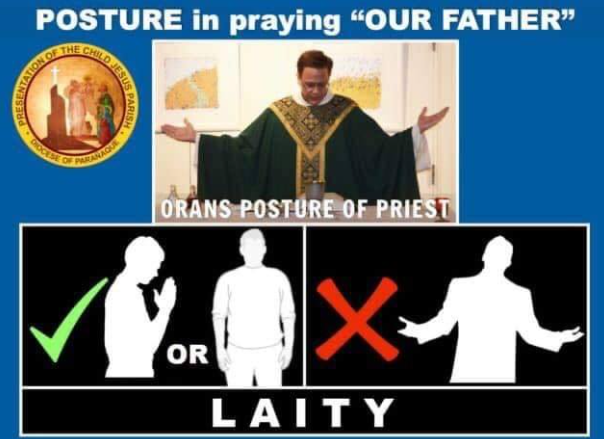
The orans posture—standing with hands extended, palms upward—has become a point of contention in some Catholic communities, as certain laypeople adopt it during the Lord’s Prayer, a practice traditionally reserved for priests. While it may feel like a natural or expressive way to pray, I respectfully urge you to reconsider using the orans posture during Mass. This gesture, though well-intentioned, disrupts the Church’s liturgical unity, confuses the distinct roles within the assembly, and introduces an unauthorized addition to the sacred liturgy. Below, I present a clear and compelling case for why the laity should refrain from this practice, grounded in Church teaching, liturgical norms, and the desire for authentic worship.
The General Instruction of the Roman Missal (GIRM), which governs the celebration of the Mass, explicitly directs priests to use the orans posture, described as “with hands extended,” at specific moments, including the Lord’s Prayer (GIRM 152, 237). This gesture signifies the priest’s unique role as in persona Christi, interceding on behalf of the entire assembly. The GIRM, however, provides no such instruction for the laity during the Lord’s Prayer, specifying only that the assembly stands (GIRM 43, 160). By adopting the orans posture, laypeople inadvertently assume a gesture proper to the priest, which risks blurring the distinction between the ordained and the non-ordained. The Church’s 1997 Instruction On Certain Questions Regarding the Collaboration of the Non-Ordained Faithful in the Sacred Ministry of Priest reinforces this, stating that deacons and laity “may not use gestures or actions which are proper to the priest celebrant,” labeling such actions as “grave abuses” (Article 6, §2). To maintain the integrity of the priest’s role, it’s best for the laity to avoid this posture.
The Mass is an act of worship, designed to reflect the Church’s unity and hierarchical structure. The Second Vatican Council’s Sacrosanctum Concilium emphasizes that “no other person, even if he be a priest, may add, remove, or change anything in the liturgy on his own authority” (SC 22.3). When some laypeople use the orans posture while others do not, and while deacons are prohibited from doing so, it creates a visual and symbolic disunity. This inconsistency undermines the Church’s goal of a cohesive liturgical experience, where each participant fulfills their proper role. For example, during the Lord’s Prayer, the priest’s orans posture signifies his leadership in prayer, while the laity’s role is to join vocally, not to mirror his gestures. By refraining from the orans posture, you help preserve the harmonious “sign language” of the Mass, ensuring that everyone’s participation reflects the Church’s ordered communion.
The orans posture, when used by the priest, carries a specific sacramental meaning: it represents his act of interceding for the people before God. When laypeople adopt this gesture, it can unintentionally suggest that they are taking on a priestly role, which may confuse others about the distinct functions within the liturgy. St. John Paul II emphasized that the Church must carefully safeguard the “roles, functions, or theological and canonical status” of its members to avoid confusion (On Certain Questions, Introduction). For instance, the deacon, who assists the priest but does not represent the people before God, is explicitly barred from using the orans posture. If laypeople use it, they risk appearing to “quasi-preside” at the Mass, which the 1997 Instruction identifies as a serious liturgical abuse. By choosing not to use the orans posture, you affirm the laity’s vital but distinct role in the liturgy, participating fully through vocal prayer and attentive presence.
You might feel that the orans posture is a legitimate expression of prayer, perhaps because it was common in the early Church or is used in private settings like the Charismatic Renewal. While the gesture has historical roots, its liturgical use is strictly regulated by the Church to maintain clarity and order. The early Church’s practices evolved under the Church’s authority, and today’s rubrics assign the orans posture exclusively to priests during the Mass. Additionally, the USCCB’s note that “no position is prescribed” for the laity’s hands during the Lord’s Prayer does not endorse the orans posture; it simply leaves the gesture unspecified, meaning no new practice should be introduced without approval. The 1995 proposal to permit the orans posture for the laity was rejected by the Holy See in the 2002 GIRM, confirming that it is not an approved practice. Pastorally, while priests may tolerate the gesture to avoid embarrassing individuals, this sensitivity does not equate to permission. Choosing to align with the Church’s norms shows respect for its authority and fosters a shared liturgical experience.
The Mass is a sacred act, not a space for personal innovation. By refraining from the orans posture, you embrace humility and obedience to the Church’s liturgical tradition, which has guided worship for centuries. Understanding the significance of the priest’s gestures—such as the orans posture when addressing God or folded hands when engaging the assembly—can deepen your appreciation of the Mass’s supernatural realities. As St. John Paul II noted, recognizing and respecting each member’s role enhances the “beauty and power” of the liturgy. Instead of adopting the orans posture, consider focusing on the words of the Lord’s Prayer, joining your voice with the priest and the community. This act of unity, rooted in the Church’s guidance, can enrich your spiritual experience and contribute to a more reverent and cohesive celebration of the Mass.
I understand that the orans posture may feel meaningful, especially if it’s part of your personal or communal prayer tradition. However, in the context of the Mass, it introduces an unauthorized gesture that disrupts liturgical unity, risks confusing roles, and contravenes Church norms. By choosing not to use the orans posture, you honor the priest’s unique role, uphold the Church’s liturgical discipline, and contribute to a unified worship experience that reflects the beauty of the Mass. I encourage you to reflect on the Church’s teachings, particularly Sacrosanctum Concilium and the 1997 Instruction, and to join the Lord’s Prayer with heartfelt vocal participation, trusting that this aligns with the Church’s vision for authentic and communal worship.
@CatechismTony
Question 1: Whether Sola Scriptura is Taught in the Sacred Scriptures
Objection 1: It seems that the Bible teaches Sola Scriptura, for it says, "All scripture is inspired by God and profitable for teaching, for reproof, for correction, and for training in righteousness" (2 Tim. 3:16-17).
Reply to Objection 1: The passage from 2 Timothy speaks of the utility of Scripture but does not exclude the necessity of Tradition or Church authority. It emphasizes the role of Scripture within a broader context of Christian teaching
I answer that St. Paul does not limit divine guidance to Scripture alone but also acknowledges oral Tradition, as seen when he instructs the Thessalonians to "stand firm and hold to the traditions which you were taught by us, either by word of mouth or by letter" (2 Thess. 2:15). Scripture, while indeed profitable and inspired by God, does not claim to be the sole source of divine revelation. The sufficiency of Scripture must be understood in harmony with the apostolic Tradition and the living magisterium of the Church.
Question 2: Whether the "Word of God" Refers Only to Written Scripture
Objection 1: It would seem that the "Word of God" refers only to written Scripture, since the Old and New Testaments are authoritative documents.
Reply to Objection 1: While the written Scriptures are indeed authoritative, they do not supplant the authority of the oral Tradition, which was equally the word of God in its time
I answer that the prophets and apostles often delivered the Word of God orally, which was authoritative even before or if it was ever recorded. Jeremiah spoke the word of the Lord for twenty-three years without all being written (Jer. 25:3, 7-8). The "Word of God" encompasses both the written and oral proclamations. The Scriptures themselves testify to this by frequently referring to oral teachings as the "word of God" or "word of the Lord" (1 Thess. 2:13).
Question 3: Whether Tradition is a Necessary Component Alongside Scripture
Objection 1: Tradition seems superfluous since Christ condemned the traditions of men (Matt. 15:2-6).
Reply to Objection 1: The condemnation of corrupt human traditions does not negate the validity and necessity of divine Tradition passed through the Church.
I answer that the Church, guided by the Holy Spirit, affirms apostolic Tradition as complementary to Scripture, as seen in the Council of Jerusalem (Acts 15:6-30). There is a distinction between "traditions of men" that oppose God's commandments and the sacred Tradition handed down by the Apostles, which is in harmony with Scripture.
---
Specifically regarding 2 Tim 3: 16-17.
2 Tim 3:16 All scripture is inspired by God and profitable for teaching, for reproof, for correction, and for training in righteousness, 17 that the man of God may be complete, equipped for every good work.
What scripture was St. Paul referring to? See the preceding verse.
2 Tim 3:15 and how from childhood you have been acquainted with the sacred writings which are able to instruct you for salvation through faith in Christ Jesus.
So St. Paul tells Timothy that the scripture is the sacred writings from Timothy's childhood that Timothy was acquainted with. Great. How old is Timothy when St. Paul wrote the letter?
1 Tim 4:12 Let no one despise your youth, but set the believers an example in speech and conduct, in love, in faith, in purity.
St. Paul doesn't tell us Timothy's age but refers to his youth using the Greek neotēs. Scholarship suggests that Timothy would be approximately 30-years-old at the time of the writing. 2 Timothy was written in AD 64. Therefore, Timothy would be born around AD 34, one year after Christ's death, resurrection and ascension. The earliest book of the New Testament was written around 48 AD, which is St. Paul's letter to the Galatians.
Therefore, any scripture that Timothy read in his youth would be the Old Testament only as none of the New Testament had been written, with maybe a possibility of Galatians as available to Timothy, but unlikely.
So St. Paul tells Timothy that Old Testament scripture was God-breathed, again, referencing what Timothy had "been acquainted with" from his "childhood."
But, you want St. Paul to mean that he was referring to The Bible, yet we know that's not what St. Paul said. You've completely misrepresented St. Paul and St. Paul even tells you that in 2 Tim 3:15 that it was the sacred scripture Timothy read in his youth, which was the Old Testament. Moreover, you can't even with any confidence that theopneustos is proven to mean God-breathed when it's only used one time in the scriptures and outside of scriptures it means "life-affirming" 90% of the time. So it can mean God-breathed and it can mean "life-affirming."
To know what the early Christians believed about Scripture, which was not in the hands of Christians because Bibles were not widely distributed. You'd have to wait at least 1,300 more years for that to even begin to take place and actually much longer afterwards. You'd turn to the writings of the sources at that time and the people would write what they believed about it and what was taught to them. They weren't taught what you believe. Your invention took 1,600 years to get to.
You would not say, "They believe what I believe about it" and not cite a single source to prove that. Every single writing of the ante-Nicene period and for the 1,500 years demonstrates clearly and explicitly that the belief held by Christians was baptismal regeneration. Their writings provide testimony to what they believed. Moreover, the majority of Christians today believe in baptismal regeneration. 75%+ because that's what was handed down from the beginning.
As an example, you don't appeal to the thing being litigated to do the litigating. Take the U.S. Constitution for example. If you want to know what Thomas Jefferson believed about it, you look to his writings about it.
Continuing, for you to claim the Church fell into heresy and apostasy immediately makes Christ a liar who said the gates of hell would not prevail. But, according to you, it did.
Now at this point you'll likely argue there was a remnant of believer, but you have no source or citation of a secret remnant of believers who were maintained and somehow carried on this secret faith underground. To be honest, you sound like a Gnostic. It would be a good time for you to walk away and realize that you projecting your beliefs onto the early Christians and saying they believed the way you believe with zero evidence to substantiate that claim is a form of narcissism. You really need to do better.
Oh, I can keep going if you want.
It's been established that Christ established a Church, the Church is visible, we are to attend it and submit to its leaders.
You have attempted to persuade me to leave earthly and fallible institutions although Scripture tells me to go to the Church that Christ established.
Moreover, Christ states if a brother is in sin, and the brother will not listen to you or a witness, to take that brother to the Church. For that to happen that Church needs to be identified, something you are a) unable to do, and b) reject.
You look pretty much to me to be one of many people who preach a different Gospel than the one St. Paul warned about, but that you accuse others of.
Im charity, I humbly ask you take a step back, objectively understand where you are, the error you're in, and what to do about.
Because right now you are the one who is determining what is and is not to be followed. All alone. All by yourself.
Just like in the Garden of Eden. It wasn't that they would know the difference between right and wrong, but they would determine it for themselves. And sometimes people use the Bible and other things as cover to do just that. Again, I really hope you think about that because your argumentation is straight sophistry and circular reasoning.
Christ established a Church (Matt 16:18) and the Church is visible (Matt 5:14, 1 Cor 12:27). I am to submit to the Church's leaders (Heb 13:17) and not forsake the assembly of the Lord (Heb 10:25) and you want to move me away from all that.
You are an "i"theist through and through. You can't answer a single question, can't tell me which church is the true church and can't give me a name of a leader I am to submit to. You are your own God, the arbiter of truth according to you.
You did really poorly in your apologetics, and I pray for your conversion.