@PIB_India Vladimir Mestvirishvili (also affectionately known as "Laado" or "Vlado") was a legendary Georgian wrestling coach who played a pivotal role in the resurgence of Indian wrestling. He passed away due to age-related illness on Monday, June 22, 2025, at the age of 81.
@NewsArenaIndia Vladimir Mestvirishvili (also affectionately known as "Laado" or "Vlado") was a legendary Georgian wrestling coach who played a pivotal role in the resurgence of Indian wrestling. HE passed away due to age-related illness on June 22, 2025, at the age of 81.
#justfyi
BIG BREAKING 🚨 CM Suvendu Adhikari announces that ISKCON will provide Mid-Day Meals to school children across Bengal.
🥗 Pure Sattvik meals to be served under the initiative.
17% of the world’s population watches from the sidelines. Wish a future beyond being just spectators and take our rightful place on the global stage with our majestic spirit dancing on the field like an elephant. 🇮🇳⚽️ #IndiaFootball@narendramodi@mansukhmandviya@khadseraksha
Yes, comparing Modi era with Nehru’s is right. Not to do so would be injustice to millions who suffered because of Nehru.
For example, Hindu Bengali refugees. Their children, grandchildren must never forget that their people were abandoned and thrown to the wolves by Jawaharlal Nehru before, during and after Partition.
Nehru despised dark-skinned Hindu Bengali refugees, among them my father, his siblings, their widowed mother and grandmother, fleeing rapacious and murderous Muslim League mobs in East Bengal; he did not want them to seek shelter in India.
Nehru wrote to CM BC Roy, instructing him not to let Hindu Bengali refugees enter West Bengal. Push them back from the border, Nehru said, don’t let them in.
Nehru insisted Hindu Bengalis of East Bengal / East Pakistan were coming to India for free-loading at the expense of Indians. He cut back Central funds for West Bengal to stop the meagre refugee assistance by way of a couple of kilos of inedible worm-infested rotten rice for Hindu Bengalis.
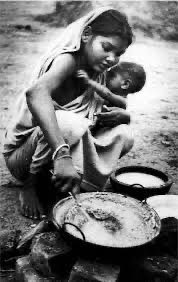
Hindu Bengali refugee women and children separated from their families, or widowed and orphaned in the Noakhali genocide and subsequent Partition Massacre of Hindus, rummaged in garbage bins and pitifully begged for morsels of food.
Hindu Bengali refugee children in rags with dark large sad eyes greedily licked on used banana leaves dumped on the streets by eateries, also known as ‘pice hotels’ in Kolkata parlance, of which there was a profusion in the post-War years. Emaciated babies and rickety children of Hindu Bengali refugees huddled with stray dogs on pavements.
Many Hindu Bengali refugees lived on ‘rice water’ or ‘fan’ (the starchy water that is thrown away after boiling rice) collected from homes of compassionate Bengalis who had little food to share.
In the morning and evening there were pheriwallahs hawking their wares; in the afternoon there were Hindu Bengali refugee women in tattered sarees that barely covered their bodies and naked children with battered and bruised aluminium pots going from house to house, begging for ‘rice water’: “Ma, fan daao Ma…”
Those voices of has hunger were to haunt Hindu Bengali refugees like my parents for long, often till death.
Driven by hate for Hindu Bengali refugees, Nehru ordered horrifyingly, nauseatingly squalid and disease-ridden refugee camps to be named ‘Permanent Liability Camps’ or PLCs — PLC 1, PLC 2… — reminiscent of the ‘Permanent Solution Camps’ of the Nazis.
When despite his best efforts Nehru failed to push back the Hindu Bengali refugees to be slaughtered in East Bengal/East Pakistan, Nehru brought his devastating Freight Equalisation Policy which collapsed industry in West Bengal. Tens of thousands of jobs were destroyed and the Hindu Bengali was rendered jobless: Those who lost their jobs and businesses began turning on Hindu Bengali refugees just as Nehru had hoped.
Yet Nehru could not break the spirit of the Hindu Bengali refugees who were grateful to Bharat and determined to help rebuild this great nation savaged by invaders and colonisers especially John Company.
Through generations we Hindu Bengali refugees toiled, we built, we paid taxes, we sacrificed for the Nation, our Nation, we succeeded in establishing ourselves as dutiful, law-abiding, loyal citizens of India. Having lost our home and hearth, we had no other home but India.
We Hindu Bengali refugees were hived off to malaria-infested inhospitable Dandakaranya and we cleared forests and made the soil fertile. We were packed off to Andaman and we rebuilt our lives there. When we tried to set up home at Marichjhapi we were slaughtered: the estuaries turned red with our blood.
We grieved, we got up, we overcame that setback.
We lived with dignity and honour, we earned our food, we were not freeloaders. We were poor but we were honest: we had integrity.
Cut to 2026.
So who have proved to be India’s ‘Permanent Liability’ cadging off the state and living on unearned money? Nehru Dynasty.
This is the condition of the Punjab mansion of Hindu businessman Todar Mal who paid 7,800 gold coins and bought 4 yards of land from the Mughal emperor Aurangzeb to bury the bodies of the 2 young sons and mother of Guru Gobind Singh on December 13, 1705.
The Mughal faujdar Wazir Khan had ordered the two young children be bricked alive as they refused to accept Islam. When they died, their grandmother died of shock
The Mughals did not want to allow the cremation to humiliate the martyrs. They stipulated that the buyer can take only as much space as he could cover with give gold coins for the land. All the Sikh chiefs just stood helplessly
That's when Todar Mal produced the coins and bought the piece of land, and cremated the three bodies.
This is biggest irony of life, India is only country where its true heritage is hidden from next generation and falsehood Is taught.
Woman Finds Hidden Pakistan Label On Bedsheet Bought At Local Fair — Shocked!
A woman in Chinchwad bought a bedsheet from the Sankashti Chaturthi fair near Shri Moraya Gosavi Mandir. After washing it, she found a hidden label in the corner. It reportedly said "Made in Pakistan." She filmed it. The video went viral instantly. Locals are now asking how Pakistani goods are entering local markets when restrictions exist. No official confirmation yet, but the demand for a proper inquiry is getting louder. Always check your product labels before buying.
#Punetimesmirror #Chinchwad #MadeInPakistan #PimpriChinchwad #VocalForLocal
His name was Khashaba Dadasaheb Jadhav.
He was born on January 15 1926 in Satara, Maharashtra. His father, a wrestler himself, introduced him to the sport when he was five years old.
He represented India at the 1948 London Olympics and finished sixth. He had never wrestled on a mat before. In India, all his training had been on dry earth.
He returned home, found a mat and started again.
When selectors were choosing the squad for the 1952 Helsinki Olympics, they left him out. Jadhav challenged the national flyweight champion Niranjan Das three times and pinned him each time.
They included him.
Then there was no money to send him.
He approached Bombay Chief Minister Morarji Desai for financial assistance and was refused. He then wrote to the Maharaja of Patiala, who arranged a final selection trial.
Jadhav won it. To cover his travel expenses, the principal of Rajaram College in Kolhapur mortgaged his own house and gave him Rs 7,000.
In Helsinki, Jadhav won his first five bouts in less than five minutes each. In the sixth round, he lost to Japan’s Shohachi Ishii by a single point and missed the final.
Under Olympic rules, he was entitled to 30 minutes of rest before his next bout. No Indian official was present to claim it.
Exhausted, he was sent straight back onto the mat. He lost.
On July 23 1952, Khashaba Jadhav won the bronze medal, independent India’s first individual Olympic medal.
When he returned home there were no government receptions, no prize money and no national honours. The country was celebrating the hockey team’s gold medal.
In his village, 151 bullock carts came to receive him. The procession took seven hours to cover a fifteen minute walk.
He was never awarded a Padma honour during his lifetime. He died in a road accident on August 14 1984.
The Arjuna Award came posthumously in 2001.
In 2017, his family threatened to auction the bronze medal because the Maharashtra government had not honoured its promise to build a wrestling academy in his name.
His college principal mortgaged his house to send him to the Olympics.
India never gave him a national award while he was alive.
Follow for stories India deserves to remember.
Deeply saddened by the passing of Suman Kalyanpur, a legendary voice who defined an era. Her melodious voice always touched my heart & soul.
My heartfelt condolences to the family, and the entire music fraternity. I pray for her departed soul. Om Shanti 🙏 #RIP#SumanKalyanpur
@@JioCare Thanks for responding. But situation is very bad with your connection. There 150 connections in my complex affected for last 2 weeks. Right now we are getting as low as 1.5 mbps speed. You better take immediate action.
@JioCare@reliancejio#JioFiber I facing issue with poor Internet speed. SR00002LFR7Q
Please prioritise. It has been a week now. Yesterday was the worst with 3mbps speed.
@mulund_info