We’re an independent financial news outlet covering macro financial trends that make a real difference to your wallet. Get ahead of the markets here first.
Latest episode of WNPI is out!
- November's 'bullshit rally'
- From 'higher for longer' rates to 'lower and sooner'
- Big moves in #gold and #Bitcoin
- Lithium stocks and EV adoption paradox
- Coal stocks: cheap or value trap?
- $SOL's bid for $PPT
https://t.co/fFUkubyn5k
Latest WNPI episode out!
- Quizzing the 'most positive man in finance'
- Impact of macroeconomic trends on small caps
- Enduring strength of iron ore
- Learning from lithium market's fluctuations
- Unearthing hidden gems
- $MGX $GQG $RMC
- AI ideas
https://t.co/DmGubcCfeR
- What updates from $LOV, $KGN, $TPW, $NCK & $AX1 reveal about consumer demand
- $ORG takeover chaos
- $NVDA huge quarter largely priced in
- High cost of capital forcing investors to get serious about valuations
- AI no substitute for good research
https://t.co/appzhBuv4I
WNPI episode out!
✅ $CBA $WBC $ANZ $NAB -- buy or sell?
✅ Is the US CPI print significant?
✅ Australia's historic wages growth
✅Outlook for cashed up ASX #gold miners
✅Unappreciated insights from the #RBA's latest Statement
https://t.co/IMPzjQIrve
ICYMI
✅ Is the US stock market overvalued?
✅ Is a recession still likely?
✅ Equity risk premium historically thin
✅ Why are iron ore prices resilient?
✅ #RBA is not omnipotent
✅ What economic outlook is the market pricing in?
https://t.co/Te9bSOptLw
Journalists have the Five W questions.
Investors only need one.
What's not priced in?
The search for the answer will direct you to all the right areas.
In this episode, @gcanavan2 argues recession risk is still underpriced by the market.
https://t.co/8eb04HhKKE
Calling all followers!
This account will be deactivated soon. Don't get left behind.
Keep following our new account @FatTailDaily for investment ideas from the edge of the bell curve.
https://t.co/lYmRacE4p5
Only ~40 stocks in the #ASX 200 are in the green this month.
The rest are either neutral or in the red.
Some, like $SGR, hit all-time lows in September.
Others, like $LKE and $BRN, registered 52-week lows.
Markets are blaming rising bond yields. So where do things stand?
Will interest rates remain ‘higher for longer’ and further depress stock valuations?
Or will the economy buckle under the high interest rate regime, forcing central banks to cut rates? And will that really be a boon for markets (hint, no, it won’t).
Are we entering a new bear market?
And is there still room for a skilled stock picker to snag bargains?
@gcanavan2 and Kiryll Prakapenka covered all this and more in the latest episode of What’s Not Priced In.
They also discussed a more pressing issue: Broncos or Panthers; Pies or Lions? #AFLGF #NRLGF
https://t.co/WDwx0mzePs
Are we entering a new era of 'higher for longer' interest rates?
Rising bond yields suggest investors are more confident inflation can return to target without a sharp slowdown.
But how confident should investors really be?
https://t.co/LQd877Yicu
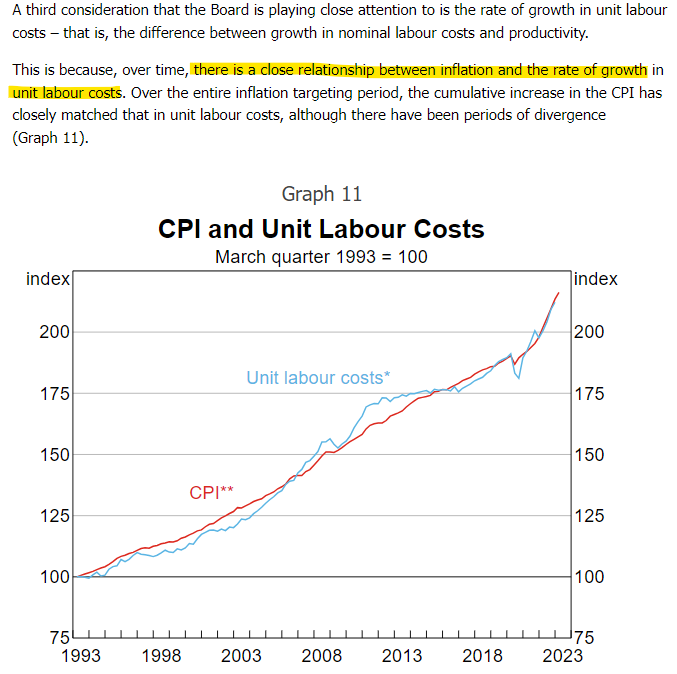
Australia's real unit labour costs rose 3.2% in the June quarter and 5.8% YoY.
The #RBA will be worried.
In May, Philip Lowe said unit labour cost growth of 3.5%-4% makes it hard to have 2.5% inflation.
#auspol#ASX#ausbiz
⚠️ New episode out ⚠️
✅ Interpreting latest inflation readings
✅ Is the market right on direction of rates?
✅ Assessing health of consumer
✅ Are $HVN and $BXB overvalued?
✅ What's going on at $FMG?
✅ Energy return on investment
https://t.co/Bg15qQEd57
Energy drives economic growth.
In fact, Vaclav Smil wrote that to ‘talk about energy and the economy is a tautology: every economic activity is fundamentally nothing but a conversion of one type of energy to another’.
And the more efficient this energy conversion, the better.
That’s what the energy return on investment (EROI) seeks to measure.
EROI is a ratio of energy produced to energy consumed by an energy production technology.
The higher the EROI, the higher a society’s standard of living.
It cannot be otherwise.
As Mark Buchanan wrote:
‘After all, the energy used up in extracting energy doesn’t create any real economic output, but merely goes to providing the energy that can then be used to produce economic output. Hence, if other factors remain fixed, a temporary drop in EROI, for any reason, means we need to use up more energy in producing energy, and therefore have less to spend on real economic activity — on this logic, economic growth should then falter
‘Indeed, this seems to be the case empirically. Over the past 150 years, periods of low EROI — implying a temporary decrease in energy available for useful economic activity — have been correlated with lower rates of economic growth.’
https://t.co/qEZdUJcbUP
Earnings season is nearly over but everyone is talking about inflation.
The latest monthly CPI reading came in lower than expected, and the market reacted well. But is this warranted? And what's the bond market telling us?
Inflation is cooling, because households are retrenching. The US consumer is running down their savings and the amount Aussie households are putting into offset accounts is at multi-year lows.
As @gcanavan2 and Kiryll Prakapenka discuss, it’s a trend that will continue.
The cause behind disinflation is restrictive monetary policy straining the consumer. Is that really a good outlook for stocks?
Speaking of stocks, are $HVN and $BXB overvalued? And what's going on at $FMG?
Finally, we turn to the energy transition and its costs.
Greg explains the importance of the energy return on investment (EROI) and why the metric is vital for economic growth.
A low energy return on investment is a low standard of living.
https://t.co/RNHANxff67
What an episode we have for you this week – packed with stock analysis and hard-earned wisdom.
This episode, we assess the winners and losers of the reporting season so far. We profile $COL, $WOW, $ALU, $WTC, $CAR, $DTL, $HUB.
Even $DMP gets a mention -- the tech stock disguised as a pizza merchant … or is it a pizza merchant disguised as a tech stock?
Anyway…
We then turn to one of the most important questions of them all – when to sell stocks.
Using his recent sell decisions as examples, @gcanavan2 takes us through the sell process.
In investing, it's OK to be wrong, not to stay wrong.
https://t.co/L6OYa1AkmY