Hello and welcome. I’m Dr J S Suri with Dr Apica Sharma the Host and the producer of the Podcast.
Today we discuss one of the biggest silent threats to healthcare in India — Antimicrobial Resistance (AMR).
The host of this Podcast oiis Dr Apica Sharma, a renowned economist from NITI Aayog ,
who brings vital insights into AMR’s economic and policy impact.
In India, antibiotics are often used without proper testing or prescription.
What seems like a quick fix is actually making infections stronger and treatments less effective.
AMR now affects not just health, but also our economy, healthcare access and national productivity.
In this episode, we’ll briefly explore:
Why antibiotics are losing effectiveness
How misuse, weak regulation and diagnostic gaps contribute
And, with Dr Apica Sharma, what AMR really costs India — and what actions are urgently needed
If you’ve ever wondered why some infections no longer respond to treatment — this conversation is for you.
I am extremely thankful to Dr Apica Sharma .
Let’s begin.
https://t.co/LuGLmK39TM
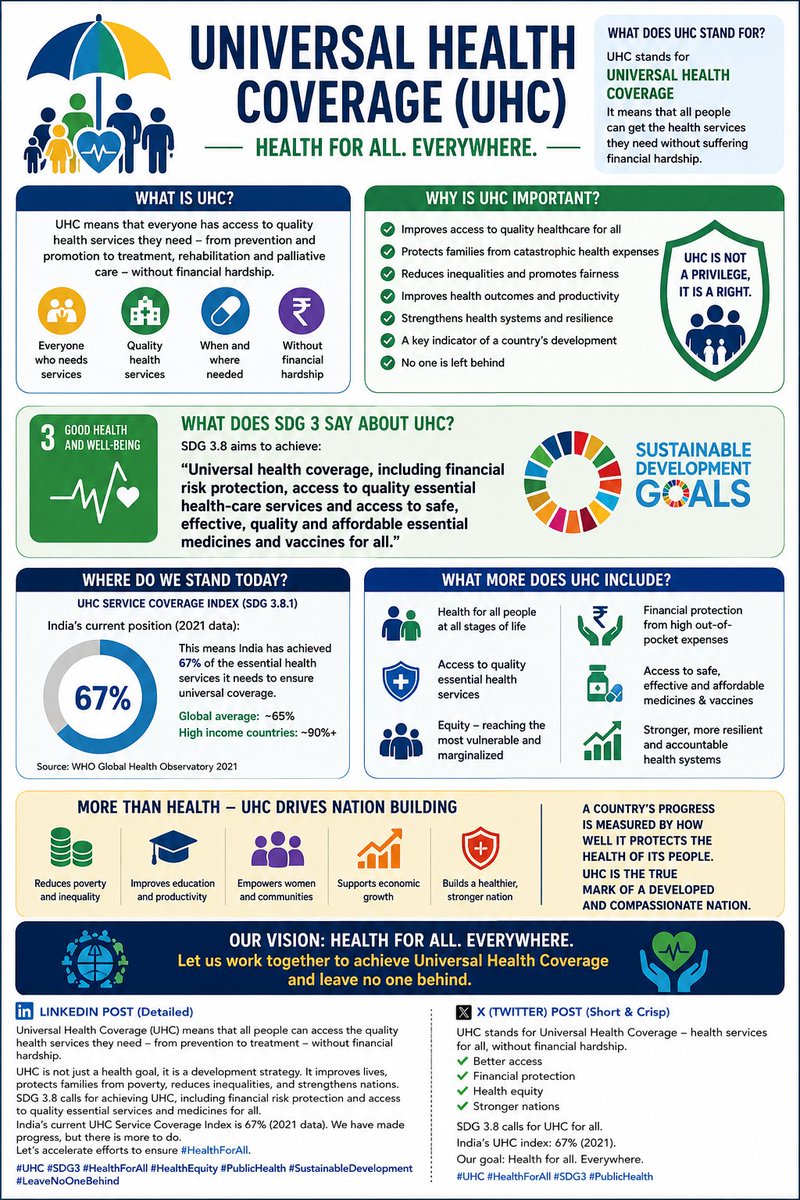
Universal Health Coverage (UHC): The True Test of a Nation's Healthcare
UHC stands for Universal Health Coverage.
In simple terms, it means that all people receive the health services they need, when they need them, without suffering financial hardship.
UHC is not merely a health goal.
It is a measure of a nation's commitment to equity, dignity, and social justice.
The World Health Organization defines UHC as access to quality promotive, preventive, curative, rehabilitative, and palliative health services for all, along with protection from financial hardship.
Why is UHC important?
Because healthcare should not depend on where a person lives, how much they earn, or whether they can afford treatment.
Strong UHC leads to:
✅ Better health outcomes
✅ Reduced poverty due to medical expenses
✅ Greater health equity
✅ Higher productivity and economic growth
✅ Stronger and more resilient health systems
Recognizing its importance, the United Nations included UHC in SDG 3 (Good Health and Well-being).
SDG Target 3.8 calls for achieving Universal Health Coverage, including financial risk protection, access to quality essential healthcare services, and access to safe, effective, quality, and affordable medicines and vaccines for all.
Where does India stand?
India's UHC Service Coverage Index has improved substantially over the past two decades and is currently around 67 out of 100, reflecting important progress. However, significant gaps remain in access, quality, equity, and financial protection.
High-performing countries typically score above 80–90.
The journey towards UHC requires:
🔹 Strong Primary Healthcare
🔹 Essential Diagnostics and Medicines for all
🔹 Adequate Public Investment in Health
🔹 Skilled and Motivated Healthcare Workforce
🔹 Digital Health Systems
🔹 Focus on Prevention and Early Diagnosis
Healthcare is not truly universal until it reaches the last village, the poorest family, and the most vulnerable citizen.
A country's greatness is not measured by the wealth of its richest citizens, but by how well it protects the health of its most vulnerable.
UHC is not a privilege.
It is a promise that no one will be left behind.
#UHC #UniversalHealthCoverage #HealthForAll #SDG3 #PublicHealth #PrimaryHealthcare #Diagnostics #Healthcare #India
@sardesairajdeep Yes, a small beginning to acknowledge the gross blunder in the system of examinations in this age of information technology
There are full proof systems of examinations working in India and the world.
Follow it religiously
Primary Healthcare: The Most Important Part of Healthcare That Most People Never See
When people think of healthcare, they think of hospitals, ICUs, robotic surgery, MRI scanners, and super-specialists.
But the strongest healthcare systems in the world are built on something far less glamorous:
Primary Healthcare (PHC).
PHC is the first point of contact between people and the health system. It includes health promotion, disease prevention, vaccination, maternal and child care, screening, early diagnosis, treatment of common illnesses, and timely referral when needed.
Why is it so important?
Because most health problems can be prevented, detected early, or managed effectively at the primary care level.
Countries with strong primary care generally have:
✅ Better health outcomes
✅ Lower healthcare costs
✅ Earlier diagnosis
✅ Less overcrowding of hospitals
✅ Greater equity and access
In simple terms:
Hospitals treat disease. Primary Healthcare prevents disease.
India has made significant progress in life expectancy, immunization, and disease control. Yet primary healthcare remains the weakest link in many areas, particularly in rural and underserved populations.
The result?
Patients often reach hospitals late, diseases are detected late, costs become high, and families face financial hardship.
To strengthen primary healthcare, India needs:
🔹 Greater public investment in health
🔹 Stronger primary care infrastructure
🔹 Adequate and motivated healthcare workforce
🔹 Essential diagnostics and medicines at the point of care
🔹 Digital health support systems
🔹 Greater emphasis on prevention and health literacy
Healthcare excellence is not built from the top down.
It is built from the ground up.
If hospitals are the pillars of healthcare, Primary Healthcare is the foundation.
And no building can stand long without a strong foundation.
The world's best healthcare systems are not necessarily the richest.
🇸🇬 Singapore
🇯🇵 Japan
🇨🇭 Switzerland
🇩🇰 Denmark
🇸🇪 Sweden
🇳🇴 Norway
🇳🇱 Netherlands
🇩🇪 Germany
🇦🇺 Australia
🇰🇷 South Korea
What do they have in common?
✅ Strong Primary Healthcare
✅ Universal Health Coverage
✅ Early Diagnosis & Prevention
✅ Good Diagnostics
✅ Adequate Public Investment
✅ Respect for Healthcare Workers
✅ Accountability & Good Governance
A simple lesson:
Hospitals treat disease.
Healthcare systems prevent disease.
The secret is not more buildings, more machines, or more slogans.
It is ensuring that the right patient gets the right care at the right time, without financial hardship.
Healthcare excellence is rarely a miracle.
It is usually the result of decades of steady investment, good policy, and public trust.
#Healthcare #PublicHealth #UHC #Diagnostics #PrimaryCare #HealthForAll
3/3
An independent inquiry into all credible allegations, with findings made public, is the minimum that the profession should expect.
Democracy demands not only a result, but a process that can withstand scrutiny.
#DMCElections#DelhiMedicalCouncil#Transparency#Accountabili
1/3
The Delhi Medical Council election must not become a case where questions are dismissed simply because the voting is over.
When substantial concerns are raised by members of the profession, the response cannot be silence. The response must be transparency.
2/3
Professional self-governance derives its legitimacy from trust.
If doctors begin to lose faith in the fairness of the electoral process, the damage extends far beyond one election—it affects the credibility of the institution itself.
@karthik2k2 True. 😄
India's referral system often resembles a one-way mountain trek:
PHC ↑ District Hospital ↑ Medical College ↑ Apex Centre.
The problem is that we quietly misplaced the PHC somewhere along the way.
When primary care weakens, tertiary hospitals become glorified OPDs
@DrDeepakKrishn1 Age is a number, not a diagnosis.
Ventilator or resuscitation decisions should rest on reversibility of illness and the patient's wishes—not an arbitrary age cut-off. Some people at 75+ make remarkable recoveries. Good medicine treats the patient, not the DOB. #MedTwitter
Healthcare is no longer just hospitals, doctors & medicines.
It is also data, software, smartphones & connectivity.
Technology can improve access for millions.
But healthcare should never become:
"Press 1 for survival."
@shrutammegopaya AI is becoming for communication what calculators became for arithmetic.
A person may have brilliant ideas but weak language skills.
AI can help organize, refine and express those thoughts clearly.
Original thinking still matters most.
@shrutammegopaya Math may help you solve problems.
Language helps you explain them, defend them, publish them, lead teams and influence people.
Many careers are built not by the smartest mind in the room,
but by the person who can communicate complex ideas clearly.
@amitsurg Chemists have functioned as de facto GPs in India for decades, often dispensing prescription drugs as if they were OTC.
The deeper issue is not online vs offline alone, but weak regulation and inconsistent enforcement — ultimately a state responsibility.
@amitsurg Medicines are not ordinary consumer products
Unrestricted online dispensing risks turning healthcare into e-commerce. Many developed nations maintain far tighter pharmacy controls and stronger prescription accountability.
Convenience should not replace clinical supervision.
A healthcare system that routinely burns out its youngest doctors cannot call itself healthy.
Hard work builds good physicians.
Relentless overwork slowly breaks them.
Doctor burnout begins early in training because hospitals brutally abuse young MDs as slave labor.
Creates culture of overwork/underliving.
Hard to be good doc without hard work, but impossible to be good doc if you're burnt out from working impossibly long hours.
& most are: