1/ 📢 Today we are proud to announce the launch of the Digital Sovereignty Alliance (#DSA), a nonprofit organization dedicated to advancing clear and ethical public policy, research, and education surrounding emerging technologies.
Clear regulatory frameworks are the foundation of a resilient digital economy. We welcome Treasury @SecScottBessent's support for advancing the Clarity Act and for establishing a bitcoin reserve. Building national digital asset holdings with transparency and sound governance strengthens long term sovereignty.
Treasury Sec. Scott Bessent says the Strategic #Bitcoin Reserve is "new ground."🇺🇸
Bessent emphasized the use of best practices so "things will be durable for the future," adding he looks forward to the CLARITY Act "being passed this summer."
DSA completed the inaugural session of its new Digital Asset Case Study Course, an educational initiative designed to introduce students to the economic, technological, and policy questions shaping the digital asset economy.
Developed in partnership with Professor Charles C.Y. Wang, Tandon Family Professor of Business Administration at @HarvardHBS, and Giveback Backpack, the program brings the Harvard case study method into @SAES’s high school learning environment.
Saturday's session was the first installment of a four-part curriculum that will continue through August, providing students with opportunities to engage with topics at the intersection of technology, finance, public policy, and leadership.
More details from @BusinessInsider👇
https://t.co/pRIChy1rde
A major step forward: the Digital Asset Market Clarity Act is now on the Senate calendar. Clear rules of the road are how nations build resilient, sovereign digital economies. We're watching this one closely. 🇺🇸
In Paris for the @UNDP_AltFinLab Scaling Blockchain for Public Good convening.
Great to meet with @XtXeXo and @Farisjebara1 today, and excited to work closer with UNDP on addressing the global challenge of financial inclusion and digital sovereignty.
Look forward to continuing the dialogue over the next sessions in Paris and deepening collaboration across partners working at the intersection of public policy, technology, and global development.
💡Think policymakers, industry leaders, and advocates are all at odds on the Clarity Act?
DSA's Senior Policy Advisor @MollyWoodman says that's one of the biggest misconceptions.
The process looks contentious because we're in the final stretch, but the shared goal remains regulatory clarity.
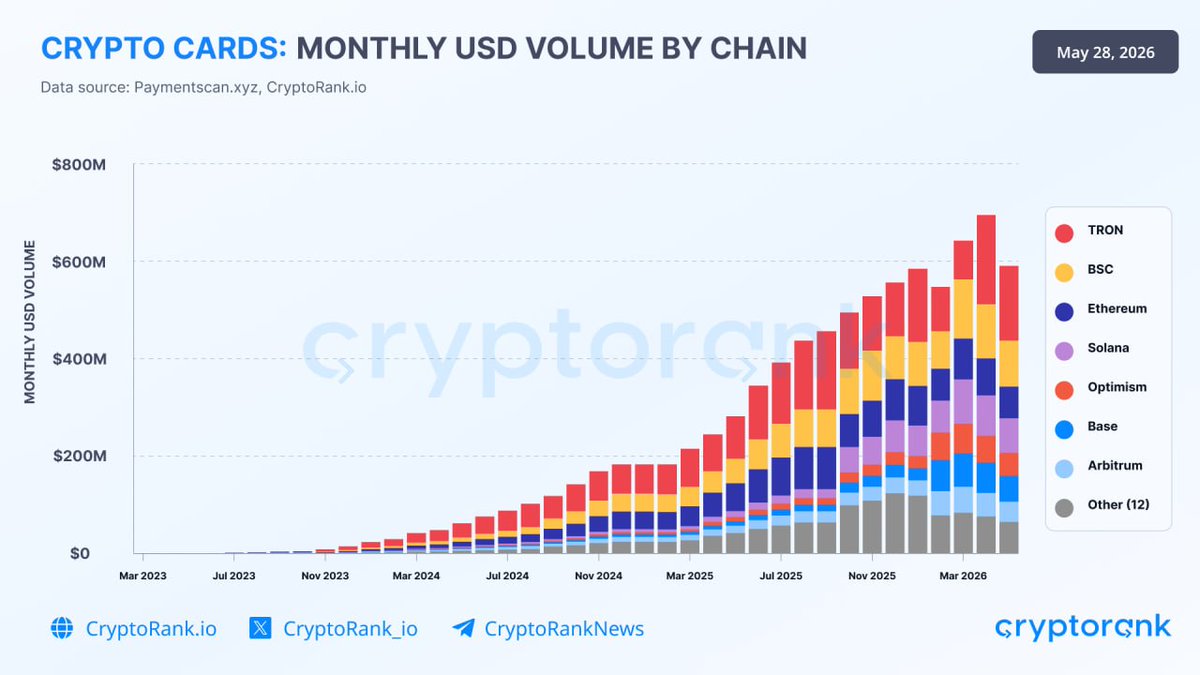
$660M/month in crypto card spend by April 2026 isn't just a milestone, it's proof that onchain value is becoming spendable money in the real world.
What excites us most is where the growth is coming from. @trondao leads the pack at $213M/mo, with @ethereum and @solana right there driving adoption too. This is the whole ecosystem rising together.
That's the heart of digital sovereignty: open payment rails, spread across many chains, that aren't beholden to a single gatekeeper. As DeFi matures into everyday infrastructure, multichain card adoption is how millions will touch crypto without even thinking about it: at the checkout, not the exchange.
The card is becoming the bridge, and the bridge is open.
💳 Crypto cards are quietly becoming one of the strongest real-world crypto adoption narratives.
What started as a niche product in 2023 has evolved into an infrastructure processing hundreds of millions in monthly volume by 2026.
By April 2026:
→ total monthly volume reached ~$660M.
Momentum like this matters. Regulated rails, real institutional backing, and a clear path to faster, traceable cross-border payments at scale. When 25+ banks commit and invest in tokenized deposits, it demonstrates a financial system genuinely ready to modernize.
We're here for it.👇
Global Watch 🇻🇳 Vietnam is considering a new framework that would allow SMEs to pledge digital assets, virtual assets, and intellectual property as collateral for bank loans.
The proposal marks a notable step toward recognizing digital assets within Vietnam's traditional financial system. If approved, the measure could expand access to credit for SMEs, which account for over 98% of registered businesses in Vietnam.
More from @Crypto_Briefing👇
https://t.co/gbirzXllul
Coordinated action between infrastructure, intelligence, and enforcement is exactly what responsible digital asset adoption requires. The @T3_FCU model is a strong example of what public-private collaboration can achieve. As digital assets become more embedded in the global financial system, initiatives like this are critical to building the trust and security that mainstream adoption depends on.
What is T3 FCU?
The T3 Financial Crime Unit is a joint initiative between @trondao, @tether, and @trmlabs focused on disrupting illicit activity across the digital asset ecosystem, particularly tied to the use of USDT on TRON.
Since launch, it has become a working model for coordinated action across infrastructure, intelligence, and enforcement.
DSA’s @AdrianWall8395 recently joined @BAndOShow’s podcast to discuss why financial literacy is essential to meaningful financial inclusion in the digital asset economy.
Adrian shares important insights on education, digital assets, and empowering individuals to make better financial decisions.
Watch the full conversation below.👇
https://t.co/iAsz3uGnEk
Global Watch 🌏Asia accounted for $12.5 trillion in stablecoin transaction volume in 2025, a 67% jump from the year prior. Singapore, Hong Kong, India, and Korea are each embedding digital assets into payments, remittances, and settlement.
Read @CoinDesk for more.👇
https://t.co/OcFV2GEOlK
Former @CFTC Chair @timmassad is pointing at something the policy conversation keeps underselling: settlement is the strategy.
Whether the future of money looks like stablecoins, tokenized deposits, or something in between, none of it scales and none of it stays interoperable without neutral, resilient public rails sitting underneath.
That's where digital sovereignty is actually contested. Not in branding, not in product launches, but in the standards, access rules, and governance of the settlement layer itself.
The Fed's work on digital settlement isn't about a CBDC. It's about making sure "these private sector initiatives succeed."
Former CFTC Chair @timmassad tells @RemyBlaireNews as stablecoins grow and banks explore tokenized deposits, the Fed is quietly ensuring its settlement systems are ready.
.@Mastercard's BitLicense confirms what is now clear: traditional finance is moving decisively onto digital asset rails, from custody and ETFs to stablecoin and tokenized deposit settlement.
The legal foundation enabling it is being built at the state level: New York's BitLicense, Wyoming's SPDI charters, Bitcoin reserve legislation in Texas and New Hampshire, and a growing set of state stablecoin and DLT statutes. The states are setting the pace, the institutions are following.🇺🇸
JUST IN: New York State grants Mastercard a BitLicense so they can "engage with evolving payment and settlement infrastructure supporting digital currencies" 🇺🇸
Clear rules of the road are how the U.S. wins. Market structure legislation gives builders, users, and self-custodians the legal clarity they need to keep innovation and digital sovereignty onshore.
Well said, @GOPMajorityWhip, thank you for carrying this message.🇺🇸
Thanks to Chairman @RepFrenchHill and my colleagues on @FinancialCmte, the United States is LEADING on market structure legislation and solidifying its place as the crypto capital of the WORLD!
@Mastercard's BitLicense confirms what is now clear: traditional finance is moving decisively onto digital asset rails, from custody and ETFs to stablecoin and tokenized deposit settlement.
The legal foundation enabling it is being built at the state level: New York's BitLicense, Wyoming's SPDI charters, Bitcoin reserve legislation in Texas and New Hampshire, and a growing set of state stablecoin and DLT statutes. The states are setting the pace, the institutions are following.🇺🇸
JUST IN: New York State grants Mastercard a BitLicense so they can "engage with evolving payment and settlement infrastructure supporting digital currencies" 🇺🇸
DSA's Managing Director @AdrianWall8395 discusses that banks and financial institutions are now highly engaged in bridging the gap between DeFi and TradFi.
Institutions are identifying unique onchain products for their existing customer bases, and bringing stablecoins into the traditional financial system. The goal is for both sides to collaborate and deliver better financial products that benefit the American public.
Global Watch 🇧🇲 Bermuda just became the world's first country to build a fully onchain economy. Airdropping stablecoins to citizens, accepting crypto at the DMV, and launching a sovereign digital dollar. Small island, massive move.
Read @CoinDesk for more👇
https://t.co/142kS8zrY5