The view from inside Integrity as recovery forces pop open the hatch…watching the helicopter pass over their shoulders and hearing all the joy, it was as good as it gets.
Four humans are about to fall into a 10,000°C wall of plasma at 25,000 mph with a heat shield NASA knows is flawed. Tomorrow evening. Off the coast of San Diego.
Orion hits the atmosphere at 36 times the speed of sound. The air can't move out of the way fast enough, so it compresses into a shockwave twice as hot as the surface of the Sun. The plasma ionizes the surrounding air and blocks all radio signals. For several minutes, the crew is falling faster than any humans have ever traveled inside a spacecraft, and nobody on the ground can talk to them.
The heat shield is 186 blocks of a material called Avcoat glued to a titanium skeleton. It works by charring, melting, and disintegrating on purpose. The destruction of the outer layer is the cooling mechanism. There is no backup system. No redundancy. The heat shield works or the crew doesn't come home.
The Artemis I heat shield came back with over 100 locations where chunks had ripped off. NASA spent two years figuring out why, concluded it was gas pressure building up inside the material during reentry, and decided not to replace the shield. They changed the flight path instead. Steeper angle, less time in the danger zone. NASA Administrator Jared Isaacman said publicly that this approach "is not the right way to do things long term."
The capsule will slow from 25,000 mph to 17 mph in thirteen minutes. Parachutes don't even deploy until the last four. Everything before that is managed by a curved piece of titanium and glue entering air twice as hot as the Sun.
Tomorrow at 5:07 PM Pacific, San Diego might hear a sonic boom. That sound is four people betting their lives on NASA's math being right.
Reid Wiseman told his two teenage daughters where to find his will before he got on this rocket. He’s raised them alone since their mom died of cancer six years ago. Right now, he is 252,757 miles from home, farther from Earth than any human being has ever been.
Wiseman grew up outside Baltimore. Got rejected from the Naval Academy, went to Rensselaer Polytechnic Institute instead, studied computer engineering. Became a Navy fighter pilot, flew F-14 Tomcats (the jet from Top Gun) on combat missions over Iraq and Afghanistan. Two Middle East deployments by his mid-twenties. He saw a Space Shuttle launch in person in 2001 and couldn’t let go of it. Applied to NASA while at sea on the aircraft carrier USS Dwight D. Eisenhower. They picked him. Nine people out of 3,500 applicants. His astronaut class, nicknamed “The Chumps,” included Jeremy Hansen, the Canadian who’s floating next to him right now.
Wiseman’s first trip to space was 165 days on the Space Station in 2014. Two spacewalks. Thirteen hours outside the hull in nothing but a suit. He climbed all the way up to Chief of the Astronaut Office, the person who decides which astronauts fly and which ones sit. Then he gave it up in 2022 to put himself back on the flight list.
His wife Carroll was a nurse in a newborn intensive care unit. She got cancer. Fought it five years. Died in May 2020 at 46. His mother died from Alzheimer’s just weeks before that. Wiseman raised both daughters by himself after that. NASA’s own bio says he considers being a single parent his hardest challenge and the best part of his life. Even while she was dying, Carroll told Reid not to step back from his career. She made him keep going. His brother is a Navy SEAL. His father is 83 and battling cancer too. The old man told reporters he wanted to stay alive long enough to see his son launch.
Before liftoff, Wiseman’s daughters snuck homemade cookies into his flight bag. He posted a photo with them in front of the rocket and wrote “I’m boarding that rocket a very proud father.”
The previous distance record from Earth belonged to the Apollo 13 crew. 248,655 miles, set in April 1970, and it was an accident. An oxygen tank blew up and the emergency route home happened to swing them farther out than anyone before. Wiseman broke that record by 4,100 miles, and his distance is on purpose. Today he flies within 4,600 miles of the Moon, photographs stretches of the far side that were too dark or at the wrong angle for any of the 24 Apollo astronauts to see, and watches a solar eclipse that nobody on Earth can see, only the four people inside that capsule.
Then he turns around and spends four days flying home to his girls.
In the state of Wyoming in the USA lies a real hydrological oddity. It's a small stream (creek) that is thought to be the only one of very few examples in the world. It is placed so precariously and perfectly that it's hard to believe it is able to exist.
1/n
Arguments for abolishing the Marine Corps on the grounds of redundancy and fiscal constraints overlook its unique role as a scalable expeditionary force essential for power projection and sea control amid great power competition, writes @CSISDefense.
https://t.co/0Z3zM474pr
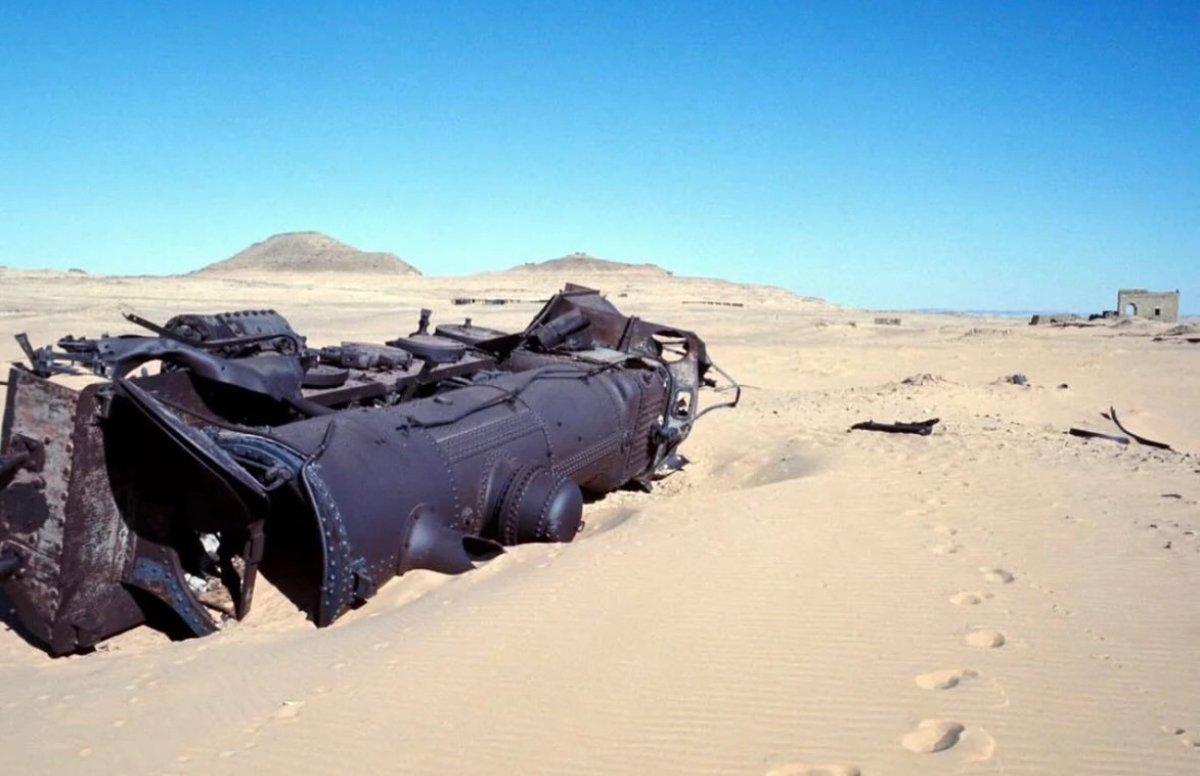
The Ottoman train, which was ambushed by Lawrence of Arabia in WW1 on the Hejaz railway, still sits abandoned in the middle of the desert today in Saudi Arabia.