We are launching the $75M DWF Labs DeFi Fund, focused on perp DEXs, money markets, and yield protocols across @ethereum, @BNBCHAIN, @solana, and @base.
Capital + liquidity + ecosystem support for teams ready to scale.
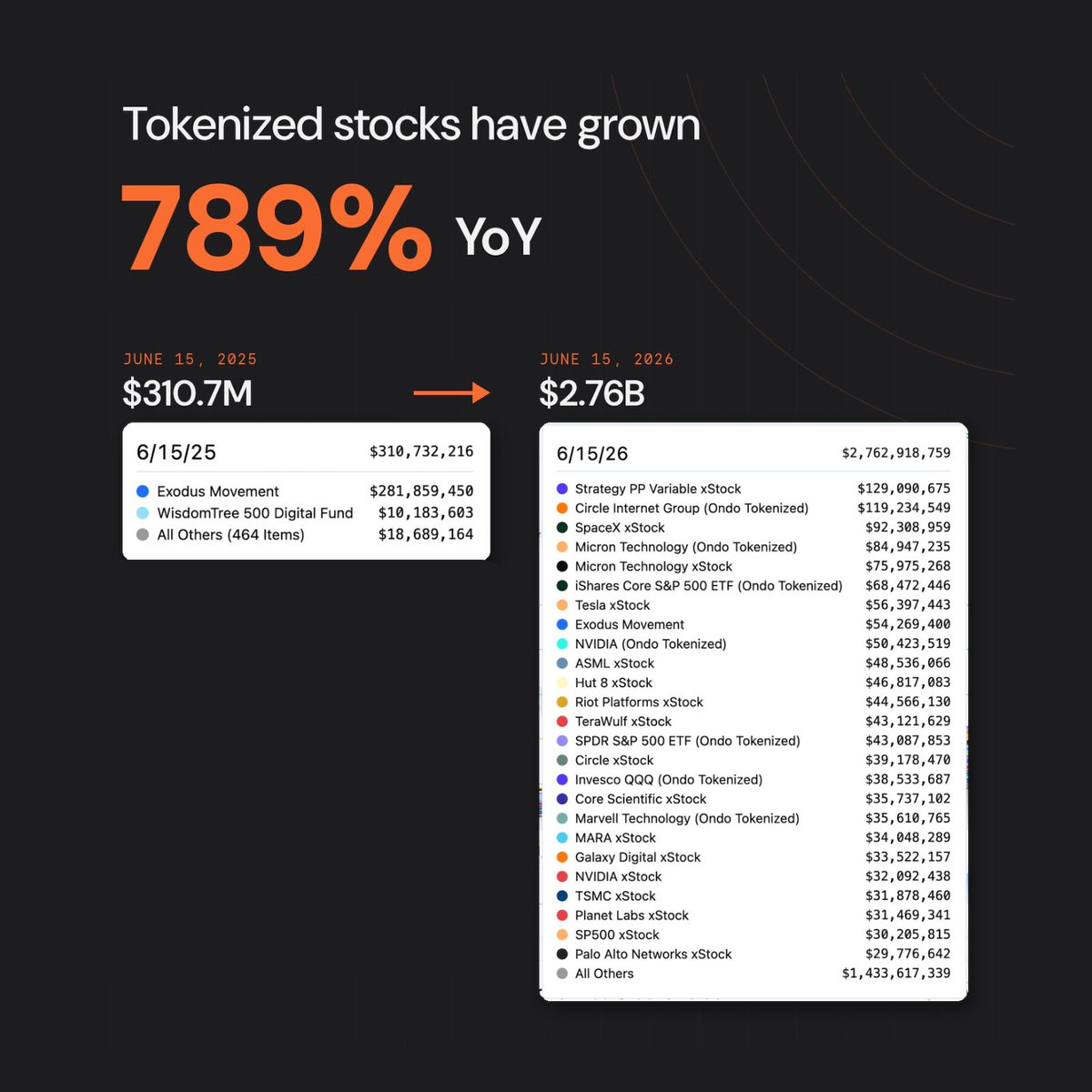
A year ago, tokenized stocks were basically one ticker.
Today: $2.76B across 100+ stocks, up 789% in 12 months.
SpaceX listed on Nasdaq June 12. Same day, it was trading onchain via xStocks and Ondo.
Over $100M tokenized in 4 days. What a time to be alive!
The whole financial market is a product of financial engineering, not only crypto, but also tradfi, stocks, commodities, etc etc
It’s not good, it’s not bad, it’s just a stage of markets development, which will end up with a crisis, but until then we have to play this game sell stories, play around narratives and metrics if we want to win. Otherwise your activity is against the trend and you lose.
Brutal, simple, but it’s what it is
Enjoy
1 day to go until TBV Demo Day 14. 🚀
Founders take the stage to pitch in front of top VCs, investors, and ecosystem builders.
If you’re a founder, investor, or just want to see what’s getting built next, this is your sign.
RSVP now 👉 https://t.co/4goyuumMUk
Microsoft, Google, Amazon and Meta are projected to spend roughly $725B on capex in 2026, up 77% from last year's record.
Data centers, chips, power contracts, and the private credit funding all of it.
AI is driving the biggest capital buildout in tech history, yet onchain finance barely touches it.
That gap is the RWA opportunity.
.@DWFVentures compares Hermes vs. Claude Code vs. Codex CLI vs. OpenClaw in 8 dimensions:
The pattern is consistent across models. Most agents excel at depth, polishing, or ecosystem integration. Hermes trades some of that simplicity for something different - persistent memory.
The tradeoff: more setup and architecture. The payoff: an agent that compounds.
Read more below 👇
Tokenized RWAs are a $380B market where 92% cannot move.
@RWA_xyz splits it in two: $31.17B distributed and transferable by investors, $349.33B represented, recordkeeping entries that never leave the issuer's system.
Of the part that moves, about $1B works as lending collateral on Morpho and Aave Horizon. Three cents on the dollar.
Perps don't have this problem. $75B traded in one week of May, and Hyperliquid RWA open interest just printed a $3B all-time high.
Either tokenized assets learn to work as collateral, or perps keep taking the order flow.
🎙️ The Sujal Show Ep. 14: @ag_dwf – The Man Behind 1,000 Crypto Deals Just Told Us Everything
@DWFLabs founder Andrei Grachev reveals what retail never sees, token listing secrets, his $1,000 crypto playbook, how market makers really make money, and his personal holdings.
We Discussed on @TheSujalShow:👇
- Why he sold most of his mined ETH at $5
- Why retail is the product, not the player
- What DWF is quietly building
- Where to put $1,000 today (his exact playbook)
- Privacy coins like $ZEC: sustainable or hype?
- 3 crypto categories that die in 5 years
- Why 1B+ cap coins won’t 10x
- Why CeDeFi (centralized DeFi) is the next big narrative
- The coin loan model nobody explains clearly
- How exchanges & market makers decide your opening price
- Why most "smart money" wallets on Hyperliquid are only showing half the picture
- How to spot fake volume on any exchange
- Why AI trading agents are "not good”
- 3 altcoins he'd put his own money
- His BTC price prediction for this cycle
Timestamps:
00:00 Intro
01:26 How Andrei got inside crypto's inner circle
03:47 Is crypto really the most manipulated market?
06:43 What market makers actually do
11:12 How market makers make (and lose) money
12:50 The smart money playbook nobody talks about
16:14 His exact $1,000 crypto strategy today
17:54 The FBI fake token sting explained
19:03 Market making vs. market manipulation
21:00 How to spot a fake pump in real time
24:25 What happens before your coin hits the exchange
29:23 The truth about stop loss hunting
35:05 Where DWF is quietly moving money right now
39:04 The $25M Trump token deal & Justin Sun drama
40:11 Rapid fire
He mined ETH at $5. Bootstrapped DWF Labs. Now he’s telling you how the game really works.
Watch now 👇
Hermes' self-improvement stack runs across four integrated layers: procedural, episodic, declarative, and maintenance.
The result is that the more the agent interacts with a specific environment, the more precise its outputs become.
OpenClaw's ClawHub offers similar concepts through community plugins, but everything is manually written and maintained. Hermes runs the loop automatically.
More from @DWFVentures in the article below 👇
Seamless liquidity movements, RWA exposure, and transferability are the key aspects behind the future of tokenized gold.
@ag_dwf shares with @Cointelegraph and @rkbaggs 👇
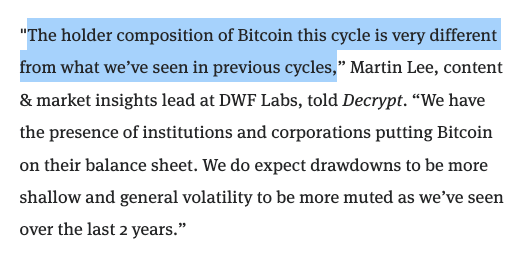
The Bitcoin market structure in 2026 is different.
Institutional adoption is compressing volatility, and non-Bitcoin assets are increasingly getting priced on their own merits.
More in @DecryptMedia👇
The hidden cost of stateless AI agents is that users are the memory layer.
Every time a session ends, the reasoning disappears and institutional knowledge doesn't get a chance to accumulate.
Hermes is built around memory and knowledge. Its skills system creates a self-reinforcing loop:
Trigger → Execution → Capture → Retrieval → Refinement → repeat
Skills compose hierarchically, and a single improvement to a foundational skill has a compounding effect through the knowledge layer.
@DWFVentures investigates in their latest article👇
2 stablecoins launched in the last 2 weeks.
Both point back to the same infrastructure layer: @stripe’s Bridge.
That’s the real story in stablecoins right now: distribution, and who owns the rails underneath it.
The last 30 days:
• @MoneyGram launched MGUSD for cross-border payments across its 60M customer network. The goal is to make MGUSD part of MoneyGram’s global payment infrastructure, starting with treasury, settlement and currency trading.
• @deel launched stablecoin wallet functionality for global contractors across 150+ countries, giving workers a way to hold and use dollar balances globally.
• @Visa is testing private stablecoin settlement with Brale’s SBC on Canton Network, built for institutional flows that need programmability and compliance without exposing transaction data.
• UK lawmakers pushed the Bank of England to rethink proposed stablecoin holding caps, warning they could choke the sterling stablecoin market before it starts.
Total stablecoin supply sits around $316 billion, still dominated by USDT and USDC, but the real fight is no longer just supply, it's distribution.
Brands bring the users. Infrastructure owns the rails: issuance, custody, wallets, settlement, compliance and liquidity.
A current gap in the AI agent market is memory.
Most assistants today don't have a way to compound what they've learned. Every interaction is a fresh start, regardless of how many hours a user has spent with them.
Hermes Agent, released by Nous Research in February 2026, is built around the opposite principle: an agent that gets more capable over time.
It is already ranked #1 on OpenRouter, with 40+ built-in tools and support for 20+ LLM providers.
@DWFVentures investigates the architecture and what it means for the agent landscape 👇
The only 2 things are working in the crypto space:
1. tradefi listings
2. market activations
3. prediction markets
Both drive volumes, engage traders and create opportunities
Despite the best deals are always done when "blood is on the streets", it is hard, people don't join
Most AI agents have a major design flaw. Missing memory.
Every session starts from 0. They don’t learn. They don’t improve.
@NousResearch built Hermes with memory in mind. It self-improves the more you use it. Compounding its capabilities.
It’s now the most-used agent by token volume. 2.2x that of OpenClaw.
The latest piece by @DWFVentures explains why Hermes has pulled ahead, how its memory architecture works, and how it stacks up against alternatives.
If you're building within crypto x AI, @DWFVentures is looking for projects to support → https://t.co/JAMhtgPDGL