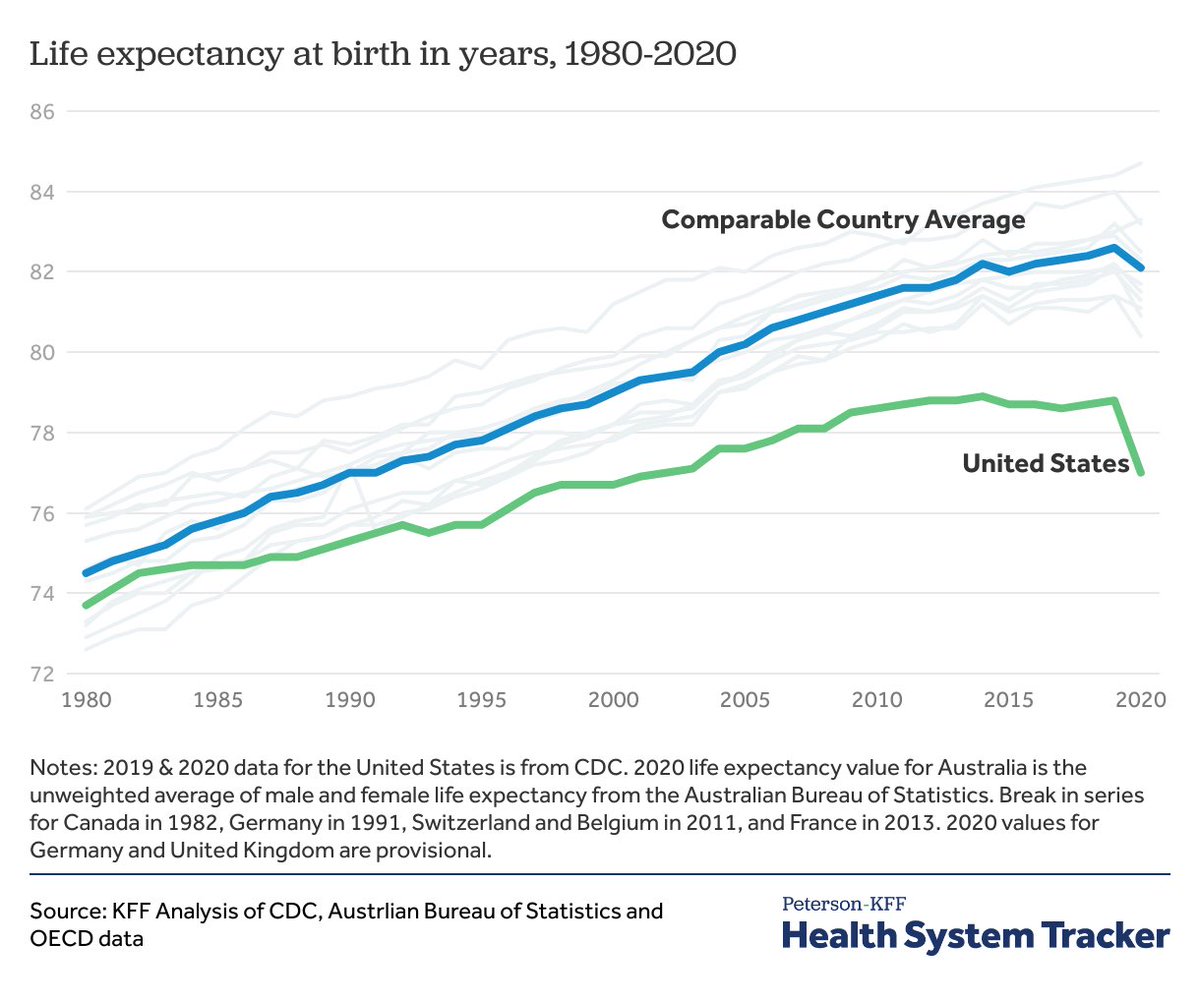
@Gab_H_R It is THE metric, it has already dropped due to people dying (younger than they should have) during the acute phase.. But when people will realise it keeps dropping despite big wave of infection and death being over, it will remind us how the world was wrong to take Covid lightly
🚨BELGIUM, MSM are waking up!😧
"The coronavirus is circulating with striking intensity in our country, but how bad will things get this winter? Virologist Steven Van Gucht: “We are only at the beginning.”"
‼️The understatement of the week, but nothing about #LongC0VID
https://t.co/ECXqckCPu9
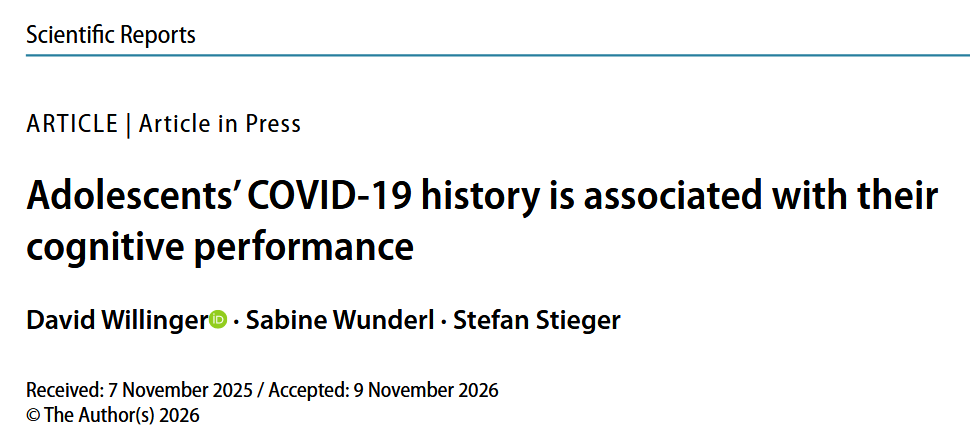
"Nos résultats indiquent que les antécédents de COVID-19 chez les adolescents sont associés à leurs performances cognitives."
Cette conclusion d'un article de @Nature devrait tous nous scandaliser et pousser à l'action.
Ce q le covid abîme, c'est aussi les générations de demain.
🚨"There's too much signal now to keep operating without prevention."
➡️A final sentence to an excellent 🧵again, underscoring your need to read this warning.....!👏👇
It’s getting surreal.
A mathematician on X announced a solution to one of the most beautiful and elegant problems in mathematics. I’ll keep him anonymous. You’ll see why in a moment.
Is ℤ Diophantine in ℚ? In other words, can a single polynomial equation pick out exactly the integers among the rational numbers?
Equations like these go back to the ancient Greeks. This particular question has been open for decades. There are good reasons to expect the answer to be no. Surprisingly, the proposed answer is yes.
So, what’s the problem?
The problem is that the author candidly says in the post “I don’t have the expertise to understand this solution”, but he posts it anyway as he has “high confidence” on it.
The proof doesn’t even have the formal Lean verification.
This is literally an AI generated proof that looks plausible, but nobody has actually verified.
This is exactly what we call Epistemia. The argument looks plausible, and plausibility takes the place of verification.
Until recently, a mathematician would be embarrassed to announce a proof he couldn’t understand.
Now it risks becoming the norm.
I think this is partly due to short term incentives.
Announcements like this get you thousands of followers and interviews with journalists. (Now you know why I’m keeping him anonymous.)
Epistemia is already a big issue.
It’s a tragedy that short-term incentives - Andy Warhol’s 15 minutes of fame - are pushing people to become even more sick.
*
In the first comment, you’ll find our epistemological fault lines paper, where we discuss Epistemia at length. I think it’s useful to understand what’s happening.
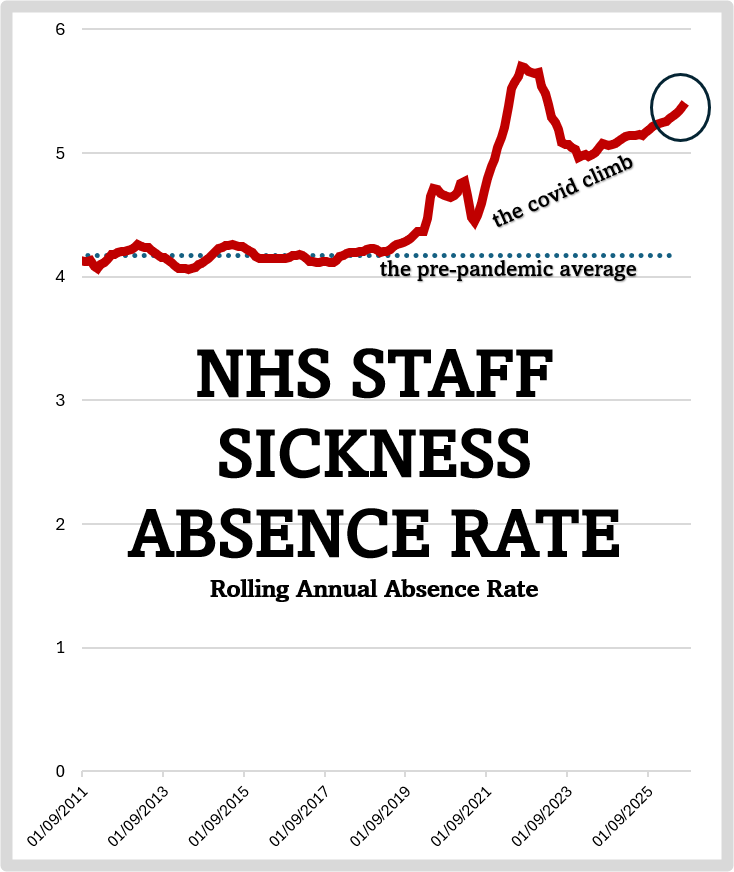
The change in the NHS Staff Sickness Absence Rate since the start of the pandemic is actually bonkers.
But the bonkers thing isn’t that it’s happening - it’s entirely predictable when you understand the science.
The bonkers thing is that they’re not doing a thing to prevent it!
it just accelerated again.
a million and a half workers.
now *31%* more likely to be off sick than before covid hit... and getting worse with every month.
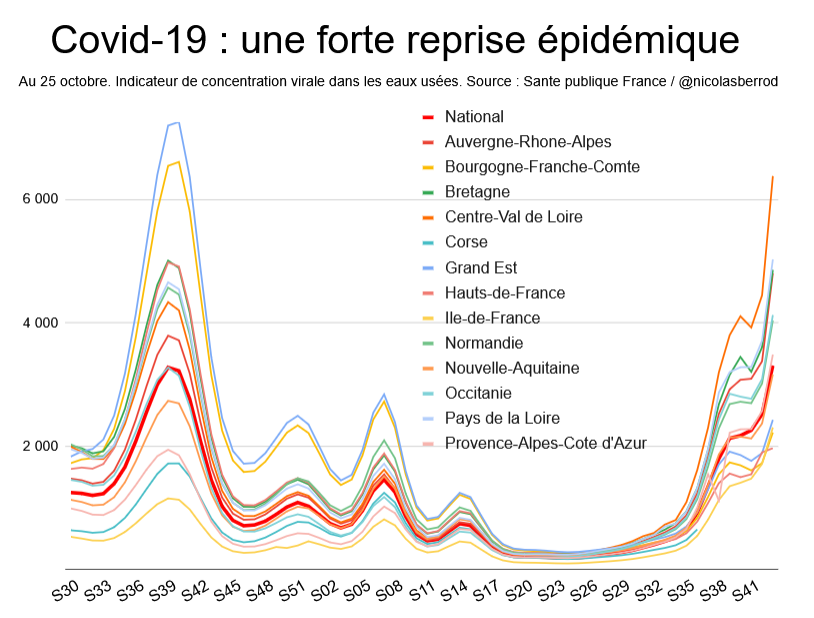
📈 Le pic épidémique de #Covid19 n'est pas du tout passé : circulation virale dans les eaux usées toujours en forte hausse, dépassant même désormais le pic de l'an dernier à la même période.
Cette hausse est toujours très marquée dans chaque région.
1. The bottom line: SARS-CoV-2 only emerged in late 2019. No-one can know the long-term effects of repeated infections, but with anosmia and cognitive dysfunction as common symptoms, the assumption I make is that there is a tsunami of early-onset neurocognitive diseases coming.
Hi Leo 👋🏻, I live in the UK & take precautions to avoid catching COVID.
I’ve read the research about the long-term harms of repeated COVID infections - none of it is good.
For me, it’s therefore worth the minor inconvenience of wearing a mask in public spaces to reduce my risk.
An unseen tsunami.
In German insurance claims data, people with a coded post-COVID diagnosis had on average 26.5 more sick-leave days in the first year (46 vs 20) and 6.9 more outpatient doctor visits than comparable people after COVID without that diagnosis🧵
@1goodtern Such a pity in 2026 we are not capable to identify a virus… oh wait! Sure we can.
So it is basically that we don’t want to know or to let people know which virus it is…
pity that could help people realise that especially some virus are not benign to catch again and again
@fillthewhole@BBCNews This article also travels in French online news. No mention of Covid in the title. Just « 2x Covid and mononucleosis » (which we know now is often a réactivation of EBV with a post Covid weaker immune system)
https://t.co/BGNG4qUzj1