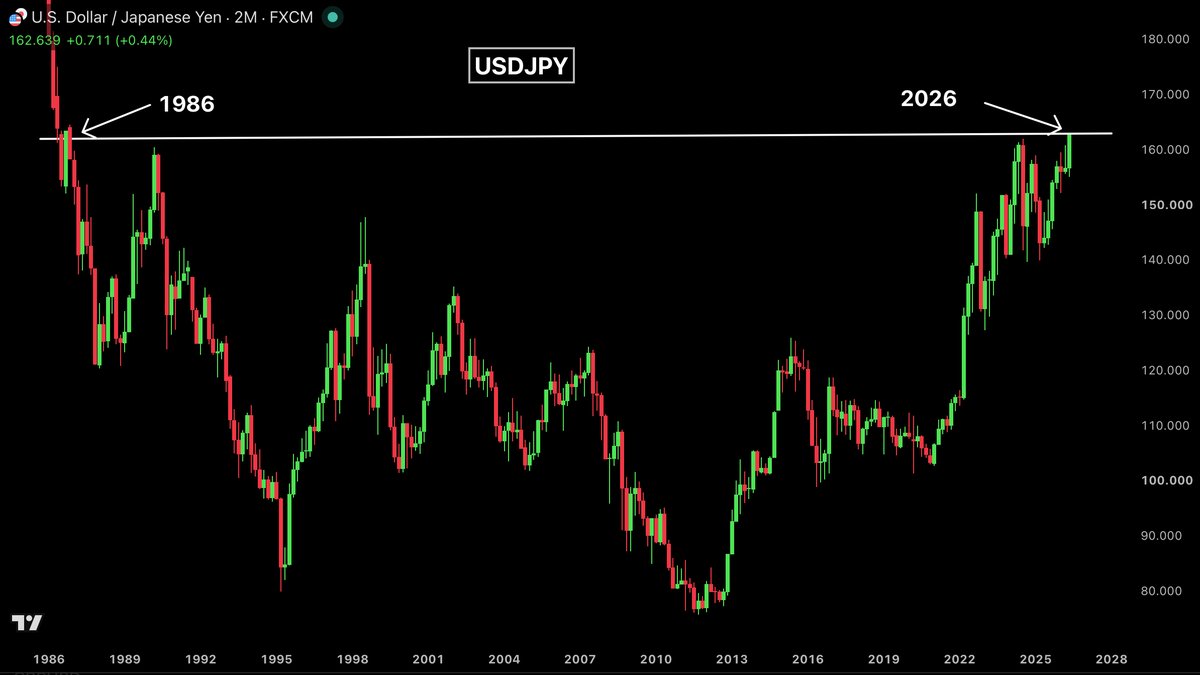
🇯🇵 JAPAN MAY BE FORCED TO SPEND $100 BILLION TO SAVE THE YEN.
USD/JPY just hit 162.66, the highest level in 40 years.
Japan already tried to fix this. In late April and early May, it spent roughly $72-$73 billion defending the yen, its biggest intervention in years.
It failed. The yen kept falling right after, and every dip since has been bought back almost instantly.
But why does the intervention alone keep failing every time?
Because it doesn't fix the actual reason traders are selling yen.
US bond yields are still far higher than Japanese yields, so traders keep choosing dollars over yen no matter how much Japan sells to stop it. Selling dollars treats the symptom.
The real cause is that Japanese rates are too low.
That's pushing the BOJ toward two things at once, not just future intervention, but actual rate hikes. Analysts expect BOJ rates to climb toward 1.5% by 2027, alongside the BOJ shrinking its bond holdings after decades of near-zero rates.
This is where it stops being just a Japan story.
As the BOJ tightens, it's draining liquidity from the same global system the Fed has been managing.
The Fed has paused shrinking its own balance sheet, but the BOJ and ECB together are still projected to drain over $1 trillion from global liquidity in 2026 alone.
Less global liquidity means less cheap money funding stocks, crypto, and risk assets worldwide, regardless of what the Fed does.
Rising Japanese yields also change behavior inside Japan itself. Japan is the world's largest net external creditor.
As JGB yields rise, Japanese investors finally have a reason to bring money home, selling US Treasuries, US equities, and global assets to buy domestic bonds that actually pay something now.
That repatriation directly threatens something specific: the yen carry trade. For years, investors borrowed yen for almost nothing and used it to buy stocks, bonds, real estate, and crypto.
Estimates put the total size of this trade between $4 trillion and $8 trillion.
When the yen strengthens, the math on that trade breaks. Borrowed yen gets more expensive to repay, forcing investors to sell the assets they bought with it.
We already saw exactly this play out in August 2024. A single small BOJ rate hike sent the yen higher. The Nikkei fell over 12% in a day, its worst session since 1987. The S&P 500 dropped 3% that same week. Bitcoin fell from $64K to $49K in six days, all triggered by one modest hike.
Now put the pieces together. Last time, even $72-73 billion in intervention wasn't enough to move the yen.
This time, the intervention will likely need to be bigger, while the BOJ is also hiking rates and Japanese capital is flowing home, all at the same time.
A bigger intervention plus more capital repatriation means more pressure on the same carry trade that broke in August 2024, except this time the trade is larger, and the forces pushing against it are stacking on top of each other instead of acting alone.
Trump earned $1.4 Billion from crypto while Bitcoin is down -54% and ETH is down -68% from its all time high.
First Pro crypto US president in history…
ZOOM OUT ON BITCOIN.
It rarely closes more than 3 quarterly candles in a row red.
It rarely closes more than 2 six-month candles in a row red.
We're closing in on the Bitcoin bear market bottom.
The next 2-3 years will be WILD!
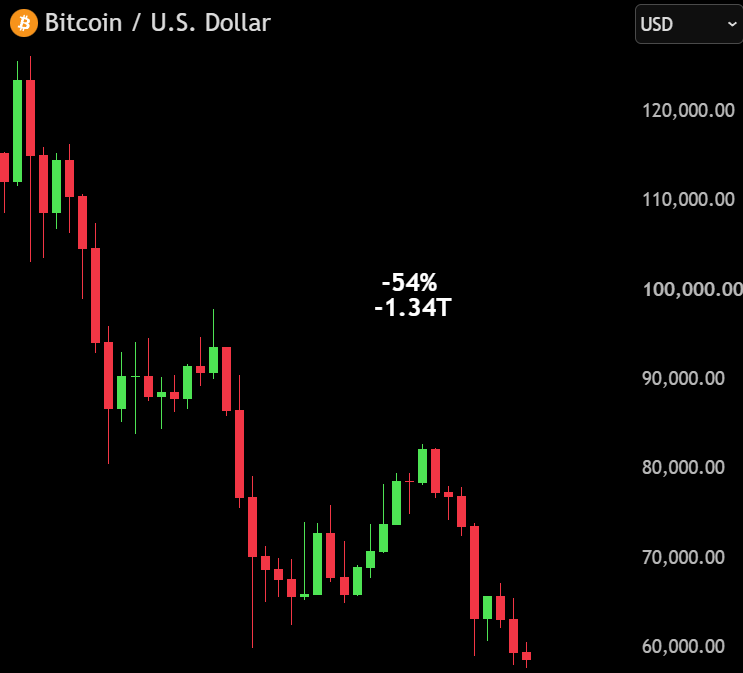
BREAKING: Bitcoin has crashed below $58,000, hitting a 652-day low.
Bitcoin is now down -54% from its peak, wiping out over $1.34 trillion in market value.