A motion to train our own doctors and nurses was given at the Reform Conference. Four doctors asked for it to be amended
They all thought any doctor or medical practitioner trained here should have to work in Britain for a minimum of 5 years
Motion was passed
+All were disgusted by doctors going on strike!
Another motion:
‘To protect our Green and pleasant land!’
Stop the tendency to build on the green belt when brown field land is available
Plus stop using agricultural land for solar panels 👏👏👏
Motion was passed
This is what has been wrong with our society for a long time and will not change under Labour
After our new and updated version of logo we asked also our friend Mike to give you the possibility to have your new TSHIRT design so, to be very chic and to follow the last moda design,here our beautiful tee shirts, visit https://t.co/ANCepzWW5G The kind people at Wisemeow have made a beautiful tee-shirt with our new logo on. Available in 3 colours and in a ladies fit - they are fabulous. If you buy one, please remember to send us a photograph to [email protected] Other designs are still available and so are our bags.
Amal and George Clonney spotted yesterday in Venice with the last and newest model of our collection. 🥰🤣
This looks like a photograph. It's not. It's an oil painting made in 1883 by Peder Mørk Mønsted.
It's called The Woodland Glade. Sunlight pours down through a high forest canopy and scatters across the ground in a thousand shifting patches of gold and shadow, each one placed with a precision that hardly seems possible for a human hand.
In his own day Mønsted was celebrated for exactly this. He was admired enough to travel the world and, in 1893, to be received as a personal guest of King George I of Greece, a king who had himself been born a Danish prince, painting the royal family and the countryside there.
But Mønsted had two misfortunes: he painted landscapes rather than important people, and he did it just as the art world was falling out of love with this kind of realism, deciding that all that loving exactitude had had its day.
So his name slipped almost entirely out of art history. And yet his paintings never stopped being loved: they circulate endlessly online, reposted by people who fall for a sunlit forest and, most of the time, have no idea who made it. The man has been forgotten, but the light he captured never has. Leonardo da Vinci once said it best: "A beautiful body perishes, but a work of art dies not."
11 sheep were stolen off Jeremy Clarkson's farm this week, and the first thing he did was apologise to the police for sounding like a man from 1856.
He counted the flock with Kaleb and found 16 Easycares where there had been 27. Somebody took 4 in every 10 sheep he owns, off 1,000 acres with a film crew on it most days, on an evening when nobody was filming.
Then he rang it in. Once you get through 700 hours of recorded messages, he said, he got a girl on the line and told her he knew he sounded like he was from 1856, but he had had some sheep stolen. She took his name and address and said, oh, not your Easycares. She watches the show. His message to whoever has them is to put them back.
In 1831 the courts of England and Wales sentenced 162 people to death for stealing sheep. It had carried the rope since 1741, and Parliament only took it off the capital list in 1832, when the sentence became transportation for life. A man who lifted 11 Easycares in 1856 went to Australia and did not come back.
NFU Mutual's figures in May had good news in them. Rural crime overall fell 6% last year, to £41.5m, with £9.3m of stolen machinery recovered.
Livestock theft went the other way. Up nearly 30%, to £4.5m. The insurer's own phrase for it now is highly organised, which means a lorry, a plan and a buyer before the animals are loaded.
There is one dedicated livestock theft officer in the United Kingdom. One, for the whole country, and the insurance company pays for him.
Clarkson is the one victim in Britain who can get it into The Sun by Thursday. The farm 4 miles down the road has the same lorry, the same night and no film crew, and when 11 ewes go out of that field nobody counts them.
In 1831 the country hanged a man for it. In 2026 it puts you on hold.
Watching Louise Haigh deliver this statement, I was struck by one thing above all else: we have heard virtually all of it before.
Perhaps that should come as no surprise. Haigh was one of the leading figures in the political coup that ultimately brought down Keir Starmer and propelled Andy Burnham into Downing Street. Listening to her now, it is becoming increasingly apparent that much of the language, political positioning and populist appeal that characterised Burnham’s campaign was not merely electoral rhetoric. It appears to be the governing philosophy of the new administration, with Haigh very much at its heart.
Much of what she says about the problems facing this country is perfectly true. That is precisely why the absence of substance is so frustrating. Identifying what is wrong with Britain is not difficult. Articulating public dissatisfaction is not difficult. Producing grand phrases about returning power to communities, putting people back in control and rewiring the state is not difficult either.
The difficult part is governing.
Where are the figures? Where are the firm commitments? Where are the timescales? Where are the measurable objectives against which this Government expects to be judged? How, precisely, will these promises be delivered and, perhaps most importantly of all, how will they be paid for?
These are not unreasonable questions. They are the most elementary questions that any Government making promises of this magnitude should be capable of answering.
There is also something rather disingenuous about presenting much of this as though it represents some revolutionary departure from what went before. A considerable amount of what Haigh described was already being pursued by the previous Government under Keir Starmer. Taking an existing direction of travel, clothing it in more populist language and presenting it with greater political theatre does not make it a new philosophy of government.
Burnham and Haigh are no longer insurgents. They are no longer campaigning against the establishment, nor are they plotting a change of leadership from the sidelines. They succeeded. They now occupy Downing Street and possess all the authority and machinery of government that comes with it.
With that victory comes responsibility.
The time for simply telling people what they want to hear has passed. It is no longer sufficient to declare that Westminster has failed, that the system is broken or that everything is about to change. Government requires rather more than identifying grievances and promising something better.
Tell us precisely what you are going to do. Tell us how you are going to do it. Tell us when it will be done. Tell us what it will cost. Then give Parliament and the British public clear measures by which your success or failure can be judged.
After Burnham’s performance at PMQs and now this statement from Haigh, a rather troubling pattern is beginning to emerge: an abundance of rhetoric, an abundance of populism and an alarming shortage of detail.
Campaigns can be won with slogans.
Countries cannot be governed by them.
Absolute farce at Holyrood and in the Scottish Government.
Q Mannivanan prioritises made-up gender identity and Palestine posturing over his actual job plus he didn’t even bother turning up to the committee meeting that he was supposed to be involved with this week. Now we’ve got a civil servant in the Scottish Government rocking up dressed as a cat.
This is the same Parliament where women have been turfed out or told they can’t wear a suffragette scarf -actual women’s rights symbolism-yet the full gender-identity circus and animal cosplay are waved through without a second thought.
Other lowlights of the Scottish Parliament’s descent into the absurd: MSPs solemnly debating self-ID while women’s single-sex spaces and sports are dismantled; the endless performative foreign-policy grandstanding that does nothing for Scots; and the steady drip of identity politics that crowds out housing, education, NHS waiting lists and the actual day-to-day failures of government.
Devolution was sold as bringing power closer to the people. What we’ve got is a taxpayer-funded theatre of the ridiculous when the Festival is over. Enough.
Larry genuinely is a national treasure. I mean this quite seriously. He is in the tradition of great London cats, but is also more significant than that. That raggedy old cat represents something half-forgotten about my country. Laugh at me if you will.
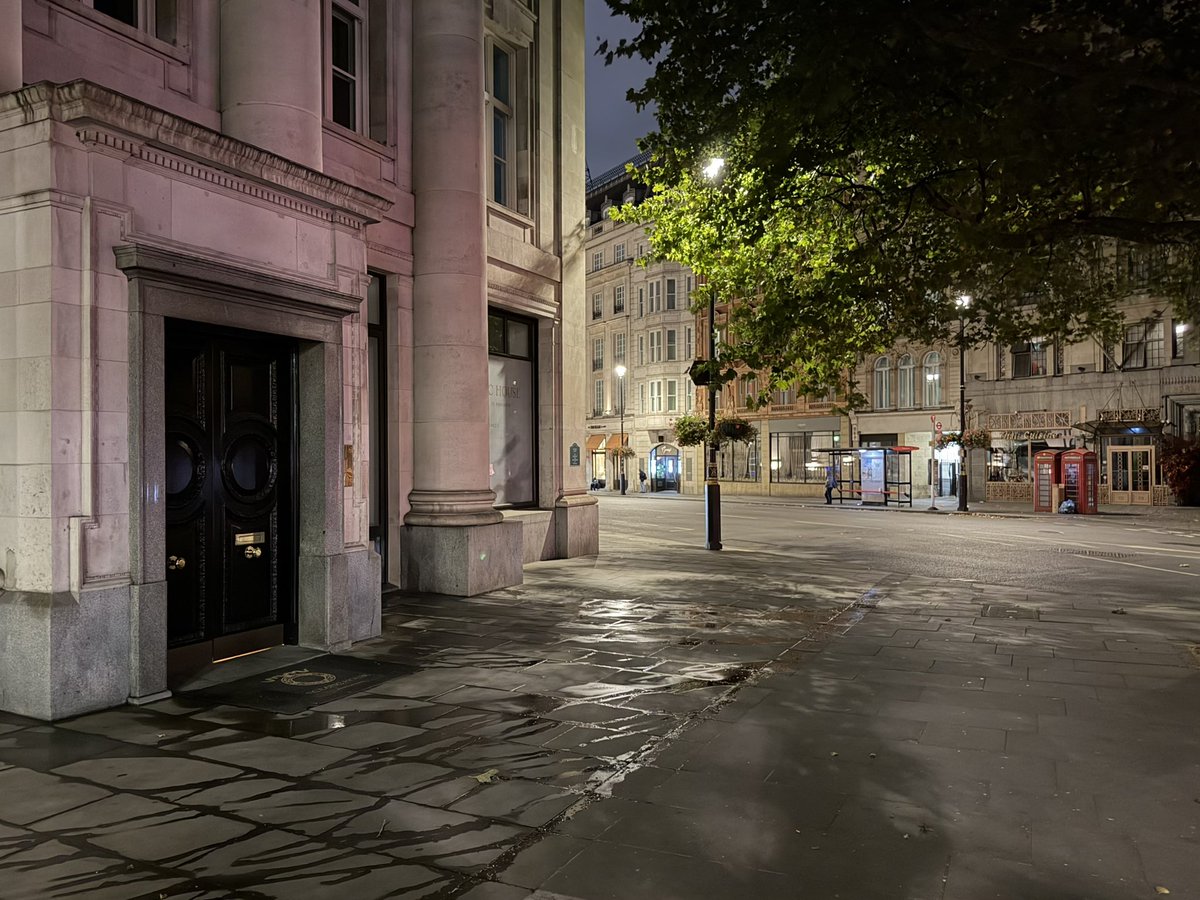
This is a photo I’ve been meaning to take for ages and finally did this morning at 4:30. It’s the exact spot that one of the most famous photos in history was taken. I’ve put the famous photo next to mine, but incredibly, there doesn’t seem to be a record of who took it. It was taken on April 16th 1912, the day after the Titanic sank. The boy selling the paper with the shocking headline, is Edward John ‘Ned’ Parfett who tragically was killed in October 1918 in the First World War, just a month before it ended. The building at that time was the head office of The White Star Line who owned The Titanic. Even though I’ve walked here a million times, it was incredible standing there this morning taking the photo.
WEF's Klaus Schwab admits it proudly...
"The world will no longer be run by superpowers like America…it will be run by the World Economic Forum and its stakeholders; BlackRock, Bill Gates & the rest of the global elite."
They're not even pretending anymore...