Student of the Word of God! Jesus saves! Husband of a wonderful loving wife and Father of four wonderful blessings God allowed me to be part of their lives.
🔥 AMILLENNIALISM HAS A GOD PROBLEM
The deepest problem with amillennialism is not simply that it denies a future literal thousand-year reign of Christ. The deeper issue is what that system must do with the covenant promises God made to Israel.
This is ultimately a question about the character of God.
Does He mean what He says?
When God covenanted with Abraham, He promised a specific people, a specific land, and an enduring relationship with Abraham’s descendants.
“I will establish my covenant between me and you and your offspring after you throughout their generations for an everlasting covenant.”
Genesis 17:7
And concerning the land:
“All the land of Canaan, for an everlasting possession.”
Genesis 17:8
The language is difficult to soften:
Offspring. Generations. Land. Everlasting covenant.
Everlasting possession.
Later, God made a covenant with David:
“Your house and your kingdom shall be made sure forever before me. Your throne shall be established forever.”
2 Samuel 7:16
Again, the promise is concrete. A house. A kingdom. A throne.
Then the prophets describe a future in which scattered Israel is regathered and spiritually transformed:
“I will take you from the nations and gather you from all the countries and bring you into your own land.”
Ezekiel 36:24
Then:
“I will give you a new heart, and a new spirit I will put within you.”
Ezekiel 36:26
God says He will gather them from the nations, bring them into their own land, cleanse them, and give them a new heart.
And then He tells us why:
“It is not for your sake… that I am about to act, but for the sake of my holy name.”
Ezekiel 36:22
That verse gets to the heart of the issue.
Israel’s ultimate restoration does not depend upon Israel being worthy. It depends upon God being faithful to His own Name.
Israel failed. Israel rebelled. Israel was judged.
But Israel’s failure does not turn an unconditional covenant into a conditional one.
JEREMIAH 31 SHOULD STOP US IN OUR TRACKS
After promising the New Covenant specifically with “the house of Israel and the house of Judah” in Jeremiah 31:31, God guarantees Israel’s continuing national identity by appealing to creation itself.
He points to the sun, moon, and stars and declares that only if this fixed order disappears will:
“the offspring of Israel cease from being a nation before me forever.”
Jeremiah 31:36
Think about that.
The sun still rises.
The moon still appears.
The stars remain.
So why should we conclude that Israel’s national calling has been permanently absorbed into the Church?
God tied Israel’s continuing identity as a nation before Him to the stability of creation itself.
PAUL COULD HARDLY BE CLEARER
Paul asks the very question this theology forces us to confront:
“Has God rejected his people? By no means!”
Romans 11:1
Then he warns Gentile believers:
“Do not be arrogant toward the branches.”
Romans 11:18
That warning should make the Church extremely careful.
Gentile believers are not told that Israel has disappeared. They are warned against boasting over Israel.
Paul then describes Israel’s present condition:
“A partial hardening has come upon Israel, until the fullness of the Gentiles has come in.”
Romans 11:25
The hardening is partial, not total.
It lasts until, not forever.
Then Paul says:
“And in this way all Israel will be saved.”
Romans 11:26
And finally:
“For the gifts and the calling of God are irrevocable.”
Romans 11:29
Irrevocable.
That word places enormous pressure on any theological system that permanently removes the national implications of God’s calling of Israel.
THE AUGUSTINIAN TURN
This interpretive weakness has deep historical roots.
Augustine helped establish the framework that later dominated much of Western Christianity. In his reading of Revelation 20, the first resurrection became spiritual regeneration, the thousand years became the present Church age, Satan’s imprisonment became a present restraint, and the saints’ reign became the Church’s present spiritual reign with Christ.
That raises an important hermeneutical question:
How many plain statements can be transformed before interpretation begins to replace the text?
Once resurrection need not mean bodily resurrection, a thousand years need not describe a future thousand-year reign, and Satan being shut in the abyss can describe his present activity under restraint, the same method can easily be carried backward into the prophets.
Then Israel becomes the Church, the land becomes spiritual inheritance, Jerusalem becomes symbolic, and David’s throne becomes exclusively heavenly.
That is precisely the danger:
The interpretive method becomes powerful enough to transform the promises it was supposed to interpret.
THIS IS WHY HERMENEUTICS MATTERS
If Israel can permanently mean someone other than Israel…
If land can permanently mean something other than land…
If Jerusalem can permanently mean something other than Jerusalem…
If David’s throne can permanently become something fundamentally different from David’s throne…
then the plain sense of the covenant promises has been profoundly altered.
And notice how beautifully the covenants fit together.
The Abrahamic Covenant gives us the people and the land.
The Davidic Covenant gives us the King and the throne.
The New Covenant gives us Israel’s cleansing and regeneration.
The prophets then describe the nations coming to Jerusalem under Messiah’s reign:
“For out of Zion shall go forth the law, and the word of the LORD from Jerusalem.”
Isaiah 2:3
Zechariah declares:
“The LORD will be king over all the earth.”
Zechariah 14:9
This is where the kingdom promises converge:
A restored Israel in the promised land, spiritually renewed, under the reign of David’s greater Son, with Jerusalem exalted and the nations coming under Messiah’s righteous rule.
That is why the Millennium is not a disposable prophetic detail.
It is the arena in which God publicly demonstrates that He has not forgotten Abraham, David, Israel, or a single word of His covenant promises.
THE ISSUE IS THE CHARACTER OF GOD
Amillennial believers sincerely affirm that God is faithful. The issue is not their sincerity.
The issue is whether the system allows the covenant promises to retain the meaning they had when God actually gave them.
God’s faithfulness is not demonstrated by making different promises than the ones He originally spoke.
It is demonstrated by keeping the promises He actually made.
God says:
“My counsel shall stand, and I will accomplish all my purpose.”
Isaiah 46:10
And Scripture asks:
“Has he said, and will he not do it? Or has he spoken, and will he not fulfill it?”
Numbers 23:19
That is the real issue.
The Millennium matters because the covenants matter.
The covenants matter because the Word of God matters.
And the Word of God matters because the character of God stands behind every promise He has made.
God will keep covenant.
God will fulfill His Word.
God will restore Israel.
And Israel’s future restoration will stand before the nations as a testimony that what God has spoken, He will do.
The Millennium matters because the character of God matters.
If Calvinism’s doctrine of “Limited Atonement” (the ‘L’ in TULIP) is true:
Why do so many passages claim the exact opposite of God only desiring some to be saved (Ie the “Elect”)?
🔥 GRACE IN THE MIDST OF WRATH: WHO ARE THE TRIBULATION SAINTS?
Jesus promised that His followers would experience persecution in this world:
“In the world you will have tribulation.”
John 16:33
But persecution from the world is not the same as the coming Tribulation, when God pours out His righteous judgment upon the world.
The Church was promised tribulation from the world, but she was never appointed to suffer God’s wrath with the world.
“For God has not destined us for wrath, but to obtain salvation through our Lord Jesus Christ.”
1 Thessalonians 5:9
Jesus gave the faithful Church this extraordinary promise:
“I will keep you from the hour of trial that is coming on the whole world, to try those who dwell on the earth.”
Revelation 3:10
Notice that Christ does not merely promise protection from individual judgments. He promises to keep His Church from the very hour of global testing.
The coming Tribulation is not the Church’s appointed trouble. Scripture calls it “the time of Jacob’s trouble” (Jeremiah 30:7).
Daniel’s seventieth week was decreed specifically for “your people and your holy city” (Daniel 9:24). It will bring judgment upon a rebellious world, refinement to Israel, and preparation for the return of her Messiah.
Yet Jacob’s Trouble will not end with Israel’s destruction. It will end with Israel’s deliverance.
God will pour upon Jerusalem “a spirit of grace and pleas for mercy,” and they will look upon the One they pierced (Zechariah 12:10). Israel’s surviving remnant will be refined, call upon the Lord, and finally declare:
“Blessed is He who comes in the name of the Lord.”
Matthew 23:39
“All Israel will be saved,” because God’s covenant promises cannot fail (Romans 11:26–29).
But even while God’s judgments are falling, His mercy will still be reaching!
After the Church is caught up, God will not leave the world without a witness. He will raise up:
• 144,000 sealed Jewish servants from the tribes of Israel
• Two supernatural witnesses prophesying in Jerusalem
• An angel proclaiming the eternal gospel to every nation
• New believers boldly sharing the testimony of Jesus
The world will multiply its rebellion, but God will multiply His witnesses.
The Holy Spirit will continue convicting, regenerating, and saving. The removal of His present restraining ministry does not mean the removal of His saving presence. No sinner has ever been born again apart from the work of the Spirit.
And what will be the result?
“A great multitude that no one could number, from every nation, from all tribes and peoples and languages.”
Revelation 7:9
These are the Tribulation saints.
They will wash their robes and make them white in the blood of the Lamb. They will refuse to worship the Antichrist. They will reject his mark when their ability to buy, sell, work, and survive depends upon receiving it.
Many will seal their testimony with their own blood.
“They have conquered him by the blood of the Lamb and by the word of their testimony, for they loved not their lives even unto death.”
Revelation 12:11
They are not saved because they endure persecution.
They endure because they have truly been saved.
Salvation will still be by grace alone, through faith alone, in Christ alone.
The beast may kill their bodies, but he cannot erase their names, steal their inheritance, or prevent their resurrection. They will stand before God’s throne, sheltered by His presence. Their hunger, thirst, suffering, and tears will end as the Lamb shepherds them to springs of living water (Revelation 7:15–17).
Those who are martyred for refusing the beast will be raised to life and reign with Christ for a thousand years (Revelation 20:4).
They will lose their place in the beast’s world because they have received a place in Christ’s Kingdom.
And at the center of it all stands the Lamb.
The Lamb who shed His blood is also the One who opens the seals. The Savior humanity rejected is the rightful Judge who will reclaim the world He purchased.
The nail-scarred Lamb is not weak.
The Lion of Judah is not unjust.
His grace does not cancel His holiness, and His wrath does not extinguish His mercy.
Even during Earth’s darkest hour, the blood of Jesus will still cleanse sinners from every tribe, nation, people, and language.
The Church delivered.
Israel refined.
The nations judged.
An innumerable multitude redeemed.
But no one should read this and presume, “I will wait until after the rapture.”
The Tribulation will bring unprecedented deception, spiritual blindness, persecution, and pressure to worship the beast. Scripture gives no assurance that those who knowingly reject the truth today will find it easier to believe tomorrow (2 Thessalonians 2:9–12).
Do not plan to give Christ your heart tomorrow while refusing His voice today.
“Behold, now is the favorable time; behold, now is the day of salvation.”
2 Corinthians 6:2
The Church is not appointed to Jacob’s Trouble. She will be gathered to Christ before the hour of testing that comes upon the whole world.
But on Earth, an innumerable multitude will discover this glorious truth:
Wrath will not silence the gospel.
Judgment will not extinguish grace.
The Lamb who judges is still the Lamb who was slain.
And everyone who calls upon the name of the Lord will be saved. 🙌
Pastor Adrian Rogers on “the potter” reference in Romans 9:20-23
@realJennaEllis
(Full sermon on Romans 9 titled: ‘Predestined for Hell? Certainly Not!’ in comment section)
🔥 HONORING WATCHMEN WHO TAKE GOD AT HIS WORD
I am thankful for Bible teachers and watchmen who refuse to allegorize away the plain meaning of Scripture.
While they may not agree on every secondary detail, these voices generally share a vital biblical hermeneutic: interpret Scripture literally, grammatically, historically, and within its proper context. Let Scripture interpret Scripture. Maintain the biblical distinction between Israel and the Church. Take God’s covenants seriously. Allow prophecy to mean what it says rather than reshaping it to fit a theological system.
They remind us that God has not rejected Israel, His promises have not failed, Jesus is returning, and the Church must remain awake, discerning, and anchored in the Word.
These teachers are not infallible, and they should never replace personal Bible study. We are called to be Bereans, testing every teaching against Scripture. But I deeply appreciate their courage, faithfulness, urgency, and willingness to proclaim truths that much of the modern Church neglects.
“Test everything; hold fast what is good.”
—1 Thessalonians 5:21
Follow and explore:
Andy Woods: https://t.co/LHiBJoFQ6h
Mark Hitchcock: https://t.co/a9E4BC1lNp
Chuck Missler/Koinonia House: https://t.co/SIGcFbCDrF
J. B. Hixson/NBW: https://t.co/yt3RVaPgMH
Arnold Fruchtenbaum/Ariel Ministries: https://t.co/z0OkDcoMpS
Brandon Holthaus: https://t.co/UqpMxCrp5w
Amir Tsarfati: https://t.co/mfiICM22ky
Jan Markell: https://t.co/IXPq3pozLt
Tom Hughes: https://t.co/fdIDEehiS2
Pete Garcia: https://t.co/4cdB7bcxyS
Britt Gillette: https://t.co/qXiI8Ei6fe
Ricky Scaparo: https://t.co/9H6NTpG4MN
James Kaddis: https://t.co/o1GW84eaha
📖 Not personalities. Not popularity. Not speculation. Scripture is the final authority.
Did “Neither Jew Nor Greek” Cancel God’s Promises to Israel?
Galatians 3:28–29 is frequently used to argue that Israel’s distinct covenant identity disappeared when the Church was formed:
📖 “There is neither Jew nor Greek… for you are all one in Christ Jesus. And if you are Christ’s, then you are Abraham’s offspring, heirs according to promise.”
The argument is straightforward: Jew and Gentile are now one in Messiah, therefore the Church has become the new Israel and inherited Israel’s promises.
But Paul never says that.
⚖️ Paul is describing equality in salvation, not the cancellation of covenant identity.
The same verse says there is neither “male nor female.” Yet becoming one in Christ obviously does not erase male and female. Neither does “neither Jew nor Greek” mean Jews cease to be Jews.
Equality before God is not erasure before God.
🏛️ So how did this passage come to be read differently?
As the early Church became increasingly Gentile, some influential theologians began interpreting Israel’s identity and promises through the Church. By the second century, Justin Martyr could describe believers in Christ as the “true Israelitic race.” Over time, supersessionist readings became deeply established in Christian theology.
But church tradition must never be allowed to overturn the plain testimony of Scripture.
🔥 Paul asks the question directly:
“Has God rejected his people? By no means!”
— Romans 11:1
Israel has experienced a “partial hardening… until the fullness of the Gentiles has come in.”
— Romans 11:25
And regarding Israel:
“They are beloved for the sake of their forefathers. For the gifts and the calling of God are irrevocable.”
— Romans 11:28–29
🌿 Then comes Paul’s olive tree.
Gentiles are wild branches grafted in among the natural branches. Paul never says the wild branches became the natural branches. Instead he warns Gentile believers:
“Do not be arrogant toward the branches.”
— Romans 11:18
That warning matters.
Paul abolishes boasting, not Israel.
✡️ And remember: Gentile salvation was never Plan B. God told Abraham from the beginning:
“In you all the families of the earth shall be blessed.”
— Genesis 12:3
The nations receiving Abrahamic blessing is evidence that the covenant is working, not evidence that it was transferred.
💬 Charles Spurgeon said it powerfully:
“Let not the chosen race be denied their peculiar share of whatever promise holy writ has recorded with a special view to them.”
Galatians 3 announces Gentile inclusion, not Jewish exclusion.
God did not have to break His promises to Israel in order to save the Gentiles.
💥 The Gospel destroys spiritual superiority between Jew and Gentile. It does not destroy the faithfulness of God to His covenant promises.
📖 “For the gifts and the calling of God are irrevocable.”
— Romans 11:29
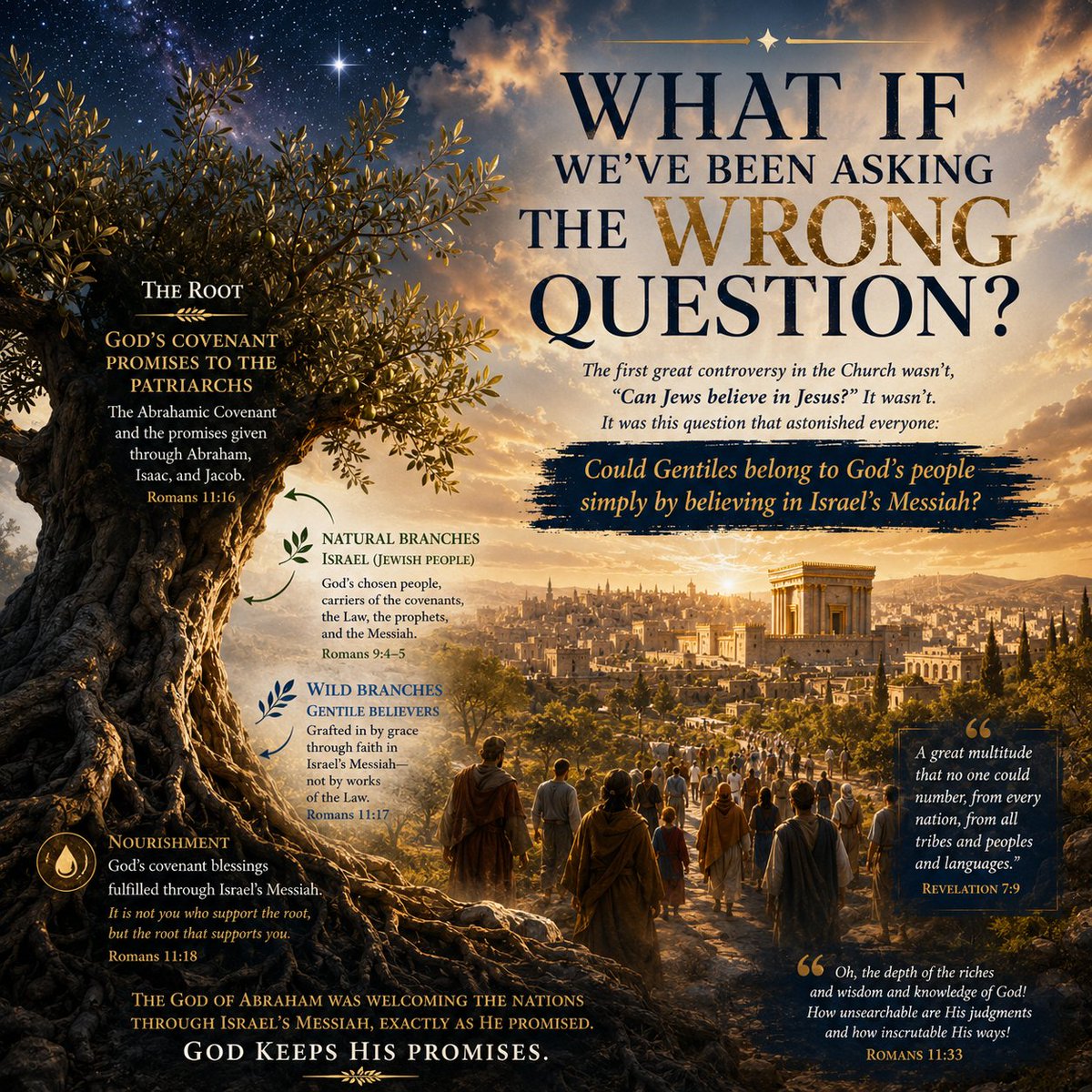
What If We've Been Asking the Wrong Question?
The Bible begins beneath a sky filled with stars. It ends before a throne surrounded by every nation. Between those two scenes is one breathtaking story of a God who keeps His promises.
❖ What Was the First Great Controversy in the Church?
Jerusalem is alive.
The Temple courts are crowded.
The apostles are preaching.
Thousands have believed (Acts 2:41; 4:4).
Every follower of Jesus is Jewish.
Now ask yourself...
What was the first great controversy in the Church?
Many Christians assume it was,
"Can Jews believe in Jesus?"
It wasn't.
Jesus was Jewish.
The apostles were Jewish.
The first disciples were Jewish.
The first churches were overwhelmingly Jewish.
The question that astonished the early Church was something altogether different.
Could Gentiles belong to God's people simply by believing in Israel's Messiah?
That single question unlocks Acts.
It explains Galatians.
It illuminates Ephesians.
And it makes Romans 11 come alive.
Come with me.
Let's watch the answer unfold.
❖ Why Did Peter Hesitate?
Peter pauses outside the home of Cornelius.
A Roman officer.
A Gentile.
Everything in his upbringing tells him not to cross the threshold.
Yet God has already spoken through a vision.
So Peter enters and says,
"God has shown me that I should not call any person common or unclean" (Acts 10:28).
Before Peter even finishes speaking, the Holy Spirit falls upon everyone listening (Acts 10:44).
The Jewish believers who came with him are "amazed" because the gift of the Holy Spirit has been poured out on Gentiles too (Acts 10:45).
Don't miss Luke's point.
God answered the question before the Church finished debating it.
❖ Why Did Jerusalem Have to Hold a Council?
The news spread quickly.
Some believers insisted Gentiles had to be circumcised and keep the Law of Moses (Acts 15:1, 5).
The apostles gathered.
Peter spoke.
Paul and Barnabas described what God had done among the nations.
The room grew quiet.
Then James stood.
"We should not trouble those of the Gentiles who turn to God" (Acts 15:19).
Peter had already captured the heart of it:
"We believe that we will be saved through the grace of the Lord Jesus, just as they will" (Acts 15:11).
Grace settled the controversy.
God keeps His promises.
But one question still remained.
Why had this surprised everyone?
❖ Was This Really God's Plan All Along?
Now travel back almost two thousand years.
An elderly shepherd lifts his eyes into a sky so crowded with stars he cannot count them.
He has no heir.
No nation.
No land.
Only the voice of God.
"In you all the families of the earth shall be blessed" (Gen. 12:3).
Did you notice?
The promise always reached beyond Abraham's own descendants.
Isaiah later declared that Messiah would become "a light for the nations" so God's salvation would reach "the end of the earth" (Isa. 49:6).
Paul looked back and made an astonishing observation:
"The Scripture... preached the gospel beforehand to Abraham" (Gal. 3:8).
The nations were never an afterthought.
God chose Abraham not instead of the nations...
But for the sake of the nations.
God keeps His promises.
❖ So Where Did We Fit Into the Story?
Paul reminds Gentile believers where we once stood.
We were "strangers to the covenants of promise" and "without hope and without God in the world" (Eph. 2:12).
Then everything changes.
"But now in Christ Jesus you who once were far off have been brought near by the blood of Christ" (Eph. 2:13).
Notice what Paul doesn't say.
He doesn't say God abandoned His promises.
He says we were brought near.
Grace didn't replace the story.
Grace welcomed us into it.
❖ Then Why Does Paul Talk About an Olive Tree?
Because pictures often teach better than propositions.
Paul doesn't describe two trees.
He describes one.
"You... were grafted in among the others and now share in the nourishing root of the olive tree" (Rom. 11:17).
Notice what Paul never says.
He never says the root changed.
He never says God planted a Gentile tree.
He never says Israel was replaced.
Wild branches were graciously grafted into a tree God had been cultivating for centuries.
As Arnold Fruchtenbaum has often emphasized, Gentile believers share in Israel's spiritual blessings without becoming Israel itself.
Paul's picture is one of participation, not replacement.
We are not the root.
We are grateful branches.
❖ Then Why Does Paul Warn Us?
Because grace can produce either gratitude...
Or pride.
Paul's warning is unmistakable.
"Do not be arrogant toward the branches" (Rom. 11:18).
Again,
"Do not become proud, but fear" (Rom. 11:20).
Why?
Because,
"It is not you who support the root, but the root that supports you" (Rom. 11:18).
James echoes the same truth:
"God opposes the proud but gives grace to the humble" (James 4:6).
The olive tree leaves no room for boasting.
Only humility.
Only gratitude.
Only worship.
❖ Has God Finished with Israel?
Paul asks the question himself.
"Has God rejected His people?" (Rom. 11:1)
His answer is immediate.
"By no means!"
Then he explains why.
"The gifts and the calling of God are irrevocable" (Rom. 11:29).
Jeremiah had already declared that Israel would endure as long as the fixed order of the sun, moon, and stars remains (Jer. 31:35-37).
God's faithfulness to the Gentiles does not weaken His faithfulness to Israel.
It demonstrates it.
God keeps His promises.
❖ How Does the Story End?
John sees what Abraham could only imagine.
"A great multitude that no one could number, from every nation, from all tribes and peoples and languages" (Rev. 7:9).
The promise has reached the nations.
Then John sees the New Jerusalem.
Its gates bear the names of the twelve tribes of Israel.
Its foundations bear the names of the twelve apostles (Rev. 21:12-14).
The story comes full circle.
The promise spoken beneath Abraham's stars has become a multitude before God's throne.
❖ So Who Is the Hero of the Story?
The first-century Church wasn't trying to figure out whether Jews could believe in Jesus.
They already were.
They were discovering something far more wonderful.
The God of Abraham was welcoming the nations through Israel's Messiah, exactly as He had promised from the beginning.
The Hero of this story is not Abraham.
Not Peter.
Not Paul.
Not Israel.
Not the Church.
The Hero is the God who keeps every promise He makes.
No wonder Paul could only conclude with worship:
"Oh, the depth of the riches and wisdom and knowledge of God! How unsearchable are His judgments and how inscrutable His ways!" (Rom. 11:33)
What If Jesus Explained the Timing of the Rapture Through a Jewish Wedding?
"The Bible begins with a wedding. It ends with a wedding. Perhaps redemption itself is the story of a Bridegroom pursuing His bride."
The Pretribulation Rapture is usually defended through prophetic chronology, the distinction between Israel and the Church, and the doctrine of imminence. Those arguments are important. Yet there is another thread that deserves careful attention: the Jewish wedding. Jesus did not speak into a cultural vacuum. He was the Jewish Messiah speaking to Jewish disciples during Passover. His words carried covenant language they immediately understood. When that Jewish background is woven together with the arc of Scripture, it forms one of the most beautiful cumulative pictures supporting the Pretribulation hope.
❖ Marriage Frames the Entire Bible
Genesis 2:24 • Revelation 19:7-9 • Revelation 21:2
The Bible opens with the first marriage in Eden and closes with the Marriage of the Lamb and the New Jerusalem prepared "as a bride adorned for her husband." Marriage is not merely an illustration; it is one of God's great covenant themes. Throughout the Tanakh, the Lord repeatedly portrays Himself as the Husband of His covenant people, preparing readers for the ultimate Bridegroom who would one day come.
"For your Maker is your husband..." (Isaiah 54:5)
"I will betroth you to Me forever..." (Hosea 2:19)
"As the bridegroom rejoices over the bride, so shall your God rejoice over you." (Isaiah 62:5)
From Genesis to Revelation, the storyline moves toward a wedding.
❖ A Bride Set Apart
Genesis 24 • 2 Corinthians 11:2
Genesis 24 records one of Scripture's most remarkable wedding narratives. Abraham sends his servant to obtain a bride for Isaac. The father initiates the plan. The son remains awaiting his bride. The servant calls the bride, and Rebekah willingly leaves her home to journey toward a bridegroom she has never seen.
This beautifully reflects the first stage of a Jewish marriage known as kiddushin (קידושין), from the Hebrew root qadash (קדש), meaning "to set apart" or "make holy." During kiddushin, the bride was already legally devoted to the bridegroom, though they still lived apart.
Paul uses this very language:
"I have betrothed you to one husband, that I may present you as a pure virgin to Christ." (2 Corinthians 11:2)
The Church is not waiting to become Christ's bride someday. She already belongs to Him. She awaits the day He comes to receive her.
❖ The Royal Bridegroom
Psalm 45 • Hebrews 1:8-9
Long before Bethlehem, David celebrated the wedding of a glorious King.
"You are the most handsome of the sons of men... Gird your sword on your side, O mighty one." (Psalm 45:2-3)
Centuries later, Hebrews identifies this royal Bridegroom as the Messiah Himself:
"Your throne, O God, is forever and ever." (Hebrews 1:8)
Psalm 45 is more than a royal wedding song. It foreshadows the greater King whose covenant love reaches its fulfillment in Christ and His redeemed people.
❖ Jesus Speaks Like a Jewish Bridegroom
Matthew 9:15 • John 3:29 • John 14:1-3
Jesus repeatedly identified Himself as the Bridegroom.
"Can the wedding guests mourn as long as the bridegroom is with them?" (Matthew 9:15)
John the Baptist likewise declared,
"The bride belongs to the bridegroom." (John 3:29)
Then, on the night before His crucifixion, Jesus made an extraordinary promise:
"In My Father's house are many μοναί (monai)... I go to prepare a place for you... I will come again and receive you to Myself." (John 14:2-3)
Jesus had just told them He was returning to the Father. The Father's house is heaven, where Christ would prepare a place before returning to receive His Bride.
The Greek word monai refers to abiding dwelling places or permanent residences. Jesus was not describing temporary lodging but enduring places within His Father's household.
Equally striking is His promise, "I will receive you to Myself." The verb is λαμβάνω (lambanō), meaning "to take to oneself" or "receive into one's own possession." It is deeply personal language. Jesus is not merely promising to return; He promises to take His Bride to be where He is.
To first-century Jewish ears, this sounded remarkably like a bridegroom returning to his father's house to prepare living accommodations before coming back to receive his bride.
Arnold Fruchtenbaum writes:
"The background of John 14 is the Jewish wedding system. The bridegroom would leave to prepare living accommodations in his father's house and later return to receive his bride."
Paul later explains why this imagery is so significant:
"This mystery is profound, and I am saying that it refers to Christ and the church." (Ephesians 5:32)
Marriage was never merely a human institution. From the beginning, it pointed beyond itself to the greater union between the Messiah and His redeemed people.
❖ Waiting for the Bridegroom
Matthew 24:36 • Matthew 25:1-13
After kiddushin came the period of waiting. The bride knew the bridegroom would return, but not the exact day. Only when the father declared the preparations complete would the son go to receive his bride. This second stage, known as nissuin (נישואין), was the joyful taking of the bride into the bridegroom's prepared home.
Jesus' words suddenly carry rich covenant imagery.
"Concerning that day and hour no one knows... but My Father only." (Matthew 24:36)
Then comes the familiar midnight announcement:
"Behold, the Bridegroom! Come out to meet Him!" (Matthew 25:6)
Every disciple in the Upper Room had witnessed Jewish weddings. They already understood this pattern. Watchfulness was not fearful speculation but joyful expectancy.
❖ Bought with a Price
Luke 22:20 • 1 Corinthians 6:20 • 1 Peter 1:18-19
Every Jewish marriage required a costly bride price.
Paul echoes that imagery:
"You were bought with a price." (1 Corinthians 6:20)
Peter adds that our redemption came not with silver or gold, "but with the precious blood of Christ."
The covenant cup likewise points back to Jewish betrothal.
"This cup is the new covenant in My blood." (Luke 22:20)
The Bride has already been purchased. The covenant has already been sealed.
❖ Kept from the Coming Hour
Revelation 3:10 • 1 Thessalonians 1:10 • 1 Thessalonians 5:9
Jesus gives the church at Philadelphia a remarkable promise.
"I also will keep you from the hour of trial that is coming upon the whole world..." (Revelation 3:10)
The Greek expression is τηρήσω ἐκ (tērēsō ek), literally, "I will keep...from."
Notice the object.
Jesus does not simply promise protection from the testing.
He promises preservation from the hour itself.
While faithful interpreters debate the phrase, its most natural reading supports exemption from the coming period of worldwide testing rather than mere protection within it. That harmonizes beautifully with Paul's assurance that believers are delivered "from the wrath to come" and are "not appointed...to wrath."
❖ Enter Your Chambers
Isaiah 26:19-21
Isaiah contributes another remarkable thread.
"Your dead shall live... Come, My people, enter your chambers, and shut your doors behind you; hide yourselves for a little while until the indignation has passed. For behold, the LORD comes out from His place to punish the inhabitants of the earth."
Notice the sequence.
Resurrection.
Prepared chambers.
Doors shut.
The Lord's indignation falls upon the earth.
Standing alone, Isaiah 26 does not establish the Rapture. Yet when read alongside John 14, 1 Thessalonians 4, Revelation 3, and Revelation 19, it becomes another fascinating piece of the larger biblical mosaic.
❖ The Wedding Before the King's Return
Revelation 19:7-16 • Zechariah 14:3-5
Revelation presents a striking chronology.
First, the Bride is ready.
"The marriage of the Lamb has come."
She is clothed in fine linen.
The Bride is already with Christ in heaven before heaven opens and the King rides forth in glory. Many premillennial scholars therefore understand the Marriage Supper of the Lamb to be the great Kingdom celebration following His return, harmonizing with Isaiah 25:6 and Jesus' kingdom banquet imagery.
Then heaven opens.
Christ rides forth as King of kings.
The armies of heaven follow Him.
Only afterward does He descend to judge the nations and establish His kingdom.
This also highlights an important distinction. In John 14, Christ comes for His Bride, receiving her to the Father's house. In Zechariah 14 and Revelation 19, He returns with His saints to judge the nations and establish His Kingdom.
The wedding precedes the visible Second Coming.
That sequence deserves careful consideration.
❖ A Fair Objection
Critics rightly remind us that doctrine should never be built upon ancient customs. They are correct.
The Pretribulation Rapture does not rest upon Jewish wedding traditions.
It rests upon Scripture.
The wedding customs simply illuminate why Jesus chose these expressions and why His Jewish audience would have understood them so naturally. Rather than creating doctrine, they reinforce themes already established by John 14, 1 Thessalonians 4, 1 Corinthians 15, Revelation 3, Revelation 19, and the consistent New Testament expectation of Christ's imminent return for His people.
❖ One Covenant Story
From Eden's first marriage...
to Rebekah's journey...
to David's royal wedding psalm...
to Isaiah's everlasting betrothal...
to the Bridegroom's promise in the Upper Room...
to Isaiah's chambers before indignation...
to the Marriage of the Lamb...
the same covenant story unfolds across Scripture.
The Bridegroom has paid the bride price.
He has sealed the covenant.
He has ascended to His Father's house.
He is preparing a place.
He has promised to receive His Bride to Himself.
And one day, the midnight cry will become reality:
"Behold, the Bridegroom is coming!" (Matthew 25:6)
Whether one ultimately embraces the Pretribulation position or not, the harmony between the Jewish wedding pattern and the biblical text deserves thoughtful consideration. Read through the lens of its original Jewish setting, the Bible tells one magnificent love story, stretching from Genesis to Revelation, of a faithful Bridegroom who keeps every covenant promise and will one day come for His Bride before returning in glory to reign.